

 Animal Zoid Editorial Team
 Hardwood floors and dog hair create a specific problem that most cleaning guides handle badly — they tell you what to use but not what to avoid, and that omission is exactly what causes scratching. If you’ve been trying to figure out how to sweep dog hair off hardwood floors without scratching, the answer isn’t just about choosing a soft broom. It’s about understanding what actually scratches hardwood, why dog hair specifically makes that risk worse, and the exact sequence of tools and techniques that removes hair efficiently without dragging abrasive particles across your floor finish.
This guide covers the scratch mechanism that most people don’t know about, the tools that work safely on hardwood, the ones that cause progressive damage even when they look harmless, and the complete cleaning sequence that works for daily maintenance and weekly deep sessions.
⚡ Quick Answer
How to sweep dog hair off hardwood floors without scratching:
Use a microfiber dust mop rather than a traditional broom — standard broom bristles spread hair and grit across the floor rather than collecting it, and any grit dragged under pressure becomes a scratch-maker. Work in the direction of the wood grain using overlapping strokes. Lift and shake the mop head frequently rather than dragging accumulated hair in a long pile. Follow with a vacuum set to hard floor mode — never carpet mode, which activates a beater bar that can damage hardwood finish.
Dog hair management is a multi-surface challenge. If you’re dealing with hair on upholstered furniture alongside the floor situation, our guides on how to get dog hair out of micro suede couches, how to stop dog hair from sticking to leather couch, and how to remove short dog hair from woven fabric seats address each surface type specifically. Our homemade static guard spray for dog hair removal covers the anti-static approach that helps on hard floors too. The complete dog shedding management guide ties all surface management together with source reduction strategies.
How to Sweep Dog Hair Off Hardwood Floors Without Scratching — Understanding What Actually Causes Scratches
The Real Scratch Mechanism Most Owners Don’t Know About
Most people assume hardwood scratches come from furniture legs or dog claws. Those are contributors — but the more consistent, progressive scratch source in pet households is something far less obvious: grit and sand particles being dragged across the floor surface during sweeping.
Here’s what happens. Dog hair doesn’t travel through your home alone. It carries with it a surprising amount of environmental debris — fine sand particles from outdoor paws, dried mud fragments, microscopic grit from driveways and sidewalks, and occasionally small stone fragments that dogs track in with every entry. This debris settles with the hair onto the hardwood surface and sits there between cleaning sessions.
When you sweep with a traditional broom, you’re not just moving hair — you’re moving everything that settled with it. A standard broom’s stiff bristles don’t lift this debris off the floor. They push it forward in front of the bristle tips, and those tips apply enough downward pressure to drag grit particles across the floor finish under force. Each individual grit particle acts as a tiny abrasive. One sweep causes almost no visible damage. Three hundred sweeps over a year creates the cloudy, dull appearance in high-traffic paths that hardwood owners often attribute to wear rather than accumulated sweeping micro-scratches.
This is why how to sweep dog hair off hardwood floors without scratching requires a different tool approach than standard floor cleaning. The goal isn’t just to collect hair — it’s to lift debris off the surface rather than dragging it across. Microfiber achieves this. Traditional broom bristles don’t. And that single tool difference is what separates floors that stay looking new for years from floors that need refinishing every few years despite “regular cleaning.”
The dog hair variable makes this worse because dog hair — particularly fine undercoat fibers — creates a static charge on hardwood floors that causes grit particles to cling near the hair rather than staying separated. When you sweep hair across the floor, the grit comes with it as a traveling companion. You’re dragging more abrasive material across more floor surface with each stroke than a household without pets would be.
How to Sweep Dog Hair Off Hardwood Floors Without Scratching — The Right Tools
What Actually Works and What Causes Progressive Damage
Knowing how to sweep dog hair off hardwood floors without scratching depends entirely on tool selection — because using the wrong tool consistently is worse than not cleaning at all in terms of long-term floor finish.
Microfiber dust mop — the primary tool.
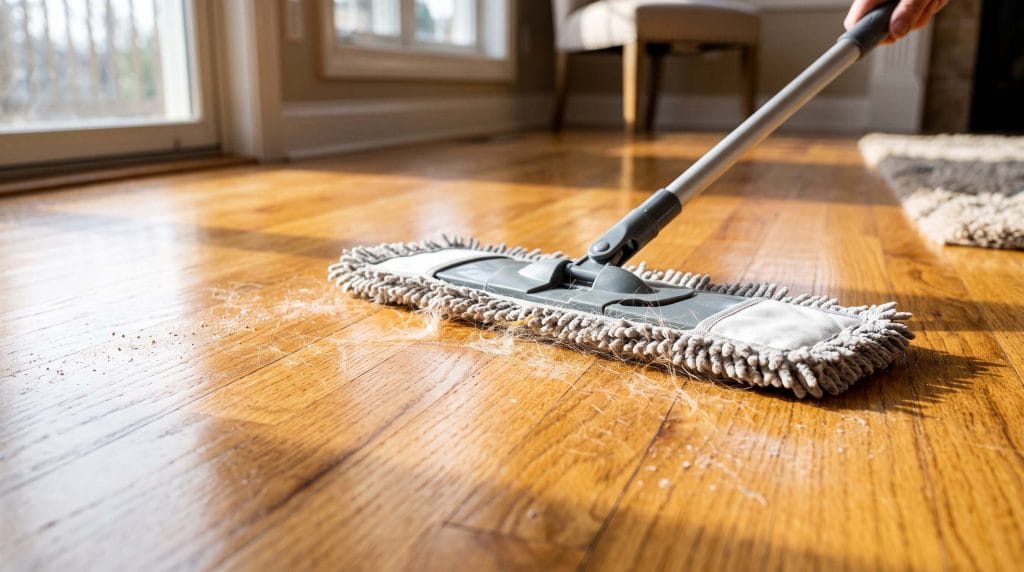
A flat microfiber dust mop is the correct daily maintenance tool for sweeping dog hair off hardwood floors without scratching. Microfiber works through electrostatic attraction — the microfiber strands carry a slight charge that attracts dust, hair, and fine grit particles toward the mop head rather than pushing them across the floor. The flat mop head glides across the hardwood surface with minimal downward pressure, and the microfiber strands trap particles within the mop head rather than releasing them back to the floor during the stroke.
The critical technique detail: lift and shake the mop head every six to eight strokes rather than continuing to push accumulated hair in a growing pile. A mop head that’s carrying a heavy hair load stops attracting new material effectively and starts dragging rather than lifting. Frequent head shaking keeps the microfiber surface actively attracting rather than just pushing.
Vacuum on hard floor setting — the weekly follow-up tool.
A vacuum set to hard floor mode — which deactivates the beater bar or raises it clear of the floor surface — extracts hair from between floorboard gaps that the dust mop’s flat head can’t reach. This is the step most daily sweeping routines miss, and it’s where dog hair accumulates most significantly over time. Hair compressed into floorboard gaps by foot traffic is harder to remove than surface hair and can eventually cause floor movement problems if moisture from cleaning is also trapped in those gaps.
Always verify your vacuum’s hard floor setting actually disengages the beater bar rather than just reducing its speed. A beater bar operating at reduced speed can still cause finish scratching on some hardwood types over repeated use. Test on a low-visibility area or consult your vacuum’s manual.
Electrostatic dry sweeper cloths — light daily maintenance option.
Disposable or washable electrostatic floor sweeper cloths (the type used with flat mop frames) work well for very light daily hair pickup between deeper cleaning sessions. They attract hair through the same electrostatic principle as microfiber but with a thinner cloth that’s better for surface pickup and less effective for gap penetration. Use these for daily light maintenance and the microfiber mop for every-other-day or every-three-day complete sessions.
What not to use — and why each causes damage.
Traditional stiff-bristle brooms push grit across the floor rather than lifting it. We’ve covered the mechanism above. Even “soft” bristle brooms with angled flagged tips still apply enough directional pressure to drag fine particles under the bristle sweep. The only broom that approaches safe for hardwood is a rubber-bristled broom — which lifts hair electrostatically like microfiber — but even rubber brooms are second choice to a flat microfiber mop.
Wet mopping as a hair removal step — applying liquid to move hair toward a collection point — should never be the primary hair removal method. Liquid on hardwood penetrates between boards, causes seasonal wood movement issues, and can lift finish at board edges over time. Remove all hair dry first, then damp mop if needed for cleaning.
Steam mops on hardwood — despite their marketing for hard floors — force moisture and heat into the wood grain in a way that accelerates finish degradation and wood movement. Not appropriate for dog hair removal on hardwood.
How to Sweep Dog Hair Off Hardwood Floors Without Scratching — The Complete Cleaning Sequence
Daily Maintenance vs. Weekly Deep Clean — Both Done Without Scratching
This is the complete sequence for sweeping dog hair off hardwood floors without scratching across both daily and weekly cleaning sessions.
Daily maintenance sequence (5–8 minutes):
Start at the far end of the room and work toward the door — this prevents you from stepping on areas you’ve already cleaned and redistributing tracked debris. Work in the direction of the wood grain rather than across it — grain-direction strokes are less likely to push debris into the wood surface, and hair collects more naturally in the direction the grain runs.
Use overlapping microfiber mop strokes — each pass overlapping the previous by two to three inches. This overlapping pattern ensures no strips of floor are missed. Dog hair that the first pass leaves slightly repositioned gets picked up by the overlapping second pass.
Lift and shake the mop head every six to eight strokes. Don’t accumulate hair into a “bunny” pile in the corner and then sweep it up — that pile contains all the grit that came with the hair, and sweeping it into a dustpan pushes the bottom layer across the floor under the weight of the pile.
Weekly deep clean sequence (15–20 minutes):
Start with the electrostatic dry cloth pass for surface pickup. Follow with a full microfiber mop pass in grain direction. Then run the vacuum on hard floor setting — specifically targeting floorboard gaps, baseboard edges, and the areas under and immediately around dog beds, feeding stations, and entry points. These locations accumulate the most hair and the most outdoor-tracked grit.
After the vacuum pass, a barely damp (not wet — barely damp) microfiber mop for cleaning the floor surface removes any residue the dry passes left. Use a pH-neutral hardwood floor cleaner diluted according to directions — not vinegar (acidic, degrades some finishes over time), not all-purpose cleaner (can leave dulling residue on hardwood finish).
Finish the weekly session with a check of the floorboard gaps in high-traffic areas. If hair remains visible in gaps after the vacuum pass, a soft brush tool — a clean paintbrush works well — run along the gap loosens compacted hair for the vacuum to extract on a second pass.
Claire’s Oak Floors — What Two Years of Wrong Sweeping Looks Like
Claire owns a four-year-old Golden Retriever named Scout. Golden Retrievers shed fine, medium-length coat fibers year-round with two dramatic seasonal coat blows — and Scout’s primary indoor territory was Claire’s open-plan living area with original white oak hardwood floors.
Claire had been sweeping daily with a traditional push broom for two years before she contacted our team. The floors were clean in the sense that visible hair was managed. But the high-traffic path between the front door and the kitchen had developed a noticeably duller appearance than the edges of the room — the classic look of accumulated micro-scratching from grit being repeatedly swept across the finish.
A flooring specialist Claire consulted estimated light screen-and-recoat refinishing would restore the finish — but advised that the same sweeping approach would reproduce the problem within another two years.
When we walked Claire through the microfiber mop replacement and the grain-direction technique, her reaction after the first session was immediate: “The mop head was absolutely filthy — not just hair, so much grit. I had no idea that was coming in with Scout every day.”
Six months after switching to the microfiber mop daily routine and weekly vacuum-on-hardwood-setting sessions, Claire’s flooring specialist assessed the traffic path as stable — no new micro-scratching visible under assessment lighting. The existing dull area hasn’t worsened. Claire is now planning the recoat as a scheduled maintenance rather than an emergency repair.
Scout still has full run of the house. The floors are staying in condition. The only change was the sweeping tool.
🐾 The Paw Entry Protocol — The Three-Minute Habit That Prevents Half the Scratch Problem
This is something we’ve observed across dozens of pet households — and it’s the prevention step that has the highest impact on how to sweep dog hair off hardwood floors without scratching becoming a manageable routine rather than a daily battle.
Most hardwood scratch grit doesn’t originate inside the home. It enters on your dog’s paws from outdoor surfaces — driveways, sidewalks, gravel paths, sandy soil. A single outdoor walk deposits enough fine grit on four paw pads to create meaningful scratch risk during the subsequent 20–30 minutes of indoor movement, as the grit gradually detaches from the pads and settles onto the floor.
The three-minute paw entry protocol:
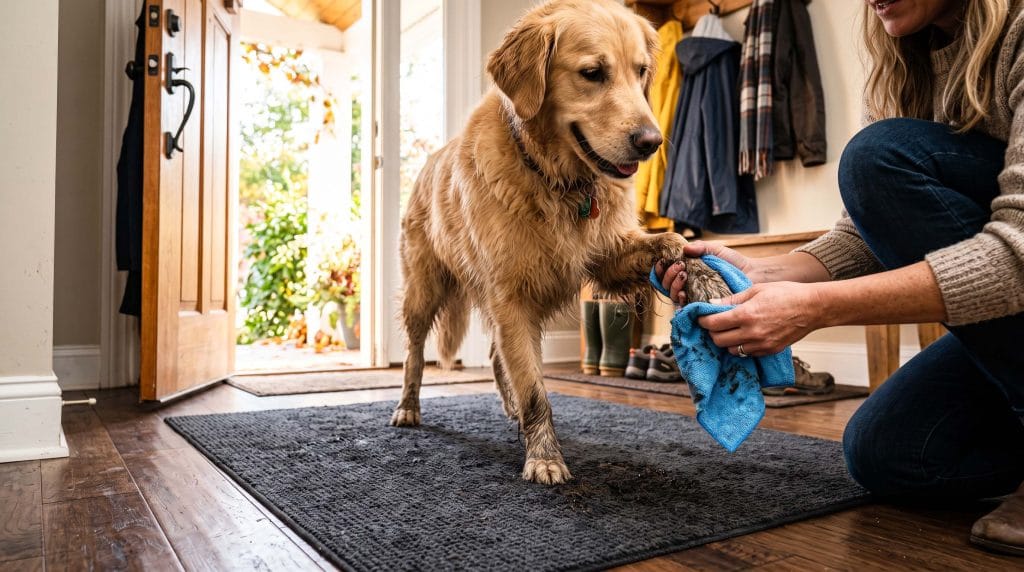
Place a slightly damp, washable mat at each entry point your dog uses — not just a dry doormat. Dry doormats capture large debris but leave fine grit on paw pads. A barely damp surface captures fine particles through surface tension.
Keep a dry microfiber cloth near each entry. After outdoor access, wipe each paw with the cloth before the dog moves into the main floor area. This sounds time-consuming. It takes approximately 30 seconds per dog and removes the majority of grit that would otherwise deposit across your hardwood for the next half hour.
Combine this with a quick dust mop pass of the entry zone — the first three to four feet inside each door — every evening. This is where outdoor grit concentrates most heavily and where the scratch risk per square foot is highest.
This single protocol reduces the total grit load on your hardwood by an estimated 40–60% compared to no entry management — which directly reduces how aggressively your sweeping routine needs to work and how frequently serious cleaning is required. Less grit means sweeping moves hair rather than hair-plus-abrasive, which is the complete goal of how to sweep dog hair off hardwood floors without scratching.
Tool Comparison — How to Sweep Dog Hair Off Hardwood Floors Without Scratching
| Tool | Lifts Hair | Lifts Grit | Scratch Risk | Best Use |
|---|---|---|---|---|
| Microfiber flat dust mop | ✅✅✅ Excellent | ✅✅✅ Excellent | ✅ Minimal | Daily primary tool |
| Electrostatic dry cloth | ✅✅ Good | ✅✅ Good | ✅ Minimal | Light daily maintenance |
| Rubber-bristle broom | ✅✅ Good | ✅ Partial | ✅ Low | Second choice to microfiber |
| Traditional stiff broom | ✅ Partial | ❌ Drags grit | ⚠️ High over time | Avoid on hardwood |
| Vacuum — hard floor mode | ✅✅✅ Excellent | ✅✅✅ Excellent | ✅ Minimal if beater bar off | Weekly deep clean |
| Vacuum — carpet mode (beater bar on) | ✅✅ Good | ✅✅ Good | ⚠️⚠️ High — damages finish | Never on hardwood |
| Wet mop — as primary hair removal | ✅ Poor | ✅ Poor | ⚠️ Moisture risk | Hair removal after dry pass only |
| Steam mop | ✅ Poor | ✅ Poor | ⚠️⚠️ High — heat + moisture | Never for hair removal on hardwood |
How to Sweep Dog Hair Off Hardwood Floors Without Scratching — Prevention Between Sessions
Reducing How Much Hair and Grit Reaches the Floor
The least glamorous but most impactful part of how to sweep dog hair off hardwood floors without scratching is reducing how much material reaches the floor in the first place. Less hair and grit means fewer cleaning sessions, less sweeping pressure, and less cumulative scratch risk per year.
Consistent brushing schedule for your dog.
Every gram of loose coat you remove through brushing is a gram that never reaches your hardwood. Dogs brushed three times weekly during peak shedding deposit dramatically less hair indoors than dogs brushed once weekly or less. Our breed-specific guides for Huskies, German Shepherds, Golden Retrievers, Labradors, and Corgis cover the breed-specific deshedding tools and routines that reduce ambient shedding volume most effectively.
Entry mats — damp and dry in sequence.
A damp entry mat followed by a dry microfiber wipe of paw pads, as described in the Pro-Tip section above, reduces grit entry by 40–60%. This is the highest-ROI prevention habit available for hardwood floor protection in pet households.
Anti-static floor treatment.
A very light application of our homemade static guard spray for dog hair removal — wiped onto the hardwood floor with a microfiber cloth and buffed dry — reduces the electrostatic charge that causes hair to cling to floor surfaces. Hair that doesn’t cling strongly releases more easily during dust mop passes, reducing the stroke pressure needed per session. This means each session does less mechanical work on the floor surface, which directly reduces cumulative scratch risk.
Hardwood Floor Dog Hair — Weekly Routine Reference
Daily (5–8 minutes):
- Start at far end — work toward door in wood grain direction
- Microfiber flat mop — overlapping strokes, grain direction
- Shake/lift mop head every 6–8 strokes
- Focus on dog traffic paths, sleeping areas, and entry zones
- Paw wipe at each entry — 30 seconds per dog
Every 2–3 days:
- Electrostatic cloth pass across full floor area
- Check entry zones — extra mop pass if needed
- Shake out entry mats — wash weekly
Weekly (15–20 minutes):
- Dry cloth pre-pass for surface hair
- Full microfiber mop — overlapping grain-direction strokes
- Vacuum — hard floor setting only, beater bar confirmed off
- Gap cleaning — soft brush along visible gap lines if needed
- Second vacuum pass on loosened gap material
- Barely damp pH-neutral hardwood cleaner mop — final pass
- Buff dry if any moisture visible after damp mop
Monthly:
- Inspect high-traffic paths under raking light for developing dull areas
- Check floorboard gaps in entry zones for compacted material
- Apply light static-reduction treatment to high-traffic areas
- Assess paw mat condition — replace if no longer capturing effectively
FAQ — How to Sweep Dog Hair Off Hardwood Floors Without Scratching
Why does a regular broom scratch hardwood floors when sweeping dog hair?
Standard broom bristles don’t lift debris off the floor — they push it forward under the bristle pressure. Dog hair carries fine grit particles from outdoor paw tracking, and sweeping moves these particles across the hardwood finish under the applied pressure of each stroke. Individual grit particles act as tiny abrasives. One session causes imperceptible damage. Repeated sessions over months and years create the characteristic dull, cloudy appearance in high-traffic paths that looks like finish wear but is actually accumulated micro-scratching from grit being dragged under sweeping pressure.
Can I vacuum dog hair off hardwood floors without scratching them?
Yes — but only with the hard floor setting active, which raises or disengages the beater bar. A beater bar in contact with hardwood finish causes direct mechanical scratching through the rotating brush contact. Most modern vacuums have a dedicated hard floor mode clearly labeled. If your vacuum doesn’t have a hard floor setting and the beater bar can’t be fully disengaged, use a canister vacuum with a floor brush attachment instead — these contact the floor only with soft bristles rather than a rotating mechanism.
How often should I sweep dog hair off hardwood floors to prevent buildup?
For single-dog households with moderate shedders, a daily microfiber mop pass and weekly vacuum session on hard floor setting keeps hardwood in clean condition without allowing hair to compress into floor gaps. For heavy-shedding breeds — Huskies, Golden Retrievers, German Shepherds — or multi-dog households, daily microfiber passes and twice-weekly vacuum sessions prevent the gap-compaction buildup that accumulates quickly during peak shedding seasons. Seasonal coat blows may require twice-daily surface passes for the two to three week peak period.
Does dog hair itself scratch hardwood floors, or is it the particles that come with it?
Dog hair itself doesn’t scratch hardwood — it’s too soft to abrade a polyurethane or oil finish. The scratch risk comes from the grit and debris that dog hair carries into the home and that settles with the hair onto the floor surface. Dragging that grit under sweeping pressure is what creates micro-scratches. This is why the entry paw protocol — reducing grit entry at the door — is as important as choosing the right sweeping tool. Less incoming grit means less abrasive material available to cause damage during cleaning.
Is there a mop specifically designed for sweeping dog hair off hardwood floors without scratching?
Flat microfiber dust mops with machine-washable heads are the category designed for this purpose. Look for a mop with a 360-degree swiveling head — this allows you to work in consistent grain-direction strokes without repositioning your body repeatedly, which reduces the chance of accidental cross-grain pressure strokes. The mop head should be replaceable and washable — a saturated mop head that’s been used for several sessions without washing loses its electrostatic attraction and begins pushing rather than lifting. Wash the mop head every five to seven sessions or when it stops picking up hair effectively.
The Honest Bottom Line on How to Sweep Dog Hair Off Hardwood Floors Without Scratching
How to sweep dog hair off hardwood floors without scratching comes down to one core principle: lift the material off the surface rather than dragging it across the surface. Every tool and technique that works operates on this principle. Every tool that causes damage violates it.
The microfiber dust mop lifts. The hard-floor vacuum extracts. The grain-direction stroke minimizes lateral particle movement. The paw entry protocol reduces the grit that arrives with the hair in the first place. The anti-static treatment reduces the charge that makes hair cling before you sweep it.
Claire’s oak floors stopped accumulating new damage the week she switched to the microfiber mop. Scout still covers the same ground in the same house. The floors are stable and staying that way — not because the dog situation changed, but because the sweeping approach did.
Want to address shedding volume at the source alongside your floor maintenance? Our guides for Huskies, German Shepherds, Golden Retrievers, Labradors, and Corgis cover the deshedding tools and routines that reduce how much hair reaches any surface in your home — and our complete dog hair management guide brings the full strategy together. 🐾
This article reflects our team’s research and hands-on testing across multiple hardwood floor types, finishes, and shedding breeds. For hardwood floor refinishing, finish repair, or significant scratch assessment, consult a certified flooring specialist.
