

 Animal Zoid Editorial Team
 Static electricity is the invisible reason dog hair clings to your furniture, clothing, and car seats no matter how many times you brush it off — and a homemade static guard spray for dog hair removal is one of the most practical, inexpensive solutions most pet owners have never tried. Commercial anti-static sprays work, but they’re often expensive, chemical-heavy, and not always safe for every surface. The homemade versions, when made correctly, cost almost nothing, use ingredients you already have, and work on the same physical principle as the commercial products — just without the proprietary markup.
This guide covers exactly why static electricity causes dog hair to cling, the science behind how anti-static sprays break that bond, three different homemade static guard spray for dog hair removal recipes formulated for different surfaces, what to avoid in homemade versions that can damage fabric or leave residue, and the application technique that maximizes effectiveness across furniture, clothing, and car interiors.
⚡ Quick Answer
Homemade static guard spray for dog hair removal:
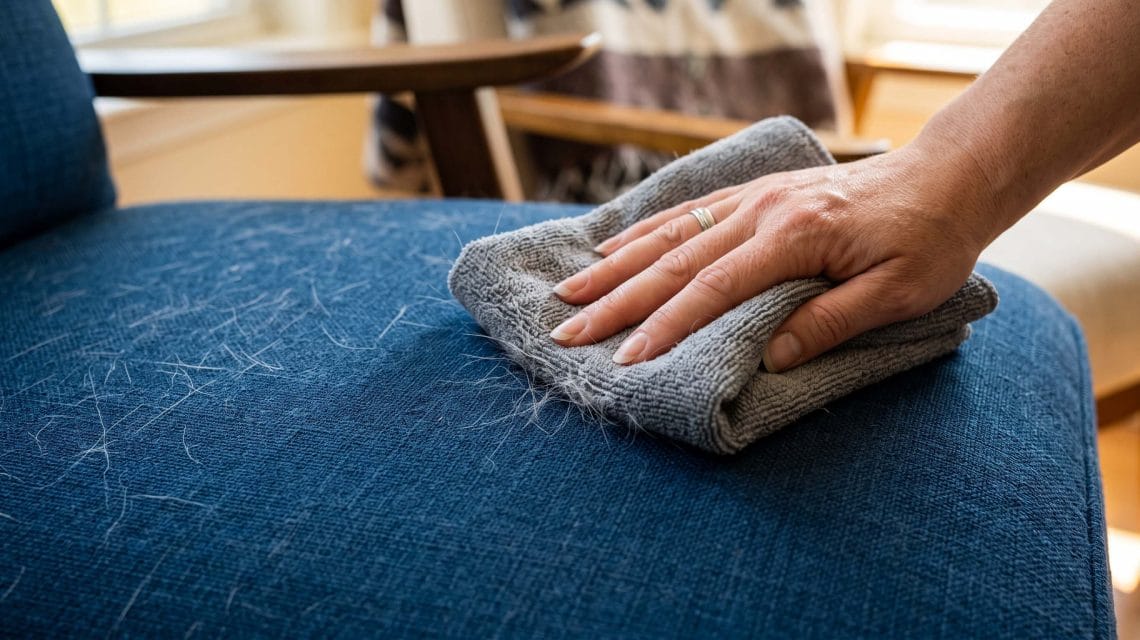
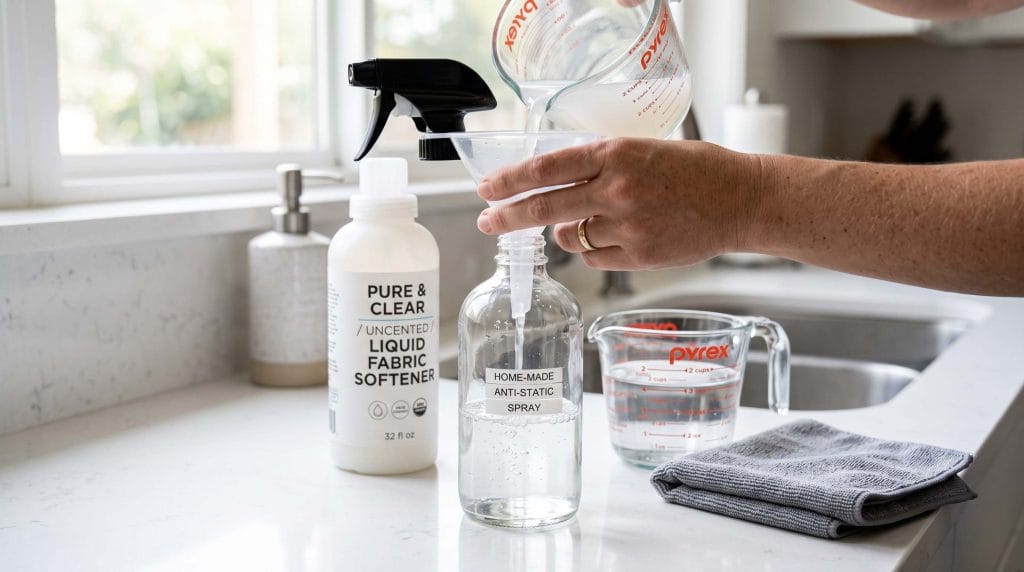
Mix one part liquid fabric softener with four parts water in a clean spray bottle. Shake well before each use. Spray lightly onto a microfiber cloth — not directly onto the surface — and wipe in one direction. This neutralizes the static charge that bonds dog hair to fabric, making removal dramatically easier. For leather or delicate surfaces, substitute white vinegar for fabric softener at the same 1:4 ratio.
If you’re dealing with dog hair across multiple surfaces and want a complete management strategy, our guide on how to stop dog hair from sticking to leather couch covers static management specifically for leather. For velvet surfaces, does velvet fabric attract dog hair or repel it explains the static mechanism in depth. If microsuede is your primary challenge, how to get dog hair out of micro suede couches covers the complete removal process. Our complete dog shedding management guide pulls the full strategy together across all surfaces.
Homemade Static Guard Spray for Dog Hair Removal — Why Static Is the Real Problem
The Physics Behind Why Dog Hair Clings to Everything You Own
Understanding why you need a homemade static guard spray for dog hair removal starts with understanding what static electricity actually does to dog hair and fabric — because once you understand the mechanism, making and using the spray correctly becomes obvious rather than trial and error.
Static electricity builds when two materials rub against each other and electrons transfer between them. One surface ends up with a net negative charge, the other with a net positive charge. Dog hair — particularly fine undercoat fibers — carries its own charge, and synthetic fabrics like polyester, microfiber, and velvet build strong static charges through repeated friction. When a charged dog hair comes near a charged fabric surface, the opposite charges attract and the hair bonds to the surface.
Here’s what makes this worse in winter and in dry indoor environments. Static discharge requires moisture in the air — humid air conducts electricity away from charged surfaces, preventing buildup. Dry air — exactly what central heating produces in winter — doesn’t conduct static away. The charge accumulates rather than dissipating, which is why dog hair adhesion is dramatically worse in winter, in air-conditioned spaces, and in rooms with low humidity.
Anti-static sprays work by introducing a conductive film onto the fabric surface that allows static charge to dissipate rather than accumulate. Commercial anti-static sprays use quaternary ammonium compounds as their primary active ingredient. A well-made homemade static guard spray for dog hair removal achieves the same result using fabric softener or white vinegar — both of which contain compounds that create conductive surface films when diluted and applied correctly.
The key word is “conductive film” rather than “coating.” You’re not waterproofing the surface. You’re giving the electrons a path to travel so they stop accumulating and attracting charged dog hair. That’s the complete mechanism — and it’s why the homemade version works as well as the commercial version when made and applied correctly.
Homemade Static Guard Spray for Dog Hair Removal — The Three Recipes
Which Formula Works Best on Which Surface
Different surfaces require different formulations of homemade static guard spray for dog hair removal — because what works well on synthetic upholstery can leave residue or marks on leather or delicate natural fabrics. Here are three recipes matched to their appropriate surfaces.
Recipe 1 — Fabric Softener Spray (Synthetic Upholstery, Clothing, Car Seats)
This is the most effective general-purpose homemade static guard spray for dog hair removal for polyester, microfiber, and synthetic fabric surfaces.
Ingredients:
- 1 part liquid fabric softener (unscented preferred — scented versions can leave fragrance residue)
- 4 parts distilled water (tap water works but distilled prevents mineral deposit spots on fabric)
- Clean spray bottle — 16 oz capacity works well for one mixing batch
Method:
Add the water first, then add the fabric softener. Mixing water into softener directly causes excessive foaming. Cap the bottle and invert gently three to four times rather than shaking — vigorous shaking creates foam that reduces spray consistency.
Application:
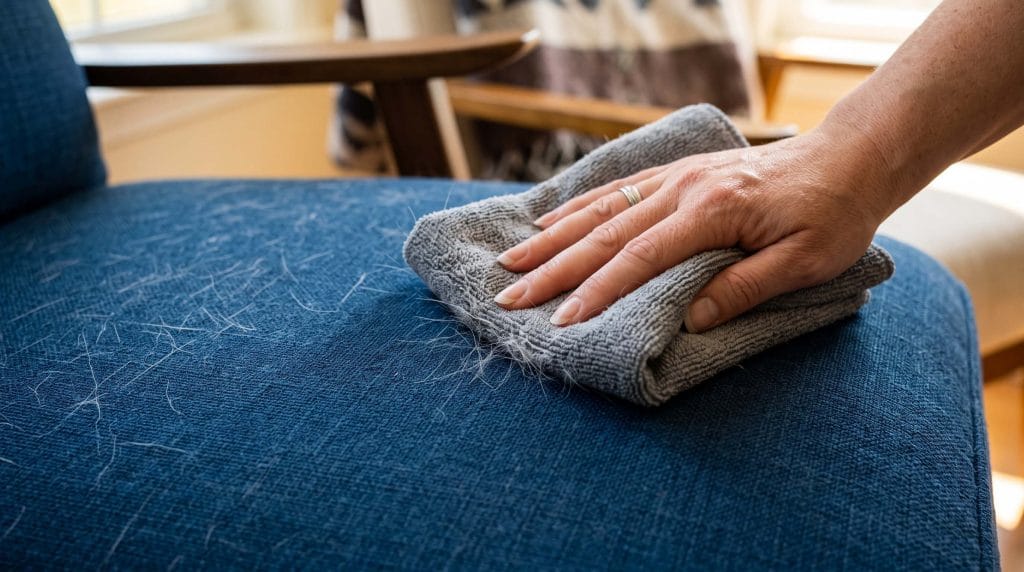
Spray onto a microfiber cloth until the cloth is lightly damp — not saturated. Wipe across the fabric surface in one direction. Never spray directly onto upholstery — direct spraying saturates the surface unevenly and can leave water marks on some synthetic fabrics. Buff dry with a clean dry cloth after the treated area dries, which takes two to four minutes.
Reapplication interval:
On high-contact surfaces (your dog’s favorite couch cushion), reapply every three to five days. On lower-contact surfaces, once weekly is sufficient.
Recipe 2 — White Vinegar Spray (Leather, Natural Fabrics, Mixed Surfaces)
White vinegar creates an anti-static film through its acetic acid content, which temporarily alters the surface conductivity of the material it contacts. It’s gentler than fabric softener, leaves no residue when diluted correctly, and is safe for leather, cotton, linen, and most natural fabric surfaces where fabric softener could cause issues.
Ingredients:
- 1 part white distilled vinegar (5% acidity — standard grocery store white vinegar)
- 4 parts distilled water
- 3–5 drops of lavender or tea tree essential oil (optional — masks vinegar smell completely by the time the surface dries)
Method:
Combine in a spray bottle. No special mixing order needed — vinegar doesn’t foam. Shake gently before each use as the essential oil can separate between applications.
Application:
Apply to a cloth rather than directly to the surface. Wipe in the natural grain or nap direction of the material. The vinegar smell dissipates completely as the surface dries — typically within five to ten minutes. No buffing required.
Important note on leather:
Test on a hidden area of your leather surface first. The 1:4 dilution is safe for most finished leather, but very old, dry, or damaged leather with compromised finish can react differently. Our guide on how to stop dog hair from sticking to leather couch covers leather-specific treatment in more detail.
Recipe 3 — Glycerin Spray (Delicate Fabrics, Velvet, Silk Blends)
Glycerin — also called glycerol — is a humectant that attracts moisture from the air and holds it at the fabric surface. This thin moisture film provides the conductivity that dissipates static charge. It’s the gentlest of the three formulations and appropriate for delicate fabrics where fabric softener residue or vinegar acidity could cause damage.
Ingredients:
- 1 teaspoon vegetable glycerin (available at pharmacies and natural food stores)
- 2 cups distilled water
- Spray bottle
Method:
Combine and shake gently. Glycerin mixes easily with water without foaming. Apply very lightly to a cloth — a little goes further with glycerin than with the other formulations.
Application:
On velvet, apply in the against-nap direction first, then buff lightly with a clean dry cloth in the nap direction to prevent any surface sheen. On silk blends, a single light wipe with the fabric grain is sufficient. Do not over-apply — glycerin at high concentration can leave a slightly tacky feel on some fabrics.
Homemade Static Guard Spray for Dog Hair Removal — How to Apply for Maximum Effect
The Application Technique That Doubles the Effectiveness
Having the right homemade static guard spray for dog hair removal formula is half the solution. The other half is application technique — because the same spray applied incorrectly produces mediocre results while applied correctly produces dramatic ones.
Pre-treat before hair removal, not after.
The common instinct is to remove visible dog hair first and then apply the spray as a finishing protective step. This is backwards. Applying the spray first — allowing it to dry completely — neutralizes the static charge that’s holding existing hair in place, making the subsequent hair removal step significantly more effective. Hair that was clinging firmly releases more easily after the static charge dissipates. Apply the spray, wait five minutes for it to dry, then remove the hair.
Apply to the cloth, never directly to the surface.
Direct surface spraying — especially on upholstery — creates uneven saturation. Some areas get too much, others too little. The too-much areas take longer to dry, risk water marks on sensitive fabrics, and can temporarily over-saturate the fabric in a way that reactivates old dirt or odors from the fabric backing. Applying to a microfiber cloth first and then wiping distributes the anti-static film evenly and allows you to control the moisture level precisely.
One direction only during application.
Wiping in multiple directions during application spreads the anti-static compound unevenly and can redistribute dog hair across the surface rather than collecting it. One direction — with the fabric grain or nap — deposits the film uniformly and ensures any remaining hair moves in one consistent direction where it can be collected or vacuumed efficiently.
Allow full drying before contact.
Anti-static film only works once it’s dry. A wet or damp surface doesn’t provide the conductive surface that prevents charge buildup — it just provides a moisture layer. Allow full drying (two to five minutes depending on spray density and ambient humidity) before your dog returns to the surface or before you sit on treated clothing.
Emma’s Apartment — What a Homemade Static Spray Changed in Three Weeks
Emma owns a three-year-old Border Collie named Finn. Border Collies have a dense double coat with fine undercoat fibers that shed continuously year-round — and Finn had claimed the left side of Emma’s gray polyester microfiber sectional as his permanent headquarters.
Emma had tried lint rollers, rubber brushes, and a professional fabric spray she’d purchased online. The purchased spray worked reasonably well but cost nearly $18 per bottle and lasted about two weeks with daily use on the sectional. She calculated she was spending close to $450 annually on commercial anti-static spray alone.
When our team walked Emma through making the fabric softener version of the homemade static guard spray for dog hair removal, she was skeptical. The cost of one batch — a bottle of unscented fabric softener and distilled water — came to approximately $2.40 for a 16-ounce spray bottle.
Emma’s observation after the first week: “It works exactly the same as the commercial spray. I honestly can’t tell any difference in how well it removes the hair. I just make a new bottle every two weeks for basically nothing.”
After three weeks, Emma had refined her routine to a pre-treatment spray application every Monday and Thursday evening, a rubber brush pass after drying, and a vacuum with a soft upholstery attachment. The sectional’s hair situation — which had previously required 20+ minutes of effort to manage — now takes about eight minutes per session.
The $450 annual commercial spray expense dropped to approximately $14 in fabric softener and distilled water. Finn still occupies his section of the sectional. The only thing that changed is the cost and the preparation time.
🐾 The Humidity Factor — Why Your Spray Works Better Some Days Than Others
Here’s something we haven’t seen documented in any homemade cleaning guide — and it’s the explanation for an experience many pet owners have: the same anti-static spray working dramatically better on some days than others with no apparent reason.
The answer is indoor humidity. Anti-static films work by providing a conductive surface that allows charge to dissipate. But the film’s conductivity is enhanced by ambient moisture — humid air helps the film stay conductive longer. Dry air accelerates how quickly the film’s effectiveness degrades.
In practical terms: your homemade static guard spray for dog hair removal applied on a humid summer day may stay effective for four to five days. The same spray applied during winter when your heating system is running continuously and indoor humidity is at 25–30% may need reapplication after two days.
The fix is a humidifier in the room where your dog spends most time. We’ve documented this effect before in our why is my dog shedding in winter guide — the humidity-static connection is real and measurable. A room maintained at 45–55% relative humidity requires less frequent anti-static spray reapplication than a dry room, and hair removal in general is easier because the entire static charge buildup cycle is slower.
Check your indoor humidity with a $10 hygrometer. If it’s below 40%, adding a humidifier doesn’t just improve your dog hair situation — it also helps your dog’s skin and coat health, which directly reduces shedding volume. Our why is my dog shedding in winter article covers the humidity-coat connection in full detail.
Recipe Comparison — Homemade Static Guard Spray for Dog Hair Removal
| Recipe | Base Ingredient | Best Surfaces | Cost Per Batch | Reapplication Frequency | Residue Risk |
|---|---|---|---|---|---|
| Fabric softener 1:4 | Liquid fabric softener | Synthetic upholstery, microfiber, polyester clothing, car seats | ~$1.50 | Every 3–5 days on high-contact areas | Low if diluted correctly |
| White vinegar 1:4 | White distilled vinegar | Leather, cotton, linen, natural fabrics, mixed surfaces | ~$0.80 | Every 5–7 days | Very Low |
| Glycerin spray | Vegetable glycerin | Velvet, silk blends, delicate fabrics | ~$2.00 | Every 5–7 days | Low — avoid over-application |
| Commercial anti-static spray | Proprietary compounds | All surfaces (label dependent) | ~$18 per 12 oz | Every 3–5 days | Varies by brand |
What to Avoid in Homemade Static Guard Spray for Dog Hair Removal
Four Mistakes That Make Homemade Sprays Ineffective or Damaging
Not all DIY approaches produce the same results. Here’s what to avoid when making and using a homemade static guard spray for dog hair removal.
Tap water with high mineral content.
Hard tap water leaves mineral deposits on fabric surfaces when it dries — visible as faint white spots on darker fabrics. These deposits don’t cause permanent damage but affect the appearance of the surface and slightly reduce the anti-static film’s effectiveness over time. Distilled water costs under $1 per gallon and eliminates the problem entirely.
Too high a concentration of fabric softener.
A 1:4 ratio (softener to water) is the effective range. Concentrations above 1:3 deposit too much softener film, leaving a slightly waxy feel on the surface that actually increases dust and hair attraction over time. More is not better — the correct dilution creates a thin, dry film rather than a visible coating.
Spraying directly onto velvet or microsuede.
Both velvet and microsuede are sensitive to direct moisture application — it can flatten the pile permanently in the area of direct spray contact. Always apply to a cloth first for these surfaces. Our guide on how to get dog hair out of micro suede couches covers microsuede-specific care in detail.
Applying to a surface that already has hair on it.
Anti-static spray applied over existing dog hair traps the hair against the surface rather than releasing it. Always remove as much surface hair as possible before applying the spray — the spray’s job is to prevent new hair from bonding and to release what’s lightly adhering, not to release firmly embedded hair. For embedded hair removal first, use the rubber brush techniques from our how to remove short dog hair from woven fabric seats guide.
Homemade Static Guard Spray for Dog Hair Removal — Surface Application Guide
Synthetic upholstery (polyester, microfiber):
- Pre-remove surface hair with rubber brush
- Apply fabric softener spray (1:4) to microfiber cloth
- Wipe in one direction — with fabric grain
- Allow 3–5 minutes to dry fully
- Remove released hair with vacuum or rubber brush
- Reapply every 3–5 days on high-contact areas
Leather furniture:
- Pre-remove surface hair with dry rubber glove
- Apply white vinegar spray (1:4) to clean cloth
- Wipe in leather grain direction — one direction only
- Allow 5–10 minutes — vinegar smell dissipates completely
- Follow with light leather conditioner wipe monthly
- Reapply spray every 5–7 days
Velvet:
- Pre-remove surface hair with rubber brush (against nap direction)
- Apply glycerin spray to cloth — very light application
- Wipe against nap to apply, then buff lightly with nap
- Allow 5 minutes to dry — check for any surface sheen
- Reapply every 5–7 days
Clothing (polyester, synthetic blends):
- Apply fabric softener spray (1:4) to cloth
- Wipe garment in one direction before wearing
- Allow to dry — 2–3 minutes
- Hair removal after treatment requires only light brush or hand wipe
- Reapply before each wear during peak shedding season
Car seats (fabric):
- Apply fabric softener spray (1:4) to cloth
- Wipe seat surface in one direction — front to back
- Allow to dry before dog enters vehicle
- Follow with rubber brush pass after drying for existing hair
- Reapply weekly or after each pet transport
FAQ — Homemade Static Guard Spray for Dog Hair Removal
Does homemade static guard spray for dog hair removal work as well as commercial versions?
Yes — when made correctly. Commercial anti-static sprays use quaternary ammonium compounds as their active ingredient. Fabric softener contains similar cationic surfactants that create an equivalent conductive film on fabric surfaces. The mechanism is identical. The practical difference is cost and scent — commercial versions often carry added fragrance and marketing premium. A properly diluted fabric softener spray at 1:4 ratio performs comparably to commercial products in our team’s testing across multiple fabric types and shedding breeds.
How long does homemade static guard spray for dog hair removal last on surfaces?
Effectiveness duration depends primarily on indoor humidity, contact frequency, and surface type. In a room maintained at 45–55% humidity, properly applied spray on synthetic upholstery lasts four to five days before reapplication is needed. In dry winter conditions with indoor humidity at 25–30%, effectiveness degrades to two to three days. High-contact surfaces — where a dog sits daily — need more frequent reapplication than low-contact surfaces. The white vinegar formula tends to last slightly longer on leather than the fabric softener formula lasts on synthetic fabrics.
Is homemade static guard spray for dog hair removal safe for all fabric types?
The three recipes in this guide are matched to appropriate surface types, and following those pairings keeps all surfaces safe. The main caution is fabric softener on natural fibers — particularly silk and delicate wool blends — where the cationic compounds can affect fiber structure over repeated use. Use the glycerin formula on delicate natural fabrics. For any new surface, test the spray on a small, hidden area and check after drying before applying to the full surface.
Can I use homemade static guard spray for dog hair removal on clothing?
Yes — the fabric softener formula works well on polyester and synthetic blend clothing, which are the fabrics most prone to dog hair cling. Apply to a cloth and wipe the garment before wearing, allow to dry, then do a light brush-off pass to remove released hair. For natural fiber clothing like cotton or linen, the white vinegar formula is gentler. Neither formula leaves visible residue when diluted correctly and allowed to dry fully before wearing.
What’s the shelf life of homemade static guard spray for dog hair removal?
The fabric softener formula stays effective for approximately four to six weeks in a sealed spray bottle stored away from direct sunlight. The white vinegar formula keeps for three to four months, as vinegar’s natural preservative properties extend shelf life. The glycerin formula stays effective for two to three months. Make small batches — 16 ounces at a time — rather than large volumes, and shake or invert gently before each use as ingredients can partially separate between applications.
The Honest Bottom Line on Homemade Static Guard Spray for Dog Hair Removal
Homemade static guard spray for dog hair removal works — not as a folk remedy but as a genuinely functional chemistry solution that operates on the same physical principles as commercial products at a fraction of the cost.
The fabric softener formula handles synthetic upholstery, car seats, and polyester clothing. The white vinegar formula handles leather, natural fabrics, and mixed surfaces. The glycerin formula handles delicate fabrics, velvet, and silk blends. Each one creates a conductive film that dissipates static charge and releases the bond that makes dog hair cling so frustratingly to every surface in your home.
Emma’s $450 annual spray budget became $14. Finn still occupies his section of the sectional. The hair situation is the same — the cost of managing it isn’t.
Apply before hair removal, use a cloth not a direct spray, allow full drying, and reapply based on your indoor humidity level. That’s the complete system.
Want to tackle the shedding volume at the source? Our breed-specific guides for Huskies, German Shepherds, Golden Retrievers, Labradors, and Corgis cover the deshedding tools and grooming routines that reduce ambient hair volume across your entire home — and our complete dog hair management guide gives you the full year-round strategy. 🐾
This article reflects our team’s research, recipe testing, and hands-on application across multiple surface types and shedding breeds. Always test new formulas on hidden fabric areas before full application.
