

 Animal Zoid Editorial Team
 Short dog hair on woven fabric seats is genuinely one of the most frustrating pet hair problems to solve — and if you’ve been wondering how to remove short dog hair from woven fabric seats without making it worse, you’re dealing with a problem that’s more physics than cleaning. Short hair from breeds like Beagles, Boxers, Labrador Retrievers, and Vizslas doesn’t sit on top of woven fabric. It threads itself into the weave structure and anchors there in a way that long hair rarely does. Standard lint rollers barely touch it. Vacuuming alone moves it around more than it removes it. And rubbing the fabric with your hand — the instinctive first attempt — usually just pushes it deeper.
This guide covers exactly why short dog hair behaves this way in woven fabric specifically, the tools that work at the weave level rather than just the surface, the cleaning sequence that pulls hair out rather than relocating it, and the prevention habits that reduce how much embeds between cleaning sessions.
⚡ Quick Answer
How to remove short dog hair from woven fabric seats:
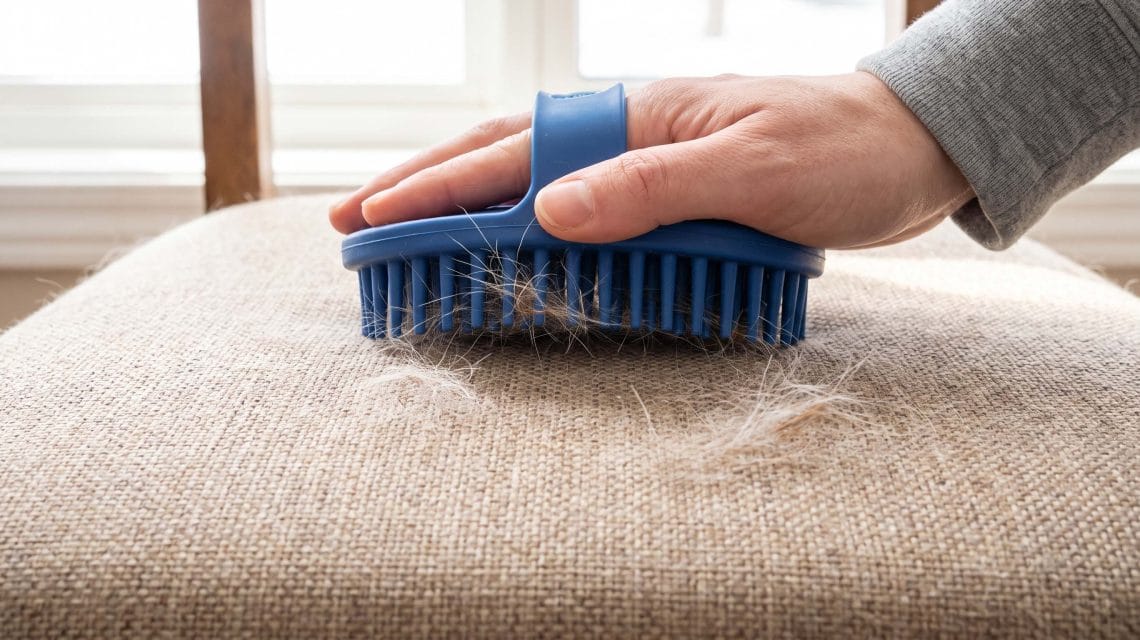
Use a stiff rubber pet hair brush in short strokes against the weave direction to break the hair’s grip on the fibers — this is the step most people skip. Follow with a vacuum using a firm upholstery brush attachment. For residual fine hairs, use a barely damp rubber glove in one-directional strokes. The key is working against the weave first to loosen, then with the weave to collect. Lint rollers alone won’t reach hair anchored inside the weave structure.
Dog hair on seats is one piece of a broader shedding challenge. If the hair problem extends to carpet, our guide on best way to remove embedded dog hair from high pile carpet covers deep pile removal in detail. For leather surfaces, how to stop dog hair from sticking to leather couch covers prevention and removal specific to that material. If velvet is also in your home, does velvet fabric attract dog hair or repel it gives you the full fabric comparison. Our complete dog shedding management guide covers the year-round strategy across all surfaces.
How to Remove Short Dog Hair From Woven Fabric Seats — Why Short Hair Is the Hardest to Remove
What Woven Fabric Does to Short Dog Hair That Makes It So Stubborn
Most people assume long dog hair is harder to manage than short hair. On smooth surfaces, that’s true. But when it comes to how to remove short dog hair from woven fabric seats, short hair creates a uniquely difficult problem — and understanding why changes your entire approach.
Woven fabric — the type used in most upholstered dining chairs, car seats, sofa cushions, and dining benches — is constructed from interlocked threads running in two directions: the warp (lengthwise) and the weft (crosswise). This creates a grid-like fiber structure with thousands of small gaps and crossing points across the surface.
Short dog hair — typically one to three centimeters in length — is exactly the right size to thread through these crossing points and anchor itself between the warp and weft threads. Long hair, by contrast, lies across multiple crossing points rather than threading through a single gap, which keeps it closer to the surface and easier to remove with surface-level tools.
Here’s the other factor that makes short hair more problematic. Most short-haired breeds produce hair with a stiff, slightly rigid shaft compared to the softer, more flexible undercoat fibers that long-haired breeds shed. That stiffness means short hair doesn’t compress easily — it holds its position between the woven threads rather than collapsing out of the gap when you apply pressure from above. Pressing down on woven fabric with a lint roller actually drives stiff short hair further into the weave rather than pulling it up.
This is the fundamental mechanics behind how to remove short dog hair from woven fabric seats being a different challenge than removing hair from smooth fabric, fleece, or carpet. You’re not cleaning a surface — you’re extracting material from inside a fiber grid. The tools and techniques that work must operate at the weave level, not above it.
How to Remove Short Dog Hair From Woven Fabric Seats — The Tools That Reach the Weave
Matching Tools to the Depth Where Short Hair Actually Lives
The tools that work for removing short dog hair from woven fabric seats succeed because they interact with the fabric at the crossing-point level — disrupting the grip that the warp and weft threads have on the embedded hair shaft. Here’s what actually works and why each tool earns its place in the process.
Stiff rubber pet hair brush — the primary removal tool.
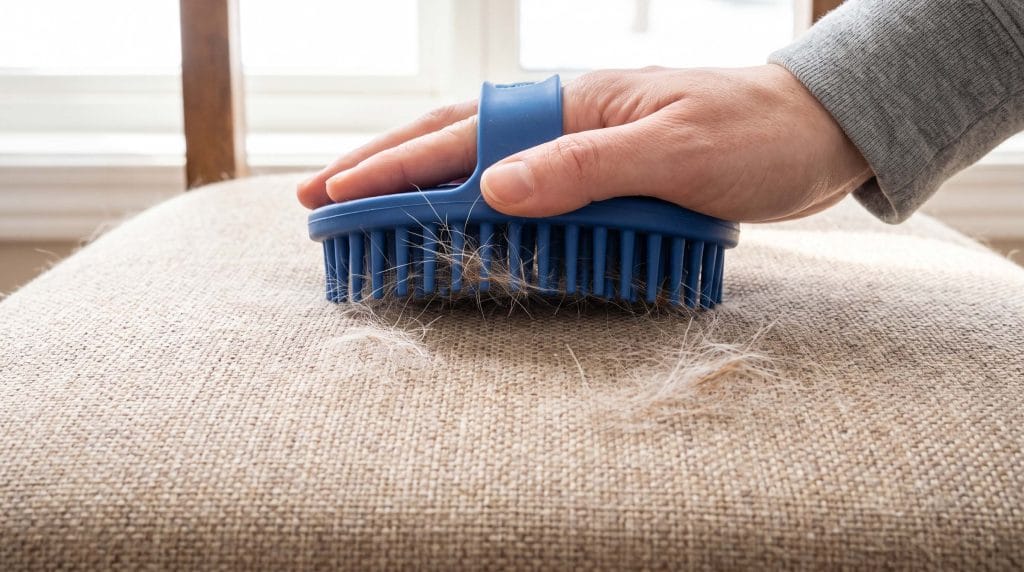
A rubber-bristled pet hair brush with firm, closely spaced bristles generates friction at the weave surface level that lifts short hair from between thread crossing points rather than sliding over them. The rubber material also disrupts static charge — less relevant for woven fabric than for fleece or velvet, but still a contributing factor in hair adhesion on synthetic woven materials. The stiffness of the bristles matters here: soft rubber bristles flex away from the weave crossing points without dislodging the hair. Firm bristles push into the gaps and lift.
Technique is critical. Use short, firm strokes against the weave direction — perpendicular to the way the main fabric threads run. This direction of stroke encounters the maximum number of crossing points per inch and creates the lifting action that dislodges embedded hair. Long strokes in any direction tend to relocate hair rather than lift it.
Vacuum with firm upholstery brush attachment.
After the rubber brush pass loosens hair from the weave, a vacuum with a firm upholstery brush attachment extracts it from the surface. The brush attachment is essential — suction alone on woven fabric primarily pulls at surface hair. The brush agitates the fabric slightly while suction lifts the agitated hair away. Use slow, overlapping strokes in the weave direction after the rubber brush pass has already loosened material.
Barely damp rubber glove — the fine hair finish pass.
After the rubber brush and vacuum stages, very fine short hairs often remain — visible as a slight shadow across the fabric surface when viewed in raking light. A rubber dish glove moistened to barely damp (not wet) creates a tacky surface that picks up these residual fine hairs through contact adhesion without the tape residue risk of a lint roller. One-directional strokes in the weave direction collect this final layer.
What doesn’t work — and why.
Lint rollers address only the top layer of hair sitting above the weave surface. They add adhesive residue to the fabric over repeated use, which increases the fabric’s hair-trapping tendency over time. Dry bare hands spread static charge across the fabric and push hair horizontally rather than lifting it. Hard-bristled brushes used with excessive pressure can snag woven threads and permanently damage the fabric structure. Wet cloths cause short dog hair to clump within the weave rather than releasing from it.
How to Remove Short Dog Hair From Woven Fabric Seats — The Cleaning Sequence That Works
Step-by-Step From First Pass to Clear Fabric
This is the complete sequence we recommend for removing short dog hair from woven fabric seats — structured to address hair at its embedded depth before attempting surface extraction.
Step 1 — Identify the weave direction.
Before any tool touches the fabric, find the primary weave direction by looking at the seat fabric in angled light. Most woven upholstery has a visible grid pattern — the main thread direction is usually front-to-back on the seat. This is the direction you’ll finish your cleaning strokes in. Your rubber brush strokes go perpendicular to this direction.
Step 2 — Dry rubber brush pass — against the weave.
Use the rubber pet hair brush in short, firm strokes running perpendicular to the main weave direction. Apply enough pressure to engage the brush tips with the weave surface rather than just gliding across the top. Work one section at a time — roughly one foot square — before moving to the next. This pass dislodges short hair from the crossing points where it’s anchored and brings it to or near the surface.
Step 3 — Collect surfaced material by hand.
After each section’s rubber brush pass, collect the hair clumps that have risen to the surface by hand before vacuuming. This prevents the vacuum from spreading loosened hair to already-cleaned sections.
Step 4 — Rubber brush pass — with the weave direction.
Run a second rubber brush pass in the weave direction across the same section. This second pass collects the hair lifted by the first pass into rows that align with the weave structure — making them easier for the vacuum to extract cleanly.
Step 5 — Vacuum with upholstery brush attachment.
Run the vacuum slowly across the section in the weave direction with a firm upholstery brush attachment. Slow, overlapping strokes work significantly better than quick passes — the brush tip needs contact time with the fabric surface to agitate and lift hair rather than just creating suction above it.
Step 6 — Raking light inspection.
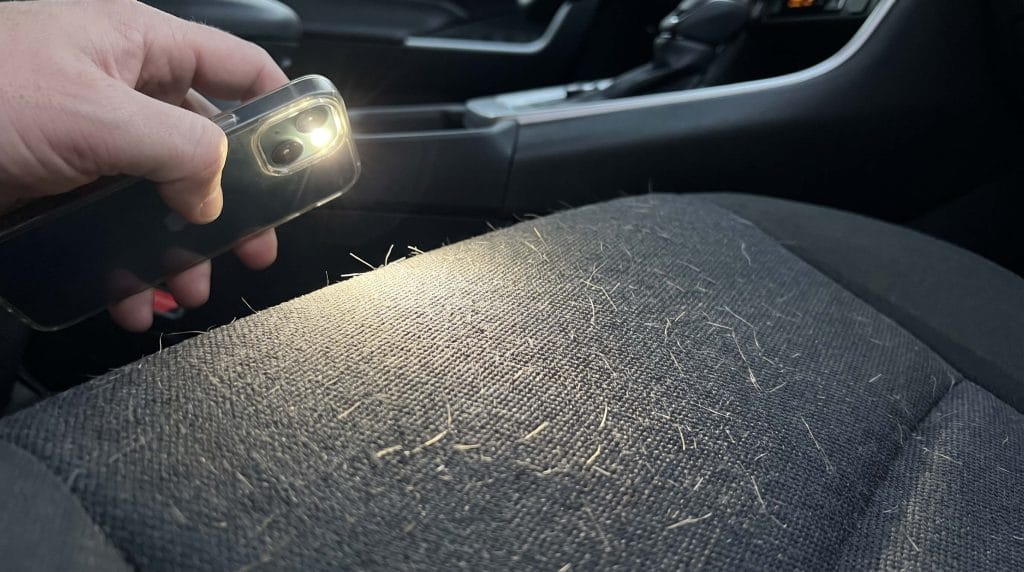
After vacuuming each section, hold a phone flashlight or desk lamp low and at an angle to the fabric surface — raking light reveals fine hair that’s invisible in direct overhead lighting. Any visible shadow of remaining fine hair indicates a section that needs the damp rubber glove pass.
Step 7 — Damp rubber glove finish pass.
Where raking light reveals remaining fine hair, use the barely damp rubber glove in one-directional strokes with the weave direction. The glove’s tackiness picks up fine hair without the saturation that causes clumping inside the weave.
Step 8 — Final vacuum pass across the full seat.
One complete vacuum pass across the entire cleaned surface in the weave direction finishes the process. By this stage, the fabric should show dramatically less hair than at the start — and any remaining hair should be confined to surface contact rather than weave-embedded.
Ben’s Car Seats — What Six Months of Beagle Hair Looks Like in Woven Fabric
Ben drives a midsize SUV with woven fabric rear seats. His three-year-old Beagle, Chester, rides in the back seat three times a week — to the dog park, to the vet, and on weekend family trips. Beagles shed a short, stiff tri-color coat year-round that embeds into woven fabric with remarkable efficiency.
After six months without targeted treatment, Ben described the rear seats as having “a permanent shadow that doesn’t come off no matter what I try.” He’d used lint rollers, a standard vacuum, and a damp cloth — none of which had made a noticeable difference because none of them addressed hair inside the weave.
We walked Ben through the complete eight-step sequence above. His reaction after the first rubber brush pass on a single section: “I pulled off what looked like a small toupee. I didn’t know that much hair was even in there.”
After the full cleaning sequence on both rear seats — which took about 35 minutes total — Ben reported that the shadow was gone. The fabric was visibly lighter in color, the texture felt different underfoot, and the seats looked the way they had when the car was new.
Ben now does a rubber brush pass and quick vacuum on the rear seats every two weeks. Each session takes about eight minutes. The six-month buildup has never returned.
His experience is exactly representative of what we see consistently with how to remove short dog hair from woven fabric seats — the problem isn’t the hair volume, it’s that standard tools never addressed the right depth. Once the correct tools and sequence are in place, maintenance becomes genuinely manageable.
🐾 The Raking Light Test — The Diagnostic Step That Changes How You Clean
Here’s a technique that professional automotive detailers and upholstery restoration specialists use routinely — and that we haven’t seen documented in any standard pet care guide aimed at home users.
Standard overhead lighting hides short dog hair in woven fabric because the light hits the surface perpendicularly, illuminating both the hair and the fabric threads evenly. The hair blends with the texture.
Raking light — a light source held low and almost parallel to the fabric surface — creates shadows behind any raised or embedded material, making it visible against the fabric background. Short dog hair that’s completely invisible under overhead lighting becomes immediately visible under raking light as a subtle gray shadow across the weave.
Use this test at three points during removing short dog hair from woven fabric seats: before cleaning to map where hair is embedded and how heavily, between the vacuum pass and the glove finish to identify which sections still need treatment, and after the final vacuum pass to confirm the clean is complete before stopping.
Without the raking light test, it’s easy to declare a seat clean when fine embedded hair remains — only to see it reappear clearly in natural sidelight from a car window or room lamp. With the raking light test, you clean to a verified standard rather than an estimated one.
A phone flashlight held at roughly 15 degrees to the fabric surface provides sufficient raking light for all three test points. This costs nothing and eliminates the guesswork from every stage of the cleaning process.
Tool Comparison — How to Remove Short Dog Hair From Woven Fabric Seats
| Tool | Reaches Weave Level | Removes Short Hair | Safe for Woven Fabric | Best Stage |
|---|---|---|---|---|
| Stiff rubber pet hair brush | ✅✅✅ Yes | ✅✅✅ Very High | ✅ Yes — firm strokes only | Primary removal pass |
| Vacuum — upholstery brush attachment | ✅✅ Partial | ✅✅ High | ✅ Yes | After rubber brush pass |
| Barely damp rubber glove | ✅ Surface-weave level | ✅✅ High for fine hair | ✅ Yes | Finish pass |
| Lint roller | ❌ Surface only | ✅ Low — surface hair only | ⚠️ Leaves adhesive residue | Not recommended |
| Stiff bristle brush (non-rubber) | ✅✅ Yes | ✅✅ Moderate | ⚠️ Risk of thread snag | Use rubber version instead |
| Suction vacuum — no brush | ❌ Surface only | ✅ Low | ✅ Yes | Not effective alone |
| Dry bare hand rubbing | ❌ Spreads hair | ❌ Ineffective | ✅ Yes | Never |
| Wet cloth | ❌ Clumps hair in weave | ❌ Counterproductive | ⚠️ May watermark | Never for hair removal |
| Tape-based roller | ❌ Surface only | ✅ Low | ⚠️ Adhesive buildup | Avoid repeated use |
How to Remove Short Dog Hair From Woven Fabric Seats — Prevention Between Sessions
Habits That Reduce How Much Hair Embeds Between Cleanings
Since how to remove short dog hair from woven fabric seats is the question, managing how deeply hair embeds between cleaning sessions makes each cleaning faster and easier. These are the prevention approaches that make a measurable difference.
Seat covers on high-contact areas.
A tightly woven washable seat cover placed over the fabric seat creates a sacrificial surface that takes the hair instead of the seat fabric. Cotton canvas, denim, or microfiber covers in a tight weave release pet hair far more easily in the wash than woven upholstery fabric does — and the seat fabric underneath stays in its original condition. Choose covers sized to fit the seat properly rather than draping loosely, which creates friction points where hair can work its way under the edge.
Consistent brushing schedule for your dog.
Short-haired breeds that shed the most problematic embedding hair — Beagles, Boxers, Vizslas, short-coat German Shepherds, Labradors — shed year-round at a volume that’s directly tied to how much loose hair they’re carrying. Brushing three times weekly during peak shedding removes loose hair before it sheds onto surfaces. Our guides for Labrador shedding, German Shepherd coat management, and our complete dog shedding management guide cover the specific tools and techniques for short and medium coats.
Bi-weekly rubber brush maintenance pass.
A quick rubber brush pass and vacuum across the seats every two weeks — before hair has accumulated to embedded depth — takes eight to ten minutes and prevents the six-month buildup situation Ben experienced from ever developing. Hair that’s been in woven fabric for two weeks is easier to remove than hair that’s been there for two months. Frequency of light maintenance beats infrequency of major cleaning every time.
Woven Fabric Seat Dog Hair — Session Reference Guide
Before cleaning:
- Identify primary weave direction — raking light test to map hair distribution
- Gather tools — stiff rubber brush, vacuum with upholstery brush attachment, rubber gloves, phone flashlight
Primary removal:
- Rubber brush — short firm strokes against weave direction, one-foot sections
- Collect surfaced hair by hand between sections
- Second rubber brush pass — with weave direction to collect into rows
- Vacuum — slow overlapping passes with upholstery brush, weave direction
Finish and verify:
- Raking light inspection — identify remaining fine hair sections
- Damp rubber glove pass on identified sections — one direction with weave
- Final vacuum pass — full seat surface
- Raking light confirmation — verify clean before finishing
Prevention:
- Seat cover on high-use areas — wash weekly
- Dog brushing 3× weekly — short-coat breeds especially
- Bi-weekly rubber brush maintenance pass — 8–10 minutes per session
- Raking light check monthly — catch early buildup before embedding deepens
FAQ — How to Remove Short Dog Hair From Woven Fabric Seats
Why is short dog hair harder to remove from woven fabric than long dog hair?
Short dog hair — typically one to three centimeters — threads through the warp and weft crossing points of woven fabric and anchors inside the weave grid. Long hair drapes across multiple crossing points rather than threading through a single gap, keeping it closer to the surface where standard tools can reach it. Short hair’s stiff shaft also holds its position in the weave gap rather than collapsing out when pressure is applied from above — which is why pressing down with a lint roller drives short hair deeper rather than lifting it.
Does vacuuming alone work for removing short dog hair from woven fabric seats?
Vacuuming alone is partially effective on surface hair but doesn’t address hair embedded at the weave crossing-point level. The suction pulls at hair above the fabric surface — but short hair anchored inside the weave structure isn’t in the airstream effectively. A vacuum with a firm upholstery brush attachment performs significantly better than suction alone because the brush agitates the fabric and dislodges hair before suction extracts it. But the most effective sequence combines a rubber brush pre-treatment pass with vacuum extraction rather than vacuuming as the sole tool.
Can I use a lint roller to remove short dog hair from woven fabric seats?
Lint rollers work only on short dog hair sitting above the woven fabric surface — typically less than 20% of the total hair present in a seat that’s been used by a dog regularly. They don’t interact with hair anchored inside the weave structure. Repeated lint roller use also deposits adhesive residue on the fabric surface that increases hair adhesion over time. A lint roller is acceptable as a between-session quick clean on light surface hair, but it’s not effective for the embedded short hair that makes woven fabric seats look persistently dirty.
How often should I clean short dog hair from woven fabric car seats?
For dogs that ride regularly — three or more times weekly — a rubber brush pass and vacuum every two weeks prevents hair from reaching the deeply embedded state that requires extended cleaning sessions. Between bi-weekly sessions, a 30-second raking light check identifies any localized heavy buildup that needs attention before the next full session. Dogs that ride daily may benefit from a weekly quick pass. The six-month accumulation pattern that Ben experienced develops when no targeted cleaning happens — bi-weekly maintenance eliminates that endpoint entirely.
Is there a way to treat woven fabric seats to repel short dog hair?
Fabric protector sprays — specifically those designed for upholstery rather than carpet — create a slight surface coating on woven fabric fibers that reduces the mechanical grip that allows short hair to thread through crossing points. The effect is partial rather than complete: treated fabric still attracts hair but accumulates it more slowly and releases it more easily during cleaning. Reapply every three to four months for maintained effectiveness. Test any fabric protector on a small hidden area first — some formulations change the fabric’s appearance or texture on certain upholstery materials.
The Honest Bottom Line on How to Remove Short Dog Hair From Woven Fabric Seats
How to remove short dog hair from woven fabric seats comes down to one principle that changes everything: short hair lives inside the weave, not on top of it. Every tool and technique that works addresses that depth. Every tool that fails operates above it.
The rubber brush is the tool. The against-weave stroke direction is the technique. The raking light test is the diagnostic. The damp rubber glove is the finisher. The bi-weekly maintenance pass is what prevents the problem from returning to the state that made you search for this guide in the first place.
Chester still rides in Ben’s SUV three times a week. The rear seats still look clean. The eight-minute maintenance routine replaced the 35-minute deep clean — and the deep clean hasn’t been necessary since.
Want to address the shedding problem at the source? Our breed-specific guides for Huskies, German Shepherds, Golden Retrievers, Labradors, and Corgis cover the deshedding tools and routines that reduce ambient shedding volume significantly — and our complete dog hair management guide brings the full strategy together across every surface in your home. 🐾
This article reflects our team’s hands-on research and testing across multiple woven fabric types and short-coated breeds. For upholstery damage or fabric restoration concerns beyond pet hair removal, consult a professional upholstery care specialist.
