

 Animal Zoid Editorial Team
 If you’re considering a velvet sofa or already own one and your dog has claimed it, you need a straight answer to this question: does velvet fabric attract dog hair or repel it? The honest answer is that velvet attracts dog hair — significantly, and for reasons that are specific to how velvet is constructed rather than just bad luck. But the full picture is more nuanced than a simple yes or no, because velvet type, pile direction, and fiber content all change how severe the problem is and how manageable it becomes with the right approach.
This guide covers the exact mechanics of why does velvet fabric attract dog hair or repel it lands where it does, how different velvet types compare to each other and to alternative fabrics, what actually works for removal and prevention, and whether velvet is a realistic choice for a home with a shedding dog.
⚡ Quick Answer
Does velvet fabric attract dog hair or repel it?
Velvet attracts dog hair. The cut pile surface of velvet creates thousands of tiny fiber tips that generate friction and static charge — both of which cause dog hair to cling and embed rather than slide off. Synthetic velvet (polyester-based) attracts hair more aggressively than natural velvet (silk or cotton) because synthetic fibers build stronger static charge. However, velvet is easier to clean than fleece or high pile carpet because the pile is short and uniform, which limits embedding depth.
Dog hair on furniture is one piece of a bigger shedding management challenge. Our complete dog shedding management guide covers the full year-round strategy. If your dog’s bedding is the primary hair problem, our guides on how to get dog hair out of fleece blankets in washing machine and how to stop dog hair from sticking to leather couch tackle specific surface types in detail. Breed-specific shedding reduction guides for Huskies, German Shepherds, Golden Retrievers, Labradors, and Corgis address the shedding volume problem at the source.
Does Velvet Fabric Attract Dog Hair or Repel It — Understanding the Fabric First
Why Velvet’s Structure Makes It a Dog Hair Magnet
Answering does velvet fabric attract dog hair or repel it properly requires understanding what velvet actually is at the fiber level — because the answer isn’t just “it attracts hair.” It’s specifically why it attracts hair, which determines which interventions actually work.
Velvet is a woven fabric with a distinctive cut pile surface. During manufacturing, loops of fiber are woven into the base fabric and then cut at the top, leaving thousands of short, upright fiber tips across the entire surface. This cut pile structure is what gives velvet its characteristic soft, directional texture — the way it changes appearance when you stroke it in different directions.
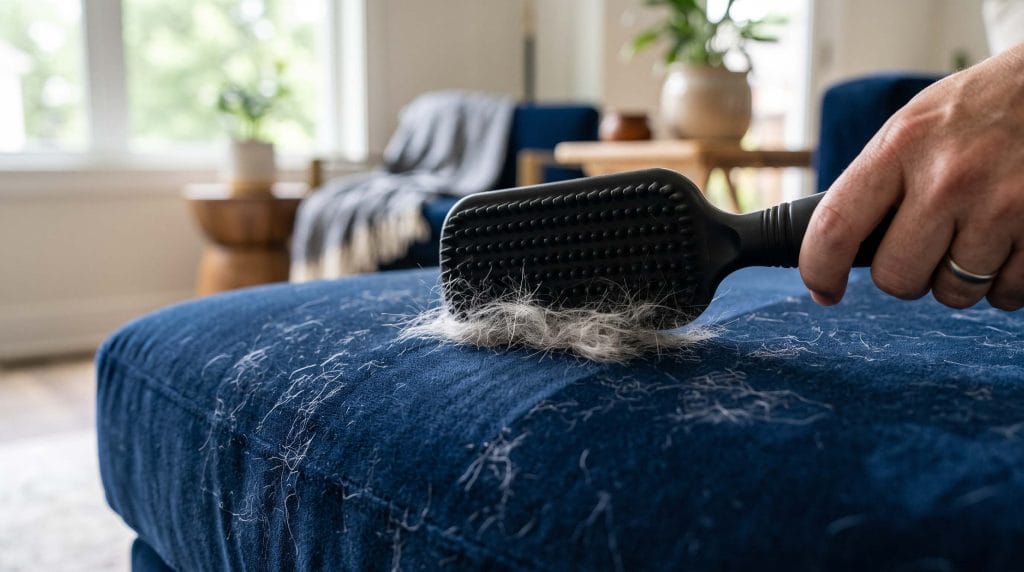
Those upright fiber tips are the problem. Each tip is a small, soft point that makes physical contact with dog hair through two mechanisms. The first is mechanical friction — the cut fiber tips are close enough together that dog hair slides between them and catches on the surrounding tips rather than gliding across the surface. The second is static charge — velvet surfaces, particularly synthetic velvet, build up static electricity through repeated contact and movement. Dog hair carries its own charge, and the attraction between the charged velvet surface and charged hair fibers is what makes hair cling persistently rather than falling away when you brush at it.
The pile direction matters significantly here. Stroking velvet against its natural pile direction raises the fiber tips and increases the surface area available for hair contact — which is why a dog sitting, shifting, and standing repeatedly in one spot generates more embedded hair than a dog that uses the furniture minimally.
So does velvet fabric attract dog hair or repel it? Attract — consistently and through two simultaneous physical mechanisms. But the severity varies considerably based on velvet type.
Does Velvet Fabric Attract Dog Hair or Repel It — Velvet Type Changes Everything
How Different Velvet Compositions Compare for Dog Hair
Not all velvet behaves identically when it comes to dog hair. The fiber composition changes both the attraction level and the ease of removal significantly — and this is the information most interior design guides skip when pet owners ask does velvet fabric attract dog hair or repel it.
Polyester velvet — highest hair attraction.
Polyester-based velvet is the most common type in mid-range furniture because it’s durable, colorfast, and less expensive than natural fiber alternatives. But polyester is also a strong static charge generator. Every time a dog sits on polyester velvet, friction builds charge on the surface. Dog hair bonds to that charge strongly and embeds between the cut pile tips firmly. Removal requires consistent effort and the right tools. If you’re asking does velvet fabric attract dog hair or repel it and your velvet is polyester, the answer is: attracts aggressively.
Cotton velvet — moderate hair attraction.
Cotton velvet has a softer, slightly less uniform pile than polyester and significantly lower static generation because cotton is a natural fiber with reasonable electrical conductivity. Hair that lands on cotton velvet tends to sit on the surface rather than embedding as deeply as it does on polyester. It’s still a hair-attracting surface — the cut pile structure sees to that — but removal is noticeably easier, and between-cleaning accumulation is lower. For pet owners committed to velvet furniture, cotton velvet is the practical choice.
Silk velvet — lowest hair attraction, highest maintenance cost.
Silk velvet generates minimal static charge and has a pile structure so smooth that dog hair has limited purchase on the surface. Hair lands and slides rather than clinging. But silk velvet is also delicate, expensive, and sensitive to moisture — which rules out most practical cleaning methods for pet hair. The low hair attraction is real, but the maintenance trade-off makes silk velvet impractical for most pet households.
Crushed velvet — unpredictable hair behavior.
Crushed velvet has an intentionally disrupted pile that runs in multiple directions rather than one consistent direction. This creates both high-friction zones and low-friction zones across the surface — meaning hair embeds heavily in some areas and sits loosely in others. The irregular pile direction also makes it harder to remove hair consistently because there’s no single stroke direction that works across the whole surface.
Velvet-look microfiber — the practical middle ground.
Velvet-look microfiber fabrics have a similar visual texture to velvet but a very different fiber structure — the pile tips are even shorter and more densely packed, and the polyester microfiber construction is treated to reduce static in most commercial products. Hair sits on this surface rather than embedding between tips. It’s not a true velvet answer to does velvet fabric attract dog hair or repel it, but for pet owners who want the velvet aesthetic without the maximum hair attraction, velvet-look microfiber is the realistic recommendation.
Does Velvet Fabric Attract Dog Hair or Repel It — How It Compares to Other Fabrics
Velvet vs. Common Furniture Fabrics for Dog Hair Management
| Fabric | Hair Attraction Level | Embedding Depth | Ease of Removal | Static Generation |
|---|---|---|---|---|
| Polyester velvet | ⚠️⚠️⚠️ Very High | Medium | Moderate effort | ⚠️⚠️⚠️ High |
| Cotton velvet | ⚠️⚠️ Moderate-High | Low-Medium | Easier | ⚠️ Low-Moderate |
| Silk velvet | ⚠️ Low | Very Low | Easy | ✅ Minimal |
| Crushed velvet | ⚠️⚠️ Variable | Variable | Difficult | ⚠️⚠️ Moderate-High |
| Velvet-look microfiber | ⚠️ Low-Moderate | Very Low | Easy | ⚠️ Low |
| High pile carpet | ⚠️⚠️⚠️ Very High | Very Deep | Very difficult | ⚠️⚠️ Moderate |
| Fleece | ⚠️⚠️⚠️ Very High | Deep | Difficult | ⚠️⚠️⚠️ High |
| Leather | ⚠️ Low-Moderate | Surface only | Easy | ⚠️ Low-Moderate |
| Tight-weave cotton canvas | ✅ Low | Minimal | Very easy | ✅ Minimal |
| Linen | ✅ Low | Minimal | Easy | ✅ Minimal |
The table makes the answer to does velvet fabric attract dog hair or repel it clear in context. Velvet sits in the moderate-to-high range for hair attraction — worse than leather and tight-weave fabrics, but better than fleece and high pile carpet. That relative position matters when making furniture decisions in a pet household.
The Story of Sophie’s Velvet Sectional — What Two Malamutes Taught Us
Sophie bought a deep navy polyester velvet sectional three months before she adopted her second Alaskan Malamute. One Malamute, she’d managed. Two Malamutes on polyester velvet turned out to be a different category of problem entirely.
She contacted our team after describing the sectional as “more silver-white than navy — I genuinely cannot tell what color it is anymore.” She’d been using a lint roller, which she described as “cosmetically hopeless — it takes off one layer and there are three more underneath.”
We walked Sophie through the specific removal sequence for velvet and, more importantly, explained the static mechanism behind why does velvet fabric attract dog hair or repel it the way it does. The lint roller was working against the static — the adhesive was pulling at hair bonded to a charged surface, which meant each pass required significant force and still left the static charge active for the next round of hair attachment.
The intervention: a rubber pet hair removal brush used against the pile direction to loosen hair, followed by a pass in the natural pile direction to collect it, followed by a light anti-static spray applied to a cloth and wiped across the sectional surface. On the first attempt, Sophie reported removing more hair in four minutes than her lint roller achieved in 20.
The longer-term solution for Sophie wasn’t switching furniture — it was establishing a twice-weekly maintenance routine with the rubber brush and anti-static wipe, combined with washable velvet-look covers on the two cushions the Malamutes used most. She now describes the sectional management as “annoying but doable” — which is an honest and realistic description of living with velvet furniture and heavy-shedding dogs.
Does Velvet Fabric Attract Dog Hair or Repel It — What Actually Works for Removal
The Right Tools and Sequence for Velvet Dog Hair Removal
Since does velvet fabric attract dog hair or repel it clearly lands on the attract side, the practical question becomes: what removes it most effectively without damaging the pile?
Rubber pet hair brush — the primary tool.
A rubber-bristled pet hair removal brush works on velvet through the same mechanism it works on fleece and car upholstery — friction disrupts the static bond between hair and fiber, and the rubber surface collects loosened hair rather than just displacing it. The technique matters on velvet specifically: brush against the natural pile direction first to lift embedded hair upward, then brush with the pile direction to collect hair into removable clumps. Never brush hard against velvet pile repeatedly in the same direction — this can permanently alter the pile lay in that area.
Anti-static spray — applied to cloth, not directly to velvet.
Anti-static spray applied to a cloth and wiped across the velvet surface neutralizes the static charge that’s holding hair to the fiber tips. This makes subsequent rubber brush passes significantly more effective because you’re removing the attraction mechanism rather than just fighting against it. Apply anti-static treatment after each cleaning session rather than before — it prevents immediate re-adhesion of new hair after cleaning.
Vacuum with upholstery attachment — on low suction.
A vacuum with a soft upholstery attachment removes hair from velvet effectively if used on low suction with slow, overlapping passes in the pile direction. High suction can pull velvet pile out of alignment or stress the weave over time. The brush attachment agitates the pile gently while suction removes loosened material.
What not to use on velvet.
Tape-based lint rollers leave adhesive residue on velvet pile that accumulates over time and increases hair adhesion. Stiff brushes damage the pile permanently. Wet cloths can watermark velvet and, when used to remove hair, cause the hair to mat into the pile rather than coming off the surface. Always clean velvet dry for hair removal.
🐾 The Pile Direction Reset After Every Clean — What Velvet Specialists Know
This comes from textile care professionals who work with velvet furniture regularly — and it’s the finishing step that makes the difference between velvet that looks pristine after cleaning and velvet that looks slightly ruffled even after thorough hair removal.
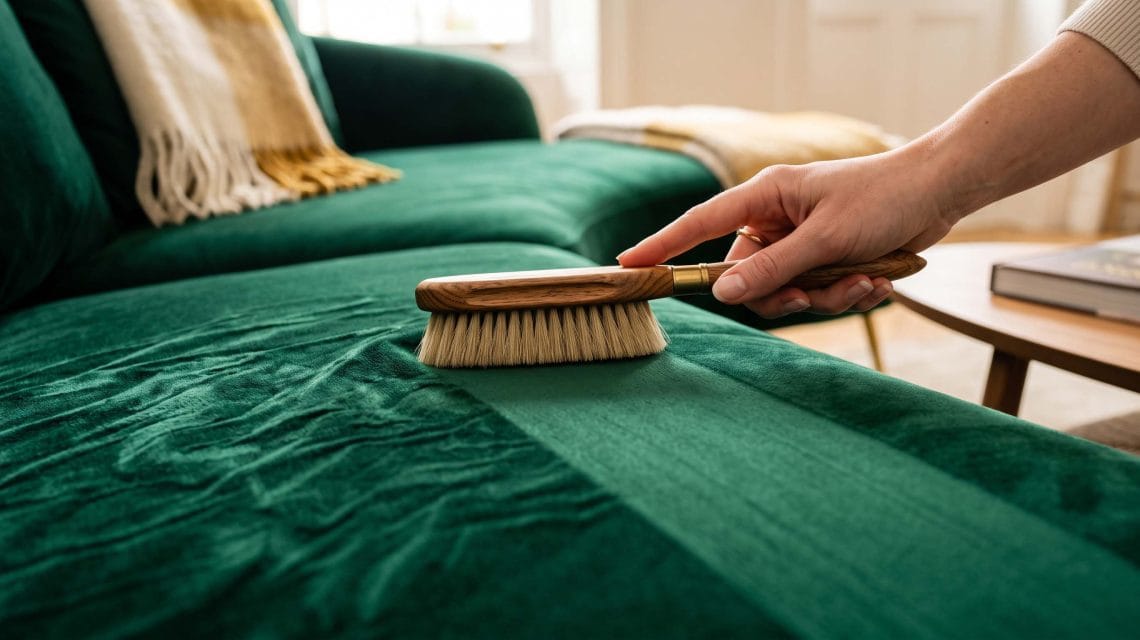
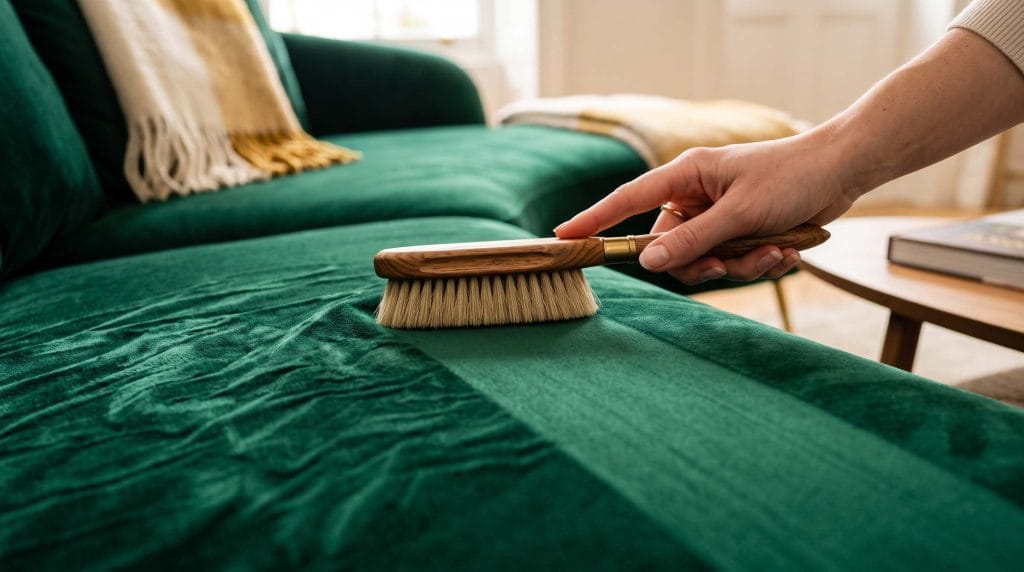
After any pet hair removal session on velvet — whether rubber brush, vacuum, or both — finish with a single pass of a clean, soft velvet brush (or a barely damp lint-free cloth) in the natural pile direction across the entire cleaned area. This resets the cut pile tips back to their natural upright-and-aligned position after the cleaning passes have disrupted their lay.
Here’s why this matters beyond appearance: velvet pile that’s been cleaned against the direction and left misaligned presents more surface area to new hair contact than pile that’s properly reset. The pile tips in misaligned sections are angled rather than upright, which creates more friction contact points for incoming hair. Reset pile attracts slightly less new hair than disrupted pile — a meaningful difference between cleaning sessions.
The pile direction on most velvet furniture runs from the back of the seat toward the front edge when you run your hand in the comfortable direction. That same direction is your reset pass direction. One light pass with a soft brush or cloth. Thirty seconds. The velvet looks significantly better and accumulates new hair slightly more slowly between cleaning sessions.
This is the step that differentiates a cleaned velvet sofa from a professionally maintained velvet sofa — and it applies directly to every household asking does velvet fabric attract dog hair or repel it and then deciding to keep their velvet furniture anyway.
Does Velvet Fabric Attract Dog Hair or Repel It — Prevention That Reduces the Problem
Managing Dog Hair on Velvet Before It Becomes Embedded
Removal is necessary. But reducing how much hair reaches the velvet and how deeply it embeds between cleaning sessions makes does velvet fabric attract dog hair or repel it a manageable daily reality rather than a constant battle.
Washable velvet-look covers on high-use cushions.
A tightly woven washable cover placed over the specific cushions your dog uses most creates a barrier between the dog and the velvet surface. The cover absorbs the hair, the static charge builds on the cover rather than the velvet, and the cover goes in the washing machine. This is the single highest-impact prevention step for households where restricting couch access isn’t realistic.
Anti-static maintenance spray between cleaning sessions.
A light anti-static wipe across the velvet surface every few days reduces the static charge that makes hair adhere. Apply to a cloth rather than directly to the velvet to avoid any residue risk on the pile. This doesn’t prevent hair from landing — it prevents hair from bonding as strongly, which makes each cleaning session faster and more effective.
Consistent brushing schedule for your dog.
Reducing the volume of loose hair your dog carries directly reduces how much lands on any surface in your home. A dog brushed thoroughly three times weekly during shedding season deposits dramatically less hair on furniture than a dog brushed infrequently. Our complete dog shedding management guide and our guides for German Shepherds, Golden Retrievers, and Huskies cover the breed-specific deshedding tools and routines that make the biggest difference.
Velvet Furniture Decision Guide for Pet Owners
Before buying velvet furniture with a shedding dog:
- Identify velvet fiber type — cotton or velvet-look microfiber preferred over polyester
- Choose darker colors — dog hair visibility is significantly lower on navy, charcoal, or forest green than on lighter tones
- Budget for washable covers on dog-accessible cushions
- Purchase a rubber pet hair brush before the furniture arrives
- Have anti-static spray on hand from day one
Weekly maintenance routine:
- Rubber brush pass — against pile direction first, then with pile direction
- Anti-static cloth wipe across all dog-accessible surfaces
- Pile direction reset pass — soft brush or lint-free cloth in natural pile direction
- Vacuum with soft upholstery attachment on low suction — slow overlapping passes
- Wash cushion covers if using them
Signs velvet needs deeper attention:
- Pile lay is visibly disrupted in high-contact areas
- Hair is visible between cleaning sessions within 24 hours
- Anti-static treatment stops making a noticeable difference (increase frequency)
- Pile tips show matting in specific areas — professional cleaning may be needed
FAQ — Does Velvet Fabric Attract Dog Hair or Repel It?
Does velvet fabric attract dog hair or repel it compared to leather?
Velvet attracts dog hair more than leather does. Leather’s smooth, non-porous surface generates less static charge than velvet’s cut pile and provides no mechanical grip for hair fibers. Dog hair on leather sits on the surface and removes easily with a dry rubber glove or damp microfiber cloth. Dog hair on velvet embeds between cut pile tips and bonds through static — requiring a rubber brush and anti-static treatment for effective removal. If pet hair management is the priority, leather outperforms velvet significantly. Our how to stop dog hair from sticking to leather couch guide covers the leather-specific management approach in detail.
Is there a type of velvet that dog hair doesn’t stick to?
No velvet type fully repels dog hair — the cut pile structure always provides some mechanical grip. But silk velvet and velvet-look microfiber attract significantly less hair than polyester velvet because of lower static generation and shorter, denser pile that limits embedding depth. For pet owners committed to velvet furniture, cotton velvet or velvet-look microfiber are the most practical options. Polyester velvet is the most problematic type in households with heavy-shedding breeds.
Does the color of velvet affect how much dog hair shows?
Color doesn’t affect how much hair the velvet attracts — it only affects visibility. Dark velvet shows light-colored dog hair dramatically. Light velvet shows dark dog hair the same way. The most practical color choice for mixed-breed households or multi-colored dog coats is a medium tone — charcoal, slate gray, or deep teal — which makes both light and dark hair less immediately visible than pure navy or cream would.
How often should I clean dog hair off velvet furniture?
For households with heavy-shedding breeds — Huskies, Malamutes, German Shepherds, Golden Retrievers — a rubber brush pass and anti-static wipe twice weekly prevents hair from reaching the deeply embedded state that’s hardest to remove. For moderate shedders, once weekly is sufficient. The longer hair sits embedded in velvet pile under repeated pet contact and movement, the more firmly the static bond and mechanical entanglement develop — making each subsequent cleaning session progressively more difficult.
Can I use a lint roller on velvet to remove dog hair?
Lint rollers work on very light surface hair on velvet but are largely ineffective on embedded hair — and they carry a risk with repeated use. Adhesive tape on velvet pile leaves microscopic residue that accumulates over time and increases the surface’s hair-attracting properties. For occasional, light surface hair a lint roller is acceptable. For consistent pet hair management on velvet, a rubber brush is significantly more effective and doesn’t carry the residue risk.
The Honest Bottom Line on Does Velvet Fabric Attract Dog Hair or Repel It
Does velvet fabric attract dog hair or repel it? Attract — clearly and consistently, through static charge and mechanical pile grip working together. That’s the honest answer, and any guide that softens it isn’t serving you well if you’re making a furniture decision with a shedding dog in the house.
But here’s the honest follow-up: velvet is manageable with the right tools, the right routine, and realistic expectations. Sophie’s Malamute-tested navy sectional is still navy. The rubber brush, the anti-static wipe, and the pile direction reset have turned a daily disaster into a twice-weekly 10-minute maintenance task. Cotton velvet or velvet-look microfiber would have made it even easier.
The question isn’t really whether velvet attracts dog hair. It does. The question is whether you’re equipped to manage it — and now you are.
Want to tackle shedding at the source so less hair reaches your furniture in the first place? Our guides for Huskies, German Shepherds, Golden Retrievers, Labradors, and Corgis cover the deshedding tools and grooming routines that make the biggest difference. Our complete dog hair management guide gives you the full picture — furniture, flooring, laundry, and grooming — in one place. 🐾
This article reflects our team’s research and hands-on testing across multiple fabric types and shedding breeds. For velvet furniture with significant pile damage or professional cleaning needs, consult a certified textile care specialist.
