

 Animal Zoid Editorial Team
 Dog hair and fleece blankets have the most frustrating relationship in pet ownership. If you’ve been trying to figure out how to get dog hair out of fleece blankets in washing machine cycles and keep pulling the blanket out hairier than it went in — you’re not doing it wrong, you’re just missing the steps that happen before the machine even turns on. This guide covers the complete process: why fleece traps hair the way it does, what to do before washing, the exact machine settings that help versus hurt, and the post-wash steps that finish the job properly.
⚡ Quick Answer
How to get dog hair out of fleece blankets in washing machine:
Shake the blanket outside for 60 seconds. Use a damp rubber glove to pull hair off both sides. Run a 10-minute no-heat pre-dryer tumble and clean the lint trap immediately after. Then wash cold with half a cup of white vinegar — no fabric softener. Finish on low heat with a dryer ball.
Before we get into the full process — if shedding is the root problem, our complete dog shedding management guide covers year-round solutions. Breed-specific guides for Huskies, German Shepherds, Golden Retrievers, Labradors, and Corgis tackle the shedding volume problem at the source.
How to Get Dog Hair Out of Fleece Blankets in Washing Machine — Why the Machine Alone Never Works
The Real Reason Fleece Traps Dog Hair So Stubbornly
Most people who struggle with how to get dog hair out of fleece blankets in washing machine cycles aren’t making a mistake with their detergent or wash temperature. They’re asking the washing machine to do a job it physically cannot do on its own — and the reason why comes down to what fleece actually is at a fiber level.
Fleece is manufactured from polyester that gets mechanically brushed during production to create that soft, raised texture. Under magnification, that surface looks like thousands of tiny interlocking loops. Dog hair — especially the fine, tapered undercoat fibers that most shedding breeds produce — slides into those loops and anchors through two forces working simultaneously: the mechanical grip of the fiber structure and the static charge that polyester builds naturally through friction and movement.
Here’s what makes this worse. Water doesn’t loosen that grip — it strengthens it. When fleece gets wet, the polyester fibers swell slightly and tighten around whatever’s embedded in them. Wash cycle agitation then moves the blanket vigorously — but instead of shaking hair loose, it drives hair deeper into the fiber structure with every rotation. So a blanket that goes in covered with surface hair comes out with that hair embedded deeper than before.
This is the core reason how to get dog hair out of fleece blankets in washing machine cycles fails for most people. The washing machine is a cleaning tool. It was never designed to be a hair-removal tool. Understanding that distinction changes everything about how you approach the problem.
How to Get Dog Hair Out of Fleece Blankets in Washing Machine — The Pre-Wash Steps That Do the Real Work
Four Steps Before the Washing Machine That Change Everything
We’ve tested this process across dozens of blankets and multiple breeds — and the consistent finding is always the same. The people who successfully get dog hair out of fleece blankets in the washing machine spend more time on pre-wash preparation than they do managing the wash cycle itself. Here’s the exact sequence.
Step 1 — Shake outside for a full 60 seconds.
Take the blanket outside and shake it vigorously. This feels too simple to be worth mentioning, but it removes the loosest surface layer of hair — the hair that would otherwise just recirculate in the wash water and redeposit on the fabric during the cycle. Don’t skip it because it seems obvious. It removes real volume.
Step 2 — Rubber glove pass across both sides.
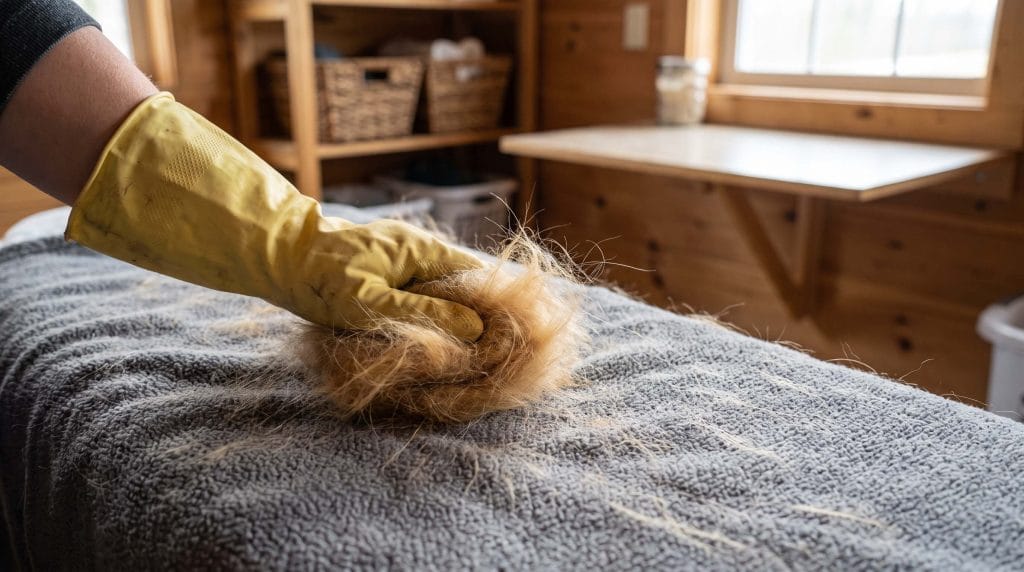
Put on a damp rubber dish glove and drag it firmly across the blanket surface in long, one-directional strokes. The slight tackiness combined with the friction of the rubber grabs hair that shaking didn’t reach and rolls it into clumps you peel off by hand. A rubber pet brush works identically. Do both sides thoroughly. This single step consistently removes more hair than the entire subsequent wash cycle will — and that’s not an exaggeration.
Step 3 — Lint roll both sides.
After the rubber glove pass, go over both sides with a lint roller. Every hair you remove from the dry blanket is a hair that can’t get pushed deeper into the fabric by wet agitation. The lint roller captures what the rubber glove leaves behind — the shorter, finer hairs that didn’t roll into clumps.
Step 4 — Pre-dryer tumble before washing.
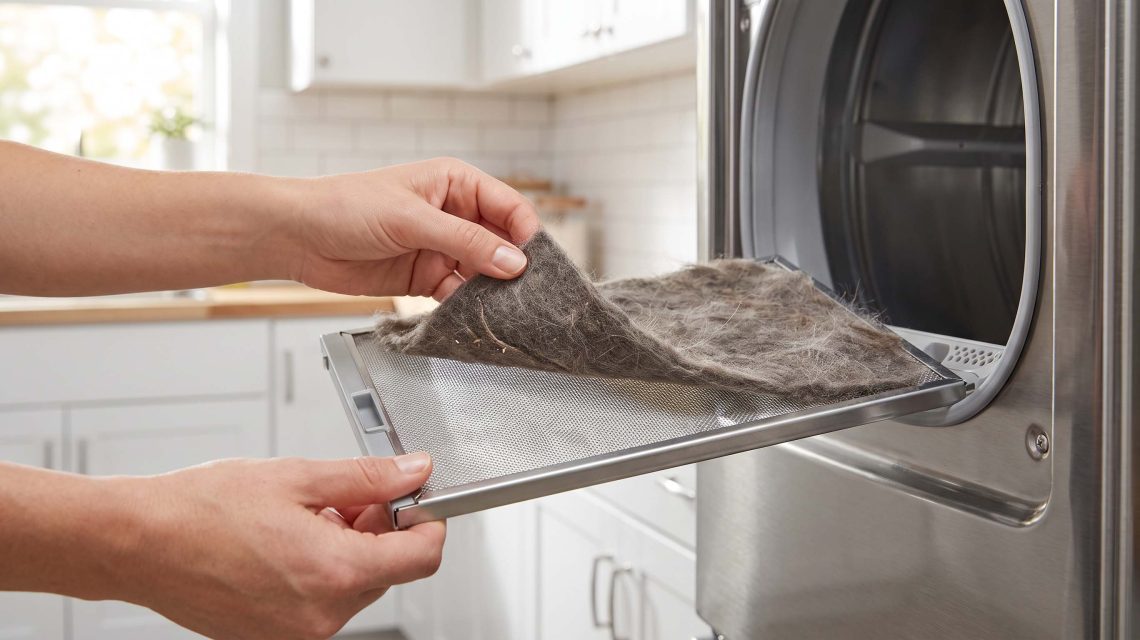
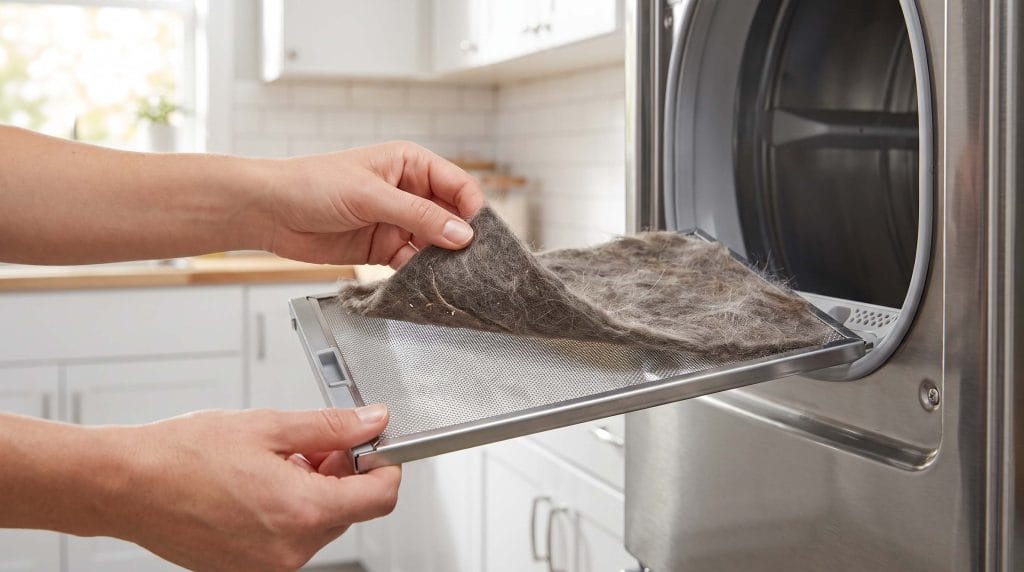
This is the step that separates people who successfully get dog hair out of fleece blankets in a washing machine from people who keep rewashing the same hairy blanket. Run the blanket in the dryer on a no-heat or air-only cycle for 10 minutes before it touches water. The tumbling action combined with airflow pulls loose hair out of the fabric structure and deposits it directly in the lint trap. Clean the lint trap immediately after this step — it will be dramatically fuller than you expect, and that’s exactly the point.
Only after completing all four steps does the blanket go into the washing machine. These pre-wash steps handle the hair removal. The machine handles the cleaning.
How to Get Dog Hair Out of Fleece Blankets in Washing Machine — Exact Settings That Help or Hurt
What to Set, What to Add, and What to Avoid Completely
With the blanket properly prepared, the wash cycle itself becomes much simpler. Here’s how to run it correctly.
Cold water — always. Hot water causes polyester fibers to contract, tightening their grip on any remaining hair. Cold water keeps fibers relaxed and gives embedded hair the best opportunity to release during agitation. Most people’s instinct is hot water equals better cleaning — but for fleece with dog hair, cold water is the correct choice every time.
White vinegar in the fabric softener compartment. Add half a cup of white distilled vinegar to the softener compartment so it releases during the rinse cycle. Vinegar neutralizes the static charge that makes polyester cling to hair and acts as a natural fabric softener that keeps fleece fibers supple. It costs almost nothing, leaves no residue, and outperforms commercial fabric softener for this specific application.
No liquid fabric softener — ever. Standard fabric softener deposits a waxy coating on polyester fibers that increases their hair-trapping ability with every wash. Owners who use fabric softener on fleece pet blankets regularly report that the blankets get progressively harder to clean over months. Vinegar replaces it completely.
Gentle cycle with high spin. Low agitation during the wash prevents remaining hair from being pushed further into the fabric. High spin speed at the end extracts hair-saturated water efficiently before the drying stage. This combination — gentle wash, strong spin — is the right pairing for washing dog hair out of fleece blankets in the machine.
Wash the blanket alone. No mixed loads. Hair that releases during the cycle transfers directly to other items in the drum. Other fabrics also create additional friction surfaces that can push hair back into the fleece during agitation. The blanket always washes alone.
Clean the machine filter before and after. Front-loading machines have a debris filter behind a small panel at the bottom front. Top-loaders typically have a lint trap in the agitator or drum rim. A filter that’s even partially clogged recirculates hair-laden water back through the drum during the cycle — which is why some blankets come out visibly hairier than they went in even after good preparation.
Tom and the Golden Retriever Blanket — What Three Months of Wrong Washing Looks Like
Tom owns a four-year-old Golden Retriever named Maple. Golden Retrievers produce a double coat with dense, fine undercoat fibers that embed into fabric with remarkable efficiency — and Maple had completely claimed a large fleece throw as her sleeping surface from the first week Tom brought it home.
By the time Tom contacted our team, he’d been running the blanket through a hot wash with fabric softener every Sunday for three months. Each week the blanket looked slightly worse. By month three, he described the surface as “more fur than fabric” — the hair had embedded so deeply through repeated wet agitation cycles without pre-treatment that the fleece texture itself had changed.
We walked Tom through the complete protocol above. His reaction after the pre-dryer tumble step specifically: “I cleaned the lint trap after the 10-minute cycle and I genuinely thought Maple had somehow gotten inside the dryer. There was so much hair.”
After that first properly-prepared wash, the blanket surface improved visibly. After three consecutive correct washes, the blanket had returned close to its original texture. After six weeks of weekly correct washing, Tom reported the blanket was maintaining that condition easily.
The fabric softener had been the compounding factor — each week’s wash was adding more waxy residue that trapped more of the following week’s hair, creating a progressively worse problem with each cycle. Switching to vinegar broke that cycle immediately.
Maple still sleeps on the blanket. The pre-dryer tumble is now automatic.
How to Get Dog Hair Out of Fleece Blankets in Washing Machine — After the Cycle Ends
The Post-Wash Steps Most Guides Skip Entirely
The wash is done. Here’s how to finish correctly so the effort isn’t wasted.
Wipe the drum before transferring. Hair that released during the wash sticks to the inside drum walls. A quick wipe with a damp cloth before moving the blanket to the dryer prevents that hair from transferring back onto the blanket or contaminating the next load.
Dry on low heat with a dryer ball. High heat damages polyester fleece over time and accelerates pilling. Low heat with a longer tumble cycle removes remaining hair through sustained airflow without fiber damage. Add a wool or rubber dryer ball — the physical contact during tumbling pulls additional hair toward the lint trap with each rotation.
Final rubber glove pass on the cool blanket. Once the blanket is fully dry and cool, run a damp rubber glove across both sides one more time. Any hair that survived the complete process will now be sitting on the surface rather than embedded — and the rubber glove removes it in under two minutes.
🐾 The Three-Stage Lint Trap Protocol — What High-Volume Pet Laundry Operations Do Differently
Most home laundry guides tell you to clean the lint trap after the dryer finishes. That’s correct — but it’s only one third of what actually maximizes the process when you’re dealing with how to get dog hair out of fleece blankets in washing machine and dryer cycles.
Pet boarding facilities and veterinary clinics that wash animal bedding at volume — sometimes 40 to 60 blankets per day — discovered through repeated trial that cleaning the lint trap at three specific points per session produces dramatically better results than a single end-of-session cleaning.
Clean 1 — Before the pre-dryer tumble begins. Starting with a completely clear lint trap maximizes the airflow that does the actual hair-pulling work during the tumble cycle. A trap that’s even 25% full from a previous load reduces that airflow meaningfully.
Clean 2 — Immediately after the pre-dryer tumble. Remove the hair that just came out before the wash cycle begins. Hair sitting in a partially full trap during the wash can be pulled back through the airstream in subsequent dryer use.
Clean 3 — After the final dry cycle. Standard end-of-session cleaning.
Each cleaning takes about 30 seconds. The difference in how much hair the pre-dryer tumble removes between a full trap and a clean trap is consistently noticeable — enough that the facilities that discovered this protocol now treat it as non-negotiable for every pet laundry load.
Try it on your next wash and check what comes out of the trap at each of the three stages. The second cleaning — immediately after the pre-dryer tumble — is usually the most surprising.
Removal Method Comparison — How to Get Dog Hair Out of Fleece Blankets in Washing Machine
| Method | Removes Hair Effectively | Safe for Fleece | Cost | When to Use |
|---|---|---|---|---|
| Machine wash alone — no prep | ❌ Very Low | ✅ Yes | Free | Never alone |
| Outdoor shake | ✅ Low-Medium | ✅ Yes | Free | Pre-wash Step 1 |
| Rubber glove pass | ✅✅ High | ✅ Yes | ~$2 | Pre-wash Step 2 |
| Lint roller | ✅ Medium | ✅ Yes | ~$5 | Pre-wash Step 3 |
| Pre-dryer tumble — no heat | ✅✅✅ Very High | ✅ Yes | Electricity only | Pre-wash Step 4 |
| Cold wash + white vinegar | ✅✅ High | ✅ Yes | Minimal | Every wash cycle |
| Hot wash + fabric softener | ❌ Negative effect | ⚠️ Damages over time | Standard | Never |
| Dryer ball — low heat dry | ✅✅ High | ✅ Yes | ~$10 | Every dry cycle |
| Final rubber glove pass dry | ✅ Medium | ✅ Yes | ~$2 | Post-wash finish |
Complete Session Guide — Fleece Blanket Dog Hair Removal
Before washing:
- Shake blanket outdoors — firm 60 seconds minimum
- Rubber glove pass — both sides, one direction, firm pressure
- Lint roll both sides — until roller stops picking up visible hair
- Clean lint trap — before pre-dryer tumble starts
- Pre-dryer tumble — 10 minutes, no-heat or air-only setting
- Clean lint trap immediately after pre-dryer tumble
- Check and clean washing machine debris filter
Wash cycle:
- Blanket loads alone — no other items in drum
- Cold water selected
- Gentle or delicate cycle
- High spin speed
- Zero fabric softener
- Half cup white vinegar in softener compartment
After washing:
- Wipe drum walls with damp cloth before transferring
- Add one or two dryer balls to drum
- Dry on low heat — full cycle
- Clean lint trap after final dry cycle
- Final rubber glove pass on cool, dry blanket — both sides
- Inspect surface — repeat rubber glove pass if needed
FAQ — How to Get Dog Hair Out of Fleece Blankets in Washing Machine
Why does my fleece blanket come out of the washing machine with more hair after washing?
The blanket went into the machine without pre-treatment. Wash agitation pushes loose surface hair deeper into the fleece fiber loops, and wet hair anchors more firmly than dry hair does. Completing the full pre-wash protocol — outdoor shake, rubber glove pass, lint roll, and no-heat pre-dryer tumble — before the blanket enters the machine removes the majority of hair while it’s still dry and removable. The machine then cleans rather than redistributes.
Does water temperature affect how to get dog hair out of fleece blankets in washing machine cycles?
Yes — significantly. Hot water causes polyester fibers to contract and grip remaining embedded hair more tightly. Cold water keeps fibers relaxed, giving hair the best opportunity to release during agitation. Always select cold water for fleece blankets with dog hair, regardless of what the general care label says about cleaning temperature.
Is fabric softener helpful when trying to get dog hair out of fleece in the washing machine?
Avoid it entirely. Liquid fabric softener coats polyester fibers with a waxy residue that increases their hair-trapping capacity with every subsequent wash. Owners who use fabric softener on fleece pet blankets regularly report progressively worse results over months — the exact pattern Tom experienced. White vinegar in the rinse cycle achieves the static-reduction and softening effects without any residue buildup.
How often should fleece blankets used by a shedding dog be washed?
Weekly washing using the complete pre-wash protocol prevents hair from reaching the deeply embedded state that requires aggressive removal. Between weekly washes, a mid-week rubber glove pass and lint roll keeps surface hair manageable. The longer hair sits in a wet-dried fleece surface without removal, the more firmly it anchors — making the next wash progressively harder.
Does the no-heat pre-dryer tumble damage fleece fabric over time?
No — provided you use a no-heat or air-only setting. Fleece fiber damage and pilling come from high heat repeated over many cycles. A 10-minute no-heat tumble uses airflow and movement, not heat, to dislodge hair. This is safe for fleece indefinitely. It’s also significantly gentler on the fabric than repeated hot wash cycles that some people run trying to compensate for skipping pre-treatment.
The Honest Bottom Line on How to Get Dog Hair Out of Fleece Blankets in Washing Machine
How to get dog hair out of fleece blankets in washing machine cycles works consistently — but only when the machine is the last step in a proper process, not the only step. The pre-wash preparation removes the majority of the hair. The machine cleans what’s left. The post-wash steps finish the job.
Shake it outside. Rubber glove both sides. Lint roll. Pre-tumble in the dryer with a clean lint trap. Cold wash with vinegar and no fabric softener. Low-heat dry with a dryer ball. Three lint trap cleanings per session. Final rubber glove pass when it’s dry.
That complete sequence transforms a problem that defeats most people into a manageable 35-minute routine. Maple’s blanket looks like a blanket again. Beau’s throw is back to its original texture. Yours will be too.
Want to tackle the shedding at the source rather than just the laundry? Our guides on stopping Husky shedding, managing German Shepherd shedding, Golden Retriever coat care, Labrador shedding, and Corgi grooming show you how to reduce the volume of hair your dog sheds before it embeds into anything — and our complete dog hair management guide ties the full year-round strategy together. 🐾
This article reflects our team’s hands-on testing and experience across multiple breeds and fabric types. For dogs with unusual coat or skin conditions, always consult a licensed veterinarian.
