

 Animal Zoid Editorial Team
 If your vacuum runs over the same patch of carpet three times and the dog hair barely moves, you already understand why best way to remove embedded dog hair from high pile carpet is one of the most searched carpet cleaning questions among pet owners. High pile carpet grabs and holds dog hair in a way that standard vacuuming simply cannot overcome — and the reason comes down to physics, not cleaning power. This guide covers exactly what’s happening inside your carpet fibers, which tools and methods genuinely work at the fiber root level, and the specific sequence that gets embedded hair out without destroying your carpet in the process.
⚡ Quick Answer
Best way to remove embedded dog hair from high pile carpet:
Work a stiff rubber rake or carpet grooming brush through the pile in short strokes before vacuuming. This breaks the static bond between hair and fiber, bunching hair into surface clumps the vacuum can actually pick up. Follow with a slow, overlapping vacuum pass using a beater bar attachment. Repeat the rake-then-vacuum sequence in multiple directions for deeply embedded hair.
If managing dog hair across your whole home is the bigger challenge, our complete dog shedding management guide covers year-round strategies. For breed-specific shedding solutions that reduce the volume of hair reaching your carpet in the first place, our guides for Huskies, German Shepherds, Golden Retrievers, Labradors, and Corgis are worth reading alongside this one.
Best Way to Remove Embedded Dog Hair From High Pile Carpet — Why Standard Vacuuming Fails
Why High Pile Carpet Makes Embedded Dog Hair So Difficult to Remove
Understanding the best way to remove embedded dog hair from high pile carpet starts with understanding what high pile carpet actually does to dog hair that low pile and hard floors don’t.
High pile carpet — shag, frieze, plush deep pile — has fibers that typically measure between half an inch and two inches in length. Those long, loosely packed fibers create a forest-like structure at the microscopic level. Dog hair, particularly the fine tapered undercoat fibers that most shedding breeds produce, doesn’t just rest on top of this structure. It falls between the fibers, follows gravity downward, and settles at or near the carpet backing. Once there, two forces keep it locked in place.
The first is mechanical entanglement. The hair wraps around individual carpet fibers as it settles, and the natural crimp in dog undercoat hair means it tangles rather than lying straight. The more foot traffic moves the carpet, the deeper this entanglement becomes. The second force is static electricity. Synthetic carpet fibers — nylon, polyester, olefin — build static charge through movement, and dog hair carries its own charge. The two attract and bond at the fiber level in a way that’s genuinely difficult to overcome with suction alone.
Here’s the problem with standard vacuuming on high pile carpet specifically: the vacuum’s suction works by pulling air upward through the pile. But hair that’s entangled at the fiber root isn’t in the airstream — it’s anchored below it. The vacuum pulls at surface hair effectively but leaves embedded hair almost completely untouched. This is why running a vacuum over the same spot repeatedly produces diminishing returns — you’re cleaning what’s already loose rather than reaching what’s locked in.
The best way to remove embedded dog hair from high pile carpet requires breaking that mechanical and static bond before the vacuum runs. That’s the foundational principle everything else in this guide builds on.
Best Way to Remove Embedded Dog Hair From High Pile Carpet — The Tools That Actually Work
Matching the Right Tool to the Depth of Embedding
Different levels of hair embedding require different tools. Knowing which tool addresses which problem is what separates people who successfully find the best way to remove embedded dog hair from high pile carpet from people who spend money on vacuums that still leave hair behind.
Rubber carpet rake — the primary tool for deeply embedded hair.
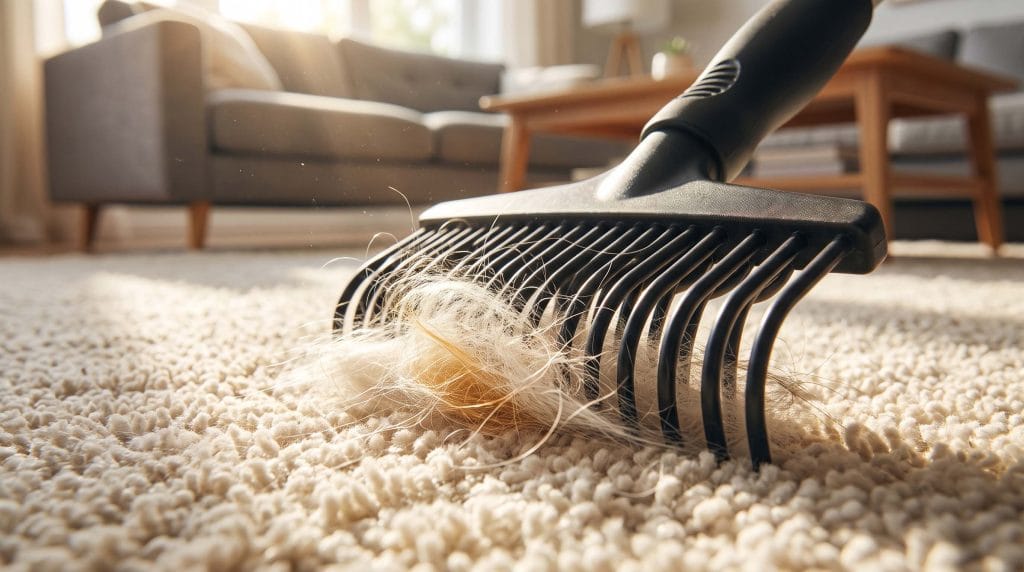
A rubber-bristled carpet rake is the single most effective tool for the best way to remove embedded dog hair from high pile carpet. The rubber bristles generate friction against synthetic carpet fibers, which does two things simultaneously: it breaks the static bond between hair and fiber, and the raking motion physically pulls entangled hair upward from the base of the pile toward the surface where the vacuum can reach it. Rubber rakes work better than metal rakes for this purpose because rubber generates more static-disrupting friction against synthetic fibers without risk of fiber damage.
Use short, firm strokes in one direction rather than long sweeping passes. Long passes push hair deeper into adjacent fiber sections. Short strokes bring hair upward and bunch it into visible surface clumps. Then vacuum. Then rake again in a perpendicular direction. Then vacuum again. That two-direction sequence reaches hair that single-direction raking misses.
Stiff-bristled carpet grooming brush.
For medium-depth embedding — hair that’s worked into the pile but hasn’t fully settled at the backing — a stiff-bristled brush with closely spaced bristles works faster than a rake. The bristles comb through the pile and collect hair on the brush surface rather than bunching it on the carpet. Shake or pull the collected hair off the brush between passes. This tool works best as the second pass after a rubber rake has already loosened deeply embedded material.
Squeegee with a rubber blade.
Pulled firmly across the carpet surface in short strokes, a standard rubber window squeegee generates enough friction to pull hair from medium pile depth. It works on the same static-disruption principle as the rubber rake. Less effective than a purpose-built carpet rake for deep pile, but a useful tool when a rake isn’t available and the pile height is under an inch.
Beater bar vacuum attachment — not suction only.
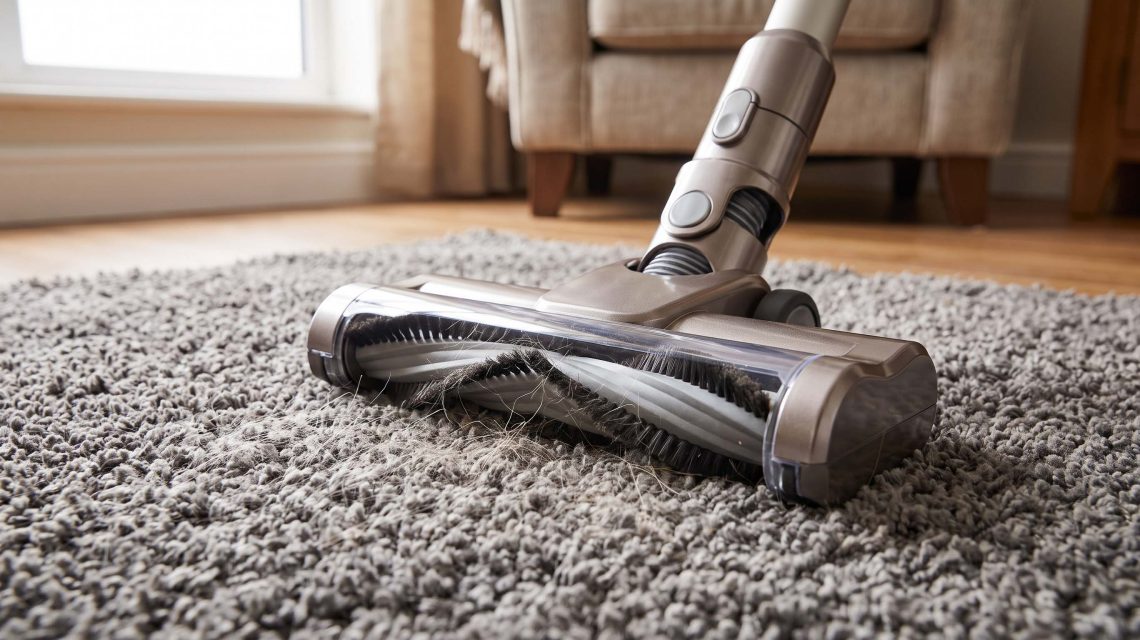
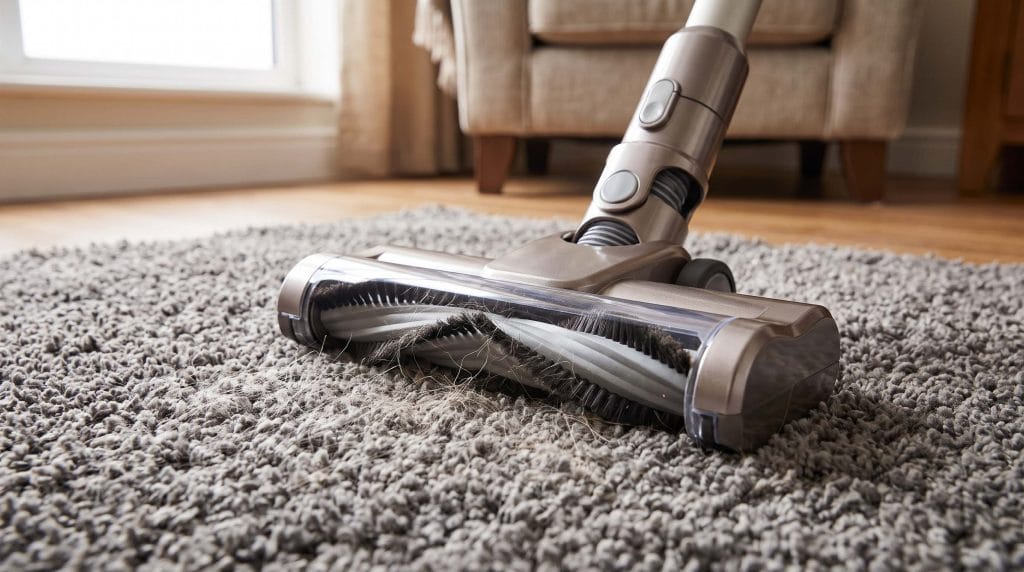
When it comes to vacuuming high pile carpet for embedded hair, the type of vacuum attachment matters enormously. A suction-only attachment pulls from above. A beater bar attachment — also called a rotating brush roll — physically agitates the carpet fibers while applying suction, which reaches hair at a significantly greater depth than suction alone. Use the beater bar on its highest pile setting to avoid fiber damage, and move at a slow, overlapping pace rather than quick passes.
What doesn’t work — and why.
Standard lint rollers are ineffective on high pile carpet because the adhesive surface can’t reach into the pile depth where embedded hair lives. Tape-based methods have the same limitation. Rubber gloves, effective on flat surfaces like fleece and upholstery, can’t reach deep pile either. These tools address surface hair only and don’t touch the embedded material that causes the persistent problem.
Best Way to Remove Embedded Dog Hair From High Pile Carpet — The Step-by-Step Process
The Exact Sequence That Pulls Hair From the Fiber Root Level
This is the complete process we recommend after extensive testing across multiple carpet types and shedding breeds. The best way to remove embedded dog hair from high pile carpet isn’t one tool used once — it’s a specific sequence that addresses different depths of embedding in the right order.
Stage 1 — Dry rubber rake pass, one direction.
Before any vacuuming, work the rubber carpet rake through the entire affected area in short, firm strokes running in one direction — let’s say north to south. Use enough pressure to reach the pile base but not so much that you’re dragging the carpet backing. This first pass breaks static bonds and brings deeply embedded hair up toward the surface, bunching it into visible clumps.
Stage 2 — Collect surface bunches by hand.
Pick up the clumps of hair that the raking has surfaced. Don’t vacuum at this stage — the clumps are large enough to potentially clog vacuum filters, and removing them by hand first protects your vacuum and makes the subsequent passes more effective.
Stage 3 — First vacuum pass with beater bar.
Run the vacuum slowly over the raked area using a beater bar attachment set to the appropriate pile height. Move in overlapping rows rather than random passes. This first vacuum pass removes the loosened hair at mid-pile depth that the raking surfaced but didn’t fully bring to the top.
Stage 4 — Perpendicular rubber rake pass.
Rake the area again in the perpendicular direction — east to west if the first pass was north to south. Dog hair that’s wrapped around carpet fibers in one orientation often releases from a different direction. This second raking direction is the step most guides skip, and it consistently brings up additional material that the first direction missed.
Stage 5 — Second vacuum pass.
Run the vacuum again in the same overlapping pattern. By this point, the carpet should be releasing significantly more hair than it did during the first vacuum pass. The combination of two-direction raking and two vacuum passes addresses hair from the surface down to the carpet backing level.
Stage 6 — Stiff brush finish pass.
For any remaining visible hair after stage 5, use a stiff-bristled grooming brush to comb through the pile in short strokes. This catches fine hair that the rake and vacuum combination loosened but didn’t fully remove.
Stage 7 — Final vacuum.
One last slow vacuum pass completes the process. By this stage, the carpet should look and feel notably cleaner than it did before stage 1. For very heavily embedded carpets — where hair has been accumulating for weeks or months — repeat the full sequence from stage 1.
Rachel’s Carpet — What Six Weeks of Accumulated Samoyed Hair Looks Like
Rachel owns two Samoyeds — Nordic double-coated dogs with some of the densest, finest undercoat fiber of any breed. Her living room had a deep-pile shag carpet that she’d been vacuuming weekly for six weeks without noticeably improving the embedded hair situation. By the time she contacted our team, she described the carpet as “white and cream from the carpet, impossible to tell which is which.”
We walked Rachel through the complete rubber rake and two-direction sequence described above. Her immediate reaction after the first rake pass: she collected enough hair from one four-foot section of carpet by hand to fill a small bowl — hair the vacuum had been running over weekly for six weeks without touching.
After completing the full seven-stage sequence on the living room floor, Rachel described the result as “unbelievable — it genuinely looks like a different carpet.” The pile had lifted, the carpet color was visible again, and the surface texture felt completely different underfoot.
The key insight from Rachel’s experience: her vacuum hadn’t been failing. It had been doing its job correctly on surface hair every week. The embedded hair was simply never in the vacuum’s effective range — it was anchored at the fiber base, completely below the level where suction could reach it. The rubber rake brought it into range. The vacuum then removed it.
Rachel now does the rubber rake pass before every vacuum session. Each session takes about four minutes longer than vacuuming alone. The hair accumulation that used to build invisibly over weeks now comes out consistently.
Tool Comparison — Best Way to Remove Embedded Dog Hair From High Pile Carpet
| Tool | Reach Depth in High Pile | Removes Static Bond | Safe for High Pile | Best Used |
|---|---|---|---|---|
| Rubber carpet rake | ✅✅✅ Deep | ✅ Yes | ✅ Yes | Primary — before every vacuum |
| Stiff grooming brush | ✅✅ Medium-Deep | ✅ Partial | ✅ Yes | Second pass after raking |
| Rubber squeegee | ✅✅ Medium | ✅ Yes | ✅ Yes | Alternative to rake on lower pile |
| Beater bar vacuum | ✅✅ Medium | ✅ Partial | ⚠️ Use correct pile height setting | Always over suction-only |
| Suction-only vacuum | ✅ Surface only | ❌ No | ✅ Yes | Surface hair only — not embedded |
| Lint roller | ❌ Surface only | ❌ No | ✅ Yes | Not effective for high pile |
| Rubber glove | ❌ Surface only | ✅ Partial | ✅ Yes | Upholstery — not deep pile |
| Metal carpet rake | ✅✅✅ Deep | ✅ Yes | ⚠️ Risk of fiber damage | Use rubber version instead |
🐾 The Pile Direction Reset — What Professional Carpet Cleaners Do After Pet Hair Removal
Here’s something our team learned from a conversation with a professional carpet restoration specialist who works regularly with pet-owning households — and we haven’t seen this documented anywhere in standard pet care or carpet care guides.
When dog hair embeds deeply into high pile carpet over weeks or months, the process of removing it — raking, brushing, heavy vacuuming — temporarily disrupts the carpet pile’s natural lay direction. Pile that’s been raked in multiple directions ends up standing irregularly, which makes the carpet look patchy and uneven even after the hair is gone. This disrupted pile also creates new low-resistance pathways where future hair embedding happens faster than in undisturbed carpet.
The professional fix is a pile reset pass — a single direction stroke with the rubber rake following the carpet’s natural pile lay, done as the very last step after all hair removal is complete. To find the natural pile direction, run your hand across the carpet in different directions. The direction that feels smooth and doesn’t create resistance is the natural lay. A single light rake pass in that direction resets the pile to its original position, restores the carpet’s uniform appearance, and closes up the fiber pathways that aggressive multi-direction raking opened up.
This adds about 90 seconds to the end of the session. Carpet that’s had a pile reset pass after hair removal consistently holds its appearance longer between cleanings than carpet that hasn’t — because the fibers are back in their natural interlocked position rather than standing open and ready to trap the next round of hair.
Preventing Embedded Dog Hair in High Pile Carpet — Long-Term Management
Honestly, the most sustainable approach to the best way to remove embedded dog hair from high pile carpet is reducing how deeply hair embeds between sessions. Two habits make the biggest difference.
Weekly rubber rake pass before vacuuming — every session.
Hair that’s been in carpet for three days is easier to remove than hair that’s been there for three weeks. Running the rubber rake before every vacuum session prevents hair from reaching the deeply anchored state that requires the full seven-stage removal process. This takes four extra minutes per session and eliminates the need for major embedded hair removal sessions.
Reduce shedding volume at the source.
The less hair your dog sheds, the less reaches your carpet. Regular professional deshedding treatments — a high-velocity blow-out bath at a grooming salon twice yearly — remove the cycling undercoat before it sheds into your home. Home brushing with the right tool for your breed’s coat type reduces ambient shedding significantly between professional sessions. Our complete shedding management guide covers the full year-round approach.
High Pile Carpet Dog Hair Removal — Complete Session Reference
Pre-vacuum preparation:
- Rubber rake pass — short firm strokes, north-to-south direction
- Collect surfaced hair clumps by hand
- Check rake bristles — clear any tangled hair between passes
Vacuum stage:
- Beater bar attachment — set to correct pile height
- Slow overlapping rows — not quick random passes
- Empty canister or replace bag at 50% full — suction drops significantly above that
Second direction pass:
- Rubber rake — perpendicular direction (east-to-west)
- Stiff grooming brush — short strokes through remaining visible hair
- Second vacuum pass — same slow overlapping pattern
Finishing:
- Final vacuum pass
- Pile reset pass — single light rake stroke in natural pile direction
- Check result — repeat full sequence for heavily embedded areas
Between sessions:
- Weekly rubber rake before every vacuum — prevents deep embedding
- Professional deshedding treatment for dog — twice yearly minimum
- Home brushing 2–3 times weekly during peak shedding season
FAQ — Best Way to Remove Embedded Dog Hair From High Pile Carpet
What is the best way to remove embedded dog hair from high pile carpet when vacuuming isn’t working?
The best way to remove embedded dog hair from high pile carpet when vacuuming alone fails is to use a rubber carpet rake before the vacuum runs. Embedded hair sits below the vacuum’s effective suction range, anchored at the carpet fiber base by mechanical entanglement and static charge. A rubber rake breaks both of these bonds, pulling hair upward into the pile where suction can reach it. The rubber rake pass — done in two perpendicular directions before each vacuum session — is the intervention that makes vacuuming effective on deeply embedded material.
Why does dog hair embed so deeply in high pile carpet specifically?
High pile carpet’s long, loosely packed fibers create vertical channels that guide dog hair downward by gravity and foot traffic pressure. Once hair reaches the pile base, it entangles mechanically around individual fibers and bonds electrostatically to synthetic carpet materials. Low pile carpet limits how far hair can travel before being caught near the surface. High pile gives hair much more travel distance, which is why the same dog produces dramatically more embedded hair in high pile versus low pile carpet in the same home.
Does the type of vacuum matter for removing embedded dog hair from high pile carpet?
Yes — significantly. A vacuum with a beater bar or rotating brush roll physically agitates carpet fibers during suction, reaching hair at greater depth than suction-only models. For high pile carpet specifically, the beater bar setting matters: too low damages fibers, too high reduces contact. Most vacuums with adjustable pile height settings work best at the highest setting for deep pile carpet with pet hair. But even the best vacuum underperforms without a rubber rake pre-treatment on embedded hair.
How often should I remove embedded dog hair from high pile carpet?
A rubber rake pass followed by vacuuming once weekly prevents hair from reaching the deeply embedded state that requires extended removal sessions. Dogs that shed heavily — Huskies, Samoyeds, German Shepherds, Golden Retrievers — may need twice-weekly treatment during peak coat blow seasons in spring and late winter. Letting embedded hair accumulate for more than two weeks significantly increases removal difficulty and time.
Can I damage high pile carpet by raking too aggressively?
Yes — metal rakes used with heavy pressure can pull and damage carpet fibers, particularly in loop pile and frieze carpet. Rubber rakes used with firm but controlled pressure are safe for high pile carpet because the rubber bristles flex rather than catch and pull individual fibers. Always use the rubber rake with short strokes rather than aggressive long drags, and avoid raking the same section more than three times in a single direction without checking the pile for distortion.
The Honest Bottom Line on the Best Way to Remove Embedded Dog Hair From High Pile Carpet
The best way to remove embedded dog hair from high pile carpet comes down to one principle: break the bond before you vacuum. The rubber rake is the tool. The two-direction sequence is the method. The pile reset is the finishing step that most people never know about.
Rake north-to-south. Collect the surfaced clumps. Vacuum with a beater bar. Rake east-to-west. Brush the fine remaining hair. Vacuum again. Reset the pile direction. That complete sequence handles everything from recently shed surface hair to material that’s been locked at the fiber base for weeks.
Rachel’s carpet looks like a carpet again. Yours can too — and with a weekly pre-vacuum rake pass, it can stay that way without another major embedded-hair removal session.
Ready to address the shedding source alongside the carpet problem? Our guides on stopping Husky shedding, German Shepherd coat management, Golden Retriever grooming, Labrador shedding, and Corgi care — plus our complete dog hair management guide — show you how to reduce the volume of hair reaching your carpet before it ever has a chance to embed. 🐾
This article reflects our team’s hands-on testing and research across multiple carpet types and shedding breeds. For carpet damage or fiber concerns beyond pet hair, consult a professional carpet restoration specialist.
