

 Animal Zoid Editorial Team
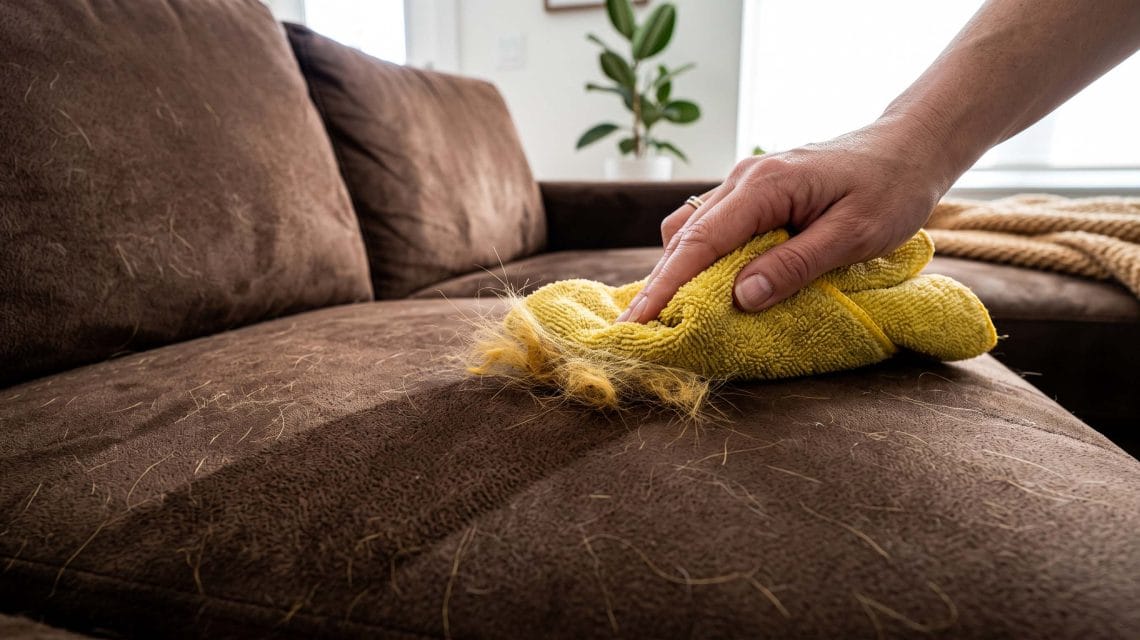
 Microsuede couches are marketed as pet-friendly — and in some ways that’s true. But if you’ve been trying to figure out how to get dog hair out of micro suede couches and finding that the hair seems to disappear into the fabric rather than sitting on it, you’ve already discovered the catch. Microsuede’s ultra-fine fiber structure is excellent at repelling liquid spills, but that same structure grabs and holds dog hair with a grip that surprises most owners. The hair doesn’t just lie on the surface — it weaves between the microfibers and anchors there, creating a layer that brushing, vacuuming, and lint rolling often fail to address completely.
This guide covers the exact mechanics of why how to get dog hair out of micro suede couches is harder than it looks, which tools interact with microfiber at the right level, the specific cleaning sequence that clears embedded hair without damaging the fabric, and the maintenance habits that prevent the problem from returning to square one within a week.
⚡ Quick Answer
How to get dog hair out of micro suede couches:
Use a dry rubber pet hair brush in short, firm strokes against the microsuede’s natural nap direction to loosen embedded hair from the microfiber structure. Collect surfaced hair by hand, then vacuum with a soft upholstery brush attachment in the nap direction. Finish with a barely damp rubber glove pass for fine residual hair. Never use tape-based lint rollers repeatedly — adhesive residue builds up in microfiber and makes future hair removal progressively harder.
Dog hair management extends across every surface in your home. If your couch problem connects to a broader shedding challenge, our guides on how to stop dog hair from sticking to leather couch, does velvet fabric attract dog hair or repel it, and how to remove short dog hair from woven fabric seats cover different upholstery types in detail. For carpet, our best way to remove embedded dog hair from high pile carpet guide handles deep pile specifically. Our complete dog shedding management guide and breed-specific resources for Huskies, German Shepherds, Golden Retrievers, Labradors, and Corgis tackle the shedding volume at its source.
How to Get Dog Hair Out of Micro Suede Couches — Understanding Why Microsuede Is Different
What Microsuede’s Fiber Structure Does to Dog Hair
Before choosing a tool or technique, understanding exactly what’s happening at the fabric level is what separates people who successfully figure out how to get dog hair out of micro suede couches from people who keep cleaning the same couch without real results.
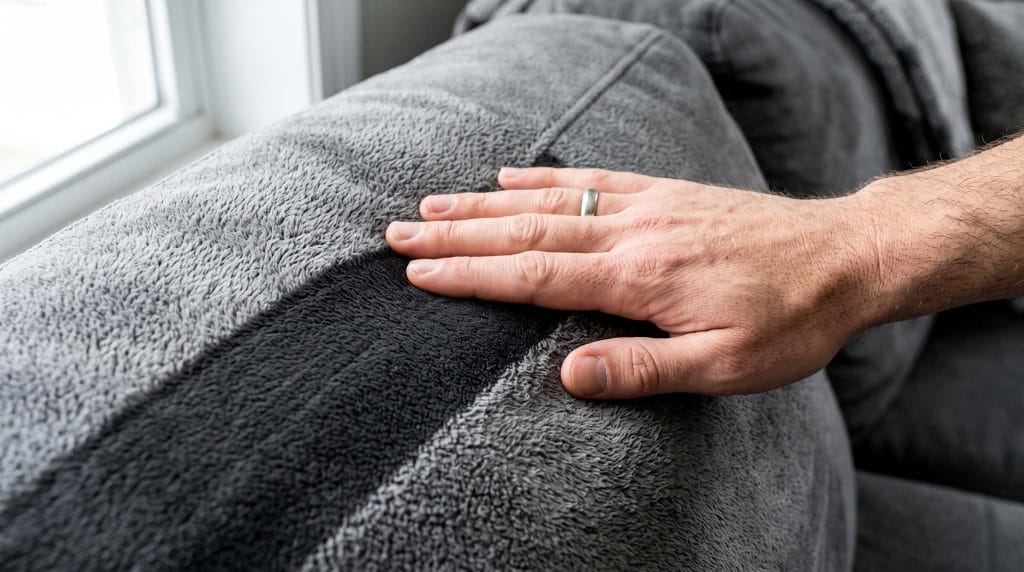
Microsuede — also called microfiber suede or faux suede — is made from polyester microfibers that are split during manufacturing into fibers measuring roughly one-hundredth the diameter of a human hair. These ultra-fine fibers are then woven into a fabric with a short, soft nap that mimics the texture of genuine suede leather. The resulting surface feels smooth in one direction and slightly resistant in the other — that’s the nap direction at work.
Here’s the problem for dog owners. Those ultra-fine split microfibers create a surface with an enormous amount of fiber surface area per square inch — far more than standard upholstery fabric. Dog hair, particularly fine undercoat fibers from double-coated breeds, slides between the microfibers and makes contact with many individual fiber surfaces simultaneously. Each contact point creates a small amount of mechanical grip. Add the static charge that polyester microfiber builds through friction — a dog sitting, shifting, and standing creates significant repeated friction — and each hair ends up anchored by dozens of tiny grip points rather than one or two.
This multi-point anchoring is why surface cleaning methods fail. A lint roller’s adhesive contacts the top of the hair but can’t overcome the dozens of lower contact points. A vacuum’s suction pulls at the exposed portion of the hair but can’t dislodge the embedded base. The cleaning approach that works for getting dog hair out of micro suede couches must disrupt the multi-point anchor rather than just pulling from the top.
There’s one more factor worth understanding. Microsuede has a defined nap direction — the direction in which the fiber tips naturally lie. Cleaning against the nap raises the fiber tips and temporarily increases the surface area available for hair contact, which sounds counterproductive. But this raised-nap state is actually the moment when hair releases most easily, because the grip points are disrupted from their set position. Cleaning with the nap immediately after then collects the released hair efficiently. This two-direction sequence — against nap to loosen, with nap to collect — is the mechanical basis of every effective technique for how to get dog hair out of micro suede couches.
How to Get Dog Hair Out of Micro Suede Couches — The Right Tools for Microfiber
Why Standard Pet Hair Tools Underperform on Microsuede
Most tools that work well on velvet, leather, or woven fabric don’t perform optimally on microsuede — and understanding why helps you choose the right approach for getting dog hair out of micro suede couches rather than cycling through products that produce marginal results.
Dry rubber pet hair brush — the primary tool.
A rubber-bristled pet hair brush works on microsuede for the same fundamental reason it works on fleece and velvet — rubber generates friction that disrupts the static bond between hair and fiber while physically lifting hair from its anchored position. For microsuede specifically, the brush bristle firmness matters: medium-firm rubber bristles reach between microfiber tips to disrupt the multi-point anchor without flattening the nap permanently. Very soft rubber bristles skim the surface without reaching the fiber depth where hair is anchored. Very stiff bristles can stress microfiber weave structure over repeated use.
Dry microfiber cloth — underused and highly effective.
A clean, dry microfiber cloth rubbed across microsuede in short strokes against the nap direction creates fiber-to-fiber friction that’s remarkably effective at loosening and collecting dog hair. This works because dry microfiber-to-microfiber contact generates strong static attraction between the cloth and the hair. The cloth surface collects hair as it dislodges it — rather than spreading it the way a bare hand does. Shake the cloth out frequently between passes to prevent redeposition.
Vacuum with soft upholstery attachment.
After the rubber brush or dry cloth pass, a vacuum with a soft upholstery brush attachment extracts loosened hair efficiently from the microsuede surface. Use low to medium suction — high suction on microsuede can flatten the nap or, over time, stress the fiber bond at the surface. Slow strokes in the nap direction following the rubber brush pass produce the best results.
Barely damp rubber glove — finish pass only.
For fine residual hair after brushing and vacuuming, a barely damp rubber dish glove in one-directional strokes with the nap direction picks up what the other tools miss. The slight tackiness of damp rubber against microfiber creates contact adhesion for fine hairs without introducing enough moisture to watermark the fabric. Immediately buff the treated area with a dry cloth after the glove pass to ensure no moisture sits on the microsuede surface.
What to avoid on microsuede.
Tape-based lint rollers leave adhesive residue that accumulates in microfiber over repeated use — each application leaves a thin film that progressively increases the fabric’s hair-trapping capacity. Stiff-bristled brushes stress microfiber bonds and alter nap texture over time. Wet cloths used for hair removal cause microsuede to watermark and can compact dog hair into the fiber structure rather than removing it. Compressed air drives fine hair deeper into the microfiber rather than extracting it.
How to Get Dog Hair Out of Micro Suede Couches — The Step-by-Step Cleaning Sequence
From Embedded Hair to Clean Microsuede — the Complete Process
This is the full cleaning sequence for getting dog hair out of micro suede couches — structured to address multi-point anchored hair at microfiber depth before attempting surface extraction.
Step 1 — Find the nap direction.
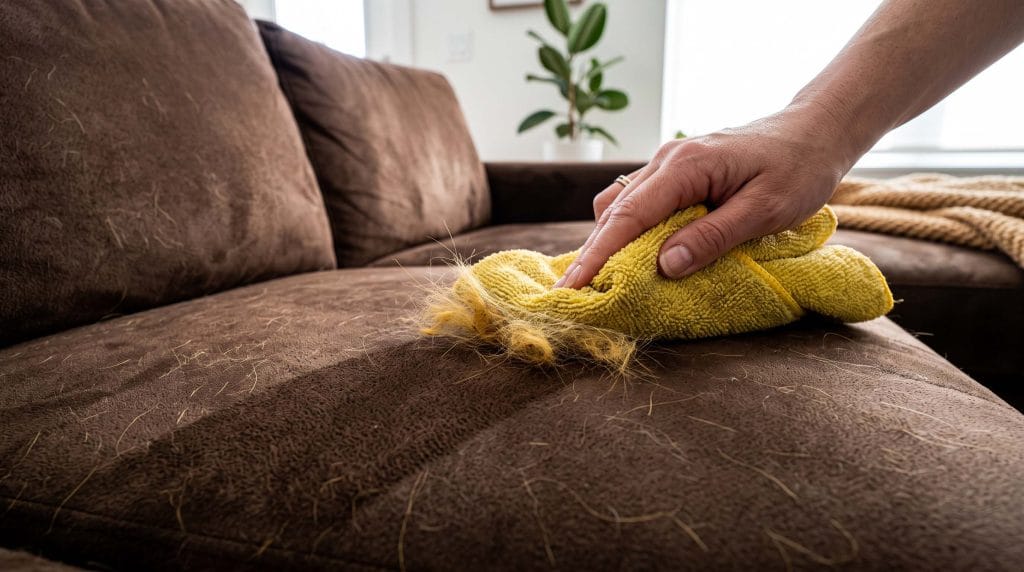
Run your hand across the microsuede in two opposite directions. One direction will feel smooth — that’s with the nap. The opposite direction will feel slightly resistant — that’s against the nap. Mark which direction is against the nap on your first cleaning so you don’t have to find it again. Your rubber brush primary strokes go against the nap. Your collection and vacuum strokes go with the nap.
Step 2 — Dry rubber brush — against the nap, short firm strokes.
Work in one-foot sections. Use short, firm strokes against the nap direction — enough pressure to engage the brush tips with the microfiber surface rather than skimming above it. This pass disrupts the multi-point anchor and brings embedded hair up toward the surface. You’ll see hair bunching at the end of each stroke.
Step 3 — Collect surfaced hair by hand.
After each section’s brush pass, collect the bunched hair by hand and dispose of it before moving to the next section. This prevents loosened hair from redepositing on adjacent cleaned areas during subsequent passes.
Step 4 — Dry microfiber cloth pass — against the nap.
Run a clean dry microfiber cloth across the same section in short against-nap strokes. The microfiber cloth collects fine hair that the rubber brush loosened but didn’t fully surface. Shake the cloth out after every two or three passes.
Step 5 — Vacuum — with the nap direction.
Run the vacuum with a soft upholstery brush attachment in slow, overlapping strokes in the nap direction. This pass extracts loosened hair from the microsuede surface. Medium suction, slow speed, full coverage of the section before moving on.
Step 6 — Nap direction check and reset.
After vacuuming each section, run your hand across the microsuede in the nap direction. The surface should feel uniformly smooth. Any areas that feel rough or resistant indicate displaced nap — use a clean dry cloth in a light with-nap stroke to reset those areas before the final pass.
Step 7 — Damp rubber glove finish pass.
Where fine hair remains visible, use a barely damp rubber glove in one-directional with-nap strokes. Follow immediately with a dry cloth buff to remove any moisture.
Step 8 — Full nap reset pass.
Finish the entire couch with a single light pass of a clean dry cloth in the nap direction across all sections. This resets the nap uniformly and leaves the microsuede looking consistently smooth rather than showing different cleaning directions in different areas.
Maria’s Microsuede Sectional — What a Golden Retriever Does in Six Weeks
Maria owns a four-year-old Golden Retriever named Honey. Golden Retrievers produce a dense double coat with fine, tapered undercoat fibers that are exactly the right size and stiffness to anchor in microsuede’s ultra-fine fiber structure. Honey’s primary sleeping location was the left end of Maria’s large gray microsuede sectional.
After six weeks without targeted treatment, Maria described the left section as “a different color from the rest — it looks darker because the hair is so dense.” She’d been using a lint roller twice a week, which removed surface hair but left embedded layers completely untouched.
When Maria contacted our team, we walked her through the rubber brush and dry microfiber cloth two-direction sequence. Her reaction after the first against-nap rubber brush pass on a single cushion: “The amount of hair that came off is genuinely disturbing. I’ve been lint-rolling this cushion twice a week and none of this was coming up.”
After completing the full eight-step sequence on the left section — approximately 40 minutes for the heavily accumulated area — the color matched the rest of the sectional. The microsuede texture, which had felt slightly stiff from embedded hair, returned to its original soft, uniform feel.
Maria now maintains the sectional with a twice-weekly rubber brush and vacuum session that takes about 12 minutes. Honey still uses the same cushion. The lint rollers went in the recycling.
Her experience illustrates exactly why understanding the multi-point anchor mechanism changes outcomes. The lint roller was addressing the top 10% of the problem. The rubber brush and microfiber cloth sequence reached the other 90%.
🐾 The Nap Direction Memory Trick — What Furniture Upholstery Specialists Do First
Here’s something professional upholstery cleaning specialists do before touching microsuede furniture — and it’s a step that makes every subsequent cleaning session faster and more effective.
On the first cleaning session, after identifying the nap direction, use a small piece of masking tape on the underside of one cushion with an arrow marking the nap direction. Something like “→ NAP” takes five seconds to write. From that point forward, every cleaning session starts with certainty about direction rather than the 30-second finding process.
But here’s the part that actually changes results: once you know the exact nap direction, you can also identify the “grain zones” — areas where the nap direction subtly shifts due to the way the fabric was cut and sewn around cushion corners and seams. Most microsuede cushions have one or two spots, typically near a corner fold or a seam run, where the nap runs at a slight angle to the rest of the surface. Cleaning these zones in the same direction as the majority of the surface produces inconsistent results — those spots never quite look clean.
Run your hand very slowly around the edges and corners of each cushion, feeling for direction changes. Mark those with a second tape note on the underside if needed. Then clean those zones in their local nap direction rather than the dominant cushion direction.
This level of detail is what separates a microsuede couch that always looks slightly “off” in certain spots after cleaning from one that looks uniformly clean across every section. Professional upholstery specialists apply this approach on every microsuede job. It adds two minutes per cushion on the first session and zero additional time on every session after that.
Cleaning Method Comparison — How to Get Dog Hair Out of Micro Suede Couches
| Method | Reaches Microfiber Depth | Removes Multi-Point Anchored Hair | Safe for Microsuede | Frequency |
|---|---|---|---|---|
| Dry rubber brush — against nap | ✅✅✅ Yes | ✅✅✅ Very High | ✅ Yes — medium-firm only | Primary tool every session |
| Dry microfiber cloth — against nap | ✅✅ Yes | ✅✅ High | ✅ Yes | After rubber brush pass |
| Vacuum — soft upholstery brush | ✅✅ Partial | ✅✅ High | ✅ Yes — low-medium suction | After cloth pass |
| Barely damp rubber glove | ✅ Surface-fiber level | ✅✅ High for fine hair | ✅ Yes — dry immediately | Finish pass only |
| Tape lint roller | ❌ Surface only | ✅ Low | ⚠️ Adhesive buildup over time | Avoid repeated use |
| Stiff bristle brush | ✅✅ Yes | ✅✅ Moderate | ⚠️ Risk of nap damage | Use rubber version instead |
| High suction vacuum alone | ❌ Surface only | ✅ Low-Moderate | ⚠️ Can flatten nap long-term | Not effective alone |
| Wet cloth — hair removal | ❌ Compacts hair | ❌ Counterproductive | ⚠️ Watermark risk | Never for hair removal |
| Compressed air | ❌ Drives hair deeper | ❌ Negative | ✅ No physical damage | Never |
How to Get Dog Hair Out of Micro Suede Couches — Preventing Buildup Between Sessions
The Maintenance Habits That Keep Microsuede Manageable
Getting ahead of the problem is always more efficient than addressing it after buildup. These are the prevention approaches that make how to get dog hair out of micro suede couches a quick routine rather than a 40-minute restoration project.
Washable couch covers on high-use spots.
A tightly woven cotton or microfiber washable cover placed over your dog’s preferred cushion protects the microsuede surface from direct hair contact. The cover absorbs the hair and the static charge builds on the cover rather than the microsuede. Weekly washing keeps the cover clear and the microsuede underneath in its original condition. Choose a cover with enough surface coverage to include the seat back to the height your dog’s back reaches when seated.
Twice-weekly rubber brush maintenance pass.
A rubber brush pass and quick vacuum on the dog’s primary cushion twice weekly — before hair has accumulated to the multi-point anchored depth — takes about six minutes and prevents the dense embedded buildup that requires the full eight-step sequence. Hair that’s been in microsuede for three days releases significantly more easily than hair that’s been there for three weeks.
Anti-static spray between conditioning sessions.
A light anti-static wipe applied to a cloth and run across the microsuede surface every few days reduces the static charge that contributes to hair bonding. This doesn’t prevent hair from landing but reduces how strongly it bonds — making each cleaning session faster and more complete. Apply after the cleaning session to protect the freshly cleaned surface.
Regular dog brushing — the source reduction approach.
Every piece of loose hair you remove from your dog through brushing is hair that never reaches your microsuede couch. Dogs brushed consistently three times weekly during peak shedding season deposit dramatically less hair on every surface in the home than dogs brushed infrequently. Our guides for Huskies, Golden Retrievers, and German Shepherds cover the specific deshedding tools and routines that reduce ambient shedding most effectively for high-shedding breeds.
Microsuede Dog Hair — Your Weekly Maintenance Reference
Every session (twice weekly for heavy shedders):
- Identify nap direction — or use your tape marker from first session
- Rubber brush — short firm strokes against nap, one-foot sections
- Collect surfaced hair by hand between sections
- Dry microfiber cloth — against nap, shake out frequently
- Vacuum — soft upholstery brush, with nap, slow overlapping passes
- Nap direction check — reset any displaced areas with dry cloth
- Damp rubber glove finish on any remaining fine hair sections
- Full nap reset pass — clean dry cloth, with nap, entire surface
Weekly:
- Wash seat cover if using one
- Anti-static cloth wipe across all microsuede surfaces
- Check seam and cushion edge areas — collect any accumulated hair
Monthly:
- Full eight-step deep clean on all cushions — including low-use areas
- Check nap condition in corner zones — confirm nap direction markers still accurate
- Inspect microsuede surface for any developing pile distortion or nap irregularity
FAQ — How to Get Dog Hair Out of Micro Suede Couches
Why doesn’t a lint roller work well for getting dog hair out of micro suede couches?
Lint rollers address only the portion of dog hair that sits above the microsuede surface — typically a small fraction of the total hair present after regular pet use. Dog hair in microsuede is anchored by multiple contact points between the hair shaft and the ultra-fine microfibers surrounding it. The lint roller’s adhesive contacts the top of the hair but can’t overcome the multi-point anchor holding the base in place. Repeated lint rolling also leaves adhesive residue in the microfiber structure that progressively increases the fabric’s hair-trapping capacity — making future removal harder with each application.
Can I use water to help remove dog hair from micro suede couches?
No — and this is one of the most common mistakes we see. Wet or even moderately damp contact during hair removal causes dog hair to clump against the microfiber surface and compact into a mat that’s significantly harder to remove than dry embedded hair. Moisture also risks watermarking microsuede, particularly on lighter colors. The only moisture-contact tool appropriate for getting dog hair out of micro suede couches is a barely damp rubber glove used as a finish pass — and even that requires immediate dry buffing afterward.
Does the nap direction really matter when cleaning microsuede?
Yes — significantly. Cleaning against the nap direction disrupts the microfiber tips and breaks the grip holding embedded hair in place. Cleaning with the nap direction after the against-nap pass collects the loosened hair efficiently and resets the fiber tips to their natural position. Cleaning exclusively in one direction — particularly if it’s the wrong direction for your specific cleaning tool — either leaves hair behind or leaves the nap disrupted, which makes the surface look inconsistently cleaned even when hair has been removed.
How often should I clean dog hair from a micro suede couch that my dog uses daily?
For dogs that use the couch daily — particularly heavy-shedding breeds like Golden Retrievers, Huskies, or German Shepherds — a rubber brush pass and vacuum twice weekly prevents hair from reaching the multi-point anchored depth that requires extended cleaning sessions. For moderate shedders with daily couch access, once weekly is sufficient. The twice-weekly maintenance routine takes about 12 minutes once you know the process. The alternative — monthly deep cleans from accumulated embedded hair — takes 40 minutes or more per session.
Is microsuede actually pet-friendly if it traps dog hair this aggressively?
Microsuede is pet-friendly in the ways it’s marketed — it repels liquid spills effectively, resists surface scratching better than natural suede, and is more durable than many fabric alternatives. The dog hair challenge is real but manageable with the right tools and routine. Compared to fleece, high pile carpet, or velvet, microsuede is actually easier to maintain long-term because the hair doesn’t embed as deeply and the nap direction gives you a mechanical advantage during cleaning. The mistake most owners make is using the wrong tools — primarily lint rollers — which don’t address the actual anchoring mechanism.
The Honest Bottom Line on How to Get Dog Hair Out of Micro Suede Couches
How to get dog hair out of micro suede couches works consistently once you understand that you’re dealing with a multi-point anchor system rather than surface contact. The rubber brush against the nap breaks that anchor. The dry microfiber cloth collects what the brush loosens. The vacuum extracts what the cloth surfaces. The damp rubber glove finishes what the vacuum misses. The nap reset pass makes everything look uniform.
Honey’s gray sectional matches across all sections again. Maria’s lint rollers are retired. The twice-weekly 12-minute maintenance session replaced the 40-minute restoration — and it’s been staying that way.
Microsuede is manageable with the right approach. The couch doesn’t have to be a write-off just because your dog claimed it.
Want to address the shedding problem at the source? Our guides on stopping Husky shedding, German Shepherd coat management, Golden Retriever grooming, Labrador shedding, and Corgi care — combined with our complete dog hair management guide — give you the full year-round strategy that reduces how much hair reaches every surface in your home. 🐾
This article reflects our team’s hands-on research and testing across multiple microsuede fabric types and shedding breeds. For microsuede damage, significant nap distortion, or stain concerns beyond pet hair, consult a professional upholstery cleaning specialist.
