

 Animal Zoid Editorial Team
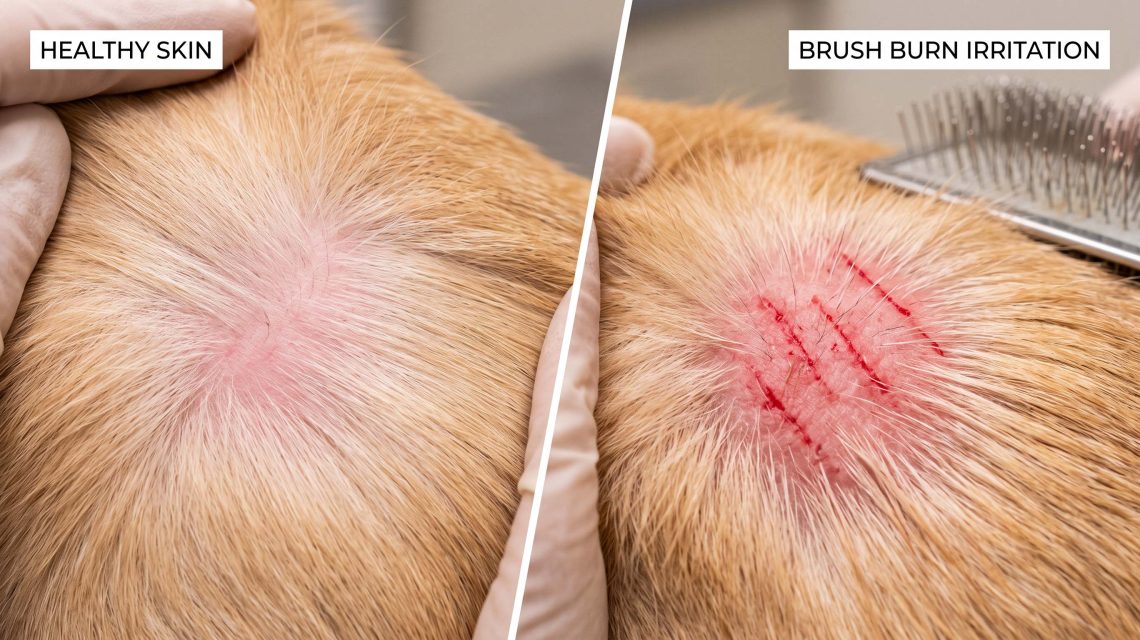
 Your dog’s skin looks pink after a deshedding bath primarily because warm water and mechanical brushing increase capillary blood flow near the surface of the dermis, a harmless biological process called vasodilation. If you find yourself asking why does my dog’s skin look pink after a deshedding bath, mild pinkness that fades within 30 to 60 minutes is completely normal, while bright red, hot, or sensitive skin points to mechanical brush burn, product irritation, or excessive dryer heat.
⚡ Quick Answer
A dog’s skin turns pink after a deshedding bath due to three main factors: temporary capillary dilation from warm water and massage, mild mechanical friction from deshedding tools, or chemical sensitivity to concentrated shampoo surfactants. If the pink tint is uniform, cool to the touch, and disappears within an hour without your dog scratching, it is simple vascular flushing. If the skin is localized in bright red patches, feels hot, or causes discomfort, your dog is likely experiencing brush burn from over-grooming or contact dermatitis from poorly diluted shampoo.
+-----------------------------------------------------------------------------------+
|               POST-BATH DERMAL RESPONSE CLASSIFICATION MATRIX                     |
|                                                                                   |
|  Mild Rosy Flush    | [NORMAL VASODILATION]  Resolves in 30–60 mins; no itch      |
|  Localized Redness  | [MECHANICAL FRICTION]  Brush burn; tender on touch          |
|  Mottled Rash/Bumps | [CONTACT DERMATITIS]   Surfactant reaction; intense itch    |
|  Flaking/Dry Skin   | [LIPID STRIPPING]      Over-washed; needs barrier repair    |
+-----------------------------------------------------------------------------------+
Seeing your dog’s skin suddenly turn a vivid shade of pink through a newly thinned-out coat can be alarming. When you strip away pounds of dead undercoat during a deep bath, you expose skin that has spent months shielded from direct light, air, and mechanical touch.
We have handled this exact scenario with dozens of anxious pet parents across every coat type imaginable. In this detailed guide, we will unpack the physiological mechanics of canine skin, the difference between healthy blood flow and painful dermal damage, and the exact steps you can take to soothe your dog’s skin right away.
The Core Reasons Why Does My Dog’s Skin Look Pink After a Deshedding Bath
To truly understand why does my dog’s skin look pink after a deshedding bath, we need to examine what happens to the canine epidermis during a vigorous grooming session. Canine skin is remarkably delicate. It is only 3 to 5 cell layers thick, compared to human skin which is 10 to 15 layers thick.
[Dense Undercoat Traps Dead Fur]
               │
               ▼  + [Warm Water & Surfactant Lather]
[Follicles Open & Capillaries Dilate (Vasodilation)]
               │
               ▼  + [Tool Friction & High Velocity Air]
[Dermal Blood Flow Surges: Skin Appears Pink / Rosy]
1. Physiological Vasodilation and Increased Circulation
When warm water hits your dog’s coat, the peripheral blood vessels in the dermis naturally expand to regulate body temperature. As you massage shampoo into the coat, that manual stimulation further accelerates local micro-circulation.
This brings oxygenated red blood cells rushing into the surface capillary beds. Because you just removed a dense layer of insulating undercoat, this natural rosy flush becomes immediately visible against the pale skin underneath.
The temperature of the bath water plays a substantial role here. If you want to understand how wash temperatures alter shedding and circulation, our research on does warm water make a dog shed more during a bath breaks down the exact thermal thresholds to use.
2. Physical Exposure of Pale, Unpigmented Skin
Dogs with light-colored or white coats (such as Samoyeds, Yellow Labs, Boxers with white markings, or Bull Terriers) naturally have unpigmented, translucent skin. When their thick, opaque undercoat is blown out or raked away, light hits the dermis directly for the first time in months.
The skin looks significantly pinker simply because the protective white or cream undercoat is no longer there to diffuse the light.
+------------------------------------------------------------------------------+
|                    UNDERCOAT REMOVAL & VISUAL CONTRAST                       |
|                                                                              |
|   BEFORE BATH:                                                               |
|   [Dense Undercoat Layer] ──► Blocks Light ──► Skin Looks Pale/Hidden        |
|                                                                              |
|   AFTER DESHEDDING:                                                          |
|   [Undercoat Stripped]    ──► Direct Light ──► Capillary Network Visible     |
+------------------------------------------------------------------------------+
3. Disruption of the Stratum Corneum Lipid Barrier
Canine skin is protected by a thin layer of natural sebum and fatty acids called the stratum corneum. Deshedding shampoos are formulated with heavy surfactants designed to dissolve oily sebum so that trapped, dead hairs can slip free from the follicle pocket.
If the shampoo is too strong, it does not just release the hair; it temporarily strips away that protective lipid film. Without its natural oil shield, the upper dermis experiences mild surface dehydration and environmental exposure, leading to temporary pinkness and mild sensitivity.
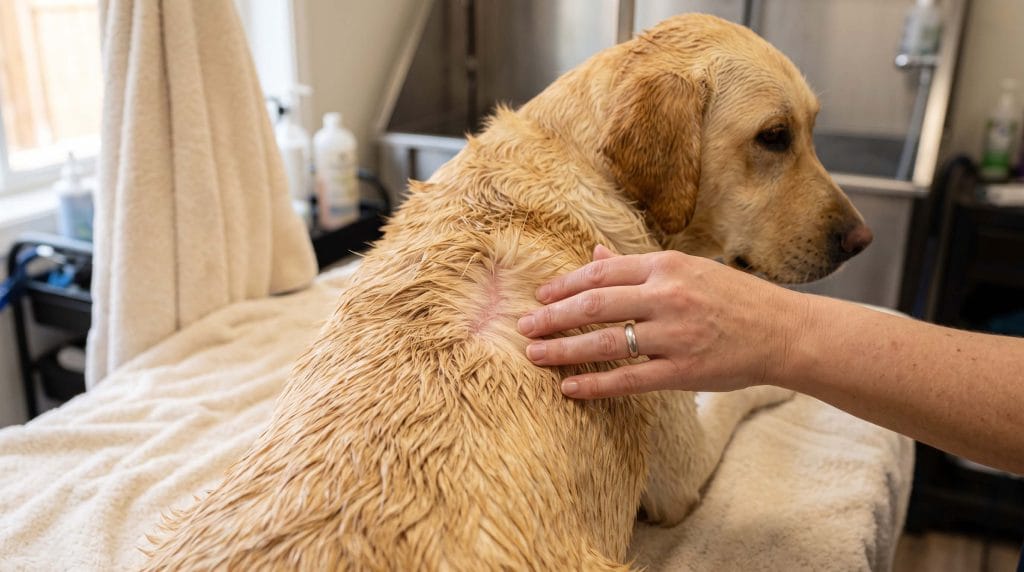
Normal Flushing vs. Brush Burn: Why Does My Dog’s Skin Look Pink After a Deshedding Bath?
It is essential to distinguish between benign vascular flushing and true mechanical injury. Knowing the visual and behavioral symptoms helps you decide whether your dog simply needs an hour of rest or active soothing care.
+----------------------------------------------------------------------------+
|                   DIAGNOSTIC SYMPTOM EVALUATION                            |
|                                                                            |
|  BENIGN FLUSHING:                                                          |
|  • Uniform, light pink tint across large body areas                        |
|  • Skin feels normal in temperature                                        |
|  • Dog is calm, relaxed, and not scratching                                |
|  • Fades completely within 45 to 60 minutes                                |
|                                                                            |
|  MECHANICAL BRUSH BURN:                                                    |
|  • Streaky, blotchy, bright red lines or patches                           |
|  • Skin radiates noticeable heat on contact                                |
|  • Dog licks, bites, shakes, or flinches when touched                      |
|  • Persists for 24 to 72 hours without intervention                        |
+----------------------------------------------------------------------------+
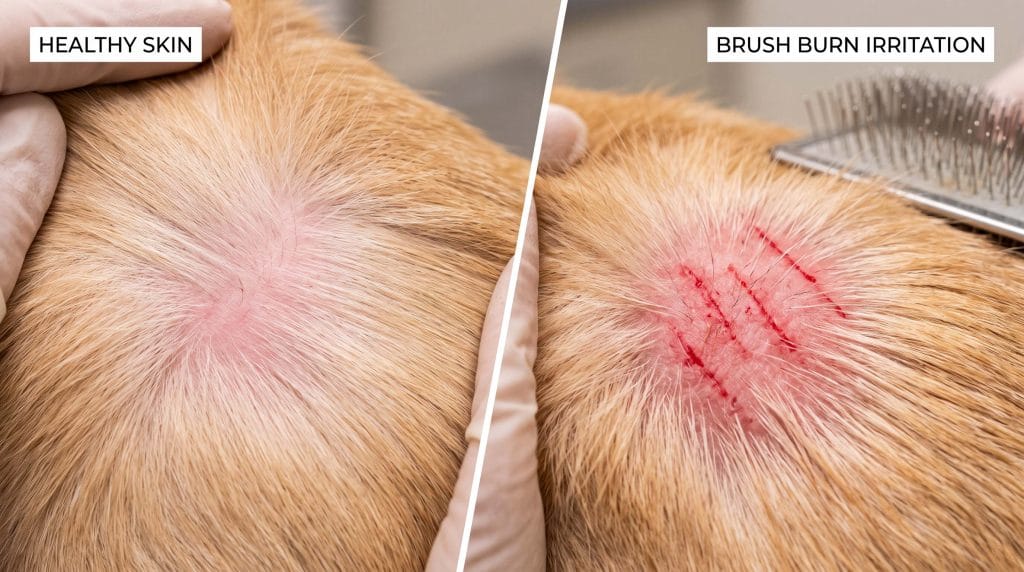
Identifying Mechanical Brush Burn (Epidermal Micro-Abrasions)
Brush burn occurs when rigid grooming tools—such as fine wire slicker brushes, metal undercoat rakes, or bladed deshedding tools—are scraped repeatedly over the same patch of skin with excessive downward pressure.
Because wet skin is soft and hydrated, metal teeth can easily shear off microscopic layers of living epidermal cells. This causes acute inflammatory erythema, resulting in jagged red lines, hot spots, and intense itching.
If you are bathing a short-coated breed, choosing the best bath brush for short-haired dogs that shed a lot will protect against this risk by swapping sharp wire pins for flexible, blunt rubber nubs.
Identifying Chemical Contact Dermatitis
If the pinkness looks mottled, resembles raised hives, or is accompanied by tiny red bumps (papules), your dog may be reacting to an ingredient in the shampoo or fragrance oils. Chemical irritation occurs most often when professional-grade concentrates are applied directly to the skin without being diluted first.
Learning how to safely dilute professional dog deshedding shampoo prevents this issue entirely by ensuring the surfactant concentration remains gentle on the skin barrier.
How Mechanical Tools Affect Why Does My Dog’s Skin Look Pink After a Deshedding Bath
The specific grooming implements you use before, during, and after the bath directly influence how your dog’s skin responds.
+--------------------------------------------------------------------------+
|                  TOOL IMPACT ON DERMAL MICRO-CIRCULATION                 |
|                                                                          |
|  1. Metal Deshedding Blades (Loop Rakes / Edge Blades)                   |
|     • Risk Level: High                                                   |
|     • Impact: Micro-scrapes epidermal ridges if held at wrong angle      |
|                                                                          |
|  2. High-Velocity Air Nozzles (Cone / Concentrator Tips)                 |
|     • Risk Level: Moderate                                               |
|     • Impact: Causes mechanical wind-shearing and convective cooling     |
|                                                                          |
|  3. Rubber Curry Brushes & Silicone Palms                                |
|     • Risk Level: Very Low                                               |
|     • Impact: Delivers safe massage that stimulates benign blood flow    |
+--------------------------------------------------------------------------+
Blade Angle and Repetitive Stroking
Metal deshedding blades feature micro-teeth designed to hook dead hair shafts. When held at an incorrect angle (perpendicular rather than flush to the coat), those metal edges scrape the skin like a razor.
Grooming the same area more than three or four times in a single session rapidly strips away living skin cells. This is particularly common on bony anatomical landmarks where skin sits tightly over bone, such as:
- The spine and shoulder blades
- The hip joints and pin bones
- The hocks and elbows
- The throat and base of the neck
High-Velocity Dryer Air Shear
High velocity dryers blow water off the skin using kinetic air speeds that often exceed 30,000 feet per minute. While this is fantastic for blasting out dead coat, holding the nozzle too close to one spot for several seconds causes severe mechanical friction known as wind-whip or air shear.
The intense air blast ripples the skin rapidly against the muscle, causing local capillaries to dilate defensively. If the dryer motor has been running for 20 minutes, the compressed air also warms up significantly, adding thermal heat to the mechanical air friction.
If you are curious about proper drying times across different coat densities, our breakdown on how long does a dog stay wet after a high velocity blow out outlines safe nozzle distances and timelines.
Case Study: Solving Bella’s Post-Bath Pink Skin Reaction
Bella, a four-year-old Yellow Labrador owned by one of our community members, Tom, regularly developed bright pink, sensitive skin along her spine and flanks every time she received an at-home deshedding bath.
Tom was convinced Bella had developed a severe allergy to deshedding shampoo. He had tried switching brands three times with no success.
+--------------------------------------------------------------------------+
|                       BELLA'S GROOMING AUDIT & FIX                       |
|                                                                          |
|  THE ROOT CAUSES IDENTIFIED:                                             |
|  • Undiluted professional shampoo applied directly to dry patches        |
|  • Metal blade rake used vigorously over wet, soapy skin                 |
|  • Dryer nozzle held 0.5 inches from spine on high heat for 15 mins      |
|                                                                          |
|  THE PROTOCOL REVISION:                                                  |
|  • Shampoo diluted 10:1 with lukewarm water                              |
|  • Swapped metal blade for a soft conical rubber curry brush             |
|  • Dryer nozzle held 3 inches away at a 45-degree sweeping angle         |
|                                                                          |
|  THE RESULT:                                                             |
|  • Post-bath pinkness dropped by 90% (mild rosy tone resolved in 20 min) |
|  • Zero itching, zero flaking, zero skin tenderness                      |
+--------------------------------------------------------------------------+
The Solution Breakdown
When we audited Tom’s bathing routine, we realized Bella was suffering from a combination of surfactant burn and mechanical tool friction. Tom was using a metal-bladed deshedding tool on Bella while her coat was wet and soapy, dragging the sharp metal teeth across softened skin.
He was also applying full-strength concentrated shampoo directly onto her back.
We adjusted his setup:
- Tom switched to a gentle rubber curry brush during the soapy stage. Brushing while lathered is highly effective when done with the right tool; see our guide on can you brush a dog while the coat is soapy for safe wet-brushing protocols.
- He diluted the shampoo 10:1 in a squeeze bottle before application.
- He pulled the high-velocity dryer nozzle back to a safe 3-inch distance, sweeping continuously along Bella’s coat rather than hovering over her spine.
During Bella’s next bath, her skin showed only a faint, healthy rosy glow that faded within twenty minutes. She experienced zero post-bath scratching or sensitivity.
Comparison Table: Causes of Post-Bath Pink Skin and How to Address Them
Understanding the specific cause of your dog’s pink skin makes it easy to apply the right fix:
| Underlying Cause | Visual Appearance | Dog’s Reaction | Duration | Immediate Action |
|---|---|---|---|---|
| Normal Vasodilation | Uniform pale pink; smooth skin | Completely calm; no scratching | 30–60 minutes | None needed; let skin normalize |
| Mechanical Brush Burn | Bright red lines, streaks, or spots | Flinching, licking, tender to touch | 1–3 days | Apply cold compress & pure aloe vera |
| Shampoo Residue / Chemical | Mottled redness, small bumps, hives | Intense scratching, biting flanks | 2–5 days | Thorough lukewarm water rinse; hypoallergenic wash |
| Thermal Dryer Flushing | Warm, generalized red patches | Panting, restless, seeking cool tile | 1–2 hours | Move to cool room; fan air circulation |
| Undercoat Mat Stripping | Raw, pink, tender expanse | Guarding body, whimpering | 2–4 days | Veterinary soothing foam; barrier repair cream |
Step-by-Step Recovery: How to Calm Pink Skin After a Deshedding Bath
If your dog is currently dealing with uncomfortable pink or red skin following a grooming session, follow this step-by-step calming protocol:
Step 1: Cool Down the Dermis (Lukewarm/Cool compress for 5–10 minutes)
   │
   ▼
Step 2: Flush Out Lingering Residue (Verify coat is 100% free of soap film)
   │
   ▼
Step 3: Apply Natural Barrier Support (100% pure aloe or colloidal oatmeal)
   │
   ▼
Step 4: Stop the Scratch Cycle (Use a lightweight surgical shirt or recovery cone)
   │
   ▼
Step 5: Environmental Cooling (Rest in an air-conditioned room with air movement)
Step 1: Apply a Cool Water Compress
Dampen a clean microfiber towel with cool (not freezing) water and drape it gently over the reddened areas for five to ten minutes.
Cool water triggers vasoconstriction, narrowing the dilated surface capillary beds and bringing immediate relief from heat, throbbing, and inflammation. Never apply ice packs directly to canine skin, as extreme cold can cause tissue shock and further damage the epidermal barrier.
Step 2: Check for Lingering Soap Residue
Part the fur and inspect the pink areas. If you feel any slickness, stickiness, or powdery residue, shampoo is still sitting on your dog’s skin.
Take your dog back to the shower and rinse the area thoroughly with lukewarm water for three to five minutes. Consider applying an acidic finishing rinse; our analysis on does apple cider vinegar rinse reduce dog shedding after bath details how diluted ACV neutralizes alkaline soap film and restores natural dermal pH.
Step 3: Apply Dermal Soothing Agents
Once the area is clean and cool, apply a pet-safe soothing topical:
- 100% Pure Aloe Vera Gel: Provides instant cooling and contains acemannan, a polysaccharide that accelerates epidermal cell repair. Ensure the product is free of alcohol, lidocaine, and artificial green dyes.
- Colloidal Oatmeal Spray: Oatmeal contains avenanthramides, potent anti-inflammatory compounds that eliminate itching and rehydrate the stratum corneum.
- Organic Chamomile Tea Mist: Brew a strong cup of pure chamomile tea, let it cool completely in the refrigerator, and mist it gently onto the reddened skin.
+-------------------------------------------------------------------------+
|                  TOPICAL SOOTHING COMPOUND SPECTRUM                     |
|                                                                         |
|   PURE ALOE VERA     ──► Cools Tissue + Accelerates Cellular Repair     |
|   COLLOIDAL OATMEAL  ──► Blocks Histamine Response + Rebuilds Lipids    |
|   CHAMOMILE EXTRACT  ──► Natural Anti-Inflammatory + Calms Nerve Ends   |
+-------------------------------------------------------------------------+
Step 4: Prevent Secondary Self-Trauma
Dogs can turn mild brush burn into a severe, infected hot spot within thirty minutes of intense licking or chewing. If your dog cannot leave the pink area alone, dress them in a lightweight, breathable cotton dog shirt or put on a soft recovery cone until the inflammation subsides.
Mistakes That Explain Why Does My Dog’s Skin Look Pink After a Deshedding Bath
Avoid these common grooming errors to keep your dog’s skin healthy, calm, and comfortable:
1. Bathing Too Frequently with Deshedding Formulas
Deshedding shampoos are intensive functional cleansers. Using them every week strips the skin’s lipid envelope entirely, leaving the dermis chronically inflamed, pink, and hyper-sensitive.
If you are unsure of safe bathing intervals, read our guide on how often you can use deshedding shampoo on a Lab or similar heavy-shedding breeds to find the right balance between shedding control and skin health.
2. Scraping Against the Grain with Metal Rakes
Never pull a bladed deshedding rake backward against the natural direction of coat growth. Doing so forces the sharp metal teeth directly downward into the skin folds, causing instant micro-lacerations.
Always work in smooth, gentle strokes following the natural flow of the hair.
3. Letting Heavy Shedding Overwhelm Your Bath Prep
If you put a heavily matted or dead-coat-loaded dog straight into the tub, you will have to brush twice as hard while they are wet to get the hair out.
Always perform a comprehensive dry deshedding session before turning on the water. If you want a complete system for managing coat blowouts, our complete shedding management guide covers year-round coat prep.
4. Overlooking Plumbing and Shower Cleanup Stress
Rushing through a bath because your bathroom is flooding leads to careless brushing and uneven rinsing. Setting up a clog-free system ensures you can take your time and groom carefully; explore our guide on how to deshed a dog in the shower without clogging pipes to keep bath time calm and organized.
The Cutaneous Micro-Circulation Response
Here is a biological mechanism that is rarely discussed in pet grooming manuals: Reactive Hyperemia in Canine Follicles.
[Undercoat Matting Compresses Skin] ──► Restricts Micro-Capillary Flow
                                                    │
                                                    ▼
               [Deep Bath & Deshedding Clears Dense Hair Pad]
                                                    │
                                                    ▼
               [Sudden Rebound Blood Flow: "Reactive Hyperemia"]
                                                    │
                                                    ▼
                 [Skin Appears Bright Pink for 45 - 90 Minutes]
When a dog carries a dense, compacted undercoat during a seasonal shed, that hair forms a tight, heavy mat across the back and hips. This compact hair pad exerts subtle, continuous pressure on the surface capillaries, slightly restricting micro-circulatory flow.
When you bathe your dog, dilute the sebum, and extract that dense hair pad, you instantly relieve that mechanical pressure. The body responds with reactive hyperemia—a sudden, healthy surge of blood flow back into the capillaries to re-oxygenate the skin.
This creates a vivid pink glow that looks dramatic but is actually a sign that the skin is breathing freely again. If your dog is relaxed, happy, and not itching, this pink flush is proof that your deshedding session successfully liberated their skin.
Post-Bath Skin Calming Protocol Checklist
Use this quick checklist to monitor and protect your dog’s skin after every deshedding bath:
- Immediate Check: Part the fur along the spine, hips, and neck to inspect skin color.
- Temperature Touch-Test: Place the back of your hand against the pink areas to check for excessive heat.
- Behavioral Scan: Watch your dog for 15 minutes; confirm there is no frantic licking, biting, or head-shaking.
- Rinse Verification: Ensure the skin feels clean, smooth, and completely free of soap residue.
- Recovery Environment: Place your dog in a cool, well-ventilated room with access to clean drinking water.
- Dryer Distance: Confirm the dryer nozzle was held at least 3 inches away during the blowout.
- One-Hour Follow-Up: Re-examine the skin at the 60-minute mark to verify the rosy tint is fading naturally.
Frequently Asked Questions
Is it normal for my dog’s skin to look pink after using a professional deshedding tool?
Yes, a mild, uniform pink tint is completely normal due to the increased blood circulation caused by the tool massaging the skin and removing the insulating undercoat. As long as the skin is not hot, scratched, or causing your dog to itch, the pinkness will fade naturally within an hour.
How can I tell if my dog has brush burn or an allergic reaction?
Brush burn typically appears as bright red lines, scratches, or localized patches over bony areas (like the spine or hips) and feels warm and tender to the touch. An allergic reaction (contact dermatitis) usually appears as widespread mottled red skin, raised hives, or tiny bumps across the belly and groin, accompanied by intense scratching and face-rubbing.
Can a high velocity dryer burn my dog’s skin?
While high velocity dryers do not use human-style heating coils, the air warms up significantly after passing through high-powered motors for 15 to 20 minutes. If you hold the nozzle too close to the skin or keep it stationary over one spot, the combination of warm air and intense kinetic friction can cause thermal flushing and wind-whip redness.
What should I do if my dog starts licking a red spot after a bath?
Clean the area with cool water, pat it dry with a clean cloth, and apply 100% pure aloe vera gel or a veterinary hydrocortisone spray. Put a lightweight t-shirt or recovery cone on your dog immediately to stop them from licking, which can rapidly turn mild irritation into an infected hot spot.
How do I prevent pink skin during the next deshedding bath?
Dilute your shampoo properly (at least 8:1 or 10:1), switch from metal blades to flexible rubber curry brushes during the wash, keep wash water lukewarm, and maintain a 3- to 4-inch distance with the dryer nozzle while keeping it in constant motion. If you own a double-coated breed, following our strategies on how to stop Labrador shedding in the house will reduce the amount of aggressive brushing required on bath day.
Keep Your Dog’s Coat Flawless and Skin Healthy
Understanding why does my dog’s skin look pink after a deshedding bath helps you separate normal, healthy vascular flushing from accidental tool irritation. By using gentle rubber grooming tools, diluting your shampoos, keeping water temperatures moderate, and monitoring drying distances, you can achieve incredible deshedding results while keeping your dog’s skin calm, healthy, and irritation-free.
To build a complete, safe, and professional-grade grooming routine at home, explore our step-by-step walkthrough on drying a double-coated dog without a high velocity dryer and our comprehensive guide on how to deal with dog shedding to master your home grooming today. 🐾
This article provides general pet grooming and skin health guidance for informational purposes. If your dog exhibits open sores, blistered skin, severe swelling, lethargy, or signs of intense pain after a grooming session, consult a licensed veterinarian immediately for professional medical treatment.
