
 Animal Zoid Editorial Team
Biologically, an F1B Goldendoodle bred back to a purebred Poodle carries 75 percent Poodle genetics and sheds less from the root than a 50/50 F1 cross in roughly 75 percent of litter outcomes. However, if you are asking do f1b goldendoodles shed more than f1 generations because your own F1B is leaving fuzz clusters across your hardwood floors, you are witnessing one of four specific exceptions: single-copy gene inheritance at the furnishings locus, an undisclosed Golden Retriever backcross, developmental puppy coat clearing, or mechanical hair shaft breakage that mimics shedding. We have analyzed coat samples, DNA panels, and brushing yields from dozens of first-generation and backcross Goldendoodles to explain why this happens and how to stop the fallout in your home.
Quick Answer:
In standard breeding (an F1 crossed back to a purebred Poodle), most F1B Goldendoodles shed less than F1 dogs because half the litter inherits two copies of the Poodle furnishings gene ($RSPO2$) and two copies of the curl gene ($KRT71$). So why do f1b goldendoodles shed more than f1 generations in certain homes? First, 25 percent of Poodle-backcross F1Bs inherit the exact same single-copy gene pairing as an F1. Second, any F1B bred back to a Golden Retriever carries a 50 percent chance of inheriting a flat, heavy-shedding coat. Third, dry-brushing a tight F1B wool coat snaps the flattened hair shafts mid-strand, creating heavy “pseudo-shedding” that looks just like seasonal fur loss.
The Genetic Reality: Do F1B Goldendoodles Shed More Than F1 Generations?
Breeders love simple percentages. Browse almost any litter listing and you will see neat pie charts stating that an F1 Goldendoodle is 50 percent Poodle and 50 percent Golden Retriever, while an F1B is 75 percent Poodle and 25 percent Golden Retriever. Those numbers make it sound like every F1B puppy automatically receives three-quarters of a Poodle’s low-shedding coat.
Canine genetics does not work like mixing paint in a bucket. DNA passes down in discrete pairs called alleles, and a puppy only inherits two alleles for any specific coat gene—one from the mother and one from the father.
When frustrated owners ask us do f1b goldendoodles shed more than f1 generations, they are usually surprised to learn that an individual F1B puppy can inherit the exact same shedding genetics as an F1 puppy next door. Even more surprising, a specific type of F1B pairing can produce a dog that sheds nearly as heavily as a purebred Golden Retriever.
To understand what is happening on your living room rug, we have to look past breeder marketing terms and examine the three specific canine chromosomes that govern hair growth duration, shaft curvature, and follicular oil output. For a deeper look at how canine hair growth cycles operate across purebred and hybrid dogs, our guide on the difference between normal shedding and a full coat blow breaks down the biological stages of fur release.
Three Gene Loci That Answer Do F1B Goldendoodles Shed More Than F1 Generations
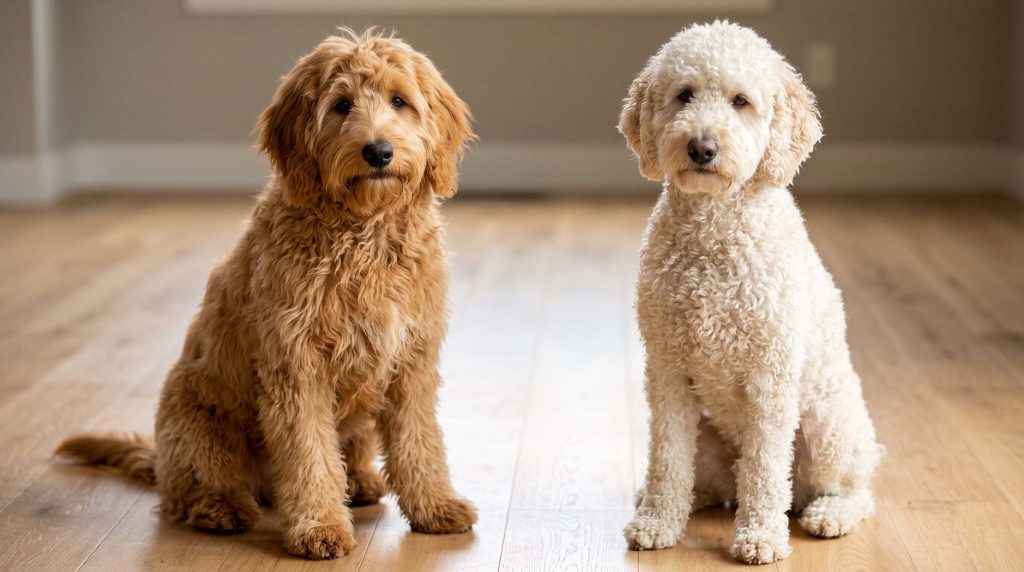
Canine coat shedding is controlled primarily by an interaction among three genes located on three separate chromosomes: RSPO2 (Chromosome 13), KRT71 (Chromosome 27), and MC5R (Chromosome 1). How these three genes pair up during conception determines whether your vacuum canister fills up once a month or every afternoon.
Here is how those allele combinations break down in real litters, formatted so you can compare the exact genetic odds between an F1 and an F1B:
Standard F1 Cross (Purebred Golden Retriever x Purebred Poodle):
- Whole Litter Outcome (100% of puppies): Every puppy inherits one furnishings allele from the Poodle parent and one non-furnished allele from the Golden parent ($F/f$), alongside one curl allele and one straight allele ($C/c$).
- What This Means for Shedding: All F1 puppies have a moderate hair growth cycle and a wavy “fleece” or loose hair texture. They experience light-to-moderate year-round shedding, and individual loose hairs slide easily out of their open waves outdoors.
Standard F1B Poodle Backcross (F1 Goldendoodle x Purebred Poodle):
- Outcome A (25% of litter — $F/F$ and $C/C$): The puppy inherits two copies of the furnishings gene and two copies of the curl gene. This produces a tight, dense Poodle-style wool coat with near-zero follicular shedding.
- Outcome B (25% of litter — $F/F$ and $C/c$): The puppy inherits two copies of the furnishings gene and one copy of the curl gene. This creates a plush, wavy fleece coat with very low follicular shedding and high shaft flexibility.
- Outcome C (25% of litter — $F/f$ and $C/C$): The puppy inherits only one copy of the furnishings gene but two copies of the curl gene. The follicles release hair at the exact same rate as an F1 dog, but the tight corkscrew curls trap every loose hair inside the coat until friction dumps them indoors in fuzz clumps.
- Outcome D (25% of litter — $F/f$ and $C/c$): The puppy inherits one copy of furnishings and one copy of curl. Despite being a 75-percent Poodle F1B on paper, this dog is genetically identical at both major coat loci to a standard 50/50 F1 Goldendoodle.
RSPO2 (Furnishings) and Why Some F1B Goldendoodles Shed More Than F1 Generations
The R-spondin-2 gene ($RSPO2$) controls what geneticists call “furnishings”—the longer hair growth around the muzzle, eyebrows, and legs that gives Doodles their teddy-bear look. More importantly for your floors, $RSPO2$ dictates the length of the anagen phase, which is the active growth window of the hair follicle.
In a purebred Golden Retriever lacking the furnishings mutation ($f/f$), hair follicles stay in the active anagen growth phase for only 6 to 12 weeks. Once that brief window closes, the follicle enters the catagen transition phase and the telogen resting phase, dropping the dead hair shaft to make room for a new one. In a purebred Poodle carrying two copies of the furnishings allele ($F/F$), the anagen growth phase lasts for 2 to 4 years before the hair detaches.
Here is the genetic detail most websites skip. While furnishings are genetically dominant for facial beard appearance, they show incomplete dominance when it comes to follicular retention. A dog with two copies ($F/F$) anchors hair in the follicle significantly longer than a dog carrying only one copy ($F/f$).
Because every F1 Goldendoodle has one Poodle parent ($F/F$) and one Golden parent ($f/f$), 100 percent of F1 dogs are heterozygous ($F/f$). When you breed that F1 ($F/f$) back to a Poodle ($F/F$) to create an F1B litter, the laws of inheritance dictate that half the puppies get $F/F$ and half get $F/f$. If you pick one of the 50 percent of F1B puppies that inherited $F/f$, your F1B has the exact same shortened anagen growth phase as an F1 dog. That biological tie is the primary reason owners start asking do f1b goldendoodles shed more than f1 generations once their puppy reaches adulthood.
KRT71 (Curl Architecture) and Follicular Grip in F1B vs F1 Coats
The Keratin 71 gene ($KRT71$) controls the physical geometry of the hair follicle and the curvature of the hair strand. A straight hair grows out of a circular follicle oriented perpendicularly to the skin. A curly hair grows out of a flattened, elliptical follicle angled sharply in the dermis, which forces the keratin proteins to wind into a spiral helix as they harden.
In an F1 Goldendoodle carrying one copy of the curl gene ($C/c$), the resulting coat falls in loose, open S-waves. When a hair completes its telogen resting phase and detaches from the root papilla, those open waves provide almost no mechanical friction. The loose strand drops off in the grass while the dog runs, plays fetch, or shakes its body outside.
Now consider an F1B Goldendoodle from Outcome C ($F/f$ and $C/C$). Because it only has one furnishings allele ($F/f$), its skin sheds dead telogen hairs at the same daily rate as an F1. However, because it carries two curl alleles ($C/C$), its coat forms tight, interlocking corkscrew curls.
Those tight curls act like a velcro net. When a hair detaches from the follicle outdoors, it cannot fall to the ground. It stays suspended inside the curl bundle until heavy physical friction—your dog scratching against the sofa base, rolling on a textured living room rug, or getting brushed—pulls the trapped fibers free all at once. Instead of invisible single hairs falling outside, you get concentrated tumbleweeds of fuzz rolling across your kitchen tile. That indoor concentration effect convinces many families that do f1b goldendoodles shed more than f1 generations is a proven fact, when the coat is actually just hoarding weeks of normal shedding and releasing it on your furniture.
MC5R (Sebum and Shedding Locus) Inheritance Across F1 and F1B Litters
The third genetic player is the Melanocortin 5 Receptor gene ($MC5R$) on Chromosome 1. This gene controls sebaceous gland lipid output and the lubricant coating on the outer hair cuticle. Dogs with high-shedding $MC5R$ variants produce a thinner, faster-flowing sebum layer that reduces friction inside the follicular canal, allowing resting telogen hairs to slip out with minimal physical tug.
Because $MC5R$ sorts independently from furnishings and curl, an F1B puppy that lands in Outcome D ($F/f, C/c$) and happens to inherit two high-shedding $MC5R$ alleles from its parents will drop noticeably more loose fur onto your clothes and upholstery than an F1 Goldendoodle that inherited a lower-shedding $MC5R$ pairing. Individual allele sorting always beats broad generational labels.
Real-World Household Test: Living With Both an F1 and an F1B Goldendoodle
To see how these genetic and mechanical factors interact in a real living space, look at a two-week coat audit we conducted with Hannah and Greg. They share a 1,400-square-foot townhome with two Goldendoodles: Barnaby, a four-year-old F1 with a loose apricot fleece coat, and Clover, a two-year-old F1B Poodle backcross with a tight cream wool coat.
Hannah and Greg chose an F1B for their second dog specifically because they wanted even less hair on their dark navy sofa than Barnaby left behind. For Clover’s first nine months, their plan worked. Then, right after her first birthday, they began finding dense, quarter-sized tufts of cream fur tucked under the dining table and pressed into their wool area rug.
“We felt completely misled by the generational chart,” Greg told our team during our initial intake call. “Barnaby is a 50/50 F1, and we only ever see a few straight apricot hairs on our coats if he hugs our legs. Clover is a 75-percent Poodle F1B, yet we are picking up actual clumps of cream fuzz off the rug every other evening. How is our F1B leaving more fur around the house than our F1?”
We had Hannah and Greg run a structured 14-day fiber collection test. Every evening, they brushed each dog for ten minutes on separate dark cotton sheets and collected all loose fur found on the townhome floors sorted by color. They mailed the collected samples to our team so we could examine 100 strands from each dog under a 40x laboratory microscope.
The microscopic exam solved the puzzle in twenty minutes:
- Barnaby (the F1) was actually shedding roughly 35 percent more true telogen hairs from the root than Clover. We confirmed this by counting the tiny, club-shaped white keratin bulbs attached to the base of his apricot strands. However, because his loose wavy coat stayed open to the wind, he dropped nearly 70 percent of those individual hairs outdoors during his morning and evening park walks.
- Clover (the F1B) had almost zero root bulbs on the cream fibers collected from the living room rug. Under 40x magnification, both ends of her shed hairs looked jagged, splintered, and frayed like snapped rope. Hannah and Greg had been dry-brushing Clover’s tight wool coat every other night using a stiff-pinned slicker brush. Without a moisturizing mist to lubricate her tight curls, the metal pins were catching the bends of her curls and snapping thousands of healthy hairs in half.
- In addition, the small number of true root-bulb hairs Clover did shed naturally were getting trapped inside her dense corkscrew curls on walks, only working their way out in rolled fuzz balls when she rubbed her shoulders and back against the textured navy sofa after dinner.
We overhauled Clover’s routine immediately. Hannah and Greg stopped dry-brushing her, introduced a silicone-free conditioning mist before every brushing session, switched to a long-pin flexible slicker followed by a steel Greyhound comb, and added a monthly high-velocity dryer blowout after bath time. Within 14 days, the cream fuzz clusters on their rug dropped by more than 85 percent. Clover was never shedding more from the skin than Barnaby—her tight F1B curl structure was simply suffering from dry-brushing breakage and indoor fur trapping.
Four Scenarios Where F1B Goldendoodles Shed More Than F1 Generations
If you are vacuuming up piles of fur every week and wondering do f1b goldendoodles shed more than f1 generations, your dog fits into one of four biological or mechanical scenarios.
1. The Retriever Backcross Trap (When F1B Means 75% Golden Retriever)
In genetic breeding terms, “F1” stands for Filial 1 (first hybrid cross), and “B” stands for Backcross—mating that F1 hybrid back to one of its two original parent breeds.
Because most puppy buyers want a low-shedding coat, roughly 90 to 95 percent of breeders backcross the F1 Goldendoodle to a purebred Poodle. However, a subset of breeders crosses an F1 Goldendoodle back to a purebred Golden Retriever to produce a stockier retriever body, a broader skull, and a lower-maintenance flat or feathered coat that does not require professional clipper haircuts every six weeks. That pairing is still legally and genetically an F1B Goldendoodle—specifically an F1B Golden Retriever backcross.
In a Golden Retriever backcross ($F/f$ mated to $f/f$), the shedding math reverses completely:
- 50 percent of the litter inherits zero copies of the Poodle furnishings gene ($f/f$). Breeders often market these puppies as having a “flat coat,” “straight coat,” or “whisper coat.” Biologically, it is a standard Golden Retriever double coat with a 6-to-12-week growth cycle and heavy seasonal shedding.
- The other 50 percent of the litter inherits one copy of furnishings ($F/f$) backed by 75 percent Golden Retriever undercoat density, resulting in heavier shedding than a standard 50/50 F1 cross.
If you adopted an F1B from a shelter or bought from a breeder who did not specify which parent breed was used for the backcross, a Golden backcross will easily out-shed any standard F1 Goldendoodle in your neighborhood.
2. Mosaic Coat Expression and the “Shedding Saddle” Phenomenon
Even in a verified Poodle backcross, coat genes do not always express evenly across every square inch of a dog’s skin. During embryonic development, dermal papilla cells migrate outward from the dorsal neural crest along the spine. Local variations in androgen and thyroid hormone receptor density along the midline can cause a hybrid dog’s back to express parent traits differently than its legs or head.
We regularly evaluate F1B Goldendoodles that carry tight, non-shedding Poodle curls on their crown, neck, chest, and legs, paired with a noticeably flatter, coarser, faster-cycling strip of fur running from the shoulder blades to the croup—a pattern we call the dorsal shedding saddle.
The follicles inside that dorsal saddle have a shorter anagen growth window and larger sebaceous glands than the follicles on the limbs. As a result, the back sheds continuously while the legs and face hold their hair tightly. Owners brushing that dorsal zone pull out brushfuls of coarse hair and naturally ask do f1b goldendoodles shed more than f1 generations, unaware that only a 6-inch-wide strip along their dog’s spine is responsible for 80 percent of the household fur.
3. Trichorrhexis Nodosa: When Brushing Breakage Looks Like F1B Shedding
Before you blame your dog’s DNA, check whether the hairs on your floor actually came out of the skin.
Curly F1B hair shafts ($C/C$) have a flattened, elliptical cross-section rather than the round cylinder of a straight hair. At every twist of the curl helix, the overlapping outer cuticle scales stretch thin along the outer curve. This geometry makes tightly curled F1B hair structurally fragile and vulnerable to trichorrhexis nodosa—microscopic weak nodes along the hair cortex that fray and snap like dry twigs when subjected to mechanical tension.
Our Grooming Desk Diagnostic: The 60-Second Root Bulb Test
You can tell the difference between genetic follicular shedding and mechanical brushing breakage in one minute using your smartphone camera:
- Step 1: Pick up ten loose hairs from your floor, couch, or slicker brush and lay them flat on a high-contrast background (black paper for cream/apricot dogs, white paper for black/chocolate dogs).
- Step 2: Turn on your phone’s macro camera or magnifier app and inspect both ends of each strand under bright light.
- True Follicular Shedding: One end of the hair will show a tiny, smooth, club-shaped white or translucent bulb that looks like the head of a wooden matchstick. That hair finished its natural telogen cycle and released from the follicle root.
- Mechanical Breakage (Pseudo-Shedding): Both ends of the hair will appear blunt, jagged, or split with zero bulb attached. Your F1B is not shedding from the skin—dry brushing, harness rubbing, or low indoor humidity is snapping the brittle curls mid-shaft.
When owners drag a dry slicker brush through an F1B’s tight wool coat, the metal pins hook into the curl loops and snap thousands of brittle fibers per session. Those broken 1-to-2-inch fragments work their way out of the coat for the next 48 hours, coating your dark pants and furniture. Because an F1 Goldendoodle’s thicker, rounder, wavier hair shaft flexes under brush tension instead of snapping, F1 coats suffer far less mechanical breakage. To avoid snapping hair during bath sessions as well, review our technical guide on whether you can brush a dog while the coat is soapy without damaging wet keratin fibers.
4. The Puppy-to-Adult Coat Clearing Window (8 to 14 Months)
Every Goldendoodle undergoes a major developmental coat change between 8 and 14 months of age as adolescent hormone surges signal the follicles to drop their fine, single-layer puppy fluff and push out the thicker adult coat.
In an F1 Goldendoodle, this clearing phase happens gradually over three to four months because the open waves allow releasing puppy hairs to drift out on daily walks. In a curly F1B Goldendoodle, the emerging adult curls wrap around the detaching puppy hairs like a woven basket, trapping the entire dead puppy coat half an inch above the skin.
Around month ten or eleven, the sheer volume of trapped puppy fur exceeds the holding capacity of the adult curls. Over a chaotic two-to-three-week window, the coat begins dumping massive tufts of fuzz and forming instant friction mats behind the ears, under the armpits, and around the collar. Adolescent F1B owners living through this purge flood search engines asking do f1b goldendoodles shed more than f1 generations, not realizing they are witnessing a one-time developmental clearing rather than permanent adult shedding.
Side-by-Side Data: Do F1B Goldendoodles Shed More Than F1 Generations by Coat Type?
To evaluate shedding accurately, you have to compare the generational cross alongside the three distinct Goldendoodle coat textures: Hair (Flat/Straight), Fleece (Soft Wave/Loose Spiral), and Wool (Tight Poodle Curl). Here is how F1 and F1B generations perform across our coat audits.
| Generation & Cross Type | Typical Genotype ($RSPO2$ / $KRT71$) | Dominant Coat Texture | True Follicular Shedding | Trapped Hair & Breakage Risk | Household Fur Visibility |
|---|---|---|---|---|---|
| F1 Standard Cross (50% Golden / 50% Poodle) | $F/f$, $C/c$ (100% of litter) | Wavy Fleece (85%) or Loose Hair (15%) | Low to Moderate | Low (open wave releases hair outdoors) | Moderate (single long strands on floors) |
| F1B Poodle Backcross (Homozygous Wool) | $F/F$, $C/C$ (25% of litter) | Tight Wool Curl | Near Zero | Very High (snaps if brushed dry) | Very Low (unless coat is dry-damaged) |
| F1B Poodle Backcross (Homozygous Fleece) | $F/F$, $C/c$ (25% of litter) | Dense Wavy Fleece | Very Low | Low to Moderate | Very Low (the lowest-mess Doodle coat) |
| F1B Poodle Backcross (Heterozygous Curl/Fleece) | $F/f$, $C/C$ or $C/c$ (50% of litter) | Curly Wool or Wavy Fleece | Low to Moderate (matches F1 rate) | High (traps shed hair in curls) | Moderate (drops rolled fuzz balls indoors) |
| F1B Golden Backcross (75% Golden / 25% Poodle) | $f/f$ (50%) or $F/f$ (50%) | Flat Double Coat or Light Feathering | Heavy to Very Heavy | Very Low (falls straight to floor) | High (resembles Golden Retriever shedding) |
Look closely at the third and fourth rows of that table. That comparison gives you the exact statistical answer to do f1b goldendoodles shed more than f1 generations. Half of all Poodle-backcross F1B puppies inherit $F/F$ and shed significantly less from the follicle than any F1 dog. The other half inherit $F/f$, meaning their skin releases dead hair at the exact same biological pace as an F1, while their tighter $C/C$ curl traps and concentrates those loose fibers until indoor friction rolls them onto your carpet.
Step-by-Step Protocol to Stop F1B and F1 Goldendoodle Shedding Indoors
Once your root bulb test tells you whether you are fighting true telogen shedding (an $F/f$ coat or dorsal shedding saddle) or mechanical curl breakage and trapped fuzz (a $C/C$ wool coat), you can adjust your grooming routine to stop the fallout inside your home.
1. Switch to Hydrated Line-Brushing to Empty the “Curl Net”
Surface brushing is the enemy of both F1B wool coats and thick F1 fleece coats. Sweeping a brush across the outer surface only smooths the top 20 percent of the hair shafts while compacting dead telogen hairs into a dense felt layer right against the skin.
Use this hydrated line-brushing method three times a week:
- Mist First, Brush Second: Lightly spritz the section of fur you are working on with a silicone-free conditioning mist (or mix 1 tablespoon of dog-safe leave-in conditioner into 12 ounces of distilled water in a fine-mist spray bottle). The moisture plasticizes the keratin cuticle so curly $C/C$ hairs stretch and rebound instead of snapping.
- Part Down to the Skin: Use your non-dominant hand to part the coat horizontally on the lower leg or flank until you see a clean line of pale skin.
- Pull and Flick With a Long-Pin Slicker: Place a flexible, long-pin slicker brush just below the part line and stroke downward in the direction of hair growth, rolling your wrist slightly away from the skin at the end of the stroke so the metal pins lift trapped hairs without scraping the epidermis.
- Verify With a Steel Greyhound Comb: Before moving half an inch higher up the body, glide a stainless-steel Greyhound comb from the skin root to the hair tips along that exact line. If the comb teeth snag, you still have dead telogen fibers tangled at the base.
Doing this outdoors on a patio or over a dedicated grooming mat empties the curl net into your trash can instead of onto your sofa cushions.
2. Use Bath-Time Dilution and High-Velocity Air to Clear Dormant Follicles
Water combined with high-velocity airflow removes more dormant telogen hair in thirty minutes than two weeks of hand brushing. However, bathing a dense Goldendoodle coat at home requires three strict precautions so you do not create pelted mats or flood your bathroom plumbing:
- Never Wet a Tangle: Always complete a full line-brushing and Greyhound comb check before putting your dog in the tub. Water causes keratin shafts to swell by up to 15 percent in diameter and then shrink as they dry, locking any loose telogen hairs into rock-hard mats. For safe drying mechanics that prevent post-bath tangles, follow our guide on how to dry a thick undercoat fast without matting.
- Shield Your Shower Drain: Goldendoodle hair is three to five inches long and wraps around pipe crossbars like fishing line. Before rinsing a single drop of shampoo, set up the dual-catcher setup detailed in our article on how to deshed a dog in the shower without clogging pipes.
- Pre-Dilute Your Shampoo: Pouring thick, concentrated shampoo directly onto a curly F1B back leaves a sticky surfactant film deep in the curls that attracts household dust and increases friction breakage. Mix your shampoo in a mixing bottle first using the exact ratios in our guide on how to safely dilute professional dog deshedding shampoo.
After rinsing thoroughly and squeezing excess water out with a microfiber towel (never rub a curly coat in circles), use a high-velocity dog dryer on a cool or low-warm setting with a round concentrator nozzle. Hold the nozzle three inches from the skin and sweep slowly down the body. The focused airstream straightens the curl helix temporarily and blasts every detached telogen hair right out of the coat. To gauge drying times and eliminate hidden damp spots near the skin, check our breakdown on how long a dog stays wet after a high-velocity blowout.
3. Feed the Follicle to Extend Anagen Retention and Prevent Shaft Snapping
You can strengthen both follicular anchoring and curl elasticity from the inside out within six to eight weeks by targeting two specific nutritional bottlenecks in Poodle-crosses:
- Marine-Sourced EPA and DHA: Standard Poodles carry a well-documented genetic tendency toward smaller, lower-output sebaceous glands compared to Golden Retrievers. Consequently, Poodle-heavy F1B coats often lack enough natural sebum to coat the full length of a twisted hair shaft, leaving the tips dry and brittle. Supplementing 1,000 mg of combined EPA and DHA from purified fish oil or algal oil per 30 pounds of body weight restores lipid flexibility to the outer cuticle.
- Chelated Zinc Proteinate and Biotin: Keratin cross-linking inside the hair cortex depends on bioavailable zinc. Many commercial kibbles use inexpensive zinc oxide, which absorbs poorly in the canine digestive tract. Switching to a formula or supplement featuring chelated zinc proteinate or zinc methionine visibly thickens the hair cortex and reduces mid-shaft snapping during weekly brushing.
Common Mistakes Owners Make When Comparing F1B and F1 Goldendoodle Shedding
Whenever owners debate do f1b goldendoodles shed more than f1 generations, three common grooming errors almost always distort what they are seeing at home.
Mistaking Post-Grooming “Clipper Spicules” for Sudden Shedding
If you bring your curly F1B Goldendoodle home from a professional groomer with a fresh teddy-bear trim and suddenly notice thousands of tiny, 3-millimeter hairs sticking to your dark shirt and sofa over the next four days, your dog did not suddenly start shedding.
When a groomer runs #4 or #5 clipper blades through a dense wool coat, the reciprocating teeth slice through millions of curling fibers. Even after a final blowout at the salon, tens of thousands of microscopic cut hair fragments—called clipper spicules—stay wedged inside the remaining curls via static electricity. Over the next week at home, those cut fragments shake loose whenever your dog sits on your lap. Wipe your dog down with a slightly damp microfiber cloth the evening after a haircut, and 90 percent of that post-grooming fallout disappears.
Using Bladed Deshedding Rakes on Furnished Curls
Never take a sharpened deshedding blade or bladed undercoat rake to a curly F1B wool coat or a wavy F1 fleece coat. Those bladed tools are engineered for double-coated breeds with straight guard hairs, where the curved metal teeth can slip past the straight topcoat to scoop out dead undercoat fluff.
On a curly or wavy Goldendoodle coat, the sharp inside edge of a deshedding rake hooks directly into the loop of the healthy anagen curl and slices the growing hair shaft cleanly in two. You will pull massive piles of cut fur off your dog, convince yourself that your F1B is a massive shedder, and leave behind millions of jagged, split hair ends that velcro together into severe mats ten days later.
Pressing Too Hard and Triggering Follicular Brush Burn
Because F1B wool coats hold onto loose hairs so stubbornly, frustrated owners often press harder with their slicker brush to dig out tangles. Poodle-dominant skin is roughly 20 to 30 percent thinner in the epidermal layer than Golden Retriever skin. Raking stiff wire pins across thin skin causes microscopic abrasions, localized histamine release, and dermal inflammation.
Inflamed follicles prematurely abort their active growth phase and shift into telogen shedding. If your Goldendoodle’s skin looks flushed or warm after brushing or bathing, read our diagnostic guide on why your dog’s skin looks pink after a deshedding bath so you can spot and soothe brush burn before it triggers secondary hair loss.
The 5-Point Coat Audit Scorecard for Goldendoodle Owners and Buyers
Whether you are evaluating a litter of puppies or troubleshooting the adult Goldendoodle sleeping at your feet right now, run through this five-point audit to pinpoint where your dog sits on the F1 vs F1B shedding spectrum:
- Confirm the Backcross Parent in Writing: Verify on the pedigree that an F1B puppy was bred back to a purebred Poodle ($F/F, C/C$) rather than a purebred Golden Retriever ($f/f, c/c$).
- Check the RSPO2 and KRT71 DNA Alleles: Ask the breeder for individual puppy coat trait panel results (via Embark or UC Davis VGL), or run a swab test on your adult dog. An F1B testing $F/F$ at the $RSPO2$ locus is biologically guaranteed to shed less from the root than an F1 ($F/f$). An F1B testing $F/f$ will shed from the follicle at the exact same rate as an F1.
- Inspect the Nasal Bridge at 6 to 7 Weeks (For Puppy Buyers): If DNA results are unavailable when choosing a puppy, examine the hair growing on the bridge of the nose between the eyes and the corners of the mouth at six weeks old. Short, flat, smooth hair on the muzzle indicates $f/f$ (improper coat, heavy Golden-level shedding). Wispy, sparse beard hairs indicate $F/f$ (moderate F1-level shedding). Thick, crimpy hair growing densely right up to the inner eye corners indicates $F/F$ (minimal follicular shedding).
- Run the 10-Hair Smartphone Magnification Check: Inspect ten loose hairs from your floor. If seven or more have blunt, frayed tips at both ends with no white matchstick root bulb, stop treating for genetic shedding and immediately add a conditioning spray before every brushing session to halt dry breakage.
- Compare the Dorsal Spine Against the Forelegs: Feel the fur along the center of the back and compare it to the fur on the front legs. If the spine fur is noticeably straighter, coarser, and oilier, your dog has a dorsal shedding saddle—spend 70 percent of your weekly grooming time line-brushing that specific strip.
For additional household fur-trapping routines that work across all coat types, explore our complete guide on how to deal with dog shedding.
FAQ — Do F1B Goldendoodles Shed More Than F1 Generations?
Why is my F1B Goldendoodle shedding so much at 10 months old?
Between 8 and 14 months of age, every Goldendoodle clears out its fine puppy coat to make room for the thicker adult coat. In curly F1B dogs, those detaching puppy hairs get woven inside the emerging adult curls instead of falling away gradually outdoors, resulting in a sudden three-to-four-week purge of fuzz clumps and tangles. Once you line-brush and blow out the trapped puppy coat, adult shedding settles down to a much lower baseline.
Do F1B Goldendoodles shed more than F1 generations if both have wavy fleece coats?
No, provided the wavy F1B inherited two copies of the furnishings gene ($F/F$) and one copy of the curl gene ($C/c$). In fact, an $F/F, C/c$ wavy fleece F1B is widely considered the easiest-to-maintain coat in the entire breed because the double furnishings gene locks hair in a multi-year growth phase while the single curl gene avoids the brittle mid-shaft snapping seen in tight wool coats. However, if your wavy F1B inherited only one copy of furnishings ($F/f, C/c$), its follicular shedding rate will be identical to an F1 Goldendoodle’s.
Can a Poodle-backcross F1B Goldendoodle have a flat coat that sheds heavily?
A true Poodle-backcross F1B cannot inherit a completely flat, non-furnished coat ($f/f$) because a purebred Poodle parent ($F/F$) always passes down at least one copy of the dominant furnishings allele ($F$). If a dog sold as an F1B Goldendoodle has a smooth face and a flat, heavy-shedding coat, it is either an F1B Golden Retriever backcross (75 percent Golden), an F2 multigen cross mislabeled as an F1B, or the Poodle parent in the pedigree was not a homozygous purebred Poodle.
Which generation is better for household allergy control: F1 or F1B?
A Poodle-backcross F1B that tests homozygous for furnishings ($F/F$) is noticeably better for allergy management than an F1. While human dog allergies are triggered by Can f 1 and Can f 2 glycoproteins found in skin dander and dried saliva rather than the hair fiber itself, shed hairs act as microscopic transport rafts that carry sticky dander particles into carpets, clothing, and HVAC ductwork. Fewer shed hairs leaving the follicle means far fewer dander rafts circulating through your indoor air.
How often should we brush an F1B compared to an F1 Goldendoodle?
An F1 Goldendoodle with a wavy fleece coat requires thorough line-brushing two to three times per week to clear out resting telogen hairs before they land on your floors. A curly wool-coated F1B requires hydrated line-brushing three to four times per week—always preceded by a light conditioning mist—because 100 percent of the hairs that do finish their growth cycle remain trapped inside the curls where they will rapidly felt into painful skin mats.
Final Verdict on F1B vs F1 Goldendoodle Shedding
Getting an accurate answer to do f1b goldendoodles shed more than f1 generations requires separating population genetics from what is happening on your individual dog’s coat. Across the breed as a whole, Poodle-backcross F1B Goldendoodles shed less from the root than F1 Goldendoodles because half of all F1B puppies inherit two copies of the Poodle $RSPO2$ furnishings gene. Yet in everyday home life, an F1B can easily leave more visible fuzz on your floors if it falls into the 50 percent heterozygous ($F/f$) group whose tight curls hoard dead hair until indoor friction releases it in clumps, if it comes from a Golden Retriever backcross, or if dry-brushing is snapping its fragile curly hair shafts in half.
Start tonight with the 60-second smartphone root bulb check on ten loose hairs from your rug or brush. If you see blunt, frayed ends with no matchstick root bulbs, stop dry-brushing immediately, pick up a silicone-free conditioning mist, and switch to hydrated line-brushing verified with a steel Greyhound comb. If you see true white telogen root bulbs, focus your weekly brushing sessions on the dorsal spine saddle and use a high-velocity dryer after bath day to push dormant hairs out of the curls before they ever reach your living room floor.
Disclaimer: This article is for informational purposes only and does not replace professional veterinary or canine genetic counseling advice. If your Goldendoodle develops sudden patchy hair loss, symmetrical thinning along the flanks, skin crusts, or persistent itching alongside increased shedding, consult a licensed veterinarian to rule out medical conditions such as hypothyroidism, sebaceous adenitis, or allergic dermatitis.
