

 Animal Zoid Editorial Team
 If your Husky drops a few hairs on the couch every day and you assume that’s just life with a double-coated breed, you might not be prepared for the seasonal explosion that’s coming. Understanding the difference between normal shedding and a full husky coat blow is the single most important thing you can learn as a Husky owner, because the two phases look similar on the surface but require completely different grooming strategies, tools, and time commitments.
⚡ Quick Answer
The difference between normal shedding and a full husky coat blow comes down to volume, speed, and origin. Normal shedding is a slow, year-round trickle of individual guard hairs and scattered undercoat fibers that leaves a light dusting of fur on furniture and clothing. A full coat blow is a rapid, hormonally triggered mass release of the entire undercoat layer, typically lasting two to four weeks, during which a Husky can shed enough dense, clumpy fur to fill multiple grocery bags. Normal shedding requires light maintenance brushing a few times a week, while a coat blow demands daily, intensive deshedding sessions to prevent painful matting and skin infections.
text+-----------------------------------------------------------------------------------+
|                SHEDDING PHASE COMPARISON AT A GLANCE                              |
|                                                                                   |
|  Normal Year-Round Shedding:                                                      |
|  • Volume: Light (a few hundred hairs daily)                                      |
|  • Texture: Individual strands, fine and scattered                                |
|  • Duration: 365 days a year, steady baseline                                     |
|  • Skin Visibility: Coat looks full and plush                                     |
|                                                                                   |
|  Full Seasonal Coat Blow:                                                         |
|  • Volume: Extreme (handfuls per brushing session)                                |
|  • Texture: Dense clumps, cotton-ball tufts, felted sheets                        |
|  • Duration: 2 to 4 weeks of intense release, twice a year                        |
|  • Skin Visibility: Patchy, uneven, skin showing through gaps                     |
+-----------------------------------------------------------------------------------+
We have worked with dozens of Husky owners who panicked during their dog’s first coat blow, convinced something was medically wrong because the sheer volume of fur seemed impossible for one animal to produce. It is not a medical emergency. It is a perfectly normal, biologically essential process. But treating a coat blow like routine shedding is a mistake that leads to matted undercoat, hot spots, and a house buried in fur for months longer than necessary.
The Core Difference Between Normal Shedding and a Full Husky Coat Blow
To grasp the difference between normal shedding and a full husky coat blow, you need to understand that these are two entirely separate biological processes happening in the same dog, just at different intensities and on different timelines.
Normal shedding is the continuous, low-level turnover of individual hair follicles cycling through their growth phases. At any given moment, roughly 10% to 15% of a Husky’s total coat is in the telogen (resting) or exogen (release) phase. Those hairs detach one by one, drifting out of the coat gradually throughout the day. You notice them on your dark pants, your car seats, and your pillow, but the overall coat still looks thick and uniform.
A coat blow is something else entirely. Triggered by shifts in daylight hours (photoperiod) and ambient temperature, the dog’s endocrine system sends a synchronized signal that pushes a massive percentage of the undercoat — sometimes 40% to 60% of total undercoat volume — into the exogen phase simultaneously. Instead of losing a few hundred hairs a day, your Husky starts releasing thousands per hour. The fur comes out in dense, cottony clumps that you can literally pull from the coat in sheets with your bare hands.
Here is why this matters practically: if you maintain the same casual brushing routine during a coat blow that you use during normal shedding, the loosened undercoat has nowhere to go. It gets trapped beneath the guard hairs, mats against the skin, and creates a damp, airless environment that breeds yeast and bacteria.
What Normal Shedding Looks Like on a Husky Year-Round
Normal shedding is the background noise of owning a double-coated breed. It never fully stops, and it should not alarm you.
During this baseline phase, you will notice a light sprinkling of individual hairs on your furniture and clothing. The hairs are typically fine, soft undercoat fibers mixed with occasional stiffer guard hairs. When you run your hand through your Husky’s coat, it feels dense and plush, with no visible gaps or thin patches.
Brushing two to three times a week with a standard undercoat rake or slicker brush keeps this normal shedding manageable. A typical session might yield a small handful of loose fur — enough to notice, but not enough to fill a trash bag.
If you want to understand how this baseline shedding compares to other heavy-shedding breeds, our complete shedding management guide breaks down the mechanics across coat types.
What a Full Husky Coat Blow Actually Looks and Feels Like
A coat blow hits fast and hard. Most first-time Husky owners describe it as “watching their dog explode.”
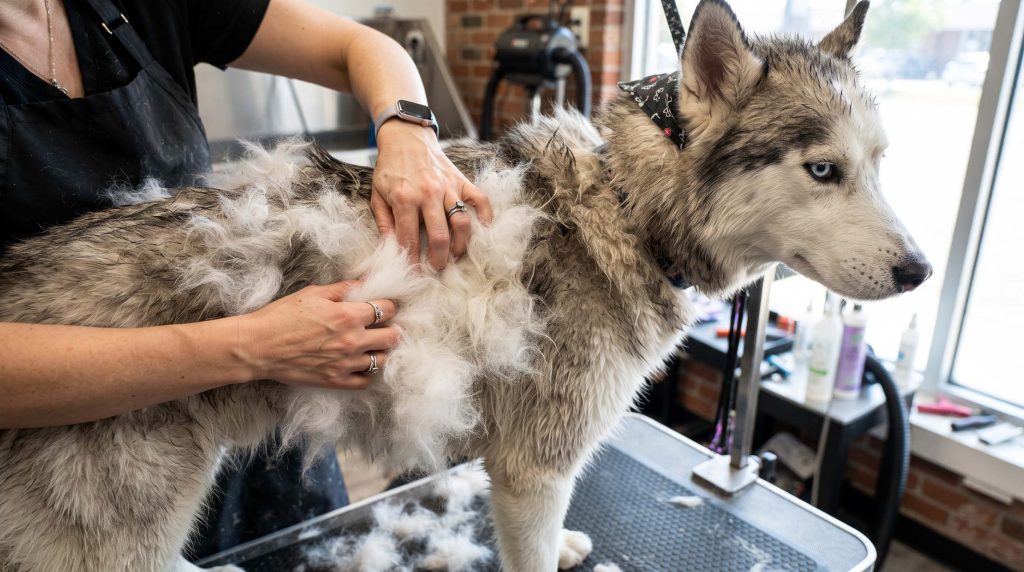
The first sign is usually texture change. Your Husky’s coat, normally smooth and uniform, starts looking lumpy and uneven. When you part the fur along the spine or flanks, you see thick, felted pads of dead undercoat sitting against the skin, separated from the guard hairs by visible air pockets.
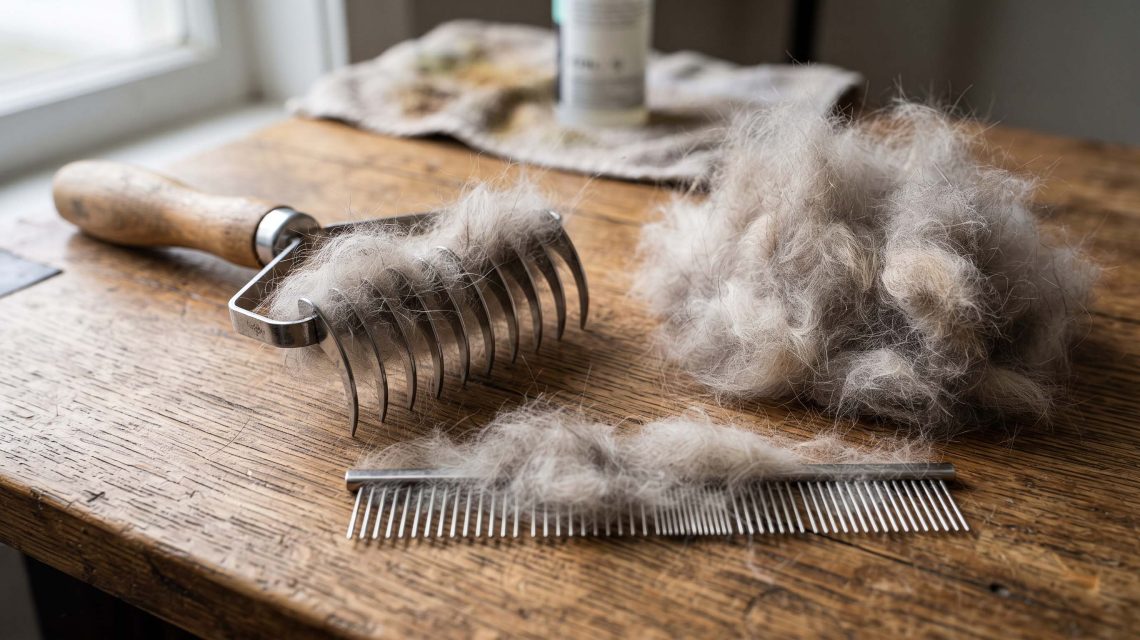
Next comes the volume. During a peak coat blow, a single ten-minute brushing session can produce enough dense undercoat to fill a standard grocery bag. The fur comes out in large, cloud-like tufts that cling together due to the crimped structure of the undercoat fibers. You will find these tufts rolling across your floors like tumbleweeds, stuck to your walls from static, and packed into the corners of every room.
The coat blow typically progresses in a specific pattern across the body:
- Neck and chest ruff — usually the first area to release
- Shoulders and upper back — follows within a few days
- Flanks and hips — the heaviest shedding zone
- “Pants” and tail — the last areas to finish blowing
The entire process takes two to four weeks from start to finish, though some Huskies with exceptionally dense coats can blow for up to six weeks during their spring transition.
The Biology Behind the Difference Between Normal Shedding and a Full Husky Coat Blow
The difference between normal shedding and a full husky coat blow originates in the dog’s pineal gland, which detects changes in daylight duration and signals the thyroid and adrenal glands to adjust hormone production accordingly.
text[Daylight Hours Shift (Spring/Fall)]
               │
               ▼
[Pineal Gland Detects Photoperiod Change]
               │
               ▼
[Melatonin Production Adjusts]
               │
               ▼
[Thyroid Hormones Signal Follicle Synchronization]
               │
               ▼
[Mass Undercoat Enters Exogen Phase Simultaneously]
During normal shedding, individual follicles cycle independently. One follicle enters the release phase while its neighbor stays firmly in active growth. This asynchronous cycling is what creates the steady, low-volume trickle of hair year-round.
During a coat blow, the hormonal signal synchronizes thousands of follicles across the entire body, pushing them into the exogen phase at roughly the same time. This is why the volume spikes so dramatically and why the fur releases in large, interconnected clumps rather than individual strands.
Huskies typically blow their coat twice a year: once in spring (shedding the dense winter undercoat to prepare for warmer weather) and once in fall (releasing the lighter summer undercoat to make room for the thick winter layer). However, Huskies living in climate-controlled homes with consistent artificial lighting may experience less predictable, sometimes year-round, mini-blows rather than two distinct seasonal events.
Visual Signs That Reveal the Difference Between Normal Shedding and a Full Husky Coat Blow
Knowing which phase your Husky is in helps you adjust your grooming routine before the situation gets out of hand.
| Indicator | Normal Shedding | Full Coat Blow |
|---|---|---|
| Daily fur volume | Light dusting, a few hundred hairs | Handfuls per brushing, bags per week |
| Fur texture | Individual strands, fine and loose | Dense clumps, cottony tufts, felted sheets |
| Coat appearance | Full, plush, uniform | Patchy, lumpy, uneven with visible gaps |
| Skin visibility | Skin hidden beneath dense coat | Pink skin visible through parted fur |
| Duration | Continuous, 365 days | Intense burst, 2 to 6 weeks |
| Trigger | Individual follicle cycling | Hormonal/seasonal synchronization |
| Grooming need | 2-3x per week, light brushing | Daily, intensive deshedding sessions |
| Matting risk | Low | Very high if not managed daily |
Elena’s Story: The Coat Blow That Looked Like a Medical Emergency
Elena, a member of our community, adopted her first Husky, Koda, at eight months old. Koda’s puppy coat was soft and manageable, and Elena brushed him casually once a week with a basic bristle brush. She knew Huskies shed, but she figured it would be similar to her friend’s Labrador — a steady, manageable amount of hair around the house.
When Koda hit fourteen months and his first adult spring coat blow began, Elena genuinely thought he was sick.
Within five days, Koda’s neck ruff started separating from his body in thick, woolly sheets. Elena could pull clumps of undercoat the size of her fist from his flanks with zero resistance. Her vacuum clogged twice in one week. Koda’s coat looked moth-eaten and patchy, with raw-looking pink skin showing through gaps along his spine.
Elena rushed Koda to the vet, convinced he had a thyroid disorder or a severe skin infection. The vet took one look at Koda, laughed gently, and explained that Koda was simply blowing his coat for the first time. The patchy appearance was normal. The volume was normal. The only real problem was that Elena hadn’t been brushing Koda frequently enough to keep up with the release, and the trapped dead undercoat was starting to mat against his skin.
text+--------------------------------------------------------------------------+
|                      KODA'S FIRST COAT BLOW TIMELINE                     |
|                                                                          |
|  Day 1-3:   Neck ruff begins separating; light clumping                  |
|  Day 4-7:   Shoulders and back release heavily; patchy skin visible      |
|  Day 8-14:  Peak blow — flanks and hips; 2 grocery bags of fur/week      |
|  Day 15-21: Tail and pants begin releasing; volume starts to taper       |
|  Day 22-28: Blow finishes; new undercoat begins growing in               |
|                                                                          |
|  Total fur removed: ~6 grocery bags of dense undercoat                   |
|  Grooming sessions during blow: Daily, 20-30 minutes each                |
+--------------------------------------------------------------------------+
After that vet visit, Elena switched to daily deshedding sessions using an undercoat rake and a high-velocity dryer. She learned to deshed Koda in the shower without clogging pipes during bath days, and she started using a properly diluted deshedding shampoo, following the ratios in our guide on how to safely dilute professional dog deshedding shampoo. By Koda’s second coat blow that fall, Elena was fully prepared, and the entire process went smoothly without a single mat or skin issue.
How to Groom During Normal Shedding vs a Full Husky Coat Blow
The difference between normal shedding and a full husky coat blow demands two entirely different grooming approaches. Using your normal-shedding routine during a coat blow is like trying to empty a swimming pool with a teaspoon.
During Normal Shedding
- Brush two to three times per week with a standard undercoat rake or slicker brush.
- Focus on the neck, chest, and hindquarters where loose fur accumulates most.
- Sessions should take 10 to 15 minutes.
- A bath every four to six weeks with a gentle shampoo keeps the coat clean and healthy.
- If you notice skin irritation during routine grooming, check our guide on why does my dog’s skin look pink after a deshedding bath to distinguish normal flushing from brush burn.
During a Full Coat Blow
- Brush every single day, ideally for 20 to 30 minutes per session.
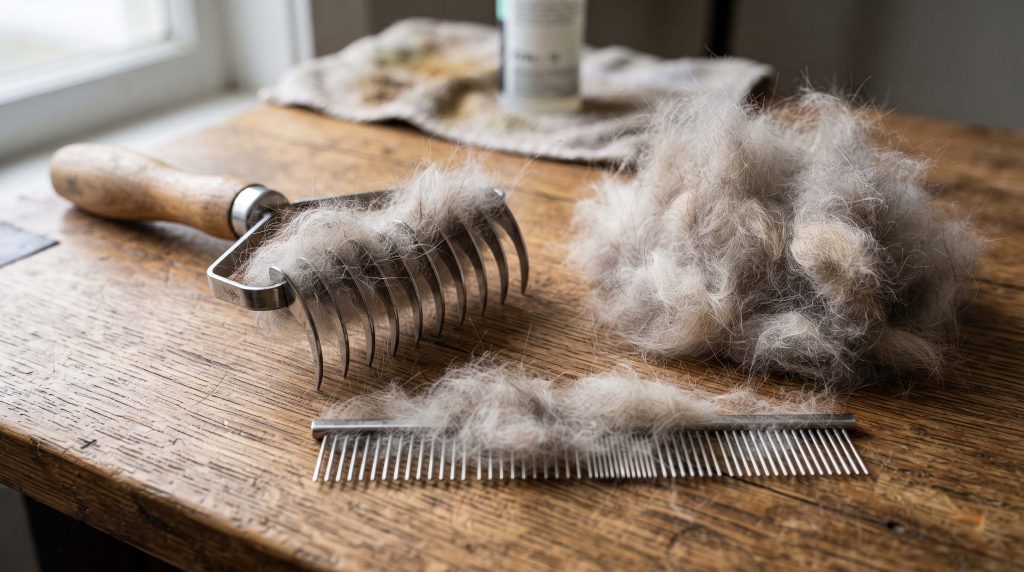
- Use a combination of an undercoat rake (to pull deep dead coat) and a wide-toothed comb (to verify you’ve reached the skin).
- Work in sections, starting from the neck and moving systematically toward the tail.
- Consider adding a high-velocity blowout session once or twice during the peak blow to blast loose undercoat free. Our guide on how long does a dog stay wet after a high velocity blow out covers realistic drying timelines for thick double coats.
- Bathe once during the peak blow week with a deshedding shampoo to help loosen the dead undercoat. If you are unsure about safe bathing frequency, our breakdown on how often you can use deshedding shampoo on a Lab applies equally to Huskies and other heavy-shedding breeds.
- After the bath, dry the coat thoroughly to prevent matting. Our step-by-step protocol on how to dry a thick undercoat fast without matting is essential reading before attempting a coat-blow bath.
Common Mistakes Owners Make During a Husky Coat Blow
Shaving the coat to “solve” the shedding. This is the single most destructive thing you can do to a Husky’s coat. The double coat regulates body temperature in both heat and cold, protects against UV radiation, and repels moisture. Shaving disrupts the guard hair growth cycle permanently in many Huskies, leading to a condition called post-clipping alopecia where the coat never grows back properly.
Treating a coat blow like normal shedding. Maintaining your casual twice-a-week brushing routine during a coat blow allows dead undercoat to compact against the skin, creating dense mats that trap moisture and breed infection.
Using the wrong tools. A basic bristle brush or a fine-toothed flea comb is useless during a coat blow. You need a long-toothed undercoat rake that reaches through the guard hairs to the skin level where the dead undercoat is trapped.
Skipping the bath-and-blowout combination. Many owners avoid bathing their Husky during a coat blow because they fear the fur will clog their drains or take forever to dry. Both concerns are valid but solvable. Setting up proper drain protection and using high-velocity drying techniques turns a bath into the most productive deshedding session of the entire blow cycle.
Ignoring skin health during the blow. The rapid release of undercoat can leave the skin temporarily exposed and sensitive. If your Husky’s skin looks unusually red or irritated during a blow, read our analysis on why does my dog’s skin look pink after a deshedding bath to determine whether the redness is normal vascular flushing or a sign of brush burn.
A Grooming Detail Most Husky Guides Overlook
Here is something we rarely see mentioned in standard Husky care articles: the direction of undercoat release during a coat blow follows a specific topographical pattern that most owners brush against rather than with.
During a spring blow, the dead undercoat releases from the skin in an upward-and-outward direction, pushed by the new, shorter summer undercoat growing in beneath it. If you brush downward against this natural release vector, you push the dead coat back against the skin and compact it further.
Brushing upward from the skin in small sections — essentially “fluffing” the coat against the grain before raking through with the natural direction — lifts the dead undercoat away from the new growth and allows your rake to capture significantly more fur per pass. This technique alone can cut your daily coat-blow grooming time by roughly 30%.
Managing Shedding Year-Round: A Seasonal Husky Grooming Calendar
| Season | Shedding Phase | Grooming Frequency | Primary Tools | Bath Frequency |
|---|---|---|---|---|
| Early Spring | Full coat blow (winter coat out) | Daily, 20-30 min | Undercoat rake + HV dryer | Once during peak |
| Late Spring/Summer | Normal baseline shedding | 2-3x per week | Slicker brush + comb | Every 4-6 weeks |
| Early Fall | Full coat blow (summer coat out) | Daily, 20-30 min | Undercoat rake + HV dryer | Once during peak |
| Late Fall/Winter | Normal baseline shedding | 2-3x per week | Slicker brush + comb | Every 6-8 weeks |
Frequently Asked Questions
How can I tell the difference between normal shedding and a full husky coat blow just by looking at my dog?
During normal shedding, your Husky’s coat looks full, plush, and uniform with no visible gaps. During a coat blow, the coat appears lumpy, patchy, and uneven, with clumps of dead undercoat visibly separating from the guard hairs and pink skin showing through in places.
How long does a full Husky coat blow last compared to normal shedding?
Normal shedding is a continuous, year-round process that never fully stops. A full coat blow is an intense, concentrated event lasting two to six weeks, typically occurring twice a year during spring and fall transitions.
Is it normal for my Husky to look patchy and thin during a coat blow?
Yes, completely normal. The patchy appearance happens because the dead undercoat releases in uneven sections across the body before the new undercoat fully grows in. As long as the skin looks healthy (not red, inflamed, or scabbed), the patchiness is temporary and resolves within a few weeks.
Should I bathe my Husky more often during a coat blow?
One strategic bath during the peak of the coat blow, combined with a high-velocity blowout, can dramatically accelerate the release of dead undercoat. However, bathing more than once or twice during a single blow cycle risks stripping the skin’s natural oils. Check our guide on does warm water make a dog shed more during a bath to optimize your wash temperature for maximum undercoat release.
Can indoor Huskies still experience a full coat blow?
Yes, though it may be less dramatic or less predictable than in outdoor Huskies. Artificial lighting and climate control can disrupt the photoperiod signals that trigger synchronized shedding, leading to prolonged, lower-intensity mini-blows throughout the year rather than two distinct seasonal events.
Know the Phase, Match the Routine
Understanding the difference between normal shedding and a full husky coat blow gives you the ability to prepare for and manage one of the most intense grooming challenges in the dog world. Normal shedding is a background hum that requires light, consistent maintenance. A coat blow is a biological event that demands daily, focused effort for a few intense weeks. Recognize which phase your Husky is in, adjust your tools and schedule accordingly, and you will keep your dog comfortable, your home manageable, and your sanity intact.
For a complete approach to managing heavy shedding across all seasons and coat types, explore our complete shedding management guide and our breed-specific strategies on how to stop Labrador shedding in the house to build a year-round grooming plan that actually works. 🐾
This article provides general grooming guidance for informational purposes. If your Husky exhibits sudden, unexplained hair loss outside of seasonal transitions, bald patches with inflamed or scabbed skin, or excessive itching, consult a licensed veterinarian to rule out thyroid disorders, allergies, or parasitic infections.
