

 Animal Zoid Editorial Team
 When is shedding season for dogs? The straightforward answer is spring and fall — but that two-word answer barely scratches the surface of what’s actually happening with your dog’s coat, and it doesn’t explain why your Husky is leaving fur tornadoes in July or why your Labrador seems to shed at a consistent, maddening rate every single month of the year.
The reality is that when is shedding season depends heavily on your dog’s breed, coat type, indoor versus outdoor lifestyle, and the specific climate where you live. Some dogs experience two dramatic seasonal coat blows. Some shed at a low, steady rate year-round. Some do both — a constant moderate shed punctuated by two intense seasonal bursts that make you wonder if the dog is auditioning to become a sweater. Understanding which category your dog falls into changes everything about how you prepare, what tools you use, and when you schedule grooming.
In this guide, we’ll cover the biology behind seasonal shedding, the exact timeline for different coat types, why indoor dogs often shed differently from outdoor dogs, which breeds shed the most during shedding season, the story of a Samoyed owner named Patrick who learned to track his dog’s coat cycle like a calendar, and the preparation routine that makes shedding season genuinely manageable rather than a months-long losing battle with your vacuum. We’ll also link to our breed-specific guides throughout — because when is shedding season has a different answer for a Husky than it does for a Poodle, and those differences matter practically. For context on why dogs shed in clumps specifically during these periods, our why does my dog shed in clumps guide covers the biology in detail.
When Is Shedding Season — The Biology Behind It
What Triggers Shedding Season in Dogs
When is shedding season isn’t a calendar event set by the weather — it’s a biological response driven by photoperiod. That’s the scientific term for the changing length of daylight hours across the year, and it’s the primary signal that triggers coat cycling in dogs with true seasonal shedding patterns.
Here’s how it works. Dogs have photoreceptors in their eyes that detect changes in daily light exposure. As days lengthen in late winter moving into spring, these receptors signal the pineal gland to reduce melatonin production. That hormonal shift triggers the hair follicles to transition from the resting phase (telogen) into an active release phase, causing the existing coat to shed en masse to make room for a lighter summer coat. In fall, the reverse happens — shortening days trigger a second coat turnover where the lighter summer coat releases and a denser winter undercoat grows in.
This is when is shedding season at its biological root: a photoperiod-driven hormonal event that your dog’s body runs on a schedule built over thousands of years of seasonal living. The timing isn’t random. It’s precise — and once you understand it, you can actually predict your dog’s coat blows with reasonable accuracy.
The practical implication: dogs who live primarily indoors under artificial lighting experience disrupted photoperiod signals. Their coat still cycles, but the timing becomes less sharp and more spread out because the artificial light exposure blurs the daylight-length signal that the coat cycle depends on. This is one of the main reasons indoor dogs often appear to shed more consistently year-round — their biological shedding trigger is receiving a confused signal rather than a clean seasonal one.
We’ve observed this pattern consistently across our work with dog owners in different living situations. The same breed — take a Golden Retriever — managed primarily indoors with consistent artificial lighting will shed more steadily across the year, while an outdoor-access Golden in the same climate will experience more defined, intense seasonal coat blows with clearer low-shed periods between them.

When Is Shedding Season for Different Dog Coat Types
Understanding When Shedding Season Hits Each Coat Type Differently
When is shedding season produces dramatically different experiences depending on your dog’s coat type. There are four main categories, and each has a distinct shedding pattern:
Double-coated breeds — Two intense coat blows per year
This is the classic when is shedding season experience. Breeds like Huskies, German Shepherds, Golden Retrievers, Labradors, Corgis, Samoyeds, Bernese Mountain Dogs, and Border Collies carry two coat layers — a dense soft undercoat and a longer protective topcoat. During shedding season, the undercoat releases almost entirely in 3–6 weeks of intense shedding that produces the clumps, tufts, and fur tumbleweeds that make double-coated breed ownership such a memorable experience.
Spring coat blow: typically March through May (Northern Hemisphere), releasing the winter undercoat to make way for a lighter summer coat.
Fall coat blow: typically September through November, releasing the summer coat and triggering growth of the denser winter undercoat.
Outside of these two windows, double-coated breeds shed at a moderate baseline rate — enough to notice, but manageable with regular brushing. Our specific guides on Husky shedding, German Shepherd shedding, Golden Retriever shedding, Labrador shedding, and Corgi shedding cover the breed-specific timing and intensity differences within this category.
Single-coated breeds — Year-round moderate shedding
Breeds with a single coat layer — including Greyhounds, Boxers, Dalmatians, and Vizslas — don’t experience dramatic coat blows. Their hair follicles cycle individually rather than in synchronized waves, producing a consistent low-to-moderate shed throughout the year without the intense seasonal peaks. When is shedding season for these breeds? Honestly, all of it — just at a manageable, distributed volume rather than in concentrated bursts.
Non-shedding or low-shedding breeds — Continuous growth without seasonal shed
Poodles, Bichon Frises, Portuguese Water Dogs, and similar breeds have hair follicles that grow continuously rather than cycling through synchronized shed phases. These dogs don’t really have a shedding season — they have a continuous growth cycle that requires regular trimming rather than seasonal shedding management. They still lose individual hairs, but not in the volume or pattern that qualifies as shedding season.
Wirehaired and terrier coat types — Minimal shedding with periodic hand-stripping
Wire-haired breeds like Wire Fox Terriers and Airedale Terriers shed minimally year-round. Their coats benefit from periodic hand-stripping — mechanical removal of dead outer hairs — rather than natural seasonal shedding. When is shedding season barely applies to these breeds in the conventional sense.
When Is Shedding Season — Breed-by-Breed Timing Guide
The Exact Shedding Season Timeline for Popular Breeds
| Breed | Coat Type | Peak Shedding Season | Duration | Year-Round Baseline | Intensity |
|---|---|---|---|---|---|
| Siberian Husky | Double | March–May / Sept–Nov | 4–6 weeks each | Moderate | 🔥🔥🔥🔥🔥 |
| German Shepherd | Double | March–May / Sept–Nov | 4–6 weeks each | Moderate-High | 🔥🔥🔥🔥🔥 |
| Golden Retriever | Double | March–May / Sept–Nov | 3–5 weeks each | Moderate | 🔥🔥🔥🔥 |
| Labrador Retriever | Double | March–May / Sept–Nov | 3–4 weeks each | Low-Moderate | 🔥🔥🔥 |
| Corgi | Double | March–May / Sept–Nov | 3–5 weeks each | Moderate | 🔥🔥🔥🔥 |
| Samoyed | Double | March–May / Sept–Nov | 6–8 weeks each | Low | 🔥🔥🔥🔥🔥 |
| Border Collie | Double | March–May / Sept–Nov | 3–4 weeks each | Low-Moderate | 🔥🔥🔥 |
| Beagle | Double (short) | March–May / Sept–Nov | 2–3 weeks each | Low | 🔥🔥 |
| Labrador (indoor) | Double | Year-round moderate | Ongoing | Moderate | 🔥🔥🔥 |
| Boxer | Single | Year-round low | Ongoing | Low | 🔥 |
| Poodle | Continuous growth | Minimal year-round | N/A | Very low | 🔥 |
| Dalmatian | Single | Year-round low | Ongoing | Low-Moderate | 🔥🔥 |
Why Indoor Living Changes When Shedding Season Happens
When is shedding season shifts for indoor dogs — and this is one of those things that trips people up because they expect their indoor Labrador to follow the same seasonal pattern as an outdoor dog of the same breed.
Indoor artificial lighting provides a relatively consistent photoperiod throughout the year — typically 12–16 hours of light exposure daily regardless of the actual season. This blunted photoperiod signal means the hormonal cue that triggers synchronized coat blows becomes weaker, less well-timed, or sometimes absent entirely. The coat still cycles, but follicles do it on individual schedules rather than the synchronized mass-release of a properly photoperiod-triggered coat blow.
The result: indoor dogs often shed at a more even, year-round rate with less dramatic seasonal peaks — but also fewer clear “off-seasons” where shedding drops to a genuinely manageable level. Let’s face it, this is probably why so many indoor dog owners feel like their dog sheds constantly — because for their specific dog in their specific environment, that’s essentially accurate.
Also worth knowing: central heating in winter reduces indoor humidity significantly, which dries out the coat and skin and can trigger increased shedding during winter months — a completely opposite pattern from what the seasonal biology would produce outdoors. If you notice your dog shedding more in winter despite the season pointing toward a “low shed” period, the indoor heating and humidity reduction is very likely the cause.
Patrick’s Story — Learning to Read His Samoyed’s Coat Calendar
One of our team members worked with Patrick, a 39-year-old landscape photographer who owned a 4-year-old Samoyed named Frost. Samoyeds are perhaps the most dramatic example of when is shedding season in action — their thick, multi-layered white coats release in volumes during coat blows that Patrick described as “like the inside of a pillow factory during an earthquake.”
Patrick’s problem wasn’t that he didn’t know shedding season existed. It was that he kept getting caught off-guard by it. Every spring and fall, the same scenario played out: Frost would start dropping fur in increasing volumes, Patrick would try to manage it reactively with whatever brush was closest, the situation would escalate over two weeks until the house looked like a snow globe, and then a frantic deep-cleaning session followed by a professional grooming appointment would finally bring things under control — approximately six weeks after they should have started.
Our team member helped Patrick build what we now call a coat calendar — a simple tracking system based on the photoperiod biology of shedding season.
Here’s how it works for Frost and for any double-coated dog:
Week 1 of February: Begin daily brushing sessions with an undercoat rake — not because visible shedding has started, but because the follicles are about to transition. Starting before the visible shed begins captures the loosening undercoat before it accumulates into clumps.
March: Spring coat blow begins. Increase brushing to twice daily during peak shedding. Schedule professional deshedding bath and high-velocity blow-out for mid-March — at the start of the coat blow rather than in the middle of it.
April–May: Continue daily brushing. Shedding slows. Return to 3x weekly maintenance brushing by late May.
June–August: Summer coat stable. 2–3x weekly brushing sufficient.
Week 1 of August: Begin daily brushing again. Fall coat blow approaches.
September: Fall coat blow begins. Repeat spring protocol — professional deshedding bath scheduled for early September.
October–November: Shed slows. Transition to maintenance schedule.
December–January: Winter coat stable. Indoor heat monitoring — increase brushing if central heating causes dry-coat shedding.
Patrick followed this coat calendar for one full year. His assessment: “The house is cleaner. The grooming costs are the same but they’re planned for rather than emergency responses. And Frost actually seems more comfortable during the coat blows because the loose undercoat isn’t sitting on him for weeks accumulating into mats.”
The insight here isn’t complicated. When is shedding season is predictable. Treat it like any other seasonal household event — something you prepare for before it arrives rather than react to after it’s already happening.
How to Prepare for Shedding Season Before It Starts
Managing When Shedding Season Hits Your Household
Preparation is everything with shedding season. Here’s the practical timeline:
4 weeks before peak shedding season (late January and late August):
Start increasing brushing frequency gradually. This does two things: it removes the dead undercoat that’s about to release before it does so onto your furniture, and it conditions your dog to longer grooming sessions before the sessions actually need to be longer. A dog who’s been brushed 5 minutes daily suddenly being brushed for 25 minutes will tolerate it less willingly than a dog whose sessions ramped up gradually over four weeks.
Also — check your grooming tools now. An undercoat rake with bent or missing tines, a slicker brush with compressed bristles, or a deshedding tool that’s past its effective life won’t perform during shedding season regardless of how much effort you apply. Our comprehensive shedding management guide covers the tool selection and replacement criteria for every coat type.
At the start of peak shedding (March and September):
Schedule a professional deshedding bath and high-velocity blow-out at the beginning of the coat blow — not in the middle or at the end. A professional blow-out at week one of shedding season removes the majority of the loosening undercoat in a single session, dramatically reducing the volume that sheds freely around your home over the following four to six weeks. This is the single most impactful intervention available for managing shedding season in double-coated breeds.
During shedding season:
Daily brushing for double-coated breeds. Use an undercoat rake for the dense undercoat layer and a slicker brush as a finishing tool for the topcoat. Work in sections — back, flanks, chest, hindquarters — rather than random passes. Vacuum every two to three days rather than weekly. Empty vacuum filters every session — a clogged filter during shedding season loses suction by 40–60%, which is precisely when you need maximum performance.
For managing the hair that does make it to your surfaces during shedding season, our guides on getting dog hair out of carpets, car seats, laundry, and fleece blankets cover the specific removal approaches for each surface type.
Diet support during shedding season:
Omega-3 fatty acid supplementation supports follicle health and helps the coat complete its transition more efficiently during shedding season. Fish oil at appropriate weight-based dosing (typically 75–100mg EPA/DHA per kilogram of body weight) started 4 weeks before shedding season produces a healthier, more efficiently cycling coat that sheds in cleaner transitions rather than drawn-out, ongoing releases. Our best deshedding brush for Beagles guide covers the grooming tool approach that complements dietary support for short double-coated breeds specifically.
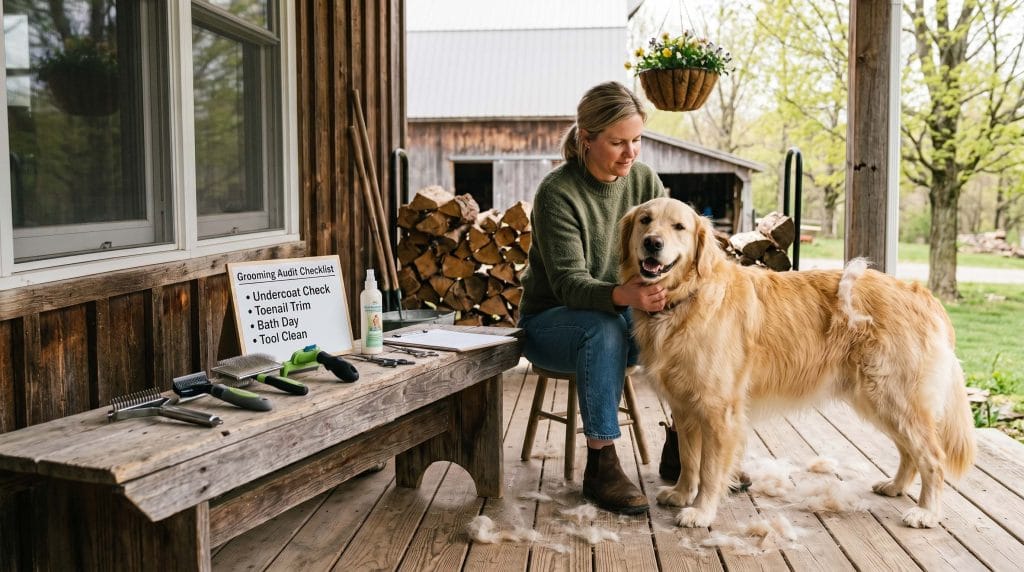
📅 The Pre-Season Grooming Audit — Something Most Owners Skip
We’re placing this at the end of the practical section because it only makes complete sense after you understand the full shedding season timeline.
Most owners address shedding season reactively — buying a new brush when the old one stops working mid-coat-blow, scheduling a grooming appointment when the house reaches a fur threshold they can’t ignore, adding omega-3 to the food after they’ve been reading about excessive shedding for two weeks.
Our team developed a Pre-Season Grooming Audit that takes 10 minutes, happens twice a year (late January and late August), and determines whether you’re actually equipped to manage the incoming shedding season before it starts.
The audit covers five things:
1. Brush and tool condition check. Run your fingers through your undercoat rake tines — are they straight, evenly spaced, and smooth at the tips? Press your palm against your slicker brush — do the bristles spring back firmly or stay compressed? A tool that feels even slightly degraded now will frustrate you during peak shedding season when you’re using it daily.
2. Grooming appointment booked. Professional deshedding appointment scheduled for the first week of March and first week of September? If not, book it now — good groomers fill up fast during shedding season, and the first-week timing is what makes the professional appointment actually useful rather than catching up to an already-advanced coat blow.
3. Vacuum filter status. Clean or replace vacuum filters before shedding season starts. Running shedding season with a compromised filter is like running a race in someone else’s shoes.
4. Omega-3 supplement started. Four weeks of supplementation before peak shedding begins supports follicle health during the transition. Start it at the audit date, not when the shedding is already visible.
5. Surface management supplies restocked. Lint rollers, rubber gloves, carpet rake — do you have what you need on hand? Shedding season is not the moment to realize you’re on your last lint roller sheet.
Ten minutes. Twice yearly. The difference between managing shedding season and being managed by it.
Your Shedding Season Preparation Checklist
Getting Ready Before Shedding Season Hits
4 weeks before peak season (late Jan + late Aug):
- Complete Pre-Season Grooming Audit (tools, appointment, filter, supplements, supplies)
- Start omega-3 fish oil supplementation at correct weight-based dose
- Increase brushing frequency gradually from current schedule
- Book professional deshedding appointment for Week 1 of March / September
- Restock surface management supplies (lint rollers, rubber gloves, carpet rake)
During shedding season:
- Daily brushing for double-coated breeds — rake first, slicker brush finish
- Professional deshedding bath and blow-out completed at start of coat blow
- Vacuum every 2–3 days with clean filter
- Surface treatment as needed — carpets, car seats, laundry, fleece
- Monitor skin underneath loosening coat — any bare patches or irritation warrant vet check
After shedding season:
- Transition back to 2–3x weekly maintenance brushing
- Schedule next pre-season audit reminder (6 months ahead)
- Note this year’s coat blow timing for your dog specifically — refine the coat calendar
FAQ — When Is Shedding Season?
When is shedding season for dogs exactly?
For double-coated breeds, peak shedding season runs spring (March through May) and fall (September through November) in the Northern Hemisphere, triggered by changing daylight hours rather than temperature. Single-coated breeds shed at a low, consistent rate year-round without peak seasons. Indoor dogs under consistent artificial lighting often shed more evenly across the year with less dramatic seasonal peaks. The exact timing varies by breed, climate, and individual dog — but spring and fall cover the peak period for the majority of dog owners asking this question.
How long does shedding season last?
For most double-coated breeds, an individual coat blow lasts 3–6 weeks of intense shedding, with a gradual onset and tapering off at the end. Samoyeds and Nordic breeds can experience coat blows lasting 6–8 weeks due to their exceptionally dense undercoats. After the coat blow completes, a low-to-moderate baseline shed continues year-round until the next seasonal peak. If your dog’s intense shedding has lasted more than 8 weeks without improvement, that’s worth a veterinary assessment — our why does my dog shed in clumps guide covers the distinction between normal seasonal shedding and shedding that signals a health concern.
Why does my dog shed so much even outside of shedding season?
Year-round heavy shedding outside of the expected seasonal periods most commonly results from one of four causes: indoor artificial lighting disrupting the photoperiod signal (causing diffuse year-round shedding rather than seasonal peaks), low-grade nutritional deficiency reducing coat cycle efficiency, stress-triggered cortisol disruption of the hair growth cycle, or an underlying health condition like hypothyroidism or allergic skin disease. Our comprehensive shedding management guide covers the diagnostic framework for identifying which of these applies to your dog’s specific situation.
Can I reduce how much my dog sheds during shedding season?
You can’t stop the coat blow — it’s a biological process your dog needs to complete. But you can absolutely reduce the volume of hair that ends up on your floors, furniture, and clothes by capturing it during grooming sessions before it sheds freely. Daily brushing with an undercoat rake during shedding season, combined with a professional deshedding bath and high-velocity blow-out at the start of each coat blow, removes the bulk of the loosening coat through grooming rather than passive shedding. Omega-3 supplementation started four weeks before shedding season also supports a cleaner, faster coat transition.
Do some breeds not have a shedding season?
Yes. Breeds with continuously growing hair — Poodles, Bichon Frises, Maltese, Portuguese Water Dogs, and similar — don’t experience shedding seasons because their follicles grow hair continuously rather than cycling through synchronized shed phases. These breeds require regular trimming or clipping rather than deshedding management. Wire-coated terriers also shed minimally and benefit from periodic hand-stripping rather than seasonal shedding management. The trade-off: these low-shedding breeds typically require more frequent professional grooming than double-coated breeds, as the continuously growing coat needs trimming every 6–8 weeks.
Stop Reacting to Shedding Season — Start Preparing for It
When is shedding season has a clear answer for most dogs: spring and fall, triggered by photoperiod changes, lasting 3–8 weeks per event depending on breed. But the useful follow-up to that answer is what you do with the timing — and that’s where the preparation approach transforms the experience from reactive damage control into a planned, manageable household event.
Patrick’s coat calendar, the Pre-Season Grooming Audit, and the professional deshedding appointment booked at Week 1 rather than Week 4 all come from the same principle: when is shedding season is predictable, and predictable events reward preparation rather than reaction.
Your dog’s coat is going to do what it’s biologically programmed to do. The hair is coming out on schedule, with or without your brushing routine, your lint rollers, or your feelings about it. The only variable you actually control is whether you’re ready when it arrives.
Start preparing now: Complete your Pre-Season Grooming Audit today, book the professional deshedding appointment, and explore our full shedding resource library — Husky shedding, German Shepherd shedding, Golden Retriever care, Labrador guide, Corgi shedding, and our complete dog shedding guide. Also check our surface management guides for carpets, laundry, car seats, and fleece blankets to handle what does make it through your grooming routine. Shedding season is coming. Be ready this time. 🐾
General guidance only. For dogs showing unusual coat changes outside of normal seasonal patterns, consult a licensed veterinarian.
