

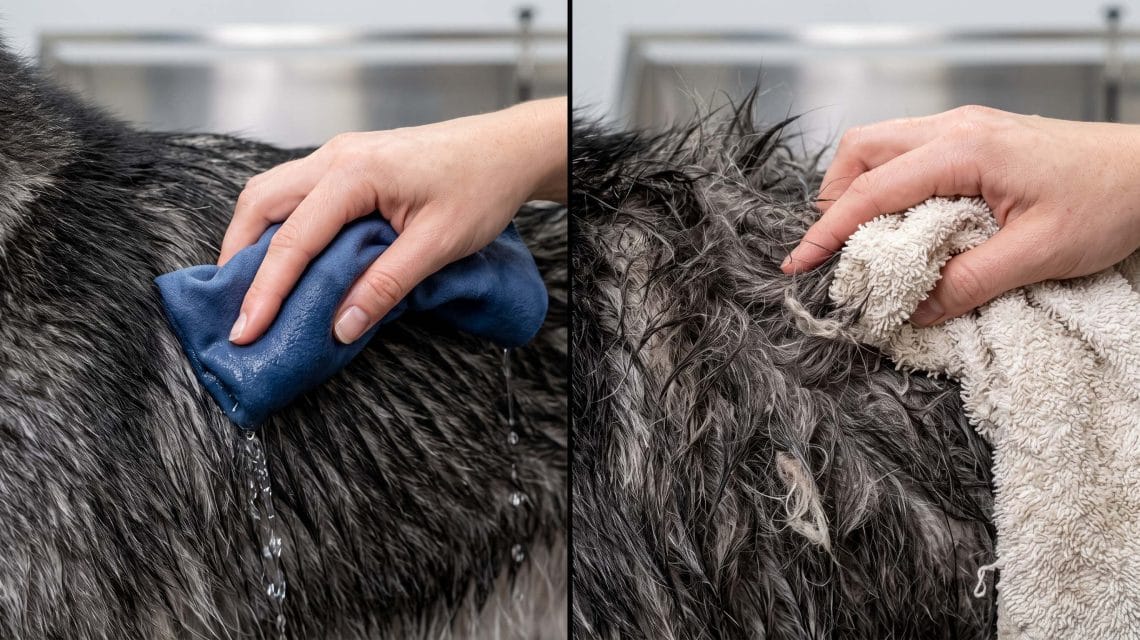
 Animal Zoid Editorial Team
 To dry a thick undercoat quickly without causing severe mats, you must absorb bulk water by pressing with high-density microfiber towels and separate the hair layers using directional, unheated high-velocity airflow. Learning how to dry a thick undercoat fast without matting saves you hours of exhausting brushing while protecting your dog from painful friction knots, trapped moisture, and secondary skin infections.
⚡ Quick Answer
To safely dry a dense undercoat fast without causing matting, never rub the coat in circles with a traditional bath towel. Instead, press and squeeze the water out with PVA synthetic chamois cloths, apply a leave-in conditioning detangler, and use a high-velocity dryer held at a 45-degree angle to slice water sheets away from the skin. Working in small, distinct sections along the grain of the hair keeps the crimped undercoat fibers aligned, preventing them from tangling or felting together while damp.
+-----------------------------------------------------------------------------------+
|                  UNDERCOAT DRYING DYNAMICS: SPEED VS. SAFETY                      |
|                                                                                   |
|  Circular Towel Rubbing     | [CRITICAL MATTING RISK]  Felted knots, 3+ hrs dry   |
|  Passive Ambient Air Drying | [HIGH HOT SPOT RISK]     Trapped moisture at dermis |
|  Human Heat Blow Dryer      | [HAIR DAMAGE RISK]       Bakes cuticle, sets tangles|
|  Directional Velocity Blow  | [OPTIMAL & SAFE]         100% dry in 25–40 mins     |
+-----------------------------------------------------------------------------------+
Anyone who lives with a double-coated breed—whether a Newfoundland, Siberian Husky, Golden Retriever, or Great Pyrenees—knows the dread of post-bath drying. A thick double coat holds onto water like a marine sponge.
If you leave that dense undercoat to air-dry on its own, the warm, trapped moisture creates a greenhouse effect against the skin, inviting acute moist dermatitis (hot spots) and fungal growth. Conversely, if you blast the coat haphazardly with high heat or scrub it with cotton towels, the wet hair fibers twist and interlock into dense, felted mats that often require clippers to remove.
We have spent years refining coat-drying protocols with heavy-shedding, thick-coated dogs. This comprehensive guide breaks down the biological physics of wet undercoats, the specialized tools you need, and the exact step-by-step techniques to get your dog bone-dry in record time without creating a single tangle.
Why Learning How to Dry a Thick Undercoat Fast Without Matting Is Essential
Understanding how to dry a thick undercoat fast without matting is not just about aesthetics; it is a fundamental pillar of canine physical health. The double coat consists of two separate structures: harsh, straight guard hairs on the outside, and thousands of fine, crimped, woolly secondary hairs packed tightly against the skin.
[Dense Secondary Undercoat] ──► Soaks Up 300% Its Weight in Water
                                            │
                                            ▼
           [Improper Drying: Wet Undercoat Shrinks & Interlocks]
                                            │
                    ┌───────────────────────┴───────────────────────┐
                    ▼                                               ▼
     [Tight Mats Pull on Dermis]                     [Trapped Moisture = Hot Spots]
When those secondary undercoat hairs get soaked, they swell with water and soften. As the water begins to evaporate without proper airflow, the individual hair shafts rub against each other.
The microscopic scales on the hair cuticles hook together like Velcro. If the dog lies down on a damp carpet or rubs against a dog bed, that friction compresses the interlocking hairs into tight, felted knots right against the delicate skin.
Furthermore, leaving a waterlogged undercoat to sit for hours causes severe skin maceration. When the skin barrier remains damp and warm, normal skin yeast (Malassezia) and bacteria (Staphylococcus pseudintermedius) multiply rapidly.
Mastering safe drying methods protects your dog from systemic skin breakdown, cuts grooming time in half, and eliminates the dreaded post-bath damp smell.
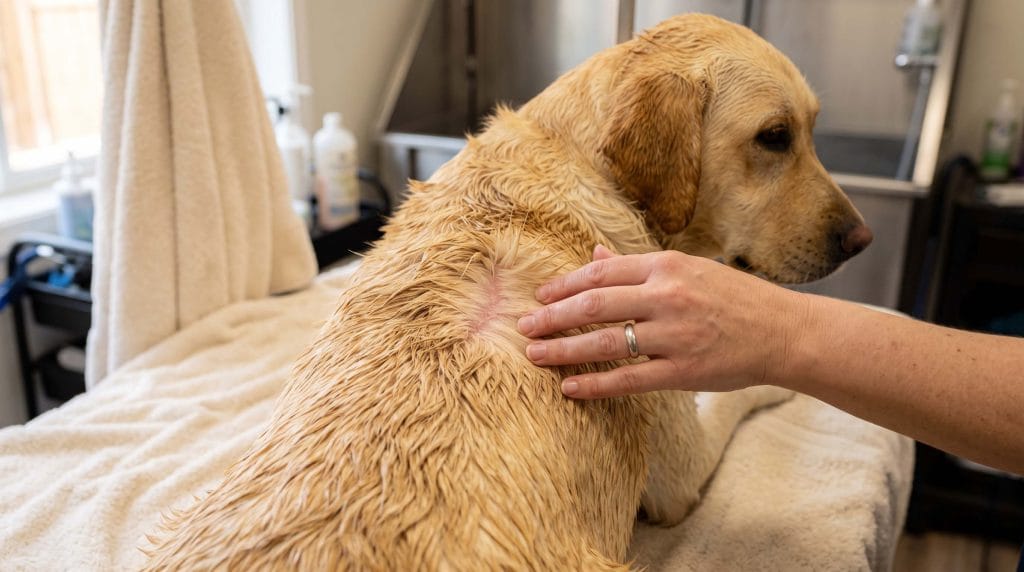
The Physics of Wet Undercoat: How Moisture Causes Matting
To understand why traditional drying methods fail, we have to look at the microscopic mechanics of wet animal fibers. Water alters the physical behavior of canine hair in two distinct ways: hydro-expansion and capillary cohesion.
+------------------------------------------------------------------------------+
|                    HYDRO-EXPANSION & CAPILLARY FORCES                        |
|                                                                              |
|   DRY HAIR SHAFT:                                                            |
|   [Smooth, Closed Cuticle Scales] ──► Hairs slide past each other smoothly   |
|                                                                              |
|   WET HAIR SHAFT:                                                            |
|   [Swollen Shaft + 30% Lifted Cuticles] ──► Scales act as mechanical hooks   |
|                                                                              |
|   CAPILLARY WATER TENSION:                                                   |
|   [Surface Water Film] ──► Pulls adjacent wet hairs into tight bundles       |
+------------------------------------------------------------------------------+
Cuticle Swelling and the Hydro-Lock Phenomenon
When water penetrates the hair cortex, hydrogen bonds temporarily break down, causing the hair shaft to swell by up to 20% in diameter. This expansion forces the exterior cuticle scales to flare outward.
In a dry state, hair cuticles lie flat, allowing strands to glide past each other effortlessly. In a wet state, the flared cuticles create significant surface friction.
If wet hairs move in opposing directions—which happens immediately when you scrub a dog with a towel—the flared scales lock into one another. This mechanical locking is irreversible without conditioning lubricants or manual line-combing.
Why Circular Rubbing Ruins Undercoats
Most pet parents instinctively grab a bath towel and scrub their dog in vigorous circular motions. On a smooth-coated dog, this does little harm.
On a double-coated breed, circular rubbing is catastrophic. It takes hundreds of fine, flared undercoat fibers and twists them into a tight knot called a friction pseudo-mat.
Once that knot forms while damp, the drying process causes the fibers to contract and shrink, pulling the mat tighter against the skin. Preparing the coat properly during the wash helps minimize this friction; for example, knowing can you brush a dog while the coat is soapy allows you to align and release dead coat in the tub before the drying phase even begins.
Equipment Needed on How to Dry a Thick Undercoat Fast Without Matting
Fast, mat-free drying relies on moving water away from the skin mechanically rather than relying on baking heat. Setting up the right tools makes all the difference.
+----------------------------------------------------------------------------+
|                       THE MAT-FREE DRYING TOOLKIT                          |
|                                                                            |
|  1. Synthetic PVA Chamois Towels ──► Lifts 80% of bulk liquid water        |
|  2. High-Velocity Dryer (4.0+ HP) ──► Shears water off roots at 45° angle   |
|  3. Wide-Tooth Steel Buttercomb  ──► Verifies skin-level separation        |
|  4. Leave-In Silicone Conditioning Mist ──► Lowers cuticle friction drag    |
|  5. Happy Hoodie Ear Compression Wrap ──► Keeps dog calm during airflow    |
+----------------------------------------------------------------------------+
1. High-Absorbency PVA Chamois vs. Standard Cotton Towels
Standard cotton terry-cloth towels saturate within thirty seconds and leave rough textile fibers on the coat that increase friction. Polyvinyl Alcohol (PVA) synthetic chamois towels, by contrast, act like a vacuum for standing water.
They hold up to ten times their weight in liquid, do not shed lint, and allow you to squeeze massive amounts of water from the coat through direct downward compression without any rubbing.
2. High-Velocity (HV) Dryers and Nozzle Attachments
A human hair dryer uses low airflow and high heat (up to 140°F), which damages canine hair cuticles and takes hours to penetrate a dense double coat. A professional high-velocity dryer uses powerful motors (producing 25,000 to 60,000 feet per minute of airflow) to physically shear water off the hair shaft with minimal, motor-warmed air.
- The Cone Nozzle (Round Concentrator): Ideal for blasting bulk water off the spine, shoulders, and rump.
- The Flat Nozzle (Water Blade): Flattens the air stream into a wide blade that parts the coat cleanly to the skin, blowing water outward in sheets without whipping the hair into tangles.
If you do not currently own a high-velocity blower, you can still dry your dog safely by following our detailed manual protocol on drying a double-coated dog without a high velocity dryer.
3. Leave-In Conditioning Sprays and Detangling Mists
A lightweight, water-based leave-in conditioning mist containing cosmetic-grade silicones (such as dimethicone or amodimethicone) or marshmallow root extract is essential. Misting the damp coat before drying coats the flared cuticles, creating a slick barrier that allows high-speed air to glide over the fibers without causing them to tangle.
Step-by-Step Guide on How to Dry a Thick Undercoat Fast Without Matting
Follow this exact sequence to ensure maximum drying speed while keeping the undercoat completely tangle-free from root to tip.
Step 1: The Compression Wrap (Absorb standing water using PVA chamois)
   │
   ▼
Step 2: Lubrication Mist (Apply lightweight detangling spray to damp coat)
   │
   ▼
Step 3: Linear High-Velocity Air Shearing (Work in grids from base to tip)
   │
   ▼
Step 4: Air-Assisted Line Drying (Use the flat nozzle to part and check skin)
   │
   ▼
Step 5: The Wide-Tooth Comb-Through (Confirm root dryness and zero knots)
Step 1: The Microfiber Press and Roll
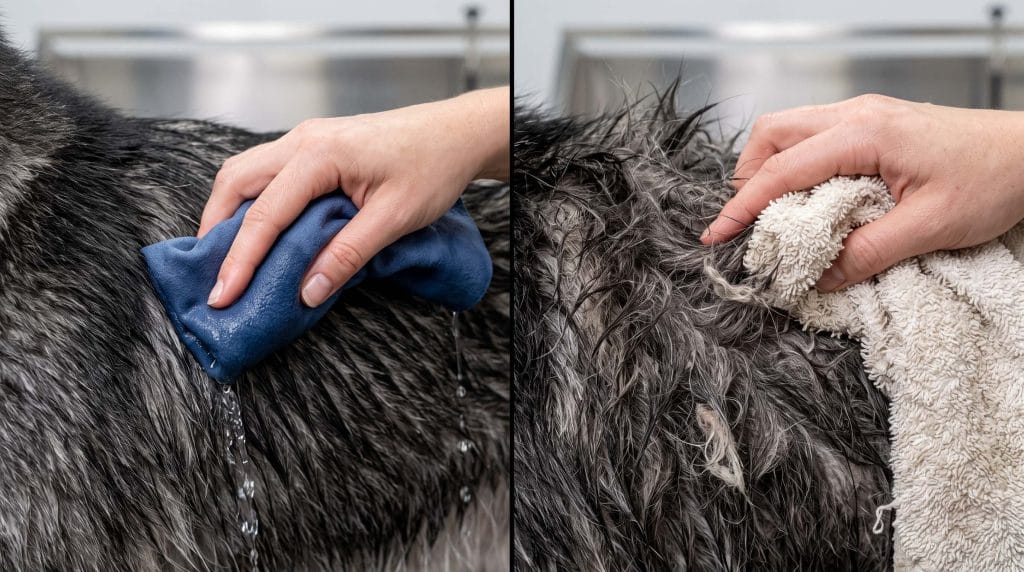
Before turning on any dryer, remove the bulk water while your dog is still in the tub or shower stall. Take your PVA chamois or high-density microfiber towel and wrap it around a section of the dog’s body (like a rear leg or the flank).
Press firmly with both hands, squeezing the water out of the coat into the towel. Wring the towel out into the drain, and repeat this squeezing motion across the neck, chest, back, belly, and tail.
Never scrub back and forth. Direct downward pressure removes up to 70% of standing water in five minutes without shifting a single hair follicle out of alignment.
Step 2: Apply a Protective Slip Agent
Lightly mist the damp coat with your leave-in conditioning spray from about 12 inches away. Focus on high-friction areas prone to severe matting:
- Behind the ears and down the neck ruff
- The armpits and groin folds
- The “pants” (long furnishings on the rear thighs)
- Under the tail and along the belly line
Run your flat hands over the coat to distribute the mist evenly. This provides the lubrication needed for the high-velocity air stream to separate hairs cleanly.
Step 3: High-Velocity Air Shearing at a 45-Degree Angle
Place an acoustic ear wrap (Happy Hoodie) over your dog’s head to protect their hearing and keep them relaxed. Turn on the high-velocity dryer and attach the round cone nozzle.
Hold the nozzle 2 to 3 inches from the dog’s skin, holding the hose at a strict 45-degree angle relative to the body. Never aim the nozzle directly at a 90-degree angle into the coat, as this causes “whip-knotting,” where the intense air blast whips the tips of the hairs around each other at thousands of RPMs, forming instant dreadlocks.
  CORRECT (45° Sweeping Angle):             INCORRECT (90° Direct Blast):

     Air Stream ──► \                           Air Stream ──► |
                     \                                         |
  ───────────────────────────────            ───────────────────────────────
  [Water Shears Forward Cleanly]             [Whip-Knotting & Tangling Occurs]
Move the nozzle in slow, steady linear sweeps following the natural downward growth of the coat. You will see a visible wall of water peeling off the skin and flying away in a fine mist. Continue sweeping that section until the heavy water spray stops completely.
Step 4: Layered Line-Drying with the Flat Nozzle
Switch to the wide, flat nozzle attachment. The flat nozzle spreads the air into a thin, powerful blade that splits the thick undercoat down to the pink skin.
Start at the lowest point of the dog (the rear hocks) and work your way upward toward the spine in horizontal rows:
- Use the air stream to hold a clean part in the fur, exposing a line of bare skin.
- Hold the nozzle steady along that part line for three to five seconds until the base of the hair is completely dry.
- Move up one inch, blow the next row of wet hair down over the dry section, and dry that new row to the skin.
- Work methodically up the thighs, across the ribcage, and over the shoulders.
By drying the undercoat in disciplined, layered rows from bottom to top, you prevent damp hair from falling back onto sections you have already dried.
+--------------------------------------------------------------------------+
|                  THE BOTTOM-TO-TOP LINE DRYING GRID                      |
|                                                                          |
|   Row 4: Upper Flank / Spine  ──► [Dry Last to Prevent Runoff]          |
|   Row 3: Mid Ribcage          ──► [Air Splits Fur Down to Dermis]        |
|   Row 2: Lower Belly Line     ──► [Sweep Moisture Downward]              |
|   Row 1: Rear Hocks & Paws    ──► [Dry First to Establish Base]          |
+--------------------------------------------------------------------------+
Step 5: Root Verification with a Steel Buttercomb
Once the entire dog looks visually fluffy and dry, take a wide-toothed metal greyhound comb (often called a buttercomb). Glide the long steel pins through the coat, making sure the tips of the teeth touch the skin gently.
If the comb glides through without snagging, the coat is 100% dry and free of mats. If the comb catches on a small, cool, damp cluster near the skin, stop immediately.
Do not yank the comb. Hold that specific section open with your fingers and give it another thirty-second pass with the flat nozzle until the moisture evaporates, then comb through smoothly.
Real Story: How Mark Dried His 110-Pound Newfoundland in 40 Minutes
Mark, a member of our pet care community, shares his life with a massive, water-loving Newfoundland named Moose. Every time Moose went swimming or had a bath, the drying process turned into an exhausting four-hour ordeal.
Mark used three human hair dryers and a mountain of bath towels, scrubbing Moose vigorously to get the water out.
The results were consistently painful. Moose frequently developed tight, felted mats behind his ears and across his rear flanks that had to be cut out with scissors.
Worse, Moose suffered from chronic hot spots on his lower back because his deep undercoat stayed damp for over twelve hours after every bath.
+--------------------------------------------------------------------------+
|                      MOOSE'S COAT DRYING MAKEOVER                        |
|                                                                          |
|  THE OLD ROUTINE:                                                        |
|  • Vigorous towel scrubbing → Created immediate friction knots           |
|  • Human hair dryers on high heat → Took 3.5 hours; baked outer coat     |
|  • Result: Dense mats in armpits/pants; recurring $200 vet hot spot visits|
|                                                                          |
|  THE NEW PROTOCOL:                                                       |
|  • PVA chamois compression wrap (lifted 2 gallons of water in 8 mins)    |
|  • 4.0 HP dual-motor velocity dryer at a 45-degree angle                 |
|  • Bottom-to-top layered line-drying with flat nozzle                    |
|  • Result: 100% bone dry in 42 minutes; ZERO mats; ZERO hot spots       |
+--------------------------------------------------------------------------+
Mark overhauled his setup using our mat-free drying protocol. After washing Moose and using a proper deshedding routine—incorporating the right wash techniques to deshed a dog in the shower without clogging pipes—Mark wrapped Moose in PVA chamois towels, lifting gallons of water without rubbing.
He then used a 4.0 HP dual-motor dryer with a flat nozzle, working in disciplined horizontal rows at a 45-degree angle.
The entire drying session took just 42 minutes. When Mark ran a metal comb through Moose’s coat, it glided effortlessly from his ears down to his tail with zero snagging. Moose has now gone over eighteen months without a single hot spot or mat.
Comparison Table: Undercoat Drying Techniques and Matting Risk
Choosing the right approach directly dictates your drying speed and the physical health of your dog’s coat:
| Drying Technique | Average Drying Time (Large Double Coat) | Matting Risk Level | Skin Health Impact | Equipment Investment |
|---|---|---|---|---|
| Linear Velocity Line-Drying | 25–45 Minutes | Zero Risk (Keeps fibers aligned) | Optimal (Massages skin, clears humidity) | Moderate ($100–$200) |
| PVA Towel Squeeze + Airflow | 60–90 Minutes | Very Low (Zero friction drag) | Good (Low stress, no thermal damage) | Minimal ($20–$40) |
| Human Blow Dryer (Warm/Hot) | 120–180 Minutes | High (Bakes mats into coat) | Poor (Risk of skin dryness & burns) | Low ($30–$50) |
| Vigorous Cotton Towel Rubbing | 180+ Minutes | Extreme (Forms friction dreadlocks) | Very Poor (Triggers hot spots & irritation) | Minimal ($10) |
| Passive Natural Air Drying | 6–12+ Hours | High (Gravity & movement tangle fur) | Hazardous (Severe risk of bacterial rot) | Free ($0) |
Common Mistakes When Trying to Dry a Thick Undercoat Fast Without Matting
Avoid these critical errors to keep your drying sessions fast, stress-free, and completely knot-free:
[MISTAKE: 90° Air Blast]         ──► Whip-Knotting & High-Speed Tangles
[MISTAKE: Bathing Mat-Loaded Coat] ──► Shrinks Knots into Rock-Hard Felting
[MISTAKE: High Heat Elements]     ──► Dehydrates Cuticle & Locks in Static
1. Washing a Dog That Is Already Matted
Water acts like glue on existing mats. If your dog has tangles or compacted undercoat before entering the tub, water swells those fibers, and the drying process shrinks them into impenetrable felt pads.
Always thoroughly brush and detangle your dog while they are 100% dry before bathing. If you manage a heavy seasonal shedder, our system on how to stop Labrador shedding in the house details how to strip out dead undercoat before water ever touches the coat.
2. Holding the Nozzle Stationary in One Spot
Never hold a high-velocity nozzle frozen over a single patch of fur. The intense air pressure can cause the skin to wind-whip against the muscle, causing capillary bruising and skin redness.
If you have ever noticed skin discoloration post-grooming, read our breakdown on why does my dog’s skin look pink after a deshedding bath to understand how nozzle distance and technique impact dermal blood flow.
3. Using High Heat to Speed Up the Process
Cranking the heat on a grooming dryer does not speed up drying on a double coat; it actually slows it down. High heat dehydrates the outer guard hairs too quickly, causing them to crimp and block air from reaching the damp undercoat beneath.
Keep the heat setting on “warm” or “ambient.” High velocity (air speed), not thermal heat, is what removes water from a dense coat.
4. Overlooking Product Dilution in the Tub
If you fail to rinse out all shampoo residue, dried surfactants leave a tacky, sticky coating on the hair shafts. This sticky film glues adjacent hairs together during drying, forming stubborn product mats.
Mastering how to safely dilute professional dog deshedding shampoo guarantees that your wash rinses clean in seconds, giving you a smooth, slick base for lightning-fast drying.
The Thermal Moisture Rebound: Why Dogs Feel Damp 30 Minutes Later
Here is an essential physiological reality that confuses many pet owners: The Core Moisture Rebound.
[High Velocity Air Clears Skin Surface] ──► Dermis Temperature Cools Down
                                                       │
                                                       ▼
                 [Dog's Internal Body Heat (101.5°F) Pushes Outward]
                                                       │
                                                       ▼
                 [Deep Follicular Moisture Migrates to Hair Roots]
                                                       │
                                                       ▼
               [Coat Feels Clammy 20-30 Mins Later: Rebound Effect]
When you blow out a thick coat, convective cooling drops the surface temperature of the skin. Once the dog steps off the table, their core body temperature (101.5°F) warms the dermal tissue back up.
This internal heat pushes micro-droplets of moisture out of deep follicle tracts toward the hair roots. If you want to know the exact timelines for post-grooming moisture normalization across various breeds, our detailed investigation on how long does a dog stay wet after a high velocity blow out outlines what to expect during the first hour after a bath.
The Air-Splitting Grid System
Here is a master-level grooming secret used in competition show preparation: The Aerodynamic Coat-Splitting Technique.
+-------------------------------------------------------------------------+
|                  THE COAT-SPLITTING AIR BLADE CYCLE                     |
|                                                                         |
|   1. Position Flat Nozzle 2 Inches from Dermis                          |
|                               │                                         |
|                               ▼                                         |
|   2. Lock Air Blade to Create Clean Parting Line (Pink Skin Visible)    |
|                               │                                         |
|                               ▼                                         |
|   3. Sweep Nozzle 2 Inches Left, Then 2 Inches Right Along the Part     |
|                               │                                         |
|                               ▼                                         |
|   4. Advance Upward by 1 Inch; Overlap Air Path with Previous Row       |
+-------------------------------------------------------------------------+- Attach your wide, flat nozzle.
- Hold the nozzle parallel to the spine, roughly two inches away from the coat surface.
- Turn the air flow up to 80% power. The flat air stream will immediately split the fur into a sharp, straight part where pink skin is visible.
- Instead of waving the hose around, move the nozzle in a tight, two-inch sweeping stroke along that exact part line.
- The air will blast water out sideways along the skin plane, preventing the hair on either side from whipping together.
- Shift the nozzle upward by one inch and repeat.
This structured grid method prevents cross-directional turbulence, guaranteeing that the undercoat stays perfectly straight, fluffy, and 100% mat-free throughout the entire blowout.
Step-by-Step Mat-Free Drying Checklist
Keep this checklist handy for your next home grooming session:
- Pre-Bath Prep: Complete a thorough dry brushing to clear all existing mats and dead coat.
- Wash Prep: Rinse thoroughly; ensure zero shampoo residue remains on the skin.
- Finishing Rinse: Consider an acidic rinse to close the cuticle; see our guide on does apple cider vinegar rinse reduce dog shedding after bath for proper pH balance.
- Compression Squeeze: Use PVA chamois towels to press and lift bulk standing water (no rubbing).
- Slip Protection: Mist high-friction areas lightly with a leave-in silicone detangling spray.
- Hearing Care: Place a Happy Hoodie over the dog’s ears before starting the machine.
- Bulk Water Blast: Use the round cone nozzle at a 45-degree angle in sweeping linear passes.
- Layered Line Dry: Use the flat nozzle to dry the coat in horizontal rows from paws to spine.
- Comb Verification: Glide a wide-toothed metal buttercomb through the coat down to the skin to confirm zero snags.
Frequently Asked Questions
Can I let my double-coated dog air-dry if I brush them while they dry?
We strongly advise against air-drying double-coated breeds. Even if you brush periodically, the deep undercoat packed against the skin stays wet for hours. This creates a prime environment for bacterial and yeast overgrowth, leading to painful hot spots, skin odor, and hidden matting at the follicular level.
Why does my dog get tiny, tight mats at the ends of their fur after using a high-velocity dryer?
Those tiny knots are called “whip-knots.” They happen when you hold the dryer nozzle at a 90-degree angle to the coat or wave the nozzle too rapidly over long fur. The intense air turbulence causes the tips of the hairs to whip around each other in circles. Always hold the nozzle at a 45-degree angle and move in smooth, straight lines.
What should I do if I discover a mat while the dog is still damp?
Do not blast the mat directly with high-velocity air, as this will felt it tighter. Stop, apply a drop of leave-in conditioning spray directly onto the knot, and gently tease the fibers apart using the end tooth of a metal comb or your fingers. Once the knot is separated, resume drying that section with the flat nozzle.
How often can I safely blow out my dog’s coat?
You can use a high-velocity dryer on a dry coat once a week to blow out dust, dander, and loose undercoat between baths. For full baths with wet blowouts, washing and drying every 3 to 6 weeks is ideal for most double-coated breeds. To understand how water temperatures influence coat release during these sessions, check our guide on does warm water make a dog shed more during a bath.
Can I use a human microfiber towel instead of a PVA chamois?
Yes, high-density human microfiber towels work well, but they saturate much faster than PVA chamois cloths. If using microfiber, keep three or four large towels ready so you can swap to a dry towel as soon as the first one becomes damp. Remember: always press and squeeze; never rub.
Master Fast, Safe Undercoat Drying at Home
Learning how to dry a thick undercoat fast without matting transforms one of the most frustrating aspects of dog ownership into a smooth, rewarding routine. By ditching circular towel friction, utilizing high-absorbency PVA chamois compression, applying protective detangling mists, and mastering the 45-degree linear line-drying technique, you can dry even the thickest double coat in under an hour while keeping the fur soft, fluffy, and completely mat-free.
To build a complete, professional-level shedding and coat care strategy for your home, explore our complete shedding management guide and check out our breed-specific advice on how often you can use deshedding shampoo on a Lab to keep your dog comfortable, clean, and healthy all year long. 🐾
This article provides general pet grooming guidance for informational purposes. If your dog has severe, skin-tight felted mats, do not attempt to wash or dry the coat at home, as this can cause intense pain and skin tearing. Consult a professional groomer or veterinarian for safe medical pelt removal.
