

 Animal Zoid Editorial Team
 ⚡ Quick Answe
How to dry a double coated dog without a high velocity dryer: towel-blot the coat first to remove excess water, then brush through the undercoat in sections while it’s still damp using a slicker brush or undercoat rake, working from skin outward. Follow with air drying in a warm room, brushing again every 15-20 minutes to prevent the undercoat from matting as it dries. It takes longer than a high velocity dryer, but done correctly, it dries the coat fully without trapping moisture against the skin.
Not everyone has a few hundred dollars sitting around for a high velocity dryer, and honestly, not everyone needs one. If you’re trying to figure out how to dry a double coated dog without a high velocity dryer, the good news is it’s completely doable — it just takes more patience and a specific technique, because double coats hold water differently than single coats do, and getting it wrong leads to matting, skin issues, and a dog that stays damp for hours.
We’ve helped plenty of pet owners work through this exact problem, usually right after they’ve decided a high velocity dryer isn’t in the budget or just isn’t necessary for their situation. This guide walks through exactly how to dry a double coated dog without a high velocity dryer using towels, air circulation, and brushing technique, why double coats specifically need a different drying approach than short-haired breeds, and the mistakes that turn a simple bath into a multi-hour matting problem.
Why Double Coats Need a Different Drying Approach
Before getting into how to dry a double coated dog without a high velocity dryer, it helps to understand what makes this coat type so much trickier to dry than a single coat. Double-coated breeds — Huskies, Golden Retrievers, German Shepherds, Corgis, Samoyeds — carry a dense, insulating undercoat beneath their longer guard hairs. That undercoat is specifically built to trap air for warmth, and unfortunately, it traps water just as effectively.
A single-coated dog like a Boxer or a Doberman dries fairly quickly with a basic towel rub, since there’s no dense secondary layer holding onto moisture. A double-coated dog’s undercoat can stay damp for hours after the guard coat feels completely dry to the touch, which creates the exact conditions matting and skin irritation need to develop. This is the entire reason high velocity dryers became popular with groomers in the first place — they force air deep into the undercoat rather than just drying the surface.
Without that tool, the job isn’t impossible. It just requires working with the coat’s structure instead of against it.
The Skin Problem Hiding Under a Damp Undercoat
Here’s something that doesn’t get explained often enough: damp undercoat sitting against skin for extended periods creates a warm, moist environment that’s genuinely ideal for bacterial and yeast overgrowth. This is part of why double-coated dogs that are bathed frequently without proper drying technique sometimes develop hot spots or skin irritation that seems to come out of nowhere. It’s not really out of nowhere — it’s usually a drying problem, not a bathing problem.
Step-by-Step: How to Dry a Double Coated Dog Without a High Velocity Dryer
This is the core technique, broken into stages, because rushing any one of these steps is where most people run into trouble.
Step 1: Remove Excess Water With Absorbent Towels
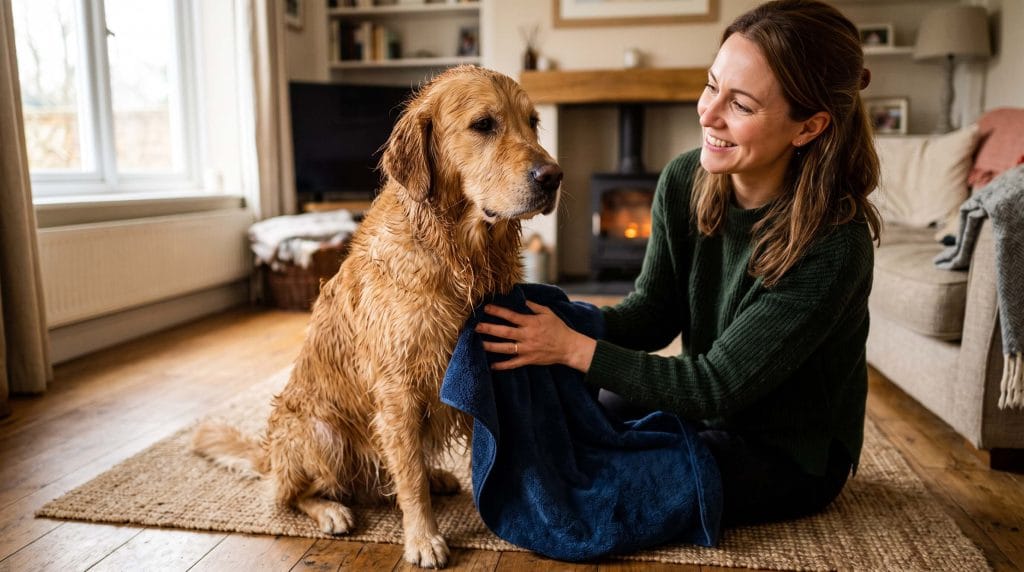
Immediately after the bath, before your dog has a chance to shake, press absorbent towels against the coat rather than rubbing. Rubbing tangles the guard hairs and pushes water deeper into the undercoat instead of pulling it out. A few microfiber towels, which hold significantly more water than standard cotton ones, make this stage faster and more effective.
Let your dog shake — it’s a genuinely useful part of the process, since dogs are biologically built to fling a surprising amount of water off their coat this way. Just be ready with a towel in hand for the aftermath.
Step 2: Brush Through the Damp Undercoat in Sections
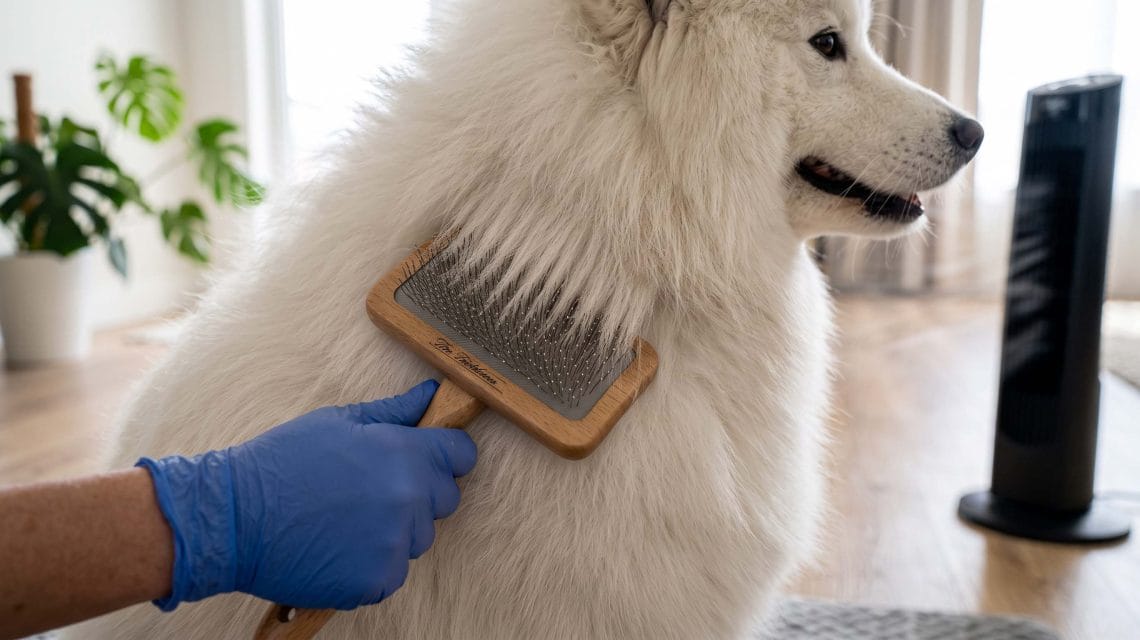
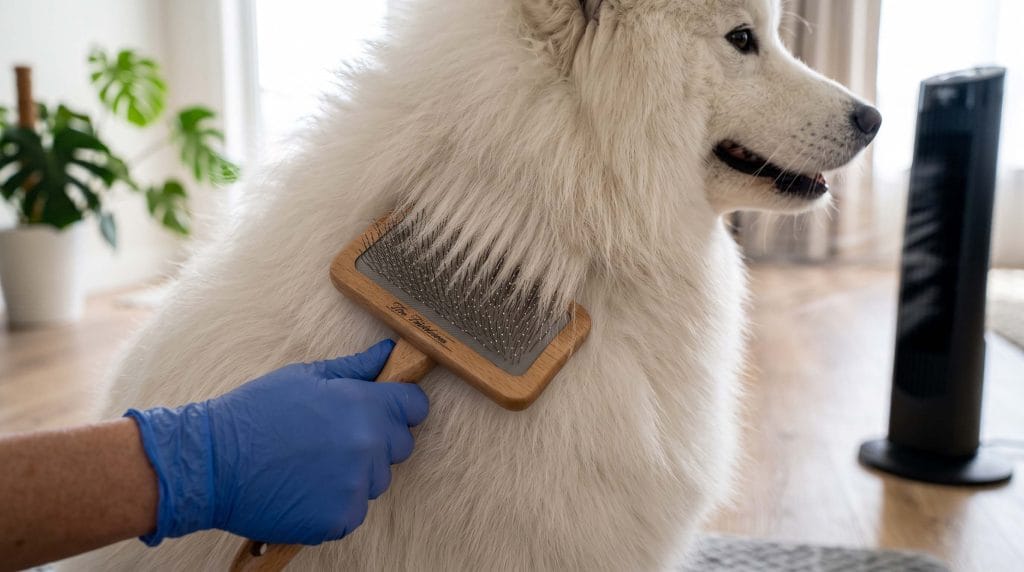
This step is the actual key to how to dry a double coated dog without a high velocity dryer successfully. Working in small sections, use a slicker brush or undercoat rake to brush from the skin outward while the coat is still damp. This lifts the undercoat away from the skin and separates individual hairs, which dramatically increases the surface area exposed to air — speeding up drying time significantly compared to leaving the undercoat compressed and flat against the body.
Skipping this step is the single biggest reason air drying takes so long and produces matting. A compressed, wet undercoat traps moisture and dries into tangled clumps. A separated, fluffed undercoat dries evenly and stays workable throughout the process.
Step 3: Use a Room Fan for Air Circulation
A standard box fan or floor fan, pointed at your dog from a few feet away, dramatically speeds up air drying compared to simply letting the dog air dry with no airflow at all. It’s not the forceful, coat-parting air of a high velocity dryer, but consistent airflow across a brushed-out, separated undercoat still moves a significant amount of moisture out of the coat over time.
Position the fan at a comfortable distance and let your dog move in and out of the airflow as they prefer. Most dogs adjust their own position naturally to stay comfortable.
Step 4: Re-Brush Every 15 to 20 Minutes
This is the step people skip most often, and it’s genuinely non-negotiable if you’re avoiding a dryer. As the coat dries, sections that were separated during the initial brush-through can start to clump back together, especially in high-undercoat areas like the neck, chest, and hindquarters. Re-brushing every 15 to 20 minutes during the drying process keeps everything separated and speeds up the overall process considerably.
Step 5: Check the Undercoat, Not Just the Surface
The guard coat on top will feel dry well before the undercoat underneath actually is. Part the coat in a few different spots — neck, chest, hips — and check with your fingers whether the base of the coat, close to skin, still feels cool or damp. This is the actual test for whether your dog is fully dry, not how the surface feels.
Comparison Table: Manual Drying Methods vs. High Velocity Dryers
| Method | Drying Time (Double Coat) | Matting Risk | Cost | Effort Level |
|---|---|---|---|---|
| Towel + air dry only | 3-5 hours | High if not brushed | Free | Low |
| Towel + brushing + fan | 1.5-2.5 hours | Low if brushed regularly | Low (one-time fan cost) | Moderate |
| Standard human hair dryer (cool setting) | 1-2 hours | Moderate | Low | Moderate to high |
| High velocity dryer | 15-30 minutes | Very low | High | Low |
Can a Regular Hair Dryer Help Dry a Double Coated Dog Without a High Velocity Dryer?
A standard human hair dryer, used carefully, can supplement the towel-and-brush method, though it comes with real limitations worth understanding. Human hair dryers produce far less airflow volume than high velocity pet dryers, and they generate considerably more heat concentration in one spot, which creates a genuine burn risk if held too close or in one place too long.
If using one, keep it on the coolest setting available, hold it at least eight inches from the skin, and keep it moving constantly rather than holding it in one spot. It works best as a finishing tool after the towel-and-brush method has already done most of the work, rather than as a primary drying method on its own.
Some dogs also find the high-pitched motor sound of standard hair dryers more stressful than the deeper hum of a high velocity dryer, so this method works better for dogs already comfortable with the sound and sensation.
Common Mistakes People Make Trying to Dry a Double Coated Dog Without a High Velocity Dryer
Skipping the brush-out step entirely. This is the mistake that turns a two-hour process into a four-hour one, and it’s also the leading cause of post-bath matting in double-coated breeds.
Rubbing instead of blotting with towels. Vigorous towel rubbing tangles guard hairs and pushes water deeper into the undercoat rather than pulling it toward the surface.
Letting the dog rest somewhere cool immediately after bathing. A cool, still environment slows evaporation dramatically. Keep your dog in a warm room with some air movement until the coat is genuinely dry.
Assuming the coat is dry because the surface feels dry. As mentioned earlier, the guard coat dries well before the undercoat does. Always check close to the skin before considering the job finished.
Using a heavy conditioner without extra rinsing. Heavy leave-in conditioners can weigh down the undercoat and slow drying time considerably. If using conditioner, a thorough rinse matters more for double coats than it might for single-coated breeds.
Brushing too aggressively on already-matted sections. If mats have already formed from a previous bath, aggressive brushing on wet hair can pull and hurt. Work mats out gently with a mat splitter or detangling spray, or consult a groomer for significant matting.
Rebecca’s Story — Drying a Samoyed Without Spending on Equipment
One of the pet owners in our community, Rebecca, has a Samoyed named Frost with one of the densest undercoats of any breed she’s owned. For the first year, Rebecca simply toweled Frost off after baths and let him air dry in the living room, assuming that was sufficient since his outer coat looked dry within an hour or so.
It wasn’t sufficient. Frost developed mild matting behind his ears and along his hindquarters every few weeks, and Rebecca eventually noticed a faint, slightly unpleasant smell developing in those same areas between baths — a telltale sign of moisture sitting against skin for too long after each wash.
A groomer explained what was actually happening: Frost’s outer coat was drying fine, but his dense undercoat stayed damp for hours longer, exactly the kind of environment that leads to both matting and minor skin issues. Rather than investing in a high velocity dryer, Rebecca adopted the section-brushing method — towel blotting immediately after the bath, brushing through in sections while damp, positioning a box fan nearby, and re-brushing every fifteen minutes until the undercoat genuinely felt dry near the skin.
The difference was significant within a single bath cycle. The matting stopped almost entirely, and the mild odor issue resolved within a few weeks of consistent proper drying. Rebecca’s total drying time runs close to two hours now compared to the roughly four hours air drying alone used to take, and Frost’s coat condition has held up noticeably better between grooming appointments.
🐾 Team Pro-Tip: The Warm Towel Trick for Faster Drying Without Equipment
Here’s something that doesn’t come up in most drying guides. Warming your towels in the dryer for five to ten minutes before using them on your dog speeds up the entire process more than people expect. Warm towels absorb water more efficiently than room-temperature ones, since heat slightly loosens water’s surface tension and makes it transfer into the towel fibers more readily.
This works especially well as a rotating system — keep two or three towels warming while you work with one, swapping in a fresh warm towel every few minutes during the initial blotting stage. It’s a small adjustment, but pet owners who’ve tried it consistently report the initial towel-drying stage taking noticeably less time, which shortens the overall process before air drying and brushing even begin.
Best Practices for Drying Double-Coated Breeds Long-Term
- Bathe less frequently, dry more thoroughly. Double coats generally don’t need frequent bathing, and spacing out baths reduces how often the drying process needs to happen at all.
- Brush before the bath, not just after. Removing loose undercoat before wetting the coat means less hair to manage during the drying process, and it reduces the raw volume of wet undercoat you’re working with.
- Keep a dedicated set of pet-only towels. Old, low-pile towels sometimes hold less water than newer microfiber ones — investing in a few good microfiber towels specifically for bath time makes a measurable difference.
- Consider the season. Warm weather naturally speeds up air drying considerably, while cold, humid conditions slow it down. Adjust bath timing when possible to warmer parts of the day.
- Watch for the specific problem areas. Neck, chest, and hindquarters typically hold the most undercoat and take the longest to dry — give these areas extra brushing attention throughout the process.
If your dog’s shedding volume feels like it’s making bath day even more overwhelming than the drying process itself, our guides on Husky shedding, Golden Retriever shedding, German Shepherd shedding, and Corgi shedding cover routines that reduce the raw undercoat volume you’re dealing with at bath time. And if you’ve noticed your dog seems to shed even more right after baths, our guide on why dogs shed more after a bath explains exactly why that happens and how it connects to the drying process covered here.
Tools Worth Having for Manual Drying
- Microfiber towels — absorb significantly more water than standard cotton towels
- Slicker brush or undercoat rake — essential for the section-brushing technique that prevents matting
- A standard box or floor fan — the most affordable substitute for forced airflow
- A cool-setting human hair dryer — useful as a finishing tool, not a primary method
- Detangling spray — helpful for working through any small tangles that form during drying
What’s Changing in At-Home Pet Drying
Portable, lower-cost pet dryers have started closing the gap between full professional-grade high velocity units and basic human hair dryers, with several mid-range options now offering adjustable airflow and reduced noise levels at price points considerably below traditional professional equipment. This middle-ground category has made it more realistic for pet owners to invest in dedicated pet drying equipment without the full cost of a salon-grade unit.
At the same time, more grooming educators have started publicly emphasizing the section-brushing technique covered in this guide, since it addresses the actual root cause of post-bath matting rather than simply relying on stronger airflow to force moisture out. Understanding coat structure, rather than just buying more powerful equipment, is increasingly recognized as the more reliable long-term solution.
Key Takeaways for Manual Double Coat Drying
- Blot with towels immediately after bathing — never rub aggressively
- Brush through the undercoat in sections while still damp
- Use a fan to increase airflow during the drying process
- Re-brush every 15-20 minutes to prevent re-matting as the coat dries
- Check near the skin, not just the surface, to confirm full dryness
- Warm towels before use to absorb water more efficiently
- Bathe less frequently and brush thoroughly beforehand to reduce overall drying time
FAQ — How to Dry a Double Coated Dog Without a High Velocity Dryer
How long does it take to dry a double coated dog without a high velocity dryer?
Using the towel, brush, and fan method described here, most double-coated dogs take between one and a half to two and a half hours to dry fully, compared to fifteen to thirty minutes with a high velocity dryer.
Is it safe to air dry a double coated dog without any tools at all?
It’s possible, but risky without regular brushing during the process. Air drying alone, without brushing the undercoat periodically, significantly increases the chance of matting and extends total drying time to three to five hours or more.
Can I use a regular hair dryer to dry my double coated dog?
Yes, on the coolest setting and held well away from the skin, though it works best as a supplement to towel drying and brushing rather than a primary method, since standard hair dryers produce far less airflow than dedicated pet dryers.
Why does my double coated dog still feel damp hours after a bath?
The dense undercoat holds moisture much longer than the outer guard coat, which often feels dry on the surface while the base of the coat near the skin stays damp for hours without proper brushing and airflow.
Does brushing before a bath make drying easier afterward?
Yes, significantly. Removing loose undercoat before bathing reduces the total volume of wet hair you’re working with during the drying process, which shortens overall drying time.
Getting the Technique Right
How to dry a double coated dog without a high velocity dryer really comes down to working with the coat’s structure — separating the undercoat through regular brushing, keeping air moving across the coat, and checking near the skin rather than trusting how the surface feels. It takes longer than a high velocity dryer, no question, but done consistently, it dries the coat fully and avoids the matting and skin issues that come from rushing the process or skipping the brush-out step.
For more on managing double coats between baths, check out our guides on Husky shedding, Golden Retriever shedding, German Shepherd shedding, Corgi shedding, and our complete shedding management guide. If you’re also wondering whether shaving might make bath day simpler, read our guide on why you shouldn’t shave a double-coated dog before making that call. 🐾
This article provides general grooming guidance for informational purposes. If your dog develops persistent skin irritation, hot spots, or severe matting, consult a veterinarian or professional groomer for hands-on assessment.
