

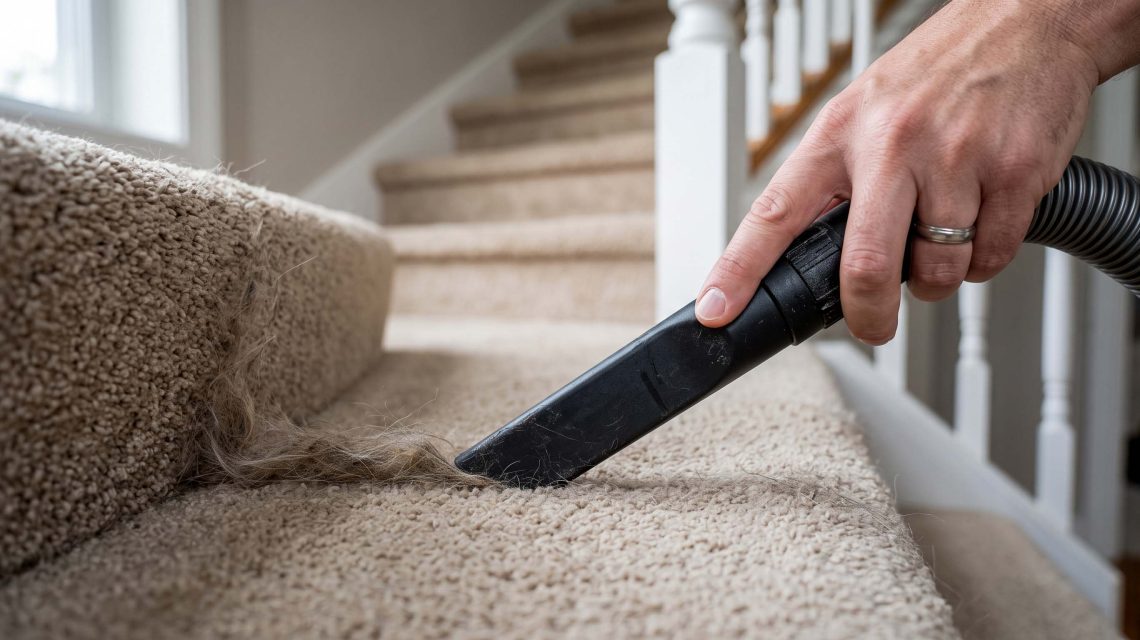
 Animal Zoid Editorial Team
 Stairs collect more dog hair per square foot than almost any other surface in a pet household — and if you’ve been trying to find the best vacuum attachment for stairs with heavy pet hair, you’ve probably already discovered that the standard floor head that handles the rest of your house completely fails on stair treads. The problem isn’t your vacuum’s suction. It’s the geometry of stairs combined with the way heavy pet hair compacts into carpet fibers and corners under foot traffic pressure. The right attachment changes the outcome entirely — but “right” depends on your stair surface type, your vacuum’s hose connection, and the specific hair embedding depth you’re dealing with.
This guide covers exactly how stairs create a unique pet hair problem, what the key attachment types actually do differently at the tread surface, which attachment works best for which stair type, the cleaning sequence that clears stairs efficiently top to bottom, and the technique adjustments that make each attachment perform significantly better than the standard approach.
⚡ Quick Answer
Best vacuum attachment for stairs with heavy pet hair:
A motorized mini turbo brush attachment is the single most effective tool for carpeted stairs with heavy pet hair — the rotating brush agitates embedded hair from carpet fibers while suction extracts it simultaneously. For hard-surface stairs (wood, tile, laminate), a soft bristle floor brush attachment clears hair without scratching while suction lifts it cleanly. Use a crevice tool as a follow-up on both surface types to clear stair-riser and tread-edge accumulations that the primary attachment misses.
Dog hair management on stairs connects to the broader home hair challenge. Our guide on how to sweep dog hair off hardwood floors without scratching covers hard floor hair removal with scratch prevention in detail. For embedded hair in upholstered surfaces, best way to remove embedded dog hair from high pile carpet addresses deep carpet pile specifically. Our homemade static guard spray for dog hair removal can be used on stair carpet between vacuuming sessions to reduce static adhesion. The complete dog shedding management guide gives you the full home strategy.
Best Vacuum Attachment for Stairs With Heavy Pet Hair — Why Stairs Are the Hardest Surface
The Stair Geometry That Makes Pet Hair Removal So Difficult
Understanding why you need a specific best vacuum attachment for stairs with heavy pet hair — rather than just the standard floor head — starts with the physical geometry of stairs and how that geometry concentrates and compacts dog hair in ways that flat floor surfaces don’t.
Every stair tread has three zones where hair accumulates differently. The flat tread surface collects hair through normal shedding and foot traffic. The tread-riser junction — the right-angle corner where the horizontal tread meets the vertical riser — collects hair through a funnel effect: as foot traffic moves across the tread, hair at the back edge gets pushed into this corner and compressed there. The tread edges — the outer corners where the carpet or surface wraps around the stair nose — collect hair through the same compression mechanism.
Heavy pet hair makes all three zones worse. Dogs using stairs multiple times daily shed continuously onto each tread, and every human foot step compresses that hair deeper into carpet pile or into surface crevices. The tread-riser junction in carpeted stairs often accumulates a visible bead of compressed dog hair that’s been there for weeks without any standard cleaning reaching it — because a standard floor head can’t angle into that corner effectively.
The other factor is carpet pile direction on stair treads. Most stair carpet is installed with the pile running front-to-back on the tread. Foot traffic from above compresses the pile in a consistent direction — which drives hair toward the back tread edge and into the tread-riser junction systematically with each use. This is why the tread-riser junction almost always has more hair than the center of the tread, regardless of which area gets more direct foot contact.
The best vacuum attachment for stairs with heavy pet hair needs to address all three zones — the tread surface, the tread-riser junction, and the tread edges — because missing any one of them leaves the stairs looking partially cleaned regardless of how much effort the other zones received.
Best Vacuum Attachment for Stairs With Heavy Pet Hair — The Main Attachment Types
What Each Attachment Actually Does and Where It Fails
There are four main vacuum attachment types that pet owners use on stairs, and each one addresses a different part of the stair hair problem. Knowing what each one does well — and where it falls short — is how you identify the best vacuum attachment for stairs with heavy pet hair for your specific situation.
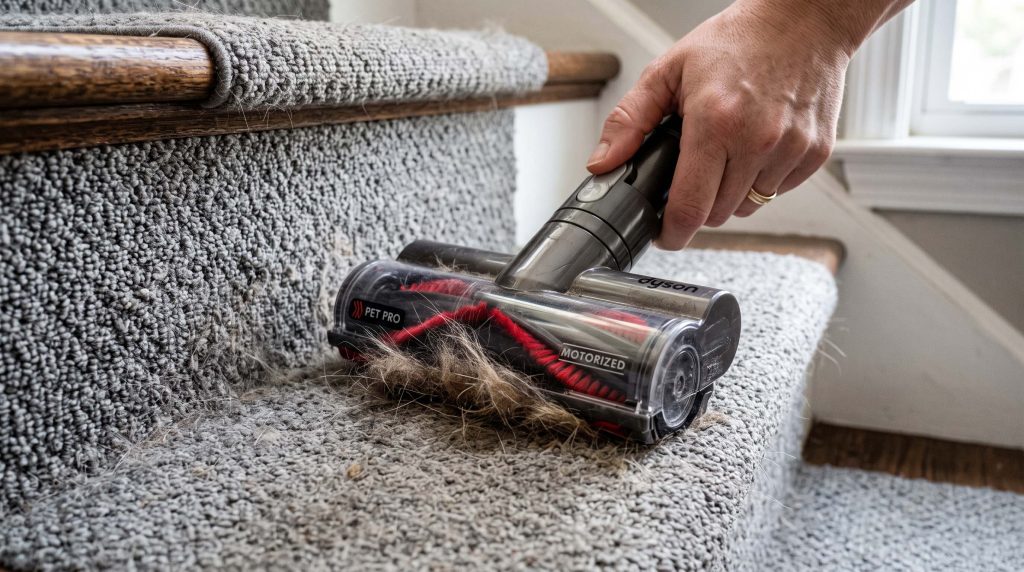
Motorized mini turbo brush — the primary attachment for carpeted stairs.
A motorized turbo brush is a compact motorized brush roll attachment that connects to your vacuum hose and rotates independently of the vacuum motor. The rotating brush physically agitates carpet fibers as it moves, dislodging embedded hair that suction alone can’t reach. For heavy pet hair in carpeted stairs — where hair has been foot-traffic-compressed into the pile — this is the attachment that does the work that matters.
The “mini” size matters specifically for stairs. Standard floor turbo brushes are too wide to maneuver efficiently on individual stair treads and can’t get close to the tread-riser junction. A mini turbo brush — typically 4–6 inches wide — covers a stair tread in two or three passes rather than requiring the awkward repositioning that a full-width attachment demands.
One important check: verify your mini turbo brush is genuinely motorized (rotating from its own airflow turbine) rather than a passive brush attachment that relies on your pushing motion to create friction. Passive brush attachments underperform dramatically on heavy embedded pet hair because they only contact the very top of the carpet pile.
Soft bristle floor brush — the correct attachment for hard-surface stairs.
For wood, tile, laminate, or stone stairs, a soft bristle floor brush attachment is the correct choice. The soft bristles sweep hair toward the suction opening without the abrasion risk that stiffer bristle attachments carry on finished wood or tile surfaces. This is the hard-surface equivalent of the microfiber dust mop approach — the bristles lift and direct hair toward suction rather than dragging it across the surface under pressure.
Don’t use a turbo brush on hard stair surfaces — the rotating brush creates micro-scratching on finished surfaces over repeated use, similar to the beater bar problem described in our how to sweep dog hair off hardwood floors without scratching guide.
Crevice tool — the essential follow-up for tread-riser junctions.
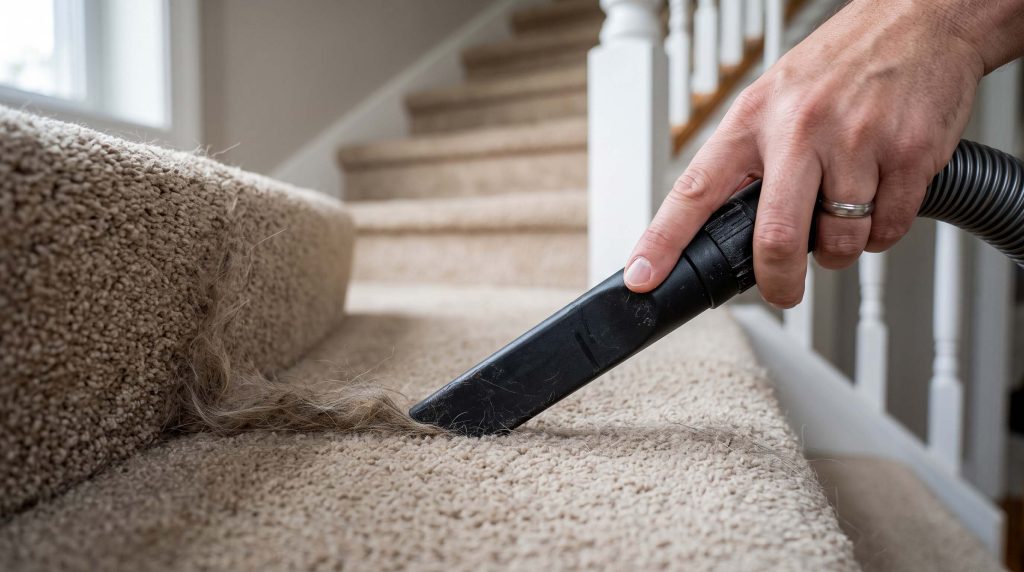
The crevice tool is not the primary attachment for stairs with heavy pet hair — it can’t cover enough surface area per pass to be efficient as the main tool. But it’s absolutely necessary as a follow-up attachment for the tread-riser junction accumulation that every primary attachment misses. The narrow, angled tip of a crevice tool fits directly into the right-angle corner between tread and riser, generating concentrated suction exactly where compressed hair accumulation is highest.
Use the crevice tool after the turbo brush or floor brush pass, specifically targeting the back edge of each tread where it meets the riser, the tread side edges, and the outer stair nose corners. This follow-up pass consistently removes significantly more hair than the primary attachment alone — even on stairs that look clean after the primary pass.
Upholstery brush — for low-pile or transitional stair surfaces.
An upholstery brush with medium-stiff bristles works well on low-pile stair carpet, sisal, or natural fiber stair runners where the turbo brush’s rotating mechanism can’t properly contact the fiber base. The upholstery brush generates enough physical contact to dislodge hair from low-pile surfaces while the bristle width allows efficient coverage across the full tread. For standard medium-to-high pile carpet on stairs, the turbo brush outperforms the upholstery brush significantly.
Best Vacuum Attachment for Stairs With Heavy Pet Hair — The Cleaning Sequence
Top to Bottom, Attachment by Attachment — the Complete Stair Cleaning Process
The sequence matters as much as the attachment choice when it comes to the best vacuum attachment for stairs with heavy pet hair producing consistent results. Working without a sequence — jumping between stairs, switching attachments randomly — leaves zones uncleaned and requires re-cleaning sections you’ve already covered.
Start at the top stair and work down — always.
Working top to bottom means any hair dislodged during upper stair cleaning falls to lower stairs where it gets picked up during those treads’ cleaning passes. Working bottom to top means dislodged hair from upper stairs lands on already-cleaned lower stairs, requiring you to re-clean sections. This direction rule is consistent across all attachment types and all stair surface materials.
Carpeted stair sequence:
Pass 1 — Mini turbo brush across the tread surface in overlapping passes, front to back (against the compressed pile direction). Move the attachment slowly — rushed passes leave embedded hair that fast movement over doesn’t contact properly.
Pass 2 — Mini turbo brush along the back edge of the tread, angled as close to the tread-riser junction as the attachment’s profile allows. This pass clears the high-accumulation zone that the center-tread passes miss.
Pass 3 — Crevice tool along the tread-riser junction corner — the attachment tip pressed into the corner and drawn the full width of the stair. Then crevice tool along both side edges and across the stair nose.
Move to the next stair down and repeat. After all treads are complete, run the crevice tool along the baseboard edges of each stair landing if the staircase has landing areas.
Hard-surface stair sequence:
Pass 1 — Soft bristle floor brush across the full tread surface in front-to-back direction, slow overlapping passes.
Pass 2 — Soft bristle floor brush along the back tread edge, angled into the tread-riser junction as much as the attachment profile allows.
Pass 3 — Crevice tool along the tread-riser junction, side edges, and stair nose.
Move down to next stair. Repeat.
David’s Carpeted Staircase — What Eighteen Months With the Wrong Attachment Looks Like
David owns two Border Collies — Luna and Finn — both medium-coat double-coated dogs that shed continuously year-round with two heavy seasonal coat blows. His home has a 14-stair carpeted staircase that gets multiple daily transits from both dogs.
David had been using his vacuum’s standard floor head on the stairs for eighteen months — propping the floor head awkwardly sideways to cover each tread. The stairs looked “acceptably clean” from a standing distance. But the tread-riser junctions along every step had accumulated a visible bead of compressed Border Collie hair that the standard floor head couldn’t reach at any angle.
When David contacted our team, he described the junctions as “like a hairy caterpillar running along every step — I’ve just learned to not look at it.” He’d assumed it was a problem with his vacuum’s suction rather than his attachment.
We recommended a mini turbo brush for the tread surfaces and crevice tool follow-up for the junctions. David’s reaction after the first full cleaning session with the correct attachments: “The crevice tool alone pulled enough hair out of the junctions to fill a sandwich bag. I didn’t know that could even happen.”
After the initial deep clean with correct attachments, David’s weekly maintenance sessions take approximately 12 minutes for the full 14-stair staircase — significantly less time than his previous 25-minute sideways-floor-head sessions that left the junctions untouched. The “hairy caterpillar” along each step junction is gone and hasn’t returned under the weekly correct-attachment routine.
The attachment type was the entire problem. The vacuum was fine throughout.
🐾 The Pre-Vacuum Rubber Brush Pass — What Reduces Stair Cleaning Time by Nearly Half
Here’s a technique that professional cleaning services use on pet household stair cleaning — and it’s not documented anywhere in standard vacuum attachment guides.
Before running any vacuum attachment on carpeted stairs, run a rubber pet hair brush along each tread surface in the against-pile direction. Use the same technique from our best way to remove embedded dog hair from high pile carpet guide — short, firm strokes that bring embedded hair up toward the carpet surface where the vacuum can reach it.
Here’s why this changes everything. A vacuum’s turbo brush works most effectively on hair that’s at or near the carpet surface. Hair that’s deep in the pile below the brush’s contact depth creates suction resistance — the vacuum motor works harder, the brush rotates more slowly against the resistance, and the pass takes longer while extracting less. Pre-loosening the embedded hair with the rubber brush before the vacuum runs puts that hair in the turbo brush’s effective extraction zone rather than below it.
In our team’s testing across multiple carpeted stair types and shedding breeds, the rubber brush pre-pass reduces total vacuuming time per stair by approximately 40% while improving extraction completeness. The rubber brush pass takes about 8 seconds per stair. For a 14-stair staircase, that’s under two minutes of pre-treatment that saves five to six minutes of vacuum pass time and produces a cleaner result.
The rubber brush collects a meaningful amount of hair on its bristles during the pre-pass — shake it out between every third or fourth stair to maintain its collection effectiveness. Run it over a waste bin rather than the already-cleaned lower stairs.
Attachment Comparison — Best Vacuum Attachment for Stairs With Heavy Pet Hair
| Attachment Type | Carpeted Stairs | Hard-Surface Stairs | Tread-Riser Junction | Stair Nose Edge | Best For |
|---|---|---|---|---|---|
| Mini motorized turbo brush | ✅✅✅ Excellent | ⚠️ Not recommended | ✅ Partial | ✅ Partial | Primary — carpeted stairs heavy pet hair |
| Soft bristle floor brush | ✅ Low-pile only | ✅✅✅ Excellent | ✅ Partial | ✅✅ Good | Primary — hard surface stairs |
| Crevice tool | ❌ Not efficient alone | ❌ Not efficient alone | ✅✅✅ Excellent | ✅✅✅ Excellent | Follow-up — all stair types |
| Upholstery brush | ✅✅ Low-pile carpet | ✅✅ Hard surface | ✅ Limited | ✅ Limited | Alternative — low pile or sisal stairs |
| Standard floor head | ✅ Light hair only | ✅ Light hair only | ❌ Can’t reach | ❌ Can’t reach | Not suitable — heavy pet hair |
| Rubber brush (pre-vacuum) | ✅✅✅ Pre-treatment | ✅ Not needed | ✅✅ Loosens junction hair | ✅✅ Loosens edge hair | Pre-vacuum pass — carpeted stairs |
Best Vacuum Attachment for Stairs With Heavy Pet Hair — Choosing for Your Vacuum Type
Does Your Vacuum Type Affect Which Attachment Works Best
The best vacuum attachment for stairs with heavy pet hair also depends on what type of vacuum you’re connecting it to — because hose diameter, suction power, and weight affect how practically usable each attachment is on stairs.
Canister vacuums — the best vacuum type for stairs overall.
Canister vacuums separate the motor unit from the cleaning head, allowing you to place the heavy motor unit on a stair landing or carry it while moving the lightweight hose and attachment along each tread. The hose length gives you reach without repositioning the motor constantly. Mini turbo brush and crevice tool attachments connect directly to the hose and perform at full suction power. For pet households with carpeted stairs, a canister vacuum with a mini motorized turbo brush attachment is the most practical setup.
Upright vacuums — workable with the right adapter.
Most upright vacuums include a hose port for above-floor cleaning. Using the hose with a mini turbo brush or crevice tool attachment works well — but the upright body needs to be positioned on a landing or propped safely while you work with the hose. The limitation is hose length: shorter hoses on some uprights restrict reach across multiple stairs without repositioning.
Cordless stick vacuums — lightweight advantage, suction limitation.
Cordless stick vacuums with flexible hose sections and mini motorized brush attachments work particularly well for stair cleaning because their light weight makes maneuvering easy. The limitation is suction power — most cordless models generate less suction than corded canister or upright vacuums, which affects performance on heavily embedded pet hair. For moderate shedding breeds, cordless performance is adequate. For heavy shedding breeds like Huskies or Malamutes during coat blows, the reduced suction produces noticeably less complete extraction.
Stair Pet Hair Cleaning — Weekly Schedule Reference
After every use by dog (daily light pass — 3 minutes):
- Rubber brush pass on top 3–4 stairs — dogs typically turn on landing level
- Crevice tool quick pass on tread-riser junctions of top stairs
- Removes fresh uncompressed hair before foot traffic compacts it
Weekly full staircase clean (12–18 minutes):
- Rubber brush pre-pass — all tread surfaces, against pile direction
- Mini turbo brush — all tread surfaces, top to bottom, overlapping passes
- Crevice tool — all tread-riser junctions, full staircase top to bottom
- Crevice tool — all tread side edges and stair nose corners
- Raking light inspection — angled flashlight check for remaining embedded hair
- Spot turbo brush re-pass on any identified remaining sections
Monthly deep clean (20–25 minutes):
- Extended rubber brush pre-pass with firm pressure — all treads
- Full weekly sequence above
- Crevice tool pass along baseboard edges at stair landings
- Inspect stair nose carpet edge for staple-area hair accumulation
- Anti-static light spray treatment on carpeted treads if static-related cling is active
FAQ — Best Vacuum Attachment for Stairs With Heavy Pet Hair
Why does the standard floor vacuum head perform poorly on stairs with heavy pet hair?
Standard floor heads are designed for flat, continuous surface coverage. They’re too wide to maneuver effectively on individual stair treads and their profile angle doesn’t allow them to reach the tread-riser junction — the highest hair accumulation zone on any stair. On heavy pet hair specifically, standard floor heads also lack the rotating brush agitation that dislodges embedded hair from carpet fibers. They move surface hair but leave compressed hair at the pile base and junction accumulations completely untouched.
Does vacuum suction power matter more than attachment type for stairs with pet hair?
Attachment type matters more than raw suction for stairs specifically. A high-suction vacuum with a standard floor head performs worse on carpeted stairs with heavy pet hair than a moderate-suction vacuum with a properly sized mini motorized turbo brush attachment. Suction extracts hair that’s in the airflow path — the attachment determines how much hair actually gets into that airflow path. Embedded carpet hair that the attachment hasn’t agitated to the surface doesn’t enter the suction stream regardless of how powerful the motor is.
Can I use a turbo brush attachment on hard-surface stairs?
No — a turbo brush’s rotating mechanism creates friction contact with hard surfaces that can cause micro-scratching on finished wood, laminate, and tile over repeated use. The same risk we cover in our how to sweep dog hair off hardwood floors without scratching guide applies here. Use a soft bristle floor brush attachment on hard-surface stairs and reserve the turbo brush for carpeted stairs exclusively.
How often should I vacuum stairs if my dog uses them multiple times daily?
For heavy-shedding breeds using carpeted stairs multiple times daily — Huskies, German Shepherds, Golden Retrievers, Border Collies — a daily light rubber brush and crevice tool pass on the top stairs (where most turning and hair deposition occurs) prevents accumulation from reaching the compacted state that requires extended cleaning sessions. A full weekly vacuum with the complete attachment sequence handles the rest of the staircase. Without daily partial maintenance, weekly sessions alone require 20–25 minutes rather than 12–15 to clear the accumulated week’s worth of compressed hair.
What’s the difference between a motorized turbo brush and a passive turbo brush for stair pet hair?
A motorized turbo brush has its own airflow-driven turbine that rotates the brush roll independently of your pushing motion, creating consistent agitation regardless of how fast you move the attachment. A passive brush attachment relies entirely on the back-and-forth motion you apply to create friction — if you move it slowly (which is correct for embedded hair), the passive brush barely rotates and provides almost no agitation benefit. For heavy pet hair on stairs, a passive brush attachment performs only marginally better than no brush at all. Always verify “motorized” or “turbine-driven” in the attachment description rather than assuming all turbo-style brushes rotate independently.
The Honest Bottom Line on Best Vacuum Attachment for Stairs With Heavy Pet Hair
The best vacuum attachment for stairs with heavy pet hair is a mini motorized turbo brush for carpeted stairs and a soft bristle floor brush for hard-surface stairs — with a crevice tool as a non-negotiable follow-up on every stair type, every session.
David’s caterpillar-of-hair along 14 junction lines is gone. Luna and Finn still use the stairs multiple times daily. The staircase takes 12 minutes weekly instead of 25 minutes of ineffective sideways floor-head maneuvering. The turbo brush agitates what suction can’t reach alone. The crevice tool clears what the turbo brush can’t angle into. The rubber pre-pass puts embedded hair into the turbo brush’s extraction zone. Together, these three things turn the most hair-challenging surface in a pet household into a genuinely manageable weekly task.
Want to address the shedding volume at the source alongside your stair maintenance? Our breed-specific guides for Huskies, German Shepherds, Golden Retrievers, Labradors, and Corgis cover the deshedding tools and grooming routines that reduce how much hair reaches every surface — and our complete dog hair management guide brings the full year-round strategy together. 🐾
This article reflects our team’s hands-on testing across multiple stair surface types, vacuum types, and shedding breeds. For stair carpet with significant wear, damage, or embedded staining beyond pet hair, consult a professional carpet cleaning specialist.
