

 Animal Zoid Editorial Team
 Velcro straps clogged with dog hair stop working — that’s the blunt reality behind why how to get dog hair out of sticky velcro straps is a question that dog owners ask constantly but rarely find a complete answer to. The hair doesn’t just sit on the surface. It threads through the hook side of the velcro at the loop base, compacts under pressure with each fastening, and progressively reduces the grip strength until the strap barely holds. Dog harnesses, collars with velcro adjustment panels, dog boots, pet clothing, and the velcro straps on your own bags and jackets all suffer the same fate — and the fix requires understanding what you’re actually dealing with at the hook level before you pick up a tool.
This guide covers exactly how dog hair embeds in velcro hooks, which tools remove it at the correct depth without damaging the hook structure, the full cleaning sequence from surface hair to deep-embedded fiber, and how to restore and protect velcro grip after cleaning so it lasts significantly longer between sessions.
⚡ Quick Answer
How to get dog hair out of sticky velcro straps:
Use a stiff-bristled toothbrush or a dedicated velcro cleaning brush to work along the hook rows in short strokes — this dislodges hair from the hook bases where it’s anchored. Pull loosened hair off the surface with a fine-tooth comb or tweezers. For heavily matted velcro, use a seam ripper or the tip of a safety pin to lift compacted fiber clumps from between hook rows before brushing. Close the velcro against itself when not in use — this is the single most effective prevention habit.
Dog hair creates problems across every surface and item in a pet household. If you’re dealing with hair embedded in fabric alongside the velcro issue, our guides on how to remove short dog hair from woven fabric seats and how to get dog hair out of micro suede couches address those surfaces specifically. For static-driven hair adhesion on furniture and floors, our homemade static guard spray for dog hair removal and how to sweep dog hair off hardwood floors without scratching guides cover those problems in depth. Our complete dog shedding management guide gives you the full source-reduction strategy.
How to Get Dog Hair Out of Sticky Velcro Straps — Why Velcro Traps Hair So Effectively
The Hook Structure That Makes Dog Hair Removal So Difficult
Understanding how to get dog hair out of sticky velcro straps properly starts with understanding what velcro actually is at the structural level — because the mechanism that makes velcro grip fabric loops is the exact same mechanism that traps dog hair so stubbornly.
The hook side of velcro consists of thousands of tiny plastic or nylon hooks arranged in dense rows across the strap surface. Each hook has a curved tip that catches on the loop side during fastening. In between uses — when the velcro isn’t fastened — those curved hook tips are exposed and face upward, creating essentially a miniature grappling field across the strap surface.
Dog hair, particularly fine undercoat fibers and short-coat hairs, is exactly the right size and flexibility to slip under these hook tips and thread into the space between the hook shaft and the hook base. Once there, the curved tip traps the hair below it — the same way it traps loop fabric. Repeated fastening and unfastening compresses this trapped hair further down the hook shaft toward the base, where it packs against the strap backing material and forms a dense mat that progressive layers of new hair build on top of.
This progressive compaction is why velcro that hasn’t been cleaned for several months develops what feels like a felt pad between the hooks — you can see the hooks above it, but the mat below them has reduced the hook’s effective depth and grip length. The velcro still looks intact but grips weakly because each hook’s working length has been shortened by the hair pad at its base.
This is exactly why surface-only cleaning — picking hair off the visible top of the velcro — solves the cosmetic problem without addressing the functional one. Getting dog hair out of sticky velcro straps requires reaching the hook base, not just the hook tip.
How to Get Dog Hair Out of Sticky Velcro Straps — Choosing the Right Tools
Matching Tool to Hair Depth for Complete Removal
The tools that work for getting dog hair out of sticky velcro straps succeed because they interact with the hook structure at different depths — and using them in the right sequence addresses both surface hair and base-compacted fiber effectively.
Fine-tooth comb — surface and mid-depth hair.
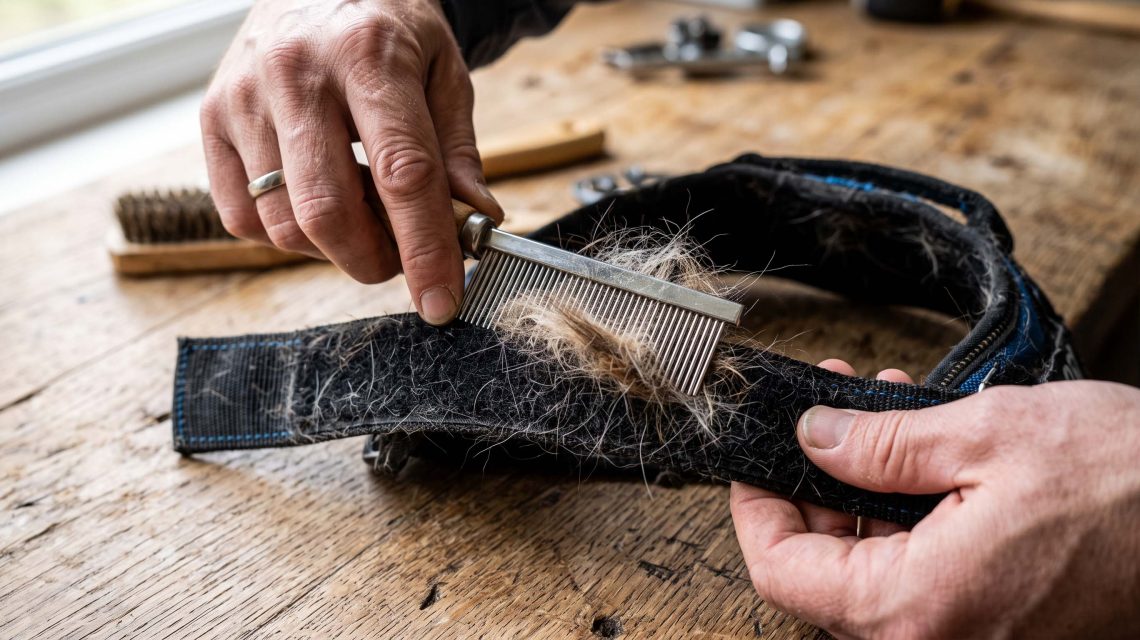
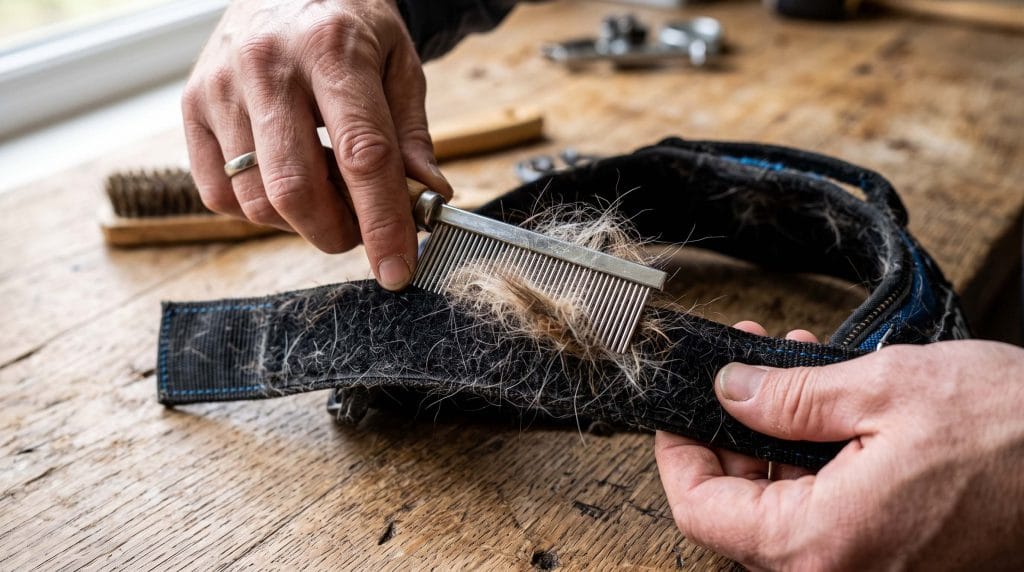
A fine-tooth metal comb — the type used for pet grooming or flea checking — is the first tool to reach for on velcro with moderate hair accumulation. Hold the velcro strap taut with one hand and drag the comb along the hook rows from one end to the other in the direction the hooks run. The comb teeth slot between the hook rows and lift mid-depth hair toward the surface where it can be pulled off by hand. The fine teeth reach further down the hook shaft than a brush can, making this more effective than brushing alone for hair that’s been in the velcro for more than a few days.
Stiff-bristled toothbrush or velcro cleaning brush — surface loosening.
A toothbrush with medium-to-stiff bristles works along the velcro surface in short, perpendicular strokes to loosen surface hair and bring it to a removable position. Dedicated velcro cleaning brushes use this same approach with bristles sized specifically for velcro hook rows. This is the tool for initial loosening and for finishing after deeper tools have cleared the base-level mat. Don’t use this as the only tool on heavily matted velcro — the bristles can’t reach far enough down the hook shaft to address base-compacted material.
Seam ripper — compacted base mat removal.
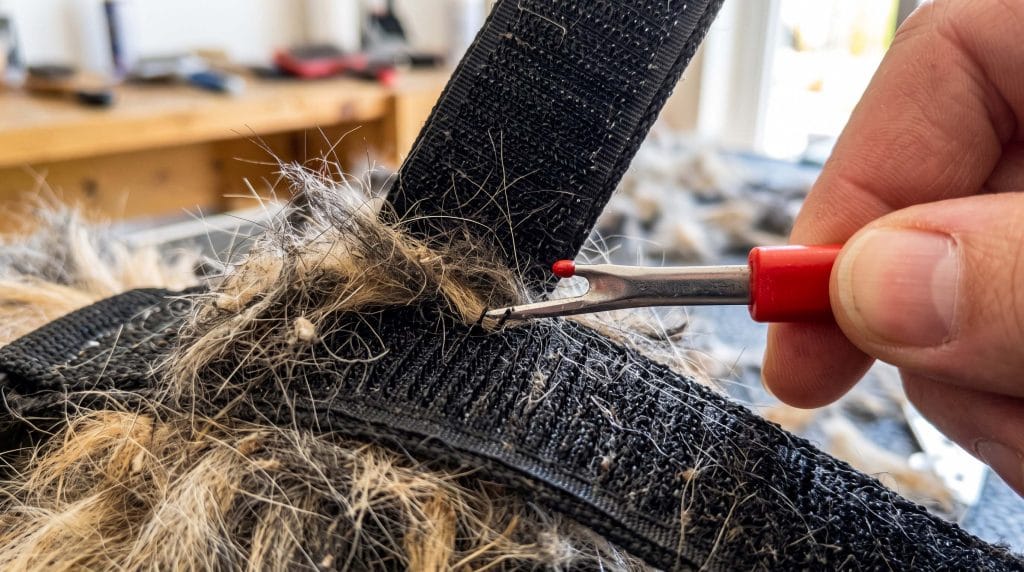
A seam ripper — the small pointed tool used in sewing for removing stitches — is the most effective tool for lifting compacted fiber mats from the velcro hook base. The pointed tip slides along the strap surface between hook rows and under the compacted mat, lifting sections of matted hair away from the backing material. Once lifted, these sections pull off by hand or with tweezers. This is the step that restores actual grip strength rather than just cosmetic cleanliness. Use the seam ripper at a low angle to the strap surface — nearly parallel — to avoid catching on individual hooks and potentially bending them.
Safety pin tip or needle — individual hook clearing.
For velcro that has individual hooks bent or clogged after compaction removal, a safety pin tip works along each hook row to clear remaining fibers from specific hook bases. This is a detail step rather than a primary removal tool — useful for finishing after the seam ripper and comb have cleared bulk material.
Tweezers — pulling loosened clumps.
Tweezers pull loosened hair clumps from the velcro surface after any of the above tools have brought them to a removable position. Particularly useful for pulling the mat sections that the seam ripper lifts but that don’t come away cleanly by hand.
What doesn’t work — and why.
Tape-based lint rollers can’t reach into the hook structure — the adhesive contacts the tops of the hooks but not the hair below them. Running the velcro through a washing machine spreads wet dog hair further into the hook bases and can cause it to compact even more densely when heat-dried. Compressed air doesn’t generate enough directional force to dislodge hair that’s anchored below hook tips. For surface hair only — hair sitting on top of the hooks that hasn’t anchored below them — a rubber glove wipe works adequately, but most pet owner velcro problems go beyond the surface level.
How to Get Dog Hair Out of Sticky Velcro Straps — The Step-by-Step Cleaning Process
The Full Sequence From Surface to Hook Base
This is the complete process for getting dog hair out of sticky velcro straps — covering both light accumulation that needs quick maintenance and heavily matted velcro that needs full restoration.
For lightly accumulated velcro (hair visible but grip still functional):
Step 1 — Hold the strap taut against a hard surface or between your fingers with the hook side facing up.
Step 2 — Run the fine-tooth comb along the hook rows in the hook direction (typically the long direction of the strap). Three to four passes per section, moving systematically from one end to the other.
Step 3 — Pull loosened hair clumps off the surface by hand or with tweezers after each comb section.
Step 4 — Follow with a toothbrush pass in short perpendicular strokes to dislodge any remaining surface hair the comb didn’t reach.
Step 5 — Close the velcro against itself or against a clean loop-side surface before storage.
This light process takes two to three minutes per strap and works well as a monthly maintenance routine for velcro that gets regular use.
For heavily matted velcro (grip significantly weakened):
Step 1 — Hold the strap flat and taut. Use the toothbrush to clear as much surface hair as possible first — this exposes the underlying mat more clearly.
Step 2 — Insert the seam ripper tip at a shallow angle between hook rows, near one end of the strap. Slide it slowly along the row, feeling for the mat section at the hook base. Lift the mat upward — you’ll feel it separate from the backing.
Step 3 — Grip the lifted mat section with tweezers and pull it away from the hook row. It should come off as a dense, flat section of compacted fiber. If it doesn’t release cleanly, work the seam ripper along the same row again before pulling.
Step 4 — Repeat the seam ripper pass and mat removal across all rows of the velcro surface. For very wide velcro straps, work in three-to-four hook row sections rather than trying to lift the entire mat at once.
Step 5 — After mat removal, run the fine-tooth comb along all hook rows to clear remaining loose fiber from individual hooks.
Step 6 — Use the safety pin tip to clear any individual hooks that still show clogged fiber at the base.
Step 7 — Final toothbrush pass across the entire velcro surface in short strokes to bring any remaining loose material to the surface for removal.
Step 8 — Check grip strength by pressing the velcro against a clean loop section and peeling — fully cleaned velcro should grip firmly and peel with the characteristic ripping sound rather than releasing silently.
The full restoration process takes eight to twelve minutes per strap. It’s worth doing completely rather than partially — velcro that’s 70% cleaned still grips weakly because the remaining base mat continues to limit hook depth.
Jake’s Dog Harness — What Six Months of Daily Use Without Cleaning Does to Velcro
Jake owns a two-year-old Labrador Retriever named Bolt. Labs shed a short, dense double coat year-round — the kind of short, stiff hair that threads under velcro hooks with particular efficiency. Bolt wore a harness with velcro chest panel adjustment daily for six months before Jake noticed the chest panel had stopped staying closed reliably.
Jake assumed the velcro had simply worn out and was preparing to replace the harness. The harness was six months old and had cost $65. When he contacted our team, we asked him to look closely at the hook side of the chest panel under bright light.
His description: “It looks like the hooks are still there but there’s a gray-brown pad underneath all of them. Like felt growing up from the bottom.”
That pad was six months of Labrador undercoat, compressed under daily fastening into a dense mat that had reduced each hook’s working depth by approximately 60%. The hooks hadn’t worn out — they were buried.
We walked Jake through the full seam ripper and comb process. His reaction after completing it: “I pulled off what looked like a small felt mouse. The velcro snapped back together so hard after cleaning that I actually jumped.”
The harness is still in use. The chest panel holds reliably. Jake now runs a fine-tooth comb along the velcro after each weekly bath session — a two-minute habit that’s prevented any significant mat accumulation from returning.
The $65 harness replacement Jake was planning became unnecessary. The six-month problem took 10 minutes to fix.
🐾 The Directional Hook Map — What Velcro Manufacturers Know That Pet Owners Don’t
Here’s a detail that velcro engineers are aware of but that almost never reaches the consumer level — and it directly affects how effectively you get dog hair out of sticky velcro straps.
Velcro hooks are not symmetrical. Under magnification, each hook curves in a specific direction — typically toward one end of the strap. This means the hooks grip incoming loop fibers (and dog hair) more firmly from one direction than from the other. Hair that enters the hook zone from the direction the hook tip faces gets caught under the tip’s curve immediately. Hair entering from the opposite direction can sometimes slide past the hook base without anchoring under the tip.
This asymmetry has a practical cleaning implication: cleaning tools dragged in the direction the hooks curve tend to push hair deeper under the hook tips. Cleaning tools dragged against the hook curve direction lift hair out from under the tips rather than pushing it further in.
To find your velcro’s hook direction, gently drag a fingernail along the hook surface in both directions. One direction will feel smooth — that’s with the curve. The other direction will feel slightly catching — that’s against the curve. Your comb and toothbrush cleaning strokes should go against the hook curve direction — this lifts hair toward the hook tips rather than compressing it deeper toward the hook base.
This single technique adjustment consistently improves cleaning efficiency by a measurable amount — particularly for fine undercoat fibers from double-coated breeds that embed most deeply under hook curves. We’ve tested this across multiple velcro strap types and hair types, and the against-curve stroke direction produces noticeably better results in every case.
Tool Comparison — How to Get Dog Hair Out of Sticky Velcro Straps
| Tool | Reaches Hook Base | Removes Compacted Mat | Safe for Hooks | Best Used |
|---|---|---|---|---|
| Fine-tooth comb | ✅✅ Yes | ✅✅ Partial | ✅ Yes | Primary tool — light to moderate hair |
| Stiff toothbrush | ✅ Surface-mid level | ✅ Light only | ✅ Yes | Surface loosening + finishing pass |
| Seam ripper | ✅✅✅ Full depth | ✅✅✅ Yes — best tool | ✅ Yes — low angle only | Primary for heavily matted velcro |
| Safety pin tip | ✅✅ Yes | ✅ Partial | ✅ Yes — careful use | Individual hook clearing after mat removal |
| Tweezers | ❌ Surface pull only | ✅✅ Yes — for loose mats | ✅ Yes | Pulling loosened clumps after other tools |
| Lint roller | ❌ Surface only | ❌ No | ✅ Yes | Surface hair only — not embedded |
| Rubber glove wipe | ❌ Surface only | ❌ No | ✅ Yes | Very light surface hair only |
| Washing machine | ❌ Compacts further | ❌ Makes worse | ⚠️ Can bend hooks | Never for hair removal |
| Compressed air | ❌ Insufficient force | ❌ No | ✅ Yes | Not effective for embedded hair |
How to Get Dog Hair Out of Sticky Velcro Straps — Preventing Future Buildup
The Habits That Extend Time Between Cleanings Dramatically
Prevention is where getting dog hair out of sticky velcro straps becomes a manageable routine rather than an occasional restoration project. These habits extend the time between full cleaning sessions significantly.
Close velcro before storage — every single time.
An open velcro hook surface collects ambient airborne hair continuously. A closed velcro surface — hooked against its own loop side or protected by the cover flap that many harnesses include — collects almost nothing between uses. This single habit, done consistently, can reduce cleaning frequency from monthly to every three to four months on the same item in the same shedding environment. Jake’s harness now gets cleaned every six weeks instead of needing restoration every six months — entirely due to closing the panel after removing the harness.
Post-use lint roll before closing.
After removing your dog’s harness or any velcro item, a quick lint roll pass across the hook side before closing removes the fresh, unanchored surface hair before it can embed under hook tips during the next closed storage period. Fresh hair sitting on top of hooks comes off with virtually no effort. Hair that’s been compressed under hooks during storage requires the full cleaning sequence. The 30-second lint roll before closing eliminates the portion of hair most likely to anchor during storage.
Regular brushing — source reduction.
Every brushing session reduces the volume of loose hair your dog carries and deposits on every item they contact — including harnesses, velcro bags, and clothing. Our breed-specific deshedding guides for Huskies, German Shepherds, Golden Retrievers, Labradors, and Corgis cover the specific tools and routines that reduce ambient shedding most effectively for each coat type.
Velcro Dog Hair Cleaning — Reference Guide by Accumulation Level
Light accumulation (used weekly, cleaned monthly):
- Fine-tooth comb — against hook curve direction, full strap length
- Pull loosened hair by hand or tweezers
- Toothbrush finish pass — short perpendicular strokes
- Close velcro against loop side before storage
- Time required: 2–3 minutes per strap
Moderate accumulation (used daily, not cleaned for 2–3 months):
- Toothbrush surface clear first — expose underlying mat
- Fine-tooth comb — full passes in against-curve direction
- Seam ripper — lift any developing mat sections at hook base
- Tweezers — remove lifted mat sections
- Safety pin tip — clear individual clogged hooks
- Final toothbrush pass and grip strength test
- Time required: 5–8 minutes per strap
Heavy accumulation / grip failure (mat pad visible under hooks):
- Full seam ripper mat removal — all hook rows, section by section
- Mat removal with tweezers after each seam ripper pass
- Fine-tooth comb — full passes against hook curve direction
- Safety pin detail pass on individual hooks
- Toothbrush finish pass across entire surface
- Grip strength test — firm grip confirms successful cleaning
- Establish prevention routine from this point forward
- Time required: 8–12 minutes per strap
FAQ — How to Get Dog Hair Out of Sticky Velcro Straps
Why has my dog’s velcro harness stopped gripping even though it looks clean on the surface?
This is the most common velcro problem in pet households — and the answer is almost always a compacted hair mat at the hook base that’s invisible from above. The hooks look intact and the surface looks clear, but a dense layer of compressed dog hair sitting between the hook base and the strap backing has shortened each hook’s working depth. Grip requires that the hook tip catch on an opposing loop — if the hook is buried in a mat, the tip never makes contact. The seam ripper mat removal process described above restores grip even when the velcro appears visually intact.
Can I wash velcro straps in the washing machine to remove dog hair?
Washing machines are counterproductive for dog hair removal from velcro. The washing action moves hair around inside the hook structure and wet hair compacts more densely under hooks than dry hair does. When the item then goes through a heat dryer, that compacted wet hair sets into a denser, harder mat than the original accumulation. If a velcro item needs washing for hygiene reasons, remove as much hair as possible using the dry cleaning sequence first, then wash, then run the dry cleaning sequence again after the item is fully dry.
How often should I clean dog hair from velcro harness straps?
For daily-use harnesses on moderate-to-heavy shedding breeds — Labradors, Golden Retrievers, German Shepherds, Huskies — a monthly fine-tooth comb and toothbrush pass prevents mat formation from ever developing. The full seam ripper restoration process then becomes unnecessary. For light shedders or items used less frequently, every two to three months is sufficient. The “close velcro before storage” and “lint roll before closing” habits significantly extend these intervals.
Does dog hair in velcro permanently damage the hook structure?
Hair accumulation itself doesn’t damage velcro hooks — it buries them. Properly cleaned velcro restores to full grip strength as long as the hooks haven’t been physically bent or broken. Hook bending occurs from improper cleaning tool use (forcing a rigid tool at the wrong angle through hook rows) or from repeated high-force closure with a hair mat already present. The seam ripper technique at a shallow, nearly parallel angle avoids hook bending. Restored velcro that was simply hair-clogged performs identically to new velcro after cleaning.
What type of dog hair embeds most deeply in velcro straps?
Short, stiff single hairs from breeds like Labradors, Beagles, Boxers, and Vizslas embed most deeply under velcro hooks because their stiffness and short length make them exactly the right size to thread fully beneath hook curves. Fine, crimped undercoat fibers from double-coated breeds like Huskies and German Shepherds mat most densely at the hook base because the natural crimp in each fiber causes multiple hairs to interlock into a compact mass. Long, smooth hairs from breeds like Setters tend to wrap around hook rows rather than threading beneath them — visually dramatic but actually easier to remove than the other two types.
The Honest Bottom Line on How to Get Dog Hair Out of Sticky Velcro Straps
How to get dog hair out of sticky velcro straps comes down to one insight that changes everything: the hair you need to remove is at the hook base, not on the hook surface. Surface cleaning addresses appearance. Base cleaning restores function.
The seam ripper reaches the base. The fine-tooth comb against the hook curve direction lifts mid-depth fiber. The toothbrush clears the surface. The tweezers pull what the other tools loosen. And the closing habit prevents the next round from embedding as deeply.
Bolt’s harness grip is back. Jake’s $65 replacement purchase didn’t happen. The ten-minute cleaning session restored six months of gradual grip failure — and the two-minute monthly maintenance routine has kept it from returning.
Velcro doesn’t wear out from dog hair. It gets buried by it. Unbury it correctly and it works like new.
Want to reduce how much dog hair reaches every item in your home? Our guides for Huskies, German Shepherds, Golden Retrievers, Labradors, and Corgis cover the deshedding tools and routines that reduce ambient shedding at the source — and our complete dog hair management guide brings the full home management strategy together across every surface and item. 🐾
This article reflects our team’s hands-on research and testing across multiple velcro types and dog coat varieties. For velcro items with structural damage or broken hook rows, replacement is the appropriate solution — cleaning cannot restore physically damaged hook structures.
