

 Animal Zoid Editorial Team
 Yes, you can safely brush a dog while the coat is soapy, provided you use flexible rubber or silicone tools rather than stiff bristle or metal wire brushes. When you understand how can you brush a dog while the coat is soapy, shampoo lather actually provides a slick protective cushion that helps dislodge dead, shedding undercoat without scratching delicate skin.
+-----------------------------------------------------------------------------------+
|               WET-BRUSHING COMPATIBILITY MATRIX BY TOOL TYPE                      |
|                                                                                   |
|  Rubber Curry / Silicone Nubs   | [SAFE & RECOMMENDED]   High Slip, Low Traction  |
|  Wide-Tooth Detangling Comb     | [CONDITIONER ONLY]     Gentle on Wet Lengths    |
|  Wire Pin Slicker Brush         | [DANGEROUS WET]        Cuts Cuticles & Skin     |
|  Metal Undercoat Deshedding Rake| [AVOID WHEN SOAPY]     Snaps Elastic Wet Hairs  |
|  Natural Bristle Brush          | [INEFFECTIVE]          Matts Lather, Skims Top  |
+-----------------------------------------------------------------------------------+
For decades, traditional grooming advice warned pet owners to never brush a dog while wet. The reasoning seemed sound: wet hair is physically weaker and prone to stretching and snapping under tension.
Modern grooming chemistry and tool design change that calculation completely. When you pair properly diluted shampoo with the right mechanical action, brushing a soapy coat becomes one of the most effective ways to extract trapped undercoat before it ever hits your drying table or your living room floor.
We have tested this technique across countless coat types, from dense Labradors to heavy-coated Shepherds, and this guide breaks down the biological mechanics, proper tool selection, and step-by-step techniques you need to know.
The Direct Science: Can You Brush a Dog While the Coat Is Soapy Without Causing Damage?
To answer whether can you brush a dog while the coat is soapy, we have to look directly at the microscopic structure of canine hair shafts and skin. Water fundamentally alters the physical properties of canine keratin fibers, changing how hair responds to mechanical pulling and friction.
[Dry Hair Shaft: Tight Cuticle Scale]
               │
               ▼  + [Water & Surfactants]
[Wet Hair Shaft: Cuticle Swells & Lifts 30%]
               │
               ▼  + [Surfactant Lather Film]
[Protective Hydro-Lipid Slip Layer Formed]
How Wet Hair Elasticity Changes When You Brush a Dog While the Coat Is Soapy
Dry canine hair consists of tightly bonded keratin protein chains held together by disulfide and hydrogen bonds. When you saturate a dog’s coat with water, those temporary hydrogen bonds break down immediately. The hair shaft absorbs up to a third of its own weight in water, causing the exterior cuticle scales (which normally lie flat like shingles on a roof) to swell and flare outward.
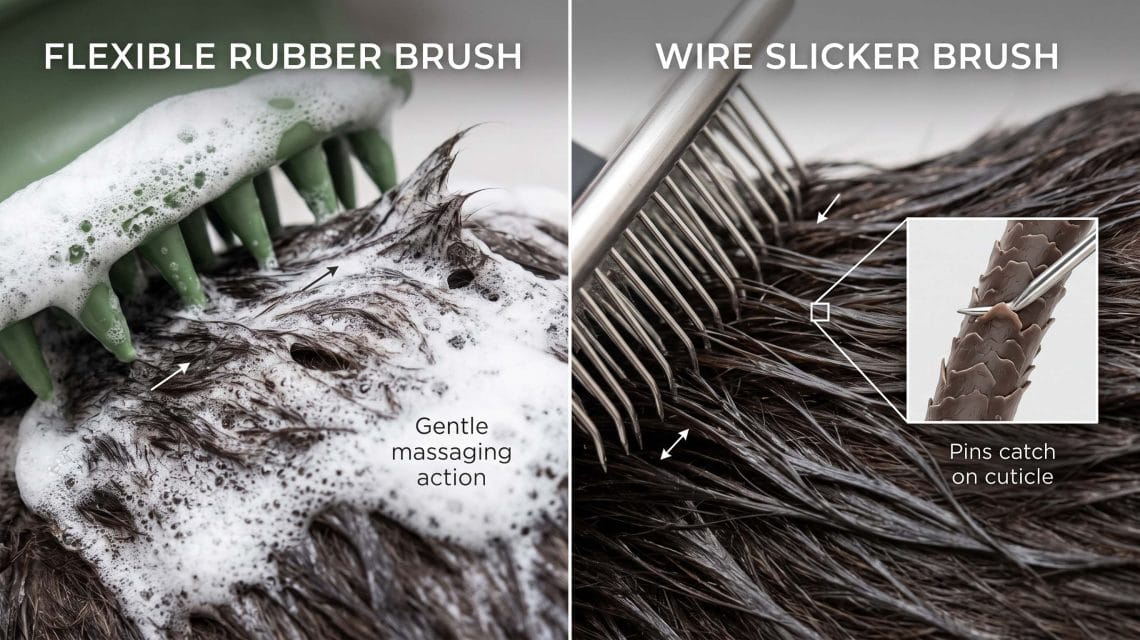
This state of hydro-expansion reduces the hair shaft’s tensile strength by roughly 30% to 40%. If you apply a rigid, high-friction tool—like a fine wire slicker—the flared cuticle scales catch on the metal pins. Instead of sliding through, the hair stretches beyond its elastic limit and snaps off midway down the shaft.
When you use a smooth rubber tool over a thick lather, the mechanical friction remains lower than the hair’s breaking threshold. The tool lifts dead, telogen-phase hairs cleanly out of the follicle without damaging the living, anagen-phase hairs anchored in the skin.
The Lubricating Role of Shampoo Surfactants During Soapy Brushing
Shampoo is not just soap; it is a complex chemical matrix of surfactants, conditioning polymers, and water. Surfactants have a hydrophilic (water-attracting) head and a lipophilic (oil-attracting) tail. As you work lather into the coat, these molecules surround individual hair fibers, creating a microscopic cushion called a lubricating boundary layer.
+------------------------------------------------------------------------------+
|                    SURFACTANT BOUNDARY LAYER DYNAMICS                        |
|                                                                              |
|      [ Rubber Nub ]                                                          |
|            │                                                                 |
|     ═══════▼════════  ◄── Micro-Slip Cushion (Surfactant Lather)             |
|     ░░░░░░░░░░░░░░░░  ◄── Swollen Cuticle Scales (Protected from Shear)      |
|     ████████████████  ◄── Core Hair Shaft (Keratin Cortex)                   |
+------------------------------------------------------------------------------+
This surfactant film lowers surface drag. When a flexible rubber nub glides over a soapy hair shaft, the lather absorbs the shear force that would otherwise tear the hair cuticle.
Diluting your concentrate properly makes a huge difference here. As we covered in our breakdown on how to safely dilute professional dog deshedding shampoo, concentrated soap paste is too tacky and creates drag, while properly diluted shampoo provides the exact watery slip needed for safe wet brushing.
What Happens If You Brush a Dog While the Coat Is Soapy Using the Wrong Tool?
The question of whether can you brush a dog while the coat is soapy always comes down to the tool in your hand. Using the wrong grooming implement on wet, soapy hair can cause immediate follicle trauma and painful skin irritation.
+----------------------------------------------------------------------------+
|                   TOOL ACTION UNDER SOAPY CONDITIONS                       |
|                                                                            |
|  METAL WIRE PINS:                                                          |
|  [Rigid Pin Point] ──► Pierces Softened Skin + Shreds Flared Cuticle       |
|                                                                            |
|  CONICAL RUBBER NUBS:                                                      |
|  [Blunt Elastic Tip] ──► Massages Dermis + Traps Dead Undercoat via Drag   |
+----------------------------------------------------------------------------+
Why Wire Pins and Slickers Fail When You Brush a Dog While the Coat Is Soapy
Wire slicker brushes and fine metal combs are designed strictly for dry coats. During a bath, water softens your dog’s stratum corneum (the outermost layer of dead skin cells).
When you drag fine, rigid wire pins across softened, waterlogged skin:
- The sharp tips easily scratch through the delicate epidermal barrier, causing micro-abrasions known as “brush burn.”
- The rigid wires catch on the open, water-swollen cuticles of adjacent hairs, ripping healthy guard hairs out at the root.
- The wire teeth channel soap away from the hair shaft, eliminating the protective lather cushion and creating high friction points.
Why Rubber Curry Tools Excel When You Brush a Dog While the Coat Is Soapy
Rubber curry brushes, silicone bath gloves, and broad elastomer massage pads work on an entirely different physical principle. They rely on surface adhesion and soft compression:
[Rubber Nub Compresses Coat] ──► [Surfactants Foam into Micro-Bubbles]
                                           │
                                           ▼
[Dead Undercoat Adheres to Rubber] ◄── [Blunt Tip Bends Around Skin Contours]- Broad, Blunt Tips: The wide, rounded points cannot puncture or scratch water-softened skin, even if you apply firm downward pressure.
- Material Flexibility: As a rubber nub meets a dense tangle of wet hair, the rubber flexes and rolls over the knot rather than jerking it violently at the root.
- Electro-Mechanical Grab: Rubber develops natural traction against wet animal fibers. It catches dead hairs that have already detached from their dermal papilla and gathers them into neat, accessible clumps.
If you are dealing with short, dense coats, matching this mechanical motion with the best bath brush for short-haired dogs that shed a lot ensures you remove maximum dead coat without creating post-bath redness.
Breed-Specific Rules: Can You Brush a Dog While the Coat Is Soapy for Every Breed?
Coat texture, hair length, and undercoat density vary wildly across the canine world. You cannot treat a Siberian Husky’s coat the same way you treat an Afghan Hound’s coat in the tub.
+--------------------------------------------------------------------------+
|                  WET-BRUSHING PROTOCOL BY BREED GROUP                    |
|                                                                          |
|  1. Short Dense Coats (Lab, Boxer, Beagle)                               |
|     • Tool: Firm rubber curry brush                                      |
|     • Motion: Tight circular patterns across entire body                 |
|                                                                          |
|  2. Heavy Double Coats (Husky, Shepherd, Newfoundland)                   |
|     • Tool: Long-nubbed silicone rake or rubber palm pad                 |
|     • Motion: Linear sweeps following the natural grain of the coat      |
|                                                                          |
|  3. Drop & Silk Coats (Yorkie, Maltese, Shih Tzu)                        |
|     • Tool: Wide-tooth seamless plastic detangling comb                  |
|     • Motion: Tip-to-root combing ONLY when saturated with conditioner   |
|                                                                          |
|  4. Curly & Wool Coats (Poodle, Bichon, Doodle)                          |
|     • Tool: Flexible rubber slicker or silicone pad                      |
|     • Motion: Gentle line-separation without tugging                     |
+--------------------------------------------------------------------------+
Short-Coated and Smooth Breeds
Breeds like Boxers, Dobermans, Pit Bulls, and Pointers have minimal hair length to cushion the skin. Because their guard hairs are short and stiff, they do not tangle, but they shed constantly.
When you brush these dogs while soapy using small, circular motions with a rubber curry, you stimulate blood circulation, exfoliate dead surface cells, and pull out thousands of loose hairs in minutes.
Heavy Double-Coated Breeds
German Shepherds, Golden Retrievers, Collies, and Bernese Mountain Dogs hold massive amounts of woolly undercoat. During a bath, that undercoat can form a dense, water-repellent felt pad against the skin.
Soapy brushing with a deep-toothed silicone curry is crucial for these breeds. It works the shampoo all the way down to the skin while pulling out dead undercoat before the rinse cycle begins.
If you are washing a heavy shedder in your home bathroom, combining this method with our strategies to deshed a dog in the shower without clogging pipes will keep your plumbing completely clear.
Drop-Coated and Curly Breeds
For long, silky coats (like Afghan Hounds or Setters) and curly coats (like Poodles or Doodles), you must never use circular motions. Circular rubbing on long, soapy hair creates catastrophic friction knots called “wet-felting.”
Instead, apply a rich conditioner and use a wide-toothed, seamless comb, working strictly in straight, gentle lines from the hair tips upward toward the roots.
Comparison Table: Dry Brushing vs. Soapy Brushing vs. Conditioner Brushing
Different stages of the bath routine serve completely different mechanical purposes. Here is how they stack up:
| Grooming Phase | Primary Purpose | Safe Tools to Use | Risk of Hair Breakage | Follicle Extraction Power |
|---|---|---|---|---|
| Pre-Bath (Bone Dry) | Remove bulk dirt, clear large mats | Undercoat rakes, slicker brushes, pin brushes | Low (Cuticles are closed) | High (Pulls dry loose fur) |
| During Bath (Soapy Lather) | Deep follicle cleaning, mass undercoat release | Rubber curry brushes, silicone bath gloves | Low (If using rubber tools) | Very High (Lather frees dead roots) |
| During Bath (Conditioner) | Align cuticles, detangle long lengths | Wide-tooth plastic combs, flexible wet-brushes | Very Low (Maximum polymer slip) | Moderate (Smooths coat) |
| Post-Bath (Damp Coat) | Stretch curls, line-drying prep | High-velocity air nozzles, soft slickers | Moderate (Hair is drying) | Moderate (Clears stragglers) |
Step-by-Step Guide: How to Safely Brush a Dog While the Coat Is Soapy
Executing this process correctly requires a specific workflow to protect the coat and make cleanup fast.
Step 1: Thorough Dry Prep (Rake out 50%+ of loose undercoat before water)
   │
   ▼
Step 2: Full Saturation (Lukewarm water down to the dermal layer)
   │
   ▼
Step 3: Lather Application (Work shampoo from spine down to flanks)
   │
   ▼
Step 4: Mechanical Soapy Brushing (Circular or linear passes using rubber)
   │
   ▼
Step 5: Rinse-Through Brushing (Light second pass as water washes away soap)
Step 1: Pre-Bath Dry Combing
Never put a severely matted or heavily shedding dog directly into the bath without dry brushing first. Water tightens existing tangles into rock-hard knots.
Spend ten minutes using a standard metal comb or undercoat rake to clear major mats and remove the top layer of dry, shedding fur. If you are managing a high-shedding household, integrating our routine for how to stop Labrador shedding in the house will keep your pre-bath prep fast and easy.
Step 2: Saturate the Coat Completely
Run lukewarm water over the dog until water penetrates all the way to the skin. If water is beading off the top of the coat, the undercoat is still dry.
Keep your wash temperatures comfortable; if you want to understand how wash temperature influences the coat, read our research on does warm water make a dog shed more during a bath.
Step 3: Apply Diluted Shampoo
Pour your diluted shampoo along the spine, neck, and thighs. Work the liquid into a rich, thick lather with your hands first.
You need visible foam across the skin before your brush touches the dog. If the coat looks dry or pasty, add a light spray of warm water to boost the lather.
Step 4: The Soapy Brush Pass
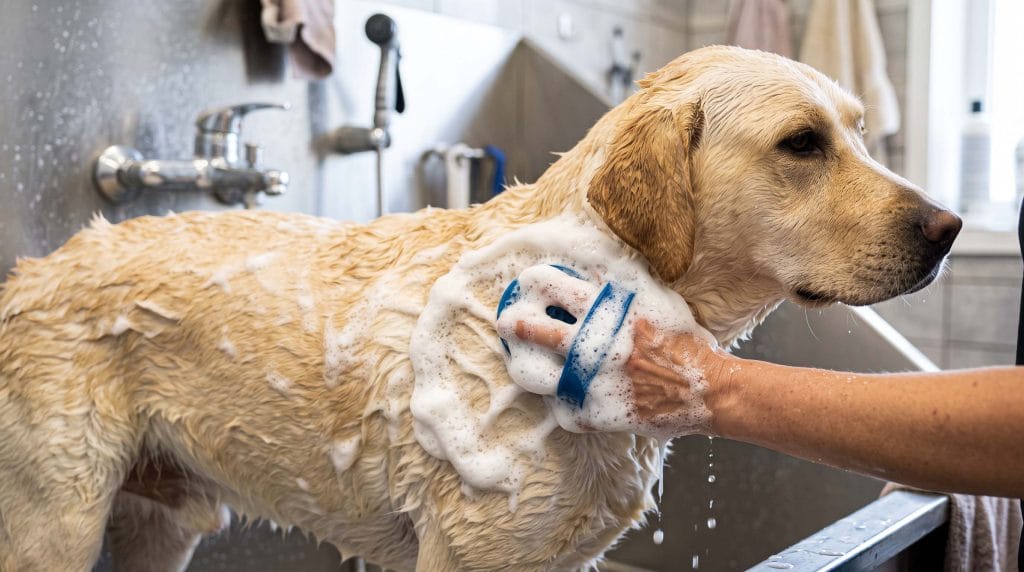
Slip your rubber curry brush or silicone glove onto your dominant hand:
- For short coats: Work in small, firm, circular motions across the shoulders, back, and hips.
- For double coats: Work in long, sweeping strokes in the direction of hair growth.
- Apply moderate downward pressure; let the rubber nubs flex against the skin.
- Every twenty seconds, peel the gathered pad of wet fur off the brush and slap it onto the shower wall or drop it into a waste bucket.
+--------------------------------------------------------------------------+
|                    THE SOAPY BRUSH MOTION PATTERNS                       |
|                                                                          |
|   SHORT COATS (Circular Scrub):        DOUBLE COATS (Linear Sweep):      |
|                                                                          |
|        ╭───╮      ╭───╮                    ───────►  ───────►            |
|        │ ↺ │      │ ↺ │                    ───────►  ───────►            |
|        ╰───╯      ╰───╯                    ───────►  ───────►            |
|     (Massages Dermis & Roots)            (Aligns & Pulls Undercoat)      |
+--------------------------------------------------------------------------+
Step 5: The Rinse-Phase Brush Pass
As you direct the clean rinse water over the coat with one hand, use your rubber brush in your other hand to sweep down the body. This rinse-phase pass catches loose hairs that broke free during the shampooing stage but are still floating in the wet coat.
Rinse until the runoff water is 100% clear and free of bubble trails.
Real Story: How Wet-Brushing Transformed Buster’s Seasonal Shed
Rachel, a member of our dog care community, lives with Buster, a five-year-old Australian Shepherd with an exceptionally thick, water-resistant double coat. Every spring, Buster’s coat blowout left Rachel’s home covered in tumbleweeds of gray-and-white undercoat.
Rachel dreaded bath day. She had always followed the traditional rule to never touch a wet dog with a brush.
She would wash Buster, towel him off, and then spend two frustrating hours with a high-velocity dryer blowing loose, wet fur into clouds that stuck to her bathroom walls, ceiling, and clothing. Buster hated the lengthy drying sessions, and his skin often looked red from the intense post-bath brushing.
+--------------------------------------------------------------------------+
|                      BUSTER'S GROOMING TRANSFORMATION                    |
|                                                                          |
|  OLD ROUTINE (Traditional Dry-Only Rule):                                |
|  • Washed without brushing in tub                                        |
|  • Post-bath blow dry time: 65 Minutes                                   |
|  • Post-bath brush out time: 45 Minutes                                  |
|  • Result: Stressed dog, red skin, fur-covered bathroom                  |
|                                                                          |
|  NEW ROUTINE (Soapy Wet-Brushing System):                                |
|  • 8-minute rubber curry pass during shampoo lather                      |
|  • Pulled 3 full cups of undercoat directly in the tub                   |
|  • Post-bath blow dry time: 25 Minutes (61% reduction!)                  |
|  • Post-bath brush out time: 5 Minutes                                   |
|  • Result: Calm dog, zero skin redness, clean bathroom                   |
+--------------------------------------------------------------------------+
Rachel decided to test our soapy brushing protocol. She diluted a professional deshedding shampoo, lathered Buster thoroughly, and used a conical rubber curry pad to sweep his coat in smooth, linear passes for eight minutes while the lather sat on his skin.
The difference was staggering. Rachel collected three massive cups of dead undercoat directly from the rubber pad while Buster stood happily enjoying the massage.
Because all that dead undercoat was already gone before Buster stepped out of the tub, his drying time dropped from over an hour to just 25 minutes. If you want to know how long a coat should take to dry after high-power drying, check our guide on how long does a dog stay wet after a high velocity blow out.
Common Mistakes When You Brush a Dog While the Coat Is Soapy
Even simple techniques can backfire if you overlook small procedural details. Avoid these common wet-grooming mistakes:
[MISTAKE: Brushing Dry Lather]    ──► High Friction ──► Broken Cuticles
[MISTAKE: Metal Pins on Wet Skin] ──► Sharp Contact ──► Epidermal Brush Burn
[MISTAKE: Swirling Long Hair]     ──► Wet-Felting   ──► Irreversible Matting
1. Brushing Without Enough Water (Dry Lather Drag)
If your shampoo lather starts to dry out or become sticky while you are working, stop brushing immediately. Sticky, collapsing lather creates heavy friction drag that pulls on living hair roots.
Always keep a cup or a handheld sprayer nearby to mist the coat with warm water, keeping the soap frothy and slick.
2. Using Metal Deshedding Blades in the Tub
Metal deshedding rakes (like loop blades or closely spaced undercoat rakes) have sharp, micro-beveled edges meant to grab dry fur. When used on a wet, soapy dog, these metal edges act like tiny scrapers against the skin.
They can slice the tops off microscopic skin folds and snap wet hair shafts near the base. Keep all metal-toothed tools outside the tub.
3. Circular Scrubbing on Long or Silky Coats
Never scrub in circles on breeds with hair longer than three inches. Circular scrubbing tangles the long guard hairs around each other, turning minor loose undercoat into dense, felted mats that can only be removed with clippers once dry.
Always brush long hair in straight lines following the natural downward flow of the coat.
4. Over-Bathing to Fight Constant Shedding
Some owners start doing soapy brush sessions every single week to eliminate hair in their house. Over-washing strips the skin of protective natural lipids, triggering reactive seborrhea (flaky, dry, itchy skin).
If you are unsure how often your dog can safely handle this treatment, check our expert analysis on how often you can use deshedding shampoo on a Lab or double-coated breeds.
The Hydrodynamic Lift Method
Here is a specialized bath-side technique professional groomers use that is rarely shared outside the industry: Hydrodynamic Undercoat Lifting.
+-------------------------------------------------------------------------+
|                  HYDRODYNAMIC UNDERCOAT LIFTING CYCLE                   |
|                                                                         |
|   1. Apply Diluted Shampoo & Build Dense Micro-Lather                   |
|                               │                                         |
|                               ▼                                         |
|   2. Back-Comb Against Grain with Rubber Nub (Lifts Trapped Undercoat)  |
|                               │                                         |
|                               ▼                                         |
|   3. Downward Sweep with Grain (Locks Released Undercoat on Tool)       |
|                               │                                         |
|                               ▼                                         |
|   4. Rinse Stream Follows Brush (Washes Clean Follicles Open)           |
+-------------------------------------------------------------------------+- Saturate the dog and build a thick, creamy foam using properly diluted shampoo.
- Take your rubber curry brush and make one slow, gentle pass against the natural grain of the coat (tail to head).
- This backward pass lifts the guard hairs and forces rich shampoo lather directly into the follicle pockets where dead undercoat rests.
- Immediately make a second, firmer pass in the natural direction of coat growth (head to tail).
- The forward pass sweeps the newly loosened undercoat out of the coat in thick, wet ribbons without pulling on the skin.
- Follow the brush stroke with your shower spray to flush the liberated hair away from the dog’s body.
This simple two-directional pass pulls out twice as much undercoat as standard single-direction brushing.
Bath-Side Wet-Grooming Protocol
Keep this quick reference guide handy for your next home bath session:
- Pre-Bath: Thoroughly brush and detangle the coat while 100% dry.
- Tool Check: Verify you are using flexible rubber or silicone (no wire pins).
- Water Prep: Ensure wash water is lukewarm, never hot.
- Lather Quality: Confirm shampoo is diluted properly and foaming richly.
- Motion Check: Use circular motions for short coats; use linear strokes for long/double coats.
- Friction Test: Add water immediately if the lather becomes pasty or sticky.
- Fur Disposal: Plaster wet fur clumps to the tub wall—never wash them down the drain.
- Rinse Brush: Make a final sweeping pass with the rubber tool while clean water flows.
- Post-Bath Rinse: Consider an acidic finishing rinse; explore our guide on does apple cider vinegar rinse reduce dog shedding after bath to restore natural coat pH.
Frequently Asked Questions
Can you brush a dog while the coat is soapy if they have sensitive skin?
Yes, but you should choose an ultra-soft silicone grooming glove or an elastomer pad rather than firm rubber. The rich shampoo lather actually protects sensitive skin by acting as a soothing barrier between the tool and the skin, reducing friction that dry brushing can cause.
Will brushing a soapy coat pull out healthy, living hair?
No, as long as you use blunt, flexible rubber or silicone nubs. Rubber tools do not generate enough mechanical grip to rip healthy anagen-phase hairs from rooted follicles; they only capture telogen-phase hairs that are already loose and resting inside the hair tract.
Should I brush my dog while applying conditioner as well?
Yes! Brushing while the conditioner sits on the coat is exceptionally beneficial, especially for medium, long, or drop-coated breeds. Conditioners contain cationic surfactants and silicones that coat the hair shaft, providing maximum slip for wide-toothed detangling combs.
What should I do if my dog hates the feeling of the bath brush?
Start slowly by using a soft silicone bath mitt worn directly over your hand. Pet your dog gently with the mitt while offering high-value treats. Most dogs find the warm lather combined with the broad, massaging rubber nubs deeply relaxing once they realize it does not pull or scratch like a wire brush.
Can I use a human wet-brush on my dog in the shower?
Human wet-brushes with flexible plastic bristles can work well on long, single-coated breeds like Yorkies, Shih Tzus, or Poodles when saturated with conditioner. However, they lack the structural strength and surface area needed to clear dense undercoat on double-coated breeds like Labs, Huskies, or Shepherds.
Master Your Dog’s Bath-Time Grooming Routine
Knowing whether can you brush a dog while the coat is soapy unlocks a faster, cleaner, and far more effective home grooming routine. By ditching rigid wire slickers in favor of flexible rubber curry tools, maintaining rich, watery lather, and matching your brushing motion to your dog’s specific coat type, you can strip out pounds of dead undercoat right in the tub without causing coat damage or skin irritation.
To build a complete, professional-grade shedding management plan for your home, explore our complete shedding management guide and our step-by-step tutorial on drying a double-coated dog without a high velocity dryer to keep your dog healthy, clean, and comfortable all year long. 🐾
This article provides general pet grooming guidance for informational purposes. If your dog suffers from active skin lesions, open hot spots, severe fungal infections, or unexplained acute hair loss, consult a licensed veterinarian before introducing wet brushing or deshedding treatments.
