

 Animal Zoid Editorial Team
The safest way to clear compacted wool from a Samoyed without tearing the skin or slicing the outer guard coat is a three-stage combination of hydrated line-combing, warm conditioner saturation, and high-velocity air sweeping. When owners ask us how to remove dead undercoat from a samoyed safely, they are usually fighting a dense wall of shed fibers that refuses to budge with standard pet store brushes. Because a Samoyed carries up to 20 crimped wool fibers inside every single follicular pore alongside one delicate guard hair, yanking dry brushes through the coat triggers pain and snaps healthy fur. This guide walks you through the exact dermatological mechanics, non-bladed tool selections, and step-by-step routines our team uses to empty a blown Samoyed coat without a single scratch.
Quick Answer:
If you need to know how to remove dead undercoat from a samoyed safely, never brush a bone-dry coat and never use a bladed deshedding tool. Instead, mist the fur with a diluted humectant conditioning spray, part the coat horizontally down to the skin, and work from the hind legs forward using a rotating-pin undercoat rake and a long-pin slicker brush. Follow up with a 99°F bath using diluted conditioner and blast the remaining loose wool out at a 45-degree angle with a cool high-velocity dryer.
The Compound Follicle Science Behind How to Remove Dead Undercoat From a Samoyed Safely
Most dog owners picture hair growing one strand per pore, just like human scalp hair. Canine skin does not work that way, and arctic breeds push follicular density to an extreme that completely changes how you must approach grooming.
Samoyeds possess compound hair follicles. Inside a single follicular opening (called an ostium), one stiff, silver-tipped primary guard hair emerges alongside 12 to 22 ultra-fine secondary undercoat fibers. All of those hairs exit through the exact same microscopic skin pore and share a single sebaceous gland collar that wraps around the bundle just beneath the epidermis.
During the active growth phase, this crowded bundle sits comfortably. However, when seasonal daylight changes trigger a coat blow, all 12 to 22 secondary wool fibers inside that pore detach from the dermal papilla at the same time. As they slide upward toward the surface, two mechanical bottlenecks happen simultaneously:
- The Ostium Sebum Plug: The waxy sebum collar at the mouth of the pore cools and stiffens around the base of the detaching wool bundle, holding all 20 dead fibers together in a sticky littletuft right at the skin line.
- The Micro-Crimp Canopy Lock: Unlike straight guard hairs, Samoyed undercoat fibers feature 8 to 12 tight sinusoidal crimps per inch. One inch above the skin, the detaching wool fibers from neighboring pores expand and weave into each other, forming a continuous, springy mat trapped beneath the heavier guard hairs.
Here is why this anatomy matters when learning how to remove dead undercoat from a samoyed safely. That single primary guard hair remains firmly rooted in the living dermis right in the center of the dead wool bundle, wired directly to sensitive mechanoreceptor nerves. If you jam a brush into the top of the coat and yank outward, the tangled wool pulls down on the rooted guard hair like a slipknot. Your dog feels a sharp pinch across hundreds of nerve endings at once, and the guard hair snaps off mid-shaft.
For a deeper look at how arctic hormone shifts trigger these synchronized follicular releases, our guide on the difference between normal shedding and a full Husky coat blow breaks down the seasonal biology.
Why Unpigmented Samoyed Fur Builds Static and Locks Dead Undercoat in Place
There is a second physical quirk unique to white arctic coats that almost every grooming blog misses. Samoyed hair is completely devoid of eumelanin and pheomelanin pigment granules. Furthermore, the central core (medulla) of a Samoyed guard hair is filled with microscopic air pockets designed to scatter light and insulate against sub-zero winds—very similar to polar bear fur.
In dark-coated breeds like German Shepherds or Black Labs, melanin granules inside the hair cortex act as natural semiconductors that absorb and dissipate static electricity during brushing. Because unpigmented, air-filled Samoyed keratin has zero melanin conductivity, it acts as a powerful electrical insulator.
Every time you drag a dry metal comb or plastic brush through a dry Samoyed coat, you generate a massive triboelectric static charge—often reaching 15 to 20 kilovolts in dry indoor air. This static charge does two terrible things to your grooming session:
- It creates an electrostatic weld that causes dead undercoat fibers to cling tightly to the outer guard hairs like iron filings on a magnet, fighting your comb on every stroke.
- It discharges tiny, painful static sparks directly onto your dog’s nose, ears, and belly skin, teaching your Samoyed to hate and fear the brush.
You cannot master how to remove dead undercoat from a samoyed safely until you neutralize that static charge with water and humectants before the first pin ever touches the fur.
Why Learning How to Remove Dead Undercoat From a Samoyed Safely Prevents Acute Moist Dermatitis
Leaving dead undercoat packed inside a Samoyed’s coat is not a harmless cosmetic issue. In our experience evaluating double-coated breeds during late spring and summer, compacted telogen wool is the number one trigger for acute moist dermatitis, commonly known as pyotraumatic hot spots.
When a Samoyed’s undercoat is clear and properly maintained, the stiff guard hairs stand upright at a 60-to-75-degree angle from the skin. When the dog moves or pants in a breeze, cool air channels all the way down to the epidermis, evaporating skin moisture and convecting body heat away.
When dead undercoat detaches and packs into a dense layer half an inch above the skin, it forms what veterinary dermatologists call a pelt tent. Air can no longer penetrate down to the skin surface. Worse yet, if your Samoyed wades into a creek, gets caught in summer rain, or drools on its chest ruff, the hollow dead wool fibers absorb up to 30 percent of their weight in water and trap it directly against the warm 101.5°F skin.
Within 6 to 12 hours inside that dark, 90-percent-humidity microenvironment, normal surface bacteria (Staphylococcus pseudintermedius) multiply explosively. The skin macerates, turns raw and weeping, and oozes serous fluid that glues the dead undercoat directly into a painful scabby lesion. Knowing how to remove dead undercoat from a samoyed safely as soon as the seasonal blow begins keeps those air channels open so the skin can breathe all summer long.
Case Study: How Hannah and Winter Cleared a Pelted Spring Coat Blow
To see how proper technique replaces force, consider a case our team guided last May involving Hannah and her rescued three-year-old male Samoyed, Winter.
When Hannah adopted Winter, he was four weeks into a massive spring coat blow that his previous owners had completely ignored—and then tried to fix in a single afternoon using a bladed deshedding rake. By the time Hannah brought him home, Winter had dense, mattress-thick slabs of impacted undercoat across his hips, britches (back of the thighs), and collar ruff. Worse, a 10-inch patch along his middle back looked chewed up, frizzy, and yellowed where the bladed tool had sliced off his protective silver-tipped guard hairs.
“Every time I even reached toward his back hips with a brush, Winter would spin around, grab my wrist gently in his mouth, and whine,” Hannah told us. “I was terrified he was going to get hot spots as the weather warmed up, and two local groomers told me they would have to shave him down if he wouldn’t stand still for dematting.”
We stepped in to show Hannah how to remove dead undercoat from a samoyed safely without shaving a single millimeter of coat or triggering Winter’s pain reflex. Here is the exact 10-day recovery log she followed:
- Days 1 to 3 (Static & Sebum Softening): Hannah threw away the bladed deshedding tool. She mixed 1 tablespoon of silicone-free coat conditioner and 1/2 teaspoon of vegetable glycerin into a 16-ounce continuous-mist spray bottle filled with warm distilled water. For 12 minutes each evening while Winter licked frozen salmon paste off a suction mat, she misted a 4-inch section of his neck and shoulder, parted the hair down to the pink skin, and gently teased out the moistened wool tufts from the tips inward using a 20mm long-pin “coral” slicker brush and a rotating-pin rake.
- Days 4 to 6 (Clearing the Britches & Flanks): Once Winter realized the misted line-combing did not pull his rooted guard hairs, he stopped guarding his hips. Hannah used a dusting of plain cornstarch to break the friction inside the tightest behind-the-leg knots, pulling out two full grocery bags of dead cream-colored wool over three short evening sessions.
- Day 7 (The Warm Conditioner Release Bath): With 85 percent of the dry compaction cleared, Hannah bathed Winter in 99°F water. She skipped harsh stripping detergents, applied a diluted deshedding shampoo followed by a heavy coat of moisturizing conditioner, and let the warm conditioner dwell for eight minutes to melt the remaining follicular sebum plugs.
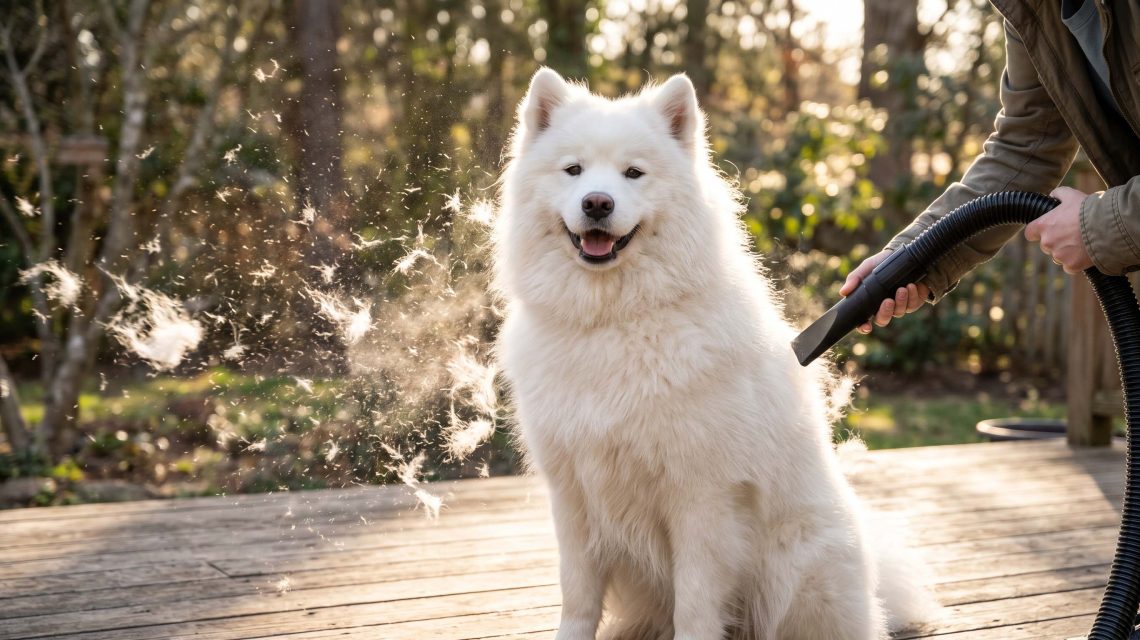
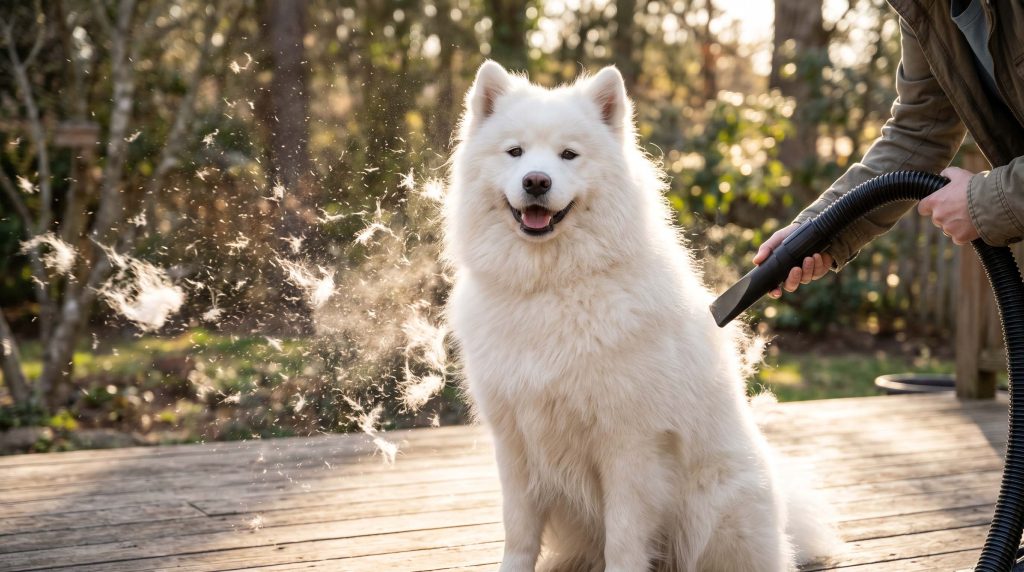
- Day 8 (The High-Velocity Blowout): Using a variable-speed high-velocity dryer set to cool air with a conical nozzle, Hannah swept the coat line by line outdoors. The remaining 15 percent of dead undercoat lifted off the skin in clean, snow-like drifts.
By Day 10, a stainless-steel Greyhound comb glided smoothly from Winter’s skin to the tips of his fur across his entire body. His skin remained pale, cool, and completely irritation-free, and the sliced guard hairs on his back slowly began shedding out to make way for healthy new growth over the following months.
Best Non-Bladed Tools for How to Remove Dead Undercoat From a Samoyed Safely
If you want to master how to remove dead undercoat from a samoyed safely, your first move is auditing your grooming caddy. Most commercial “deshedding tools” sold in big-box pet stores are engineered for short-haired Labradors or Beagles and will permanently ruin an arctic double coat.
| Grooming Tool | Samoyed Coat Safety | Undercoat Extraction Power | Guard Hair Preservation | Specific Role in Your Routine |
|---|---|---|---|---|
| Long-Pin Bent Slicker (20mm–25mm flexible pins) | ★★★★★ | ★★★★☆ | ★★★★★ | Initial line-brushing and loosening compacted wool layers |
| Rotating-Pin Undercoat Rake (single row, 1-inch rounded teeth) | ★★★★★ | ★★★★★ | ★★★★★ | Pulling thick telogen wool bundles out from the skin line |
| Stainless Steel Greyhound Comb (coarse/medium dual tooth) | ★★★★★ | ★★★★☆ | ★★★★★ | Verifying zero hidden compaction down at the epidermis |
| Variable-Speed High-Velocity Dryer | ★★★★★ | ★★★★★ | ★★★★★ | Blasting sebum plugs and loose wool out after bath time |
| Pin Brush (oval cushion, no balls on pin tips) | ★★★★☆ | ★★☆☆☆ | ★★★★★ | Daily surface fluffing and separating outer guard hairs |
| Bladed Deshedding Tool / Stripping Rake | ★☆☆☆☆ | ★★☆☆☆ | ★☆☆☆☆ | AVOID COMPLETELY (Slices guard hairs and scrapes dermis) |
Why Rotating-Pin Rakes and Long-Pin Slickers Protect Silver-Tipped Guard Hairs
Look closely at two critical equipment details when buying tools for a Samoyed:
First, when choosing a slicker brush, pin length and cushion flexibility are everything. Standard slicker brushes have short 10mm pins that only scratch the top half-inch of a Samoyed’s 4-inch coat. You need a professional long-pin slicker (often modeled after the Chris Christensen “Coral” or “Big G” geometry) with 20mm to 25mm angled pins set into a soft, air-cushioned rubber pad. When those long pins hit a snag, the flexible cushion absorbs the shock and bends the pins backward, releasing the healthy guard hair instead of ripping it out by the bulb.
Second, if you buy a traditional pin brush for daily maintenance, never buy a brush with little plastic balls coated onto the tips of the metal pins. Those coated balls are fine for straight human hair, but inside a crimped Samoyed undercoat, the wider ball heads hook behind microscopic wool tangles on the outward stroke and yank living guard hairs out of the skin. Always choose polished, rounded stainless-steel pins with seamless, uncoated tips.
Step-by-Step Protocol: How to Remove Dead Undercoat From a Samoyed Safely at Home
Trying to brush a blowing Samoyed from head to tail over the top of the coat is like trying to vacuum a thick shag carpet through a bedsheet. You have to work underneath the guard coat using this three-step sequence.
Step 1: Anti-Static Humectant Misting and Dry Line-Combing
Always perform your initial heavy undercoat extraction before putting your Samoyed in the bathtub, but never do it on bone-dry fur. If you soak a heavily packed Samoyed coat in water before removing at least 75 percent of the dead wool, the wet wool fibers swell by 15 percent, interlock their cuticle scales, and shrink as they dry into solid felt armor right against the skin.
Here is the safe pre-bath line-combing sequence:
- Mix Your Anti-Static Slip Spray: In a fine-mist spray bottle, combine 14 ounces of warm distilled water, 1 tablespoon of silicone-free dog conditioner, and 1/2 teaspoon of pure vegetable glycerin or aloe vera juice. Shake well.
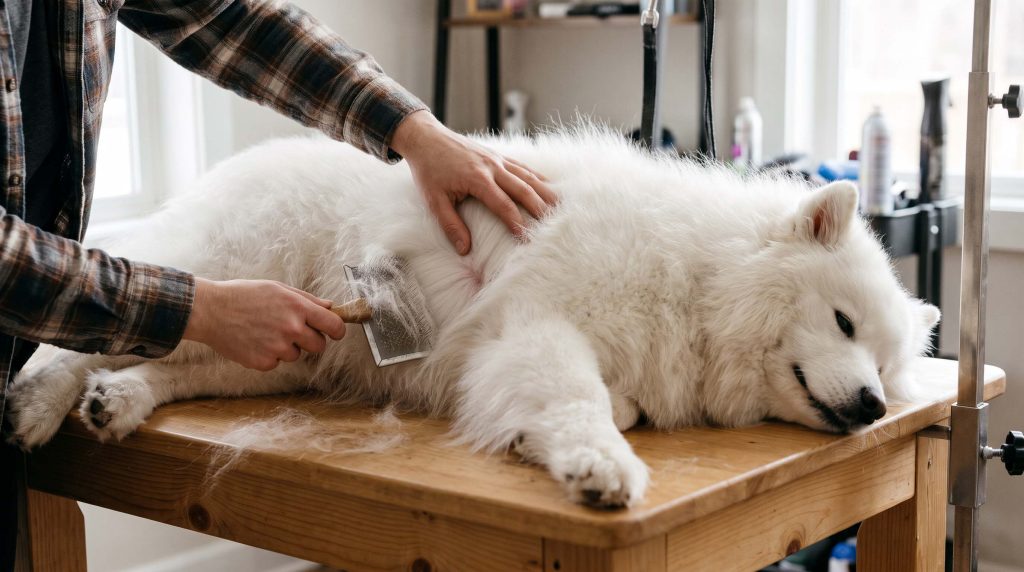
- Lay Your Samoyed on Their Side: Working with your dog lying on a cool tile floor or a grooming table is ten times easier on both your wrists and your dog’s joints than forcing them to stand for forty minutes.
- Create a Horizontal Skin Part at the Lowest Point: Start at the lower hind leg (just above the hock) or the lower flank. Use your non-dominant hand to push the bulk of the fur upward toward the spine. You must see a clean, horizontal line of pale pink skin. If you only see white fuzz at the base of your part, you have not parted deep enough.
- Mist the Part Line: Spritz two light puffs of your conditioning mist directly onto the fur just below your hand. The moisture kills the 20-kilovolt static charge instantly and plasticizes the brittle wool fibers so they stretch instead of snapping.
- Stroke Downward With Your Long-Pin Slicker: Place the pins of your slicker brush right below the exposed skin line (never slamming the metal pins perpendicular into the bare skin) and pull downward in the direction of hair growth. At the end of the 3-inch stroke, roll your wrist slightly upward away from the body to lift the loosened wool out.
- Clear With the Rotating-Pin Rake and Verify With the Steel Comb: Pass your rotating-pin rake through that exact 1-inch strip to scoop out the thick wool bundles, then glide the coarse side of your steel Greyhound comb from the skin to the tips. Once the Greyhound comb slides through with zero resistance, drop another half-inch layer of fur down from your upper hand and repeat.
Work systematically upward from the lower legs to the spine, then move to the chest ruff, neck, and breeches. For tips on preventing mats in high-friction areas behind the pinnae during this stage, check our guide on how to dry a thick undercoat fast without matting.
Step 2: The 99-Degree “Close-Open-Close” Hydro-Bath Method
Once your Greyhound comb passes cleanly through the coat, a warm hydro-bath releases the remaining 20 to 25 percent of dead undercoat that is still anchored inside the follicular pores by waxy sebum collars.
Water temperature is a non-negotiable scientific variable here. Canine sebaceous waxes (composed primarily of cholesterol esters and diester waxes) have a thermal melting point between 96°F and 101°F (35.5°C to 38.3°C). If you wash your Samoyed outdoors with a cold garden hose, the 60°F water freezes the sebum plugs solid inside the follicular ostia, locking the dead wool in place. Always use indoor lukewarm water calibrated right around 99°F.
Before turning on the shower, protect your household plumbing. A single Samoyed coat blow releases enough dense wool to block a standard 2-inch PVC P-trap in five minutes. Install the dual-stage strainer setup detailed in our guide on how to deshed a dog in the shower without clogging pipes.
Next, use the professional Arctic groomer’s Close-Open-Close (Conditioner-Shampoo-Conditioner) bathing technique:
- First Pass (Conditioner on Wet Coat — “Close”): After soaking the coat thoroughly to the skin with 99°F water (which takes a full 4 to 5 minutes on a water-repellent Samoyed coat), apply a generous layer of diluted moisturizing conditioner before shampooing. Massage it in along the grain of the hair and let it sit for 3 minutes. The fatty alcohols and cationic surfactants in the conditioner bind to the dry, rough cuticles of the dead wool fibers, coating them in slip so they slide past the healthy guard hairs without tangling.
- Second Pass (Diluted Deshedding Shampoo — “Open”): Without rinsing the first conditioner layer completely out, apply your pre-diluted deshedding shampoo directly over it. Always pre-mix your shampoo with warm water in a squeeze bottle first so it penetrates all 3 inches of coat depth evenly; see our exact dilution chart in how to safely dilute professional dog deshedding shampoo. Use a soft rubber curry brush to massage the lather linearly down the body—never scrub in circles. Our breakdown on whether you can brush a dog while the coat is soapy explains why linear strokes with a soft rubber tool are safe while wire pins on wet, soapy hair cause severe elastic stretching. If you need a gentle rubber tool for this bath step, check the top picks in our review of the best bath brush for heavy-shedding short hair dogs.
- Third Pass (Final Conditioner Soak & Rinse — “Close”): Rinse the shampoo mixture out, apply a light second pass of diluted conditioner for 3 minutes to seal the guard hair cuticles, and rinse until the water squeezing off the belly and hocks is 100 percent clear.
Before opening the shower door, use the towel-wrap containment method in our guide on how to stop a dog from shaking water everywhere after a bath and squeeze—never rub—excess water out of the coat with heavy microfiber towels.
Step 3: High-Velocity Air Sweeping to Blast Out Dead Samoyed Undercoat
High-velocity drying is the secret weapon when mastering how to remove dead undercoat from a samoyed safely. A dedicated high-velocity pet dryer produces a concentrated column of unheated or barely warm air moving at 15,000 to 28,000 feet per minute.
Instead of pulling dead hair out with metal teeth, the air stream parts the coat right down to the epidermis, vibrates the loosened telogen wool bundles out of their warm follicular pores, and pushes them straight off the tips of the guard hairs with zero mechanical drag.
Follow these four rules during your blowout to avoid whipping the guard hairs into aerodynamic knots (called “wind-whipping”):
- Use the Flat Concentrator or Round Cone Nozzle on Cool/Low-Warm Air: Never use high heat on a Samoyed. High heat swells the skin capillaries, causes intense itching, and bakes sebum onto the coat.
- Hold the Nozzle 3 to 4 Inches Away at a 45-Degree Angle: Pointing the nozzle straight down at a 90-degree angle drives loose undercoat sideways into neighboring hair shafts, tying tiny wind knots. Holding the nozzle at a 45-degree angle pushes water and loose wool in one smooth direction along the natural lay of the guard coat.
- Sweep Slowly Like Painting a Wall: Do not flick the dryer hose frantically back and forth like you are waving a wand. Fast whipping motions tangle wet guard hair tips instantly. Move the nozzle in slow, deliberate 6-inch sweeps from the spine down toward the toes.
- Dry to 100 Percent Bone-Dry at the Skin Line: Samoyed undercoat holds invisible moisture deep against the skin long after the outer guard hairs look dry and fluffy. Check our timing and tactile testing guide on how long a dog stays wet after a high-velocity blowout to make sure you do not leave damp pockets behind the ears, under the elbows, or at the base of the tail.
How to Remove Dead Undercoat From a Samoyed Safely After Spaying or Neutering (“Spay Coat” Management)
If your Samoyed was spayed or neutered and suddenly developed an overwhelmingly thick, cotton-candy-textured coat that seems to shed year-round without ever finishing a clean seasonal blow, you are not imagining things. You are dealing with gonadectomy-induced hypertrichosis, widely known among arctic breed specialists as spay coat or neuter coat.
Here is the endocrinological mechanism behind this change that veterinary dermatology studies have mapped out. In an intact male or female Samoyed, gonadal sex hormones (estradiol and testosterone) provide a continuous negative feedback signal to the pituitary gland, keeping Luteinizing Hormone (LH) and Follicle-Stimulating Hormone (FSH) at controlled baseline levels. Hair follicles in double-coated breeds actually possess direct LH and prolactin receptors on their dermal papillae.
When a Samoyed is spayed or neutered, estrogen and testosterone drop to near zero, removing the brake on the pituitary gland. Circulating LH levels stay permanently elevated—often rising 10 to 20 times higher than intact baseline levels. This chronic hormonal signal alters the compound hair follicles in three distinct ways:
- Secondary Wool Overgrowth: The fine secondary undercoat fibers stay in their active anagen growth phase longer, growing physically longer than the primary guard hairs and emerging past the silver outer canopy as dull, yellowish-white fuzz.
- Cuticle Roughening: Without gonadal hormone regulation of sebaceous lipids, the undercoat cuticles become dry, porous, and Velcro-like.
- Loss of Seasonal Synchronization: Instead of blowing the entire undercoat cleanly twice a year in spring and fall, the follicles desynchronize and shed heavy volumes of cottony wool continuously 365 days a year.
When figuring out how to remove dead undercoat from a samoyed safely on a spayed or neutered dog with a spay coat, you have to adjust your routine in two ways. First, increase your hydrated line-combing frequency from once a week to two or three short 15-minute sessions per week, because the dead wool never stops accumulating. Second, double the amount of leave-in conditioner in your misting bottle. A spay coat lacks natural lipid slip, so extra topical conditioning is mandatory to let your rotating-pin rake glide through the overgrown wool without snapping the sparse guard hairs hiding underneath.
Common Mistakes When Figuring Out How to Remove Dead Undercoat From a Samoyed Safely
Even well-meaning owners accidentally damage their Samoyed’s coat or skin by falling into three widespread grooming traps.
Using Razor-Edged Deshedding Blades That Slice Guard Hair Tips
We cannot emphasize this strongly enough: never use a short-toothed stainless-steel deshedding blade (such as a Furminator or sharpened stripping comb) on a Samoyed. Those tools have a sharpened inner blade edge designed to catch and pull short hairs on single-coated breeds.
When dragged through a Samoyed’s long double coat, the narrow teeth pack up with wool within half an inch and begin acting like a razor knife, slicing the outer guard hairs cleanly off mid-shaft. A natural Samoyed guard hair tapers to a microscopic, smooth silver point that reflects sunlight, repels dirt, and sheds snow. Once you slice that tapered tip off with a bladed tool, the blunt, exposed inner cortex absorbs dirt, turns a dingy yellow-grey color, and splits at the end. Worse, because guard hairs have an active growth cycle lasting up to two years, it can take 18 to 24 months for a sliced Samoyed topcoat to fully shed out and regain its natural dirt-repelling sheen.
Bathing a Packed Samoyed Coat Before Line-Combing
Taking a Samoyed at the peak of its spring coat blow and putting it straight into the bathtub to “wash the loose hair out” is the fastest way to create a pelted coat. Unless you have a commercial-grade 5-horsepower forced-air dryer and decades of salon experience, soaking a 3-inch layer of uncombed dead wool turns it into wet papier-mâché. As the water evaporates, hydrogen bonds reform between the tangled keratin chains, shrinking the wool tight against the skin and cutting off circulation. Always clear at least 75 to 80 percent of the loose bulk via misted line-combing before turning on the bath faucet.
Shaving the Double Coat and Triggering Post-Clipping Alopecia
Every June, owners overwhelmed by shedding ask their groomer to shave their Samoyed down into a short “puppy cut” or “lion cut” to keep the dog cool and stop the hair fallout. Shaving a healthy Samoyed is dermatologically harmful for three proven reasons:
- Thermal Insulation Loss: The outer guard coat reflects solar radiation away from the body while the cleared undercoat zone allows convective air cooling. Shaving removes that solar shield, allowing direct infrared heat and UV rays to hit the unpigmented pink skin, increasing surface skin temperatures and causing severe sunburn.
- Post-Clipping Alopecia (Coat Funk): Because arctic primary guard hairs cycle very slowly and rely on thermal cues at the follicle base, shaving them to the skin often causes the primary follicles to arrest in deep telogen stasis for 1 to 3 years. Meanwhile, the fast-cycling secondary wool grows back immediately without any guard hair protection, turning the entire dog into a giant velcro magnet for burrs, mud, and mats.
- Follicular Ingrowth and Erythema: Clipper blades irritate the raised compound follicular ostia. If your dog’s skin ever looks flushed after any grooming or bathing session, consult our diagnostic guide on why your dog’s skin looks pink after a deshedding bath to treat epidermal inflammation immediately.
Our Arctic Grooming Bench Secret: The Cornstarch-and-Cool-Air Friction Release for Pelted Britches
Every Samoyed has two ultra-difficult trouble zones during a coat blow: the britches (the dense curtains of long fur on the back of the thighs) and the tail base. Because your dog sits directly on their britches every day, body weight compresses the shedding wool into dense, rope-like mats that even a conditioned slicker brush struggles to separate without tugging on tender hamstring skin.
Here is the dry-lubrication trick our team uses on heavily compacted Samoyed britches before we ever reach for a spray bottle:
Grab two tablespoons of plain, unscented kitchen cornstarch (never talcum powder, which is hazardous to canine lungs). Part the matted section of the britches with your fingers and pack the dry cornstarch powder deep into the base of the compacted wool clump, rubbing it gently between your thumb and forefinger like you are counting paper bills.
Cornstarch consists of microscopic, smooth spherical starch granules that measure roughly 10 to 15 microns in diameter—smaller than the 25-micron diameter of a Samoyed undercoat fiber. Those tiny starch spheres roll directly between the interlocking cuticle scales of the crimped wool and absorb the sticky sebum holding the clump together. Instantly, the coefficient of friction inside the knot drops by more than half.
Hold the base of the fur next to the skin firmly between two fingers so zero tension reaches the dermis, and tap the cornstarch-dusted clump from the outer tips inward with the edge of your long-pin slicker brush. The tight mat will literally slide apart like dry silk. Once the clump opens up, hit it for ten seconds with your cool high-velocity dryer outdoors to blow both the cornstarch and the freed dead wool away cleanly.
The Samoyed Seasonal Coat-Blow Safety Audit
Before and during every major deshedding session, run through this seven-point safety audit to guarantee you are protecting your Samoyed’s skin and outer guard coat:
- [ ] Pass the Uncoated-Pin Inspection: Check every brush and rake in your hand. Confirm there are zero sharp metal blades, zero micro-serrated edges, and zero plastic ball tips on the ends of the pins.
- [ ] Neutralize Static Before Contact: Mist the working zone lightly with your water-conditioner-glycerin spray before making your first brush stroke so static electricity does not snap dry fibers or shock your dog.
- [ ] Verify the Pink Skin Line: Never drag a brush blindly over the surface canopy. Always hold the upper coat back with your non-dominant hand until you see a crisp horizontal line of bare pink skin.
- [ ] Anchor Above Every Snag: Whenever you encounter a tight wool tuft around the ears, armpits, or britches, pinch the base of the hair between your fingers right at the skin line so your fingertips take 100 percent of the pulling tension instead of your dog’s skin nerves.
- [ ] Calibrate Bath Water to 98°F–100°F: Use a quick thermometer check at the tub spout so the water is warm enough to melt follicular sebum plugs without scalding or flushing the delicate arctic dermis.
- [ ] Sweep the Dryer, Never Whip It: Hold your high-velocity dryer cone at a 45-degree angle and move it in slow, linear strokes along the lay of the coat to avoid tying wind knots in the guard hair tips.
- [ ] Complete the Final Greyhound Comb Audit: At the end of the session, glide a stainless-steel Greyhound comb down to the skin across the neck ruff, behind the ears, under the elbows, along the spine, and down the britches. If the comb glides effortlessly from root to tip, the undercoat is 100 percent clear and safe from hot spots.
For additional household containment strategies to keep flying white wool off your furniture and out of your HVAC vents during blow season, review our master guide on how to deal with dog shedding.
FAQ: How to Remove Dead Undercoat From a Samoyed Safely
How long does a full Samoyed coat blow last, and how often should we groom during it?
A seasonal Samoyed coat blow typically lasts 3 to 5 weeks from the moment the first small tufts appear on the flanks until the final neck ruff clears. During this window, you should perform 15-to-20-minute misted line-combing sessions three to four times a week, followed by one warm Close-Open-Close conditioner bath and high-velocity blowout around week two when the bulk of the telogen wool has detached from the follicles.
How can we tell if we are pulling out healthy guard hair instead of dead undercoat?
Inspect the hair caught in your brush or rake. Dead Samoyed undercoat looks like soft, dull-white, highly crimped cotton balls with tiny white club-shaped bulbs at the base and zero stiffness. Healthy outer guard hairs are 3 to 5 inches long, straight, stiff like fishing line, and feature a sparkling, translucent silver sheen at the tip. Seeing a few shed guard hairs in the brush is normal, but if your tool is pulling out handfuls of long, straight, shiny hairs—or if you hear a sharp “snapping” sound while brushing—you are either brushing too dry, pulling through an unlubricated knot, or using a tool that catches healthy hair.
Why does my Samoyed puppy at 7 months old have thick mats forming behind the ears and under the collar?
Between 6 and 10 months of age, Samoyed puppies shed their ultra-fine, single-texture puppy fluff while their harsh adult guard coat and dense adult undercoat push through the same compound follicles. During this crossover month, the emerging stiff guard hairs spear straight through the detaching cottony puppy coat, weaving instant mats in high-friction zones behind the ears, under the front legs, and under the collar. Remove your puppy’s collar whenever they are indoors during this transition and perform daily 5-minute misted line-combing checks on those friction zones.
Is it safe to use a high-velocity dryer on a Samoyed’s face and ears?
Never point a high-velocity dryer nozzle directly at a Samoyed’s eyes, nasal passages, or inside the ear canals, as the intense air pressure can damage the corneas or eardrums and the noise (often 75 to 85 decibels) stresses the dog. When drying the head and neck ruff, place a soft cotton grooming “happy hoodie” over your Samoyed’s ears to muffle the sound and absorb ear moisture, remove the concentrator nozzle from the dryer hose, turn the airflow speed down to 30 percent, and direct the gentle air stream from behind the skull forward away from the eyes.
Can dietary supplements make it easier to remove dead undercoat from a Samoyed?
Supplements will not stop a seasonal coat blow because the shedding cycle is controlled by daylight hours and melatonin signaling in the brain. However, supplementing marine-sourced Omega-3 fatty acids (EPA and DHA at roughly 1,000 mg per 30 pounds of body weight daily) improves the lipid balance of your Samoyed’s sebaceous glands. Healthier, more fluid sebum prevents waxy follicular plugs from gluing dead wool bundles inside the pores and keeps the outer guard hair cuticles smooth so shed undercoat slides out with far less brushing friction.
Final Thoughts on Safe Samoyed Undercoat Removal
Understanding how to remove dead undercoat from a samoyed safely comes down to respecting the unique compound follicle architecture and static-prone keratin of this arctic breed. Force, dry raking, and bladed tools destroy the silver-tipped guard coat that keeps your dog clean, cool, and weather-protected. By neutralizing static charge with a humectant conditioning mist, parting the coat horizontally down to the skin for methodical line-combing, melting follicular sebum plugs in a 99°F conditioner bath, and letting a high-velocity dryer sweep the loosened wool away, you turn a stressful seasonal ordeal into a pain-free routine.
Start today by retiring any bladed deshedding tools in your drawer and mixing up your conditioning mist bottle before tonight’s brushing session. Part the fur on your Samoyed’s lower hip until you see a clean line of pale skin, mist lightly, and work upward half an inch at a time with a long-pin slicker and rotating-pin rake. Within a few calm, consistent sessions, your Samoyed’s skin will breathe freely, their silver guard coat will sparkle in the sun, and those giant white tumbleweeds rolling across your living room floor will be history.
Disclaimer: This article is for informational purposes only and does not replace professional veterinary or certified grooming advice. If your Samoyed exhibits weeping sores, hot spots, foul-smelling skin beneath compacted fur, symmetrical bald patches, or extreme pain when touched lightly along the back, stop home grooming immediately and consult a licensed veterinarian to evaluate and treat underlying dermatological or endocrine conditions safely.
