

 Animal Zoid Editorial Team
 ⚡ Quick Answer
How to stop dog hair from blowing all over kitchen floor comes down to matching your cleanup method to your dog’s coat type. Fine, lightweight undercoat hair from breeds like Labradors and German Shepherds floats and drifts far more than the coarser guard hair from breeds like Pugs or Boxers. Brushing regularly to remove loose undercoat before it sheds, switching from dry sweeping to a damp mop, and identifying your specific coat type solves the problem faster than generic cleaning advice ever will.
Not all dog hair behaves the same way once it hits a kitchen floor, and that’s the piece most cleaning guides skip entirely. A Labrador’s shedding looks and acts completely different from a Boxer’s or a Corgi’s, and if you’ve ever wondered why your neighbor’s shedding dog seems to leave less mess than yours despite similar size, coat type is usually the reason. Learning how to stop dog hair from blowing all over kitchen floor starts with understanding what kind of hair you’re actually dealing with, because the fix for a fine-coated shedder looks nothing like the fix for a wiry, coarse-coated one.
We’ve worked with pet owners across nearly every coat type imaginable, and the pattern shows up again and again. Owners with double-coated, dense-undercoat breeds fight a completely different battle than owners with short, coarse-haired breeds, even on the exact same kitchen floor. This guide breaks down how to stop dog hair from blowing all over kitchen floor by coat type, why certain breeds create more airborne drift than others, and the specific routines that work best depending on what’s actually shedding in your house.
How Coat Type Changes the Way Dog Hair Behaves on Kitchen Floors
Before diving into fixes, it’s worth understanding why coat structure matters so much. Dog hair falls into a few broad categories, and each one interacts with hard kitchen flooring differently.
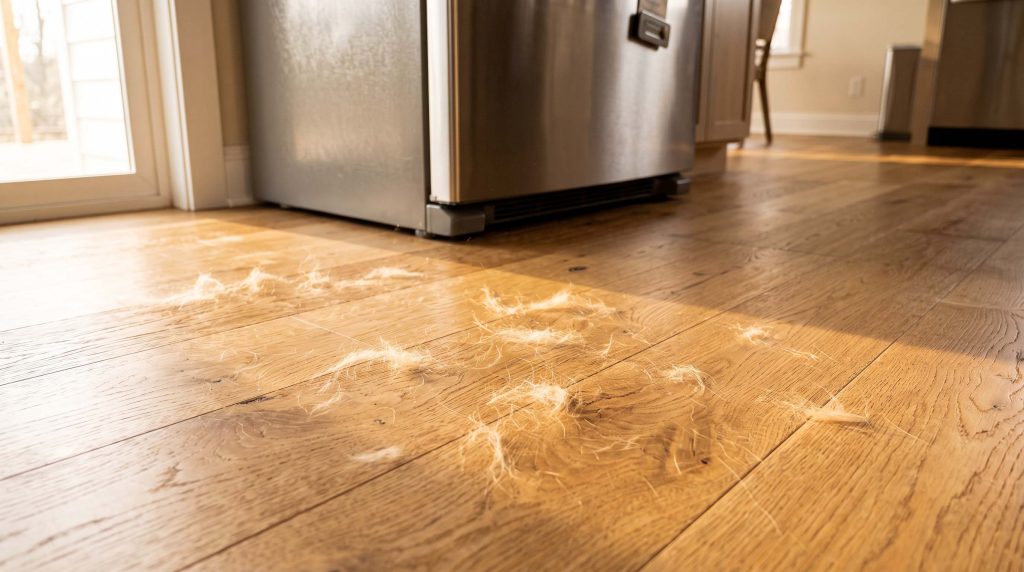
Double-coated breeds — Labradors, Golden Retrievers, German Shepherds, Huskies, Corgis — carry two layers: a coarser topcoat and a soft, dense undercoat. That undercoat is the real troublemaker on kitchen floors. It’s fine, lightweight, and barely weighs anything, which means it lifts into the air with the smallest air current and drifts across tile or hardwood like dust rather than settling where it falls.
Single-coated, short-haired breeds — Boxers, Pugs, Beagles, Dobermans — shed hair that’s shorter, coarser, and heavier per strand. This hair tends to drop and stay closer to where it fell, since it doesn’t have the same feather-light quality that catches air currents the way undercoat fluff does.
Wire-haired and curly-coated breeds — Poodles, Wire Fox Terriers, Airedales — shed the least overall, and what does come loose tends to be coarser and less prone to floating.
This distinction matters enormously for how to stop dog hair from blowing all over kitchen floor, because a Husky owner and a Boxer owner are dealing with genuinely different physical materials on their floor, even if both dogs shed a similar total volume.
Why Undercoat Hair Is the Real Kitchen Floor Villain
Here’s a detail that rarely gets explained clearly: undercoat hair has a hollow, lightweight shaft structure that’s biologically designed to trap air for insulation. That same hollow structure that keeps a Husky warm in winter is exactly what makes the shed hair act almost like a tiny piece of down feather once it separates from the dog. It catches air, floats, and resettles far more readily than the denser, solid guard hairs from short-coated breeds.
If your dog is a heavy undercoat shedder, this explains why sweeping never seems to fully solve the kitchen floor problem — you’re not dealing with heavier debris that falls and stays. You’re dealing with something closer to fine dust that reacts to every door opening, every ceiling fan rotation, and every footstep across the room.
How to Stop Dog Hair From Blowing All Over Kitchen Floor With Double-Coated Breeds
If your dog is a Labrador, Golden Retriever, German Shepherd, Husky, or similar double-coated breed, the fix has to start before the hair ever reaches the floor.
Brush during peak shedding, not after it’s already loose. Undercoat rakes and slicker brushes pull dead hair out at the source, which means less of that lightweight, floating hair ever makes it to the kitchen in the first place. Twice-weekly brushing during normal shedding, increasing to daily during seasonal coat blows, cuts down the raw volume significantly.
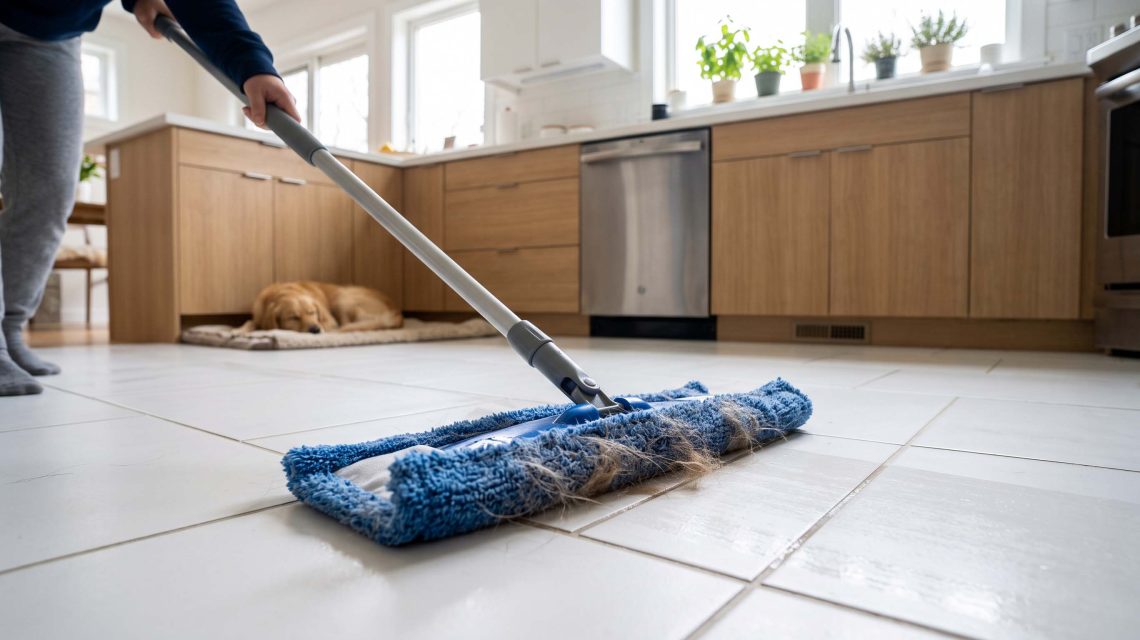
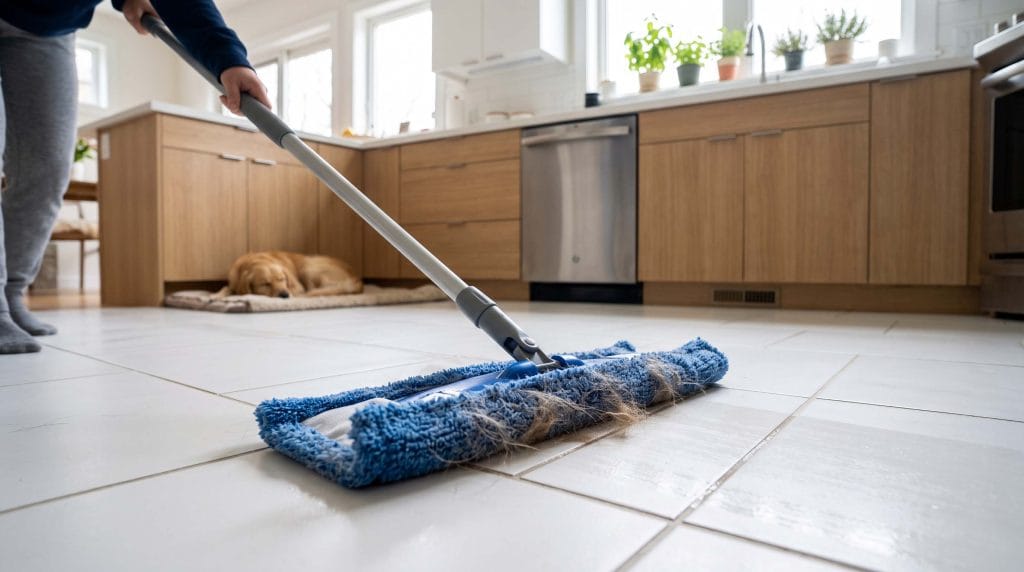
Use a damp mop instead of dry sweeping. Dry brooms displace air as they move, and that airflow is exactly what sends fine undercoat hair skating across the room instead of collecting into a pile. A slightly damp microfiber mop grabs hair through direct contact, sidestepping the float-and-drift problem almost entirely.
Keep resting spots away from ceiling fans and vents. Double-coated breeds tend to nap on cool tile or hardwood specifically because their thick coat runs warm, which means kitchen floors often become a favorite resting spot. Combine that natural habit with a nearby air source, and you’ve got a constant hair-launching setup.
Owners dealing with heavy double-coat shedders get the most value from pairing floor cleaning with a real brushing routine. Our guides on Husky shedding management, German Shepherd shedding, and Golden Retriever shedding cover exactly how to reduce this hair before it ever reaches the floor.
How to Stop Dog Hair From Blowing All Over Kitchen Floor With Short-Coated Breeds
Short-coated breeds like Boxers, Pugs, Beagles, and Labradors’ close cousins don’t produce the same floating undercoat fluff, but that doesn’t mean their hair is easy to deal with. It creates a different problem entirely — embedding rather than drifting.
Short, coarse hair tends to work its way into grout lines, floor seams, and the small gaps between cabinet bases and flooring rather than floating across the open room. Sweeping actually performs reasonably well on this hair type since it’s heavier and stays closer to the ground, but it needs a slightly different follow-up step.
A rubber-bristled broom works exceptionally well here, since the static charge it generates grabs coarse, short hair out of grout lines and small floor gaps more effectively than a standard broom. Rubber bristles also outperform vacuum brush rolls on textured tile, where standard vacuum heads sometimes skip over recessed grout entirely.
Grout and seam cleaning matters more for this coat type than for fine, floating undercoat hair. A stiff grout brush run along tile seams every couple of weeks prevents the kind of embedded buildup that eventually becomes visible even after regular sweeping.
How to Stop Dog Hair From Blowing All Over Kitchen Floor Based on Your Flooring Material
Coat type is half the equation. Flooring material changes the other half, and this gets overlooked constantly.
Tile and grout lines trap coarse, short hair in the recessed seams, which needs targeted grout brushing rather than just surface sweeping.
Hardwood and laminate are the smoothest surfaces in most kitchens, which means fine undercoat hair travels the farthest and fastest across these floors compared to any other material. A damp mop pass matters most here.
Vinyl and linoleum, particularly textured versions designed to mimic wood or stone, sit somewhere in between — smooth enough for drift, but textured enough to catch some hair the way tile grout does.
Matching your cleaning method to both your dog’s coat type and your specific flooring material solves the problem far more completely than a one-size-fits-all routine ever could.
Comparison Table: Coat Type vs. Kitchen Floor Cleaning Method
| Coat Type | Hair Behavior on Hard Floors | Best Cleaning Method | Brushing Priority |
|---|---|---|---|
| Double-coated (Husky, Lab, Shepherd) | Floats, drifts with airflow | Damp mop + rubber pre-sweep | High — daily during coat blow |
| Short-coated (Boxer, Pug, Beagle) | Stays close, embeds in seams/grout | Rubber broom + grout brush | Moderate — weekly |
| Wire/curly-coated (Poodle, Terrier) | Minimal shedding, low drift | Standard sweep + occasional mop | Low — as needed |
| Long, silky-coated (Cocker Spaniel) | Moderate drift, tangles in corners | Damp mop + corner vacuum attachment | Moderate to high |
Common Mistakes Pet Owners Make Regardless of Coat Type
A few habits undercut cleaning efforts no matter what breed or floor type is involved.
Using the same method for every coat type. A rubber broom that works beautifully on a Boxer’s coarse hair does very little for a Husky’s floating undercoat, and vice versa with a damp mop on grout-embedded short hair.
Sweeping right after ceiling fans or HVAC cycles run. Airflow disturbs loose hair regardless of coat type, but it matters most for fine undercoat shedders, where even a light breeze sends hair traveling across the whole room.
Ignoring grout lines on tile floors. Short-coated breed owners especially tend to sweep the open floor and skip the seams, where coarse hair accumulates invisibly over weeks.
Waiting until shedding season to start brushing. Reactive brushing after hair is already everywhere is far less effective than a consistent routine that removes loose hair before it sheds naturally.
Marcus and Bella — A Boxer Owner’s Different Kind of Kitchen Floor Battle
One of the pet owners in our community, Marcus, has a Boxer named Bella and a tile kitchen floor with fairly wide grout lines. For a long time, Marcus assumed his cleaning routine simply wasn’t thorough enough, since he swept daily and still noticed a faint gray-brown haze along the grout lines every few weeks.
What Marcus didn’t realize at first was that Bella’s short, coarse coat sheds hair that behaves completely differently from the floating undercoat fluff his sister’s Golden Retriever leaves around her house. Bella’s hair wasn’t drifting across the open floor the way his sister described dealing with — it was working directly into the grout lines and staying there, invisible during a quick sweep but building up steadily over time.
Once Marcus added a stiff grout brush to his routine every two weeks, along with switching his regular broom for a rubber-bristled one, the gray haze disappeared almost completely. The fix had nothing to do with sweeping more often. It had to do with recognizing that Bella’s coat type created a completely different cleaning problem than the floating-hair issue most general kitchen cleaning advice assumes every dog owner is dealing with.
🐾 A Detail Groomers Notice About Coat Type and Seasonal Timing
Here’s something that comes up often in conversations with groomers handling multiple breeds — double-coated dogs and short-coated dogs don’t just shed different textures, they often shed on different calendar timelines too. Double-coated breeds tend to blow coat dramatically twice a year, spring and fall, with relatively lighter shedding in between. Short-coated breeds like Boxers and Pugs shed at a fairly constant low level all year round, without the same dramatic seasonal spike.
This means a household with a double-coated dog needs a much more aggressive kitchen floor routine specifically during those two seasonal windows, while a household with a short-coated breed benefits more from a steady, unchanging weekly routine year-round. Treating both situations the same way — either going all-out constantly or only ramping up seasonally — leaves one type of owner over-cleaning and the other under-cleaning for most of the year.
Best Practices for Managing Kitchen Floor Hair Long-Term
- Identify your dog’s coat category first — double-coated, short-coated, or wire/curly — before choosing a cleaning routine, since the wrong method wastes effort on the wrong problem.
- Brush outside the kitchen entirely, ideally in a room with a door that closes, so loose hair never gets the chance to reach the floor in the first place.
- Match your tool to your flooring material — grout brushes for tile, damp mops for hardwood and laminate, and a combination approach for textured vinyl.
- Adjust cleaning frequency to your dog’s shedding calendar, ramping up during seasonal coat blows for double-coated breeds and maintaining a steady routine for short-coated ones.
- Keep a rubber broom and a damp mop both on hand, since most multi-dog households end up dealing with more than one coat type at once.
For breed-specific brushing routines that reduce shedding volume before it ever reaches the kitchen, our guides on Labrador shedding, Corgi shedding, and German Shepherd shedding cover the tools and techniques specific to each coat type. Our complete shedding management guide ties these routines together for households managing multiple breeds and coat types at once.
Tools Worth Having Based on Coat Type
- Undercoat rake — essential for double-coated breeds, pulls loose fluff before it sheds naturally
- Rubber-bristled broom — best for short-coated breeds and grout line maintenance
- Damp microfiber mop — the go-to for fine, floating undercoat hair on smooth flooring
- Stiff grout brush — solves the embedded hair problem specific to tile flooring
- Handheld vacuum with crevice attachment — useful for corners and cabinet gaps regardless of coat type
What’s Changing in Coat-Specific Floor Care
Vacuum manufacturers have started designing brush rolls specifically calibrated for different hair types, with some newer models offering a switch between a “fine hair” setting optimized for undercoat fluff and a “coarse hair” setting for short, embedded hair. Flooring companies have also introduced grout sealants marketed specifically toward pet owners, reducing how deeply short, coarse hair can work into tile seams over time.
On the grooming side, deshedding tools have become more precisely calibrated to specific coat densities, with separate tool designs for double-coated versus single-coated breeds rather than the one-size-fits-all rakes that used to dominate the market. This shift matters because it reflects what pet owners have known anecdotally for years — coat type isn’t a minor detail in the shedding conversation, it’s the entire foundation of which cleaning approach actually works.
Key Takeaways Checklist by Coat Type
- Identify whether your dog is double-coated, short-coated, or wire/curly-coated
- Use an undercoat rake for double-coated breeds during peak shedding
- Switch from dry sweeping to a damp mop for fine, floating hair on hardwood or laminate
- Add a rubber broom and grout brush routine for short-coated breeds on tile
- Increase cleaning frequency seasonally for double-coated dogs, keep it steady for short-coated ones
- Brush outside the kitchen in a separate, closed room
- Match cleaning tools to your specific flooring material, not just your dog’s breed
FAQ — How to Stop Dog Hair From Blowing All Over Kitchen Floor
Does coat type really change how to stop dog hair from blowing all over kitchen floor?
Yes, significantly. Fine undercoat hair from double-coated breeds floats and drifts with airflow, while coarser hair from short-coated breeds tends to stay put and embed into seams and grout instead.
What’s the best method to stop dog hair from blowing all over kitchen floor with a Husky or Labrador?
Regular brushing with an undercoat rake to remove loose hair before it sheds, combined with a damp mop instead of dry sweeping, handles the floating undercoat problem most effectively.
Why does my Boxer’s hair collect in grout lines instead of blowing across the floor?
Short, coarse hair is heavier than fine undercoat fluff and doesn’t catch air currents the same way, so it tends to settle into recessed grout lines and floor seams rather than drifting across open space.
Should double-coated and short-coated dog owners clean kitchen floors differently?
Yes. Double-coated breed owners benefit most from damp mopping and airflow management, while short-coated breed owners get better results from rubber brooms and regular grout brushing.
Does seasonal shedding affect how often I need to stop dog hair from blowing all over kitchen floor?
For double-coated breeds, yes — cleaning frequency should increase significantly during spring and fall coat blows. Short-coated breeds shed fairly consistently year-round, so a steady weekly routine usually works better than seasonal spikes.
Bringing It All Together
How to stop dog hair from blowing all over kitchen floor really depends on what kind of hair you’re actually dealing with. Fine, floating undercoat from double-coated breeds needs damp mopping and consistent brushing to cut off the problem at the source. Coarser hair from short-coated breeds needs grout attention and rubber-bristled tools to catch what settles into seams instead of drifting across the room.
Once you match your routine to your dog’s actual coat type instead of relying on generic cleaning advice, the kitchen floor stops feeling like a losing battle. Check out our guides on Husky shedding, Labrador shedding, Corgi shedding, German Shepherd shedding, and our complete shedding management guide to build a routine that actually fits the dog you’ve got. 🐾
This article provides general cleaning guidance for informational purposes. Always check flooring manufacturer instructions before using grout brushes, sealants, or specialty cleaning tools on tile, hardwood, or laminate surfaces.
