

 Animal Zoid Editorial Team
 Watching your dog look thin, bony, and low-energy is genuinely heartbreaking — especially when you’re doing everything you thought was right. If you’re desperately searching for answers on how to make a dog gain weight fast, you’ve found the right guide. One of our team members, Marcus, fostered a three-year-old Greyhound mix named Pip who arrived from a rescue shelter so underweight that his ribs were visible from across the room. His spine protruded noticeably, his energy was almost nonexistent, and he showed zero interest in play. Marcus described those first few days as “genuinely alarming — like caring for a dog who had simply given up on feeling good.” That experience launched an intensive, vet-guided journey to understand exactly how to make a dog gain weight fast safely, sustainably, and without causing digestive distress or other health complications along the way. Here’s what most well-meaning owners miss: weight gain in dogs isn’t simply about feeding more food. It’s about feeding the right food, in the right amounts, on the right schedule — while simultaneously ruling out the underlying medical causes that may be keeping your dog underweight in the first place. In this comprehensive guide, we’ll walk you through why dogs become underweight, how to identify the root cause, which foods and supplements produce the fastest healthy weight gain, how to structure a weight gain feeding plan, and how Pip gained 11 pounds in eight weeks using the exact strategies we’ll share here. We’ve addressed related nutrition and coat health topics in our comprehensive dog shedding guide and our dog atopy home remedy guide — both of which connect directly to the nutritional strategies we’ll cover today.
Why Your Dog Is Underweight — Before You Learn How to Make a Dog Gain Weight Fast
Before implementing any weight gain strategy, identifying why your dog is underweight is the most important step in the entire process. Jumping straight to high-calorie feeding without understanding the root cause can mask serious medical conditions and delay critical treatment.
Dogs become underweight for several distinct reasons, and each one requires a different primary response:
Medical causes that require veterinary attention first:
- Intestinal parasites (worms): One of the most common causes of weight loss in dogs — parasites steal nutrients before your dog’s body can absorb them. A simple fecal test at your vet confirms or rules this out within 24 hours
- Malabsorption disorders: Conditions like exocrine pancreatic insufficiency (EPI) prevent proper nutrient absorption regardless of how much your dog eats
- Dental disease: Painful teeth or gum disease makes eating genuinely uncomfortable, causing dogs to eat less than they need
- Hyperthyroidism: Though less common in dogs than cats, thyroid dysfunction can cause persistent weight loss despite normal or increased appetite
- Cancer: Unexplained, rapid weight loss in adult dogs warrants immediate veterinary evaluation
- Chronic infections or inflammatory conditions: Persistent illness burns calories at accelerated rates
Non-medical causes:
- Insufficient calorie intake: Simply not eating enough for their size, activity level, or life stage
- High activity demands: Working dogs, sporting dogs, and highly active breeds burn far more calories than standard feeding guidelines account for
- Competition feeding: Multi-dog households where a more dominant dog consumes a larger share of communal food
- Stress or anxiety: Anxious dogs often eat less — if your dog also shows nervous behavior around visitors, our how to stop dog barking at strangers guide addresses the anxiety connection in detail
- Recent illness or surgery: Recovery periods frequently produce temporary weight loss that requires deliberate nutritional support
- Poor food quality: Budget kibble with low digestibility means your dog absorbs far fewer nutrients per cup than the feeding guide suggests
According to the Association for Pet Obesity Prevention, approximately 20% of dogs presenting as underweight have an underlying medical condition driving the weight loss. Therefore, a veterinary checkup before beginning any weight gain program is not optional — it’s the responsible foundation of everything that follows.
How to Make a Dog Gain Weight Fast — The Nutritional Foundation
Once your veterinarian has ruled out or treated underlying medical causes, you can begin the nutritional strategy phase with confidence. Knowing how to make a dog gain weight fast through nutrition means understanding three core principles: caloric density, macronutrient ratios, and feeding frequency.
How to Make a Dog Gain Weight Fast With the Right Food Choices
Caloric Density — The Most Important Factor
The fastest path to healthy weight gain runs through caloric density — choosing foods that deliver significantly more calories per cup or per gram than your dog’s current food. Standard adult maintenance kibble typically delivers 300-360 calories per cup. High-performance or puppy formulas deliver 450-550 calories per cup. That difference compounds dramatically over multiple daily meals.
Protein — The Foundation of Healthy Weight Gain
Healthy weight gain in dogs means gaining lean muscle mass alongside appropriate fat stores — not simply adding fat. Achieving this requires high-quality animal protein as the foundation of every meal. Look for foods where a named animal protein (chicken, beef, salmon, lamb) appears as the first ingredient, with minimum 30% crude protein content for a weight gain diet.
Fat — The Most Calorie-Dense Macronutrient
Dietary fat delivers 9 calories per gram compared to 4 calories per gram from protein or carbohydrates — making it the most efficient tool for increasing caloric intake without dramatically increasing food volume. For underweight dogs, target foods with 18-20% fat content minimum, and consider adding healthy fat supplements to boost caloric density further.
Our top food recommendations for fast, healthy weight gain:
| Food Type | Calories/Cup | Protein % | Fat % | Weight Gain Speed | Our Rating |
|---|---|---|---|---|---|
| High-performance dry kibble | 450-550 | 30%+ | 18-20% | Fast | ⭐⭐⭐⭐⭐ |
| Puppy formula kibble (all breeds) | 420-500 | 28-32% | 16-20% | Fast | ⭐⭐⭐⭐⭐ |
| Raw diet (balanced) | 500-600 | 35%+ | 20%+ | Very Fast | ⭐⭐⭐⭐ |
| Wet/canned food (high protein) | 400-500 per can | 30%+ | 15%+ | Moderate-Fast | ⭐⭐⭐⭐ |
| Home-cooked diet (vet-guided) | Varies | Varies | Varies | Moderate | ⭐⭐⭐ |
| Standard adult maintenance kibble | 300-360 | 22-26% | 12-15% | Slow | ⭐⭐ |
| Budget/economy kibble | 250-320 | 18-22% | 8-12% | Minimal | ⭐ |
How to Make a Dog Gain Weight Fast — High-Calorie Food Additions
Beyond upgrading your dog’s primary food, strategic calorie-dense food additions dramatically accelerate weight gain when incorporated correctly. These additions work alongside — not instead of — a quality primary diet.
Best Food Additions to Help Make a Dog Gain Weight Fast
1. Sardines in water (not oil)
Sardines pack an extraordinary nutritional punch — high in protein, rich in omega-3 fatty acids, and genuinely palatable to most dogs. Add 1-2 sardines per meal for small dogs and 3-4 for large breeds. Beyond the caloric benefit, omega-3s support coat health and reduce systemic inflammation, which accelerates recovery in dogs who were underweight due to illness. This connects directly to the coat health benefits we covered in our dog atopy home remedy guide.
2. Eggs (cooked)
Scrambled or hard-boiled eggs provide exceptional bioavailable protein alongside healthy fats and essential amino acids. One large egg delivers approximately 70 calories and 6 grams of high-quality protein. Add one egg daily for small dogs and two eggs for large breeds — always cooked, as raw egg whites contain avidin, which blocks biotin absorption with prolonged feeding.
3. Pumpkin puree (plain, canned)
Counterintuitively, pumpkin helps with weight gain in underweight dogs by improving digestive efficiency — helping the gut absorb more nutrients from every meal. Add 1-2 tablespoons per serving. This is particularly valuable for dogs whose underweight condition stems from digestive inefficiency rather than insufficient intake.
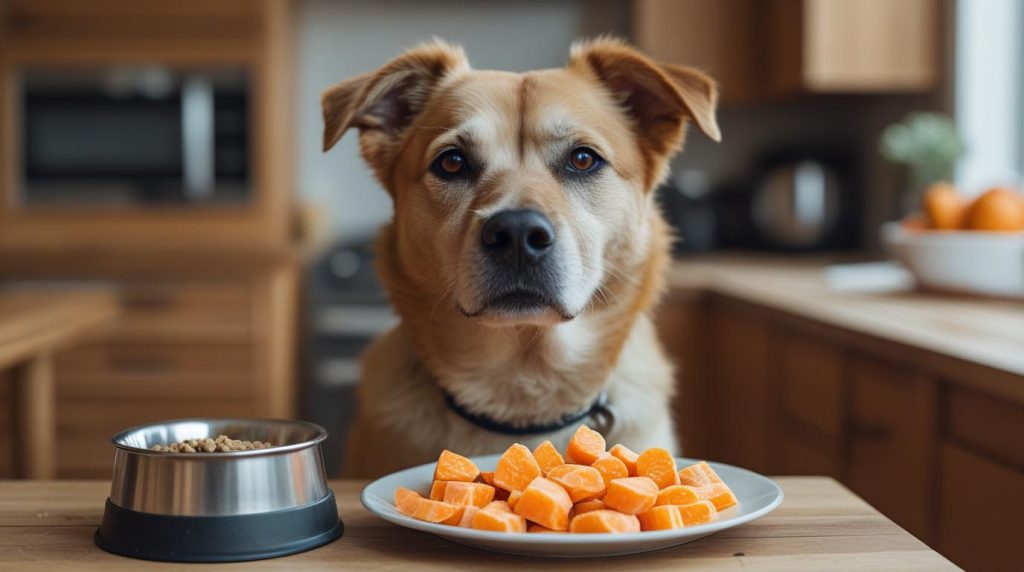
4. Sweet potato (cooked, mashed)
Cooked sweet potato provides complex carbohydrates, fiber, vitamins A and C, and approximately 86 calories per 100 grams. It’s gentle on the digestive system and particularly useful for dogs transitioning back to normal food after illness or surgery.
5. Coconut oil
One tablespoon of coconut oil delivers approximately 120 calories from medium-chain triglycerides, which dogs metabolize efficiently for energy. Start with half a teaspoon daily and increase gradually to avoid digestive upset. Coconut oil also supports skin and coat health — a direct benefit for dogs whose underweight condition has affected coat quality.
6. Peanut butter (xylitol-free)
Plain peanut butter without xylitol provides approximately 90 calories per tablespoon alongside protein and healthy fats. Use as a meal topper or mix into food to increase palatability for finicky eaters.
7. Bone broth (unsalted, onion-free)
While not exceptionally high in calories, bone broth dramatically increases palatability for dogs who are reluctant eaters — which is common in underweight dogs recovering from stress, illness, or trauma. Adding bone broth to dry kibble increases overall food intake by making meals significantly more appealing.
How to Make a Dog Gain Weight Fast — The Feeding Schedule Strategy
What you feed matters enormously. However, how you feed matters just as much. The feeding schedule you implement directly determines how efficiently your dog’s body converts food into healthy weight gain.
Building the Right Feeding Schedule to Make a Dog Gain Weight Fast
Increase meal frequency rather than portion size
The single most important feeding schedule change for underweight dogs is transitioning from one or two large daily meals to three or four smaller meals throughout the day. Here’s why this works so powerfully: underweight dogs frequently have reduced stomach capacity and compromised digestive efficiency. Large meals overwhelm their digestive system, leading to incomplete nutrient absorption and sometimes vomiting or loose stools. Smaller, more frequent meals deliver nutrients in amounts the digestive system handles comfortably — maximizing absorption at every meal.
The 10% caloric increase rule
Dramatically increasing food intake overnight is one of the most common — and damaging — mistakes owners make when learning how to make a dog gain weight fast. A dog who has been eating insufficient calories for weeks or months has a compromised digestive system. Sudden large increases cause refeeding syndrome in severely underweight dogs — a potentially life-threatening condition where the body cannot handle the sudden influx of nutrients.
Instead, increase daily caloric intake by 10% every 3-4 days until reaching the target caloric level. This gradual approach protects digestive health while still producing meaningful weight gain progress.
Calculate your dog’s target calories
Most underweight dogs need 20-30% more calories than their Resting Energy Requirement (RER) to gain weight at a healthy rate. The standard formula:
- RER = 70 × (body weight in kg)^0.75
- Weight gain target = RER × 1.4 to 1.7 multiplier
For a 15kg (33lb) dog: RER = 70 × (15)0.75 = approximately 530 calories. Weight gain target = 530 × 1.5 = approximately 795 calories daily.
How to Make a Dog Gain Weight Fast — Supplements That Accelerate Results
Alongside food upgrades and schedule optimization, targeted supplementation significantly accelerates healthy weight gain in underweight dogs.
Key Supplements to Help Make a Dog Gain Weight Fast
Omega-3 fatty acids (fish oil)
Beyond supporting coat and skin health — which we’ve detailed extensively in our breed-specific guides for German Shepherds and Golden Retrievers — omega-3 supplementation reduces systemic inflammation that can interfere with healthy weight gain in dogs recovering from illness or chronic stress.
Probiotics
Underweight dogs frequently have compromised gut microbiome diversity, which reduces digestive efficiency and nutrient absorption. A quality canine probiotic supplement (not human probiotics, which have different bacterial strains) improves gut function and maximizes the nutritional value your dog extracts from every meal — directly accelerating weight gain results.
B-vitamin complex
B vitamins support metabolism, energy production, and appetite regulation. Underweight dogs — particularly those who were underweight due to poor nutrition rather than illness — often show B vitamin deficiencies that suppress appetite and slow weight gain. A vet-recommended B-complex supplement addresses this directly.
Digestive enzymes
For dogs with malabsorption issues or compromised digestive efficiency, supplemental digestive enzymes (lipase, protease, amylase) dramatically improve nutrient extraction from food. This is particularly important for dogs diagnosed with exocrine pancreatic insufficiency or chronic pancreatitis.
Common Mistakes That Slow Down How to Make a Dog Gain Weight Fast
Even well-intentioned owners make errors that significantly slow weight gain progress or create new health problems alongside the weight issues they’re trying to solve.
Why These Mistakes Undermine How to Make a Dog Gain Weight Fast
❌ Mistake 1: Skipping the vet visit
Starting a weight gain program without veterinary evaluation risks missing treatable medical causes — particularly intestinal parasites and EPI — that will prevent weight gain regardless of what you feed. Always begin with a comprehensive vet check including fecal testing and bloodwork.
❌ Mistake 2: Increasing food volume too rapidly
As mentioned above, sudden dramatic increases in food intake can cause refeeding syndrome in severely underweight dogs. The 10% gradual increase rule protects your dog’s digestive system while still producing consistent progress.
❌ Mistake 3: Feeding table scraps exclusively
Owners who respond to an underweight dog by loading them up with table scraps create nutritional imbalances — too much fat, insufficient protein, wrong calcium-phosphorus ratio — that cause digestive problems and potentially harm long-term health even while adding short-term weight.
❌ Mistake 4: Ignoring palatability
An underweight dog who won’t eat enthusiastically won’t gain weight regardless of food quality. Warming food slightly, adding bone broth, or topping with sardines dramatically increases palatability and ensures your dog actually consumes the full intended meal.
❌ Mistake 5: Expecting overnight results
Healthy weight gain in dogs progresses at approximately 1-2% of body weight per week when done correctly. A 20-pound dog should gain approximately 0.2-0.4 pounds per week — which means reaching a healthy weight from a significantly underweight state takes 6-12 weeks. Patience and consistency produce lasting results; crash-feeding approaches produce digestive problems.
❌ Mistake 6: Neglecting exercise during weight gain
Complete rest during weight gain produces fat accumulation without muscle development — leaving your dog soft and metabolically unhealthy even at a normal weight. Gentle, appropriate exercise during the weight gain period ensures the gained weight includes lean muscle mass alongside healthy fat stores.
For dogs whose underweight condition connects to anxiety-driven reduced appetite — a pattern we’ve observed frequently in rescue dogs with behavioral challenges — addressing the behavioral component alongside nutrition produces dramatically better results. Our guides on how to stop a dog from jumping on guests and how to stop a dog from pulling on the leash address anxiety-related behaviors that sometimes co-occur with stress-induced weight loss.
Pip’s Story — How Marcus Used These Strategies to Make a Dog Gain Weight Fast
Let us return to Pip’s story, which we introduced at the beginning of this guide. When Pip arrived at Marcus’s home from the rescue shelter, he weighed 34 pounds — approximately 11 pounds below the healthy weight range for his breed mix. His body condition score was 2 out of 9, meaning his ribs, spine, and hip bones were all clearly visible with minimal muscle coverage. His coat was dull and dry. His energy was almost nonexistent.
Marcus’s first step was a complete veterinary evaluation. The vet found mild intestinal parasites — treated immediately with a single deworming course — alongside significant underweight status without other underlying medical causes. With parasites treated, the nutritional program began.
Here’s exactly what Marcus implemented:
- Week 1: Switched from the shelter’s standard kibble to a high-performance kibble delivering 480 calories per cup. Added bone broth to every meal for palatability. Transitioned to three meals daily instead of two. Applied the 10% caloric increase rule — started at 10% above calculated RER and increased gradually.
- Week 2: Added one cooked egg to morning meals and two sardines in water to evening meals. Introduced a canine probiotic supplement. Pip’s appetite visibly improved — he began finishing meals enthusiastically rather than picking at them.
- Week 3: Added half a teaspoon of coconut oil to one daily meal. Began gentle 15-minute leash walks to encourage lean muscle development alongside fat stores. Pip’s energy level showed noticeable improvement — he began showing interest in toys for the first time.
- Week 4-5: Increased to four meals daily during peak weight gain phase. Added omega-3 fish oil supplementation. Pip’s coat began improving noticeably — the dull, dry appearance giving way to a healthier sheen as nutritional status improved.
- Week 6-8: Consolidated the routine. Pip’s weight gain averaged 1.2 pounds per week throughout the program. By the end of week eight, Pip weighed 45 pounds — exactly 11 pounds gained in eight weeks, landing precisely within his healthy weight range.
The transformation extended far beyond the scale. Pip’s energy was vibrant. His coat shone. He played enthusiastically during walks and had begun initiating play sessions spontaneously at home. His body condition score had improved from 2/9 to a healthy 5/9. Marcus described the eight-week journey as “one of the most rewarding experiences of fostering — watching a dog rediscover what it feels like to be genuinely healthy.”
🐾 Team Pro-Tip: The “Rotation Feeding” Strategy
After working with dozens of underweight rescue dogs and owner-reported weight gain challenges, we’ve developed what we call the “Rotation Feeding” strategy — a technique that accelerates weight gain by combining multiple food sources across the week rather than feeding a single food exclusively.
Here’s how it works:
Rather than choosing one high-calorie food and feeding it exclusively, rotate between 2-3 high-quality protein sources across the week:
- Monday/Tuesday: High-performance dry kibble + cooked egg + bone broth
- Wednesday/Thursday: Canned high-protein wet food + sardines + pumpkin puree
- Friday/Saturday: High-performance kibble + cooked chicken breast + coconut oil
- Sunday: “Jackpot meal” — their favorite combination from the week, served warm
Why rotation feeding accelerates weight gain:
- Prevents palatability fatigue — dogs who eat the same food daily often reduce intake over time as novelty fades. Rotating maintains enthusiastic eating throughout the program
- Provides broader nutrient spectrum — different protein sources deliver different amino acid profiles, vitamins, and minerals, creating a more complete nutritional foundation
- Identifies food preferences — rotation quickly reveals which foods your specific dog finds most palatable, allowing you to prioritize those during the most critical weight gain phases
We’ve seen rotation feeding increase daily caloric intake by 15-20% compared to single-food programs — simply because dogs eat more enthusiastically when their meals vary. For underweight dogs where every calorie counts, this difference compounds meaningfully across weeks.
✅ Key Takeaways Checklist
Track your dog’s weight gain program:
- Completed comprehensive veterinary evaluation before starting
- Fecal test completed — parasites ruled out or treated
- Bloodwork completed — medical causes identified or eliminated
- Switched to high-calorie, high-protein primary food (450+ calories/cup)
- Calculating daily caloric target using RER formula × 1.4-1.7 multiplier
- Applying 10% gradual caloric increase every 3-4 days
- Transitioned to 3-4 smaller meals daily instead of 1-2 large meals
- Added calorie-dense food supplements (eggs, sardines, coconut oil)
- Incorporated bone broth for palatability improvement
- Started canine probiotic supplementation
- Added omega-3 fish oil at weight-appropriate dosage
- Implemented gentle exercise to encourage lean muscle development
- Weighing dog weekly and tracking progress against 1-2% weekly gain target
- Trying rotation feeding strategy to maintain enthusiastic eating
- Scheduled follow-up vet appointment at 4-week mark to assess progress
Frequently Asked Questions About How to Make a Dog Gain Weight Fast
How quickly can a dog safely gain weight?
Healthy, sustainable weight gain in dogs progresses at approximately 1-2% of current body weight per week. For a 30-pound underweight dog, that means approximately 0.3-0.6 pounds per week — reaching a healthy target weight in 8-12 weeks depending on how underweight they started. Faster weight gain than this typically indicates fluid retention or fat accumulation without muscle development, neither of which represents genuine health improvement.
What is the best food to make a dog gain weight fast?
High-performance dry kibble delivering 450-550 calories per cup with 30%+ protein and 18-20% fat consistently produces the best weight gain results in our experience. Puppy formula food works equally well for adult underweight dogs and delivers a similar nutritional profile. Supplementing either option with cooked eggs, sardines, and bone broth accelerates results significantly beyond the food alone.
Can I feed my dog human food to help them gain weight?
Certain human foods work excellently as weight gain supplements — cooked eggs, plain cooked chicken, sardines in water, plain cooked sweet potato, xylitol-free peanut butter, and plain canned pumpkin are all safe and nutritionally beneficial. However, human food should supplement rather than replace a balanced dog food, as human diets lack the correct calcium-phosphorus ratio and other micronutrients dogs require for long-term health.
My dog eats constantly but stays thin. What’s wrong?
A dog who eats enthusiastically but cannot maintain weight almost certainly has an underlying medical cause — most commonly intestinal parasites, exocrine pancreatic insufficiency (EPI), or a malabsorption disorder. This pattern requires immediate veterinary evaluation, as no amount of nutritional optimization will produce weight gain when the digestive system cannot absorb nutrients properly. A fecal test and bloodwork panel will identify the cause quickly.
How do I know if my dog is underweight?
The Body Condition Score (BCS) system provides the most reliable assessment. At a healthy weight (BCS 4-5 out of 9), you should be able to feel your dog’s ribs easily without pressing hard, but not see them visually. The waist should be visible from above, and the abdomen should tuck upward from the chest. If you can see ribs, spine, or hip bones clearly without touching, or if your dog scores below 3/9 on the BCS chart, they are clinically underweight and need immediate nutritional intervention with veterinary guidance.
Make a Dog Gain Weight Fast — Start Your Dog’s Recovery Journey Today
Learning how to make a dog gain weight fast safely and sustainably requires understanding that healthy weight gain is a process — not an event. It demands the right foundation (veterinary clearance), the right nutrition (calorie-dense, protein-rich food with strategic supplements), the right feeding structure (frequent small meals with gradual caloric increases), and the right patience (6-12 weeks for meaningful, lasting results).
Throughout this guide, we’ve explained why dogs become underweight and why identifying the root cause must come first, walked through the nutritional principles and food choices that produce the fastest healthy weight gain, introduced the high-calorie food additions that accelerate results, built a complete feeding schedule strategy, covered the supplements that support the process, highlighted the critical mistakes that slow progress or cause harm, and shared Pip’s complete eight-week transformation from an alarmingly thin rescue dog to a vibrant, healthy companion.
The most important thing we want you to take away is this: your dog’s underweight condition is not a reflection of your love for them. Most owners in this situation are already doing everything they knew to do — they simply needed better information. Now you have it.
Start today. Schedule that vet appointment, upgrade your dog’s food, implement the rotation feeding strategy, and add one or two calorie-dense food supplements to tomorrow’s meals. For more dog health and nutrition resources, explore our dog atopy home remedy guide, our comprehensive dog shedding guide, and our complete behavior series. Your dog’s healthiest, happiest chapter is just ahead. 🐾
