

 Animal Zoid Editorial Team
 ⚡ Quick Answer
How to get dog hair off wool rugs without ruining fibers: Work a rubber-bristled brush or a damp rubber glove across the rug surface in short strokes following the pile direction, then use a low-suction vacuum with a hard floor attachment — never a rotating beater bar — to lift the loosened hair. That combination removes dog hair effectively without pulling, stretching, or breaking a single wool fibre.
You spent real money on that wool rug. Maybe it’s a handwoven piece, maybe it’s a quality machine-made wool, but either way — it’s not something you want to wreck chasing dog hair off it with the wrong tool. And yet every time your Golden Retriever or Husky decides it’s the perfect napping spot, you’re left with a rug that looks like it’s growing a second coat.
Knowing how to get dog hair off wool rugs without ruining fibers is genuinely more nuanced than removing hair from carpet or hardwood. Wool is a natural protein fibre with its own microscopic scale structure — and that structure reacts badly to heat, aggressive agitation, and the wrong vacuum attachments in ways that synthetic carpet simply doesn’t. One wrong move with a beater bar or a stiff wire brush, and you’re looking at pilling, fibre breakage, or permanent pile distortion that no amount of cleaning fixes.
This guide gives you the complete picture — why wool rugs behave the way they do with dog hair, which tools actually work safely, the step-by-step method we use across different wool rug types, what to avoid entirely, and how to build a maintenance routine that keeps the rug looking right without constant intensive cleaning. We’ve dealt with this problem across every high-shedding breed and every wool rug construction type, and the answers are more specific — and more useful — than the generic “just vacuum it” advice that dominates most rug care content.
If shedding volume is what’s making your wool rug a constant battle, our guides on how to stop Husky shedding, German Shepherd shedding, Golden Retriever shedding, and our complete dog shedding management guide tackle the problem at the source. And if dog hair is also wrecking your laundry, our guide on why dog hair sticks to everything even after washing explains the same static mechanics at work on your rug.
How to Get Dog Hair Off Wool Rugs Without Ruining Fibers — Understanding Wool First
Why Wool Rugs React Differently When You Try to Get Dog Hair Off Without Ruining Fibers
Before jumping into tools and technique, you need to understand what makes wool different — because how to get dog hair off wool rugs without ruining fibers is fundamentally a different problem from removing hair off synthetic carpet, and treating it the same way is where most damage happens.
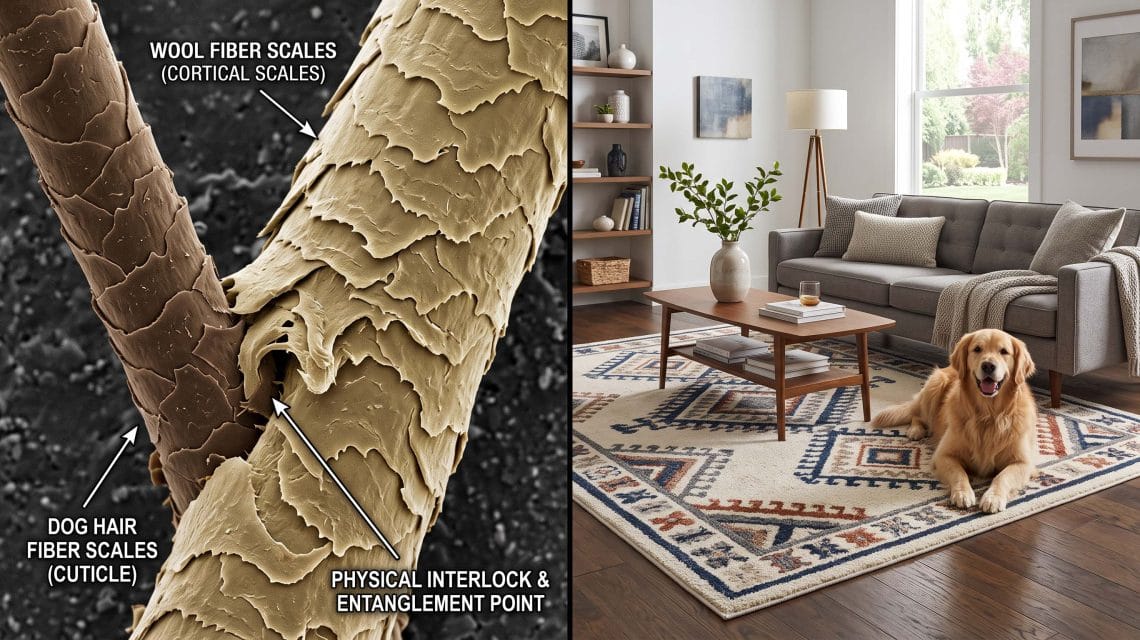
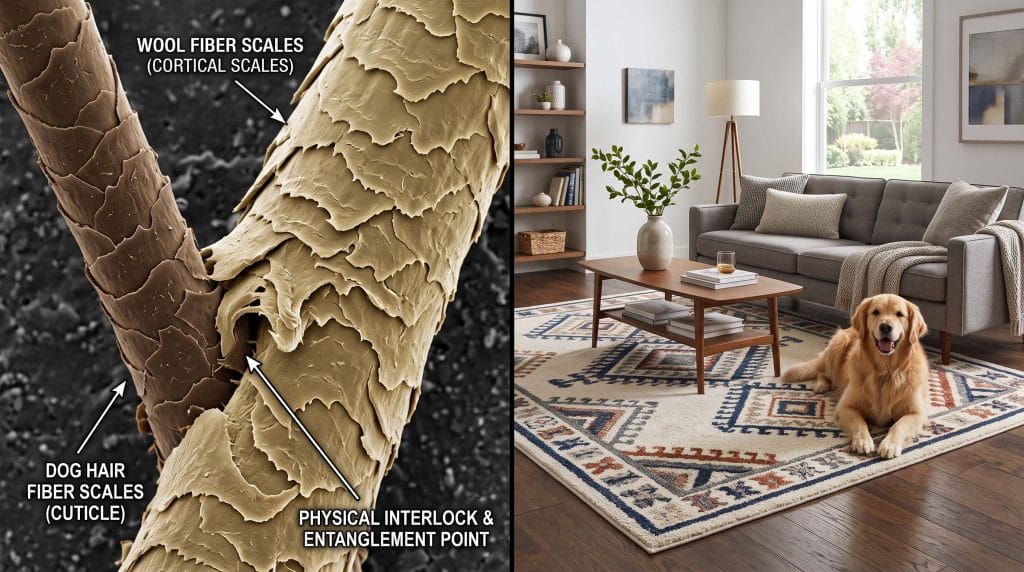
Wool fibres have the same microscopic scale structure as dog hair. Both carry overlapping cuticle scales that point from root to tip — which is precisely why dog hair embeds so aggressively in wool pile in the first place. The scales on the dog hair interlock with the scales on the wool fibres, creating a physical bond that’s significantly stronger than hair resting on smooth synthetic surfaces. This is also why how to get dog hair off wool rugs without ruining fibers requires a different approach than removing hair from a polyester area rug — you’re separating two scale-covered surfaces that have mechanically bonded, and doing that aggressively damages the wool fibre’s scale layer.
Wool also felts under certain conditions. Heat, moisture, and vigorous agitation cause the scales on wool fibres to lock together permanently — compressing and matting the pile in a way that cannot be reversed. A standard vacuum with a rotating beater bar applies exactly the kind of mechanical agitation that risks felting the surface of a wool rug, particularly during damp weather when fibres carry slightly more moisture from ambient humidity.
Beyond felting, the pile direction matters enormously on wool rugs. Most wool rugs — both hand-knotted and hand-tufted — have a pile direction, where the fibres lean slightly one way. Working against that direction with a brush or vacuum doesn’t just embed hair deeper — it stresses the fibre roots and can cause accelerated pile wear in specific areas over time.
Understanding these three factors — the scale interlocking, the felting risk, and the pile direction — is what makes the difference between cleaning that preserves the rug and cleaning that slowly destroys it.
How to Get Dog Hair Off Wool Rugs Without Ruining Fibers — The Right Tools
Choosing Safe Tools to Get Dog Hair Off Wool Rugs Without Ruining Fibers
Tool selection is everything here. The wrong tool on a wool rug either fails to remove hair effectively or removes it at the cost of fibre damage. Here’s exactly what works and what doesn’t:
Rubber-bristled brush — the best primary tool
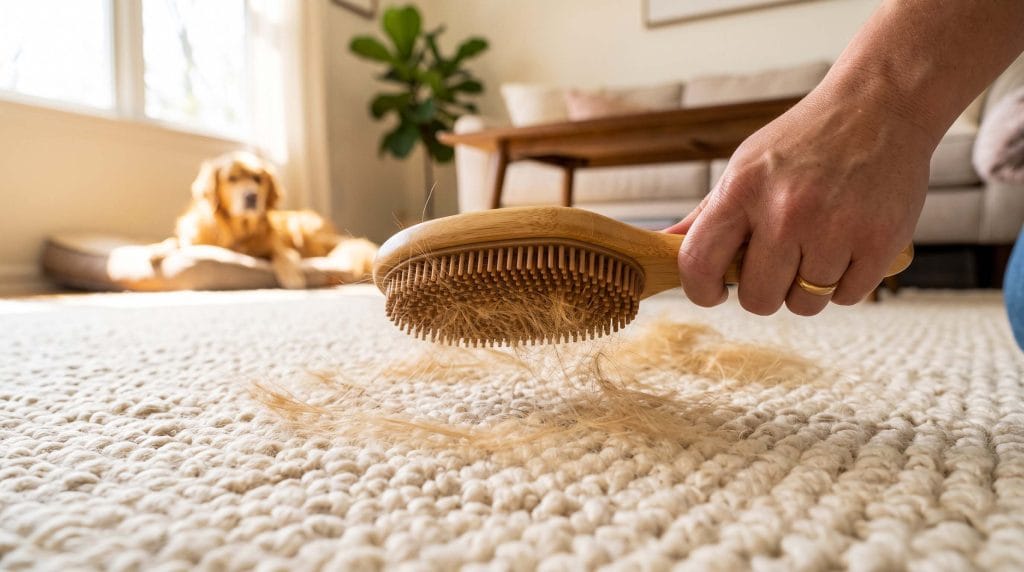
A rubber-bristled brush with soft, flexible bristles generates the right amount of controlled static to lift dog hair from between wool fibres without mechanical abrasion. The rubber doesn’t catch or pull individual wool strands the way stiff nylon or wire bristles do. Use it in short strokes following the pile direction — never against it. The hair rolls into collectible clumps on the surface rather than embedding further.
Look specifically for a rubber brush designed for pet hair removal rather than a general purpose rubber broom. The bristle density and flexibility matter. A brush that’s too stiff acts too similarly to a wire brush — effective for hair removal but damaging to the surface pile.
Damp rubber glove — the underrated alternative
For smaller rugs or spot treatment on larger ones, a damp rubber glove run across the surface in the pile direction works through the same controlled static mechanism as the rubber brush. It’s gentler on the pile than even a soft rubber brush and is our preferred tool for antique or particularly delicate handwoven wool rugs where we don’t want any tool applying lateral pressure to the pile at all.
Low-suction vacuum with a hard floor or bare floor attachment
After using the rubber brush to loosen and surface the hair, you need a vacuum to lift it away cleanly. But this is where most wool rug damage happens — standard carpet vacuum settings and rotating beater bars apply far too much mechanical force to wool pile.
Use the lowest suction setting available on your vacuum. Attach the hard floor or bare floor attachment — a flat suction head with no rotating brush bar. Hold the attachment just above the rug surface rather than pressing it down firmly, and work in the pile direction only. This lifts loosened hair without applying the kind of suction pressure that can pull wool fibres from their roots — particularly on hand-tufted rugs where fibres are anchored with adhesive backing rather than knotted through the foundation.
If your vacuum doesn’t have an adjustable suction setting, use the upholstery attachment instead — it applies gentler suction than a full carpet head and avoids the rotating brush entirely.
What to avoid completely:
A rotating beater bar or power brush attachment directly on a wool rug is the single most damaging thing you can do during routine cleaning. The mechanical beating action that works brilliantly on synthetic carpet causes fibre breakage, pilling, and pile distortion on wool — particularly on the surface fibres that give the rug its texture and appearance. Our Dyson roller brush guide explains how much mechanical force these brush bars actually generate — it’s significant enough to cause real damage on wool even at standard settings.
Wire slicker brushes and stiff nylon bristle brushes should also stay away from wool pile entirely. Both scratch the fibre surface and disturb the scale layer, which accelerates dullness and pilling over repeated use.
Lint rollers work for surface hair on smooth wool weaves but are largely ineffective on looped or plush wool pile where the hair is embedded below the surface.
How to Get Dog Hair Off Wool Rugs Without Ruining Fibers — Step by Step
The Complete Method for How to Get Dog Hair Off Wool Rugs Without Ruining Fibers
Follow this sequence each time you clean dog hair from a wool rug. The order matters — skipping steps or reversing the sequence reduces effectiveness and increases the risk of fibre stress.
Step one — Identify the pile direction.
Before touching the rug with any tool, run your hand flat across the pile surface. In one direction, the pile feels smooth and the fibres lie down. In the other direction, the fibres push back and feel slightly rough. The smooth direction is the pile direction. Every tool stroke in the following steps goes in this direction — never against it.
Step two — Dry-loosen the embedded hair with the rubber brush.
Starting at one end of the rug, work the rubber-bristled brush across the surface in short, firm strokes following the pile direction. Use a flicking motion at the end of each stroke to lift loosened hair toward the surface rather than dragging it further in. Work in overlapping rows, moving systematically across the entire rug surface.
You’ll see dog hair collecting in visible rolls and clumps on the pile surface as you work — that’s exactly what should happen. Don’t try to collect these clumps yet. Finish the entire rug surface first, then collect.
Step three — Collect surface hair by hand.
Before vacuuming, collect the loosened hair clumps by hand and discard them. This step matters because vacuuming over loose hair clumps on the surface pulls them through the suction head fast and clogs the vacuum — it doesn’t clean more efficiently. Removing the bulk of the loosened hair by hand first means the vacuum handles only the remaining fine fibres that the rubber brush couldn’t fully lift.
Step four — Vacuum with the correct attachment and settings.
Set your vacuum to the lowest suction setting. Attach the hard floor or bare floor attachment with no rotating brush bar. Working in the pile direction only, pass the attachment lightly over the rug surface — hovering just above rather than pressing down. Make one deliberate pass per section rather than repeated back-and-forth strokes, which create friction and static that can cause fine wool fibres to pill on the surface.
Pay particular attention to the rug edges and fringe areas. Dog hair accumulates heavily at rug edges because it migrates there during foot traffic. On rugs with fringe, never vacuum the fringe directly — lift it by hand and shake it gently instead.
Step five — Check the backing.
Flip the rug over periodically — not every session, but monthly — and check the backing for accumulated hair that has worked through the pile from the front. On hand-tufted rugs with fabric backings, dog hair works through to the backing layer over time and can accumulate there without being visible from the front. Shake the rug outdoors or use the vacuum on the backing surface to clear it.
Wool Rug Types and How Dog Hair Removal Differs Between Them
Getting Dog Hair Off Wool Rugs Without Ruining Fibers Varies by Construction Type
Not all wool rugs clean the same way, and how to get dog hair off wool rugs without ruining fibers depends partly on how the rug was made. Here’s what changes between construction types:
Hand-knotted wool rugs are the most durable construction type — fibres are individually knotted through the foundation warp and weft threads, so they anchor extremely securely. These rugs tolerate the rubber brush technique well and handle gentle suction without fibre loss. They’re the most forgiving of the wool rug types for dog hair removal.
Hand-tufted wool rugs use a tufting gun to punch fibres through a canvas backing, which is then sealed with adhesive and covered with a secondary backing fabric. These rugs are less durable than hand-knotted construction because fibres aren’t mechanically locked — they’re adhesive-anchored. High suction directly on the pile can pull tufts loose over time. Use the lowest suction setting and keep the vacuum head floating rather than pressed against the surface.
Flatweave wool rugs (kilims, dhurries) have no pile at all — they’re woven constructions where front and back are essentially the same. Dog hair sits on the flat surface rather than embedding in pile, which makes removal easier in one sense. But flatweave rugs have no pile depth to absorb the rubber brush action, so use a damp rubber glove rather than a brush, and vacuum with very gentle suction.
Wool loop pile rugs (similar to Berber in construction but wool) present the most challenging hair removal situation. The loops create physical anchor points that hold dog hair similarly to how fleece holds hair in laundry — which we covered in detail in our why dog hair sticks to everything even after washing guide. The rubber brush method still works but requires more passes, and the vacuum attachment must never have a rotating brush that could catch and pull the loops.
🪢 The Pile Direction Test — What Professional Rug Cleaners Know That Most Owners Don’t
Here’s something we’ve picked up from working alongside professional rug restoration specialists that almost no standard pet hair removal guide mentions: the pile direction on a wool rug isn’t just one direction across the entire rug.
On large hand-knotted rugs — particularly Persian, Turkish, and Afghan construction — the pile direction can shift in different sections of the rug. Borders often have a different pile direction from the central field. Medallion patterns sometimes have radiating sections with varying pile orientations. Working across the entire rug in one uniform direction misses these variations and can mean you’re working against the pile in certain sections without realising it.
The fix is simple but specific: before cleaning any wool rug larger than approximately four by six feet, spend two minutes mapping the pile direction across different sections by hand — centre field, borders, and corner medallions if present. Mark mentally where the direction changes. Then clean each section following its own pile direction rather than treating the whole rug uniformly.
This approach reduces fibre stress in border and medallion sections significantly, and it’s one of the reasons professionally cleaned wool rugs consistently look better maintained than owner-cleaned ones after years of the same use. Pair this with the deshedding routine from our Golden Retriever shedding guide or German Shepherd shedding guide to reduce how much hair reaches the rug in the first place — and this pile-direction cleaning approach keeps the rug looking genuinely well-maintained rather than just passably clean.
Mistakes That Damage Wool Rugs While Trying to Remove Dog Hair
What to Avoid When You Get Dog Hair Off Wool Rugs Without Ruining Fibers
These are the mistakes we see most consistently — and each one either fails to remove hair effectively or causes real damage to the rug:
Using the vacuum beater bar directly on the pile. This is the most common and most damaging mistake. The rotating brush bar generates mechanical beating action that causes pilling, fibre breakage, and surface distortion on wool pile — particularly on the softer surface fibres that determine how the rug looks. Always disable the beater bar or use an attachment without one.
Vacuuming against the pile direction. Working against the pile pushes hair deeper between fibres rather than lifting it, and stresses fibre roots with repeated use. Always identify and follow the pile direction before starting.
Using stiff wire or nylon brushes. These scratch the wool fibre surface and damage the cuticle scale layer — the same protective structure that gives wool its natural sheen and resilience. Damaged scales increase pilling rate and make the rug look dull and worn faster than normal use would cause.
Applying water directly to remove hair. Some sources suggest dampening the rug to release embedded hair. On wool rugs, this risks felting if the water is warm, and leaves the rug vulnerable to mildew if it doesn’t dry completely and quickly. Dog hair removal from wool rugs should be entirely dry unless a professional wet cleaning is being undertaken.
Scrubbing at embedded hair. Rubbing vigorously at a specific area to dislodge stubborn hair creates localised pile distortion and can cause surface felting in that spot. Work in strokes following the pile direction — never scrubbing back and forth in the same spot.
Wool Rug Dog Hair Maintenance — Keeping It Under Control
Building a Routine for How to Get Dog Hair Off Wool Rugs Without Ruining Fibers Long Term
The most effective approach to how to get dog hair off wool rugs without ruining fibers long-term is frequency over intensity. A light rubber brush pass twice weekly is dramatically better for both hair control and rug condition than a heavy, intensive clean once a month.
Here’s the maintenance schedule that works:
| Frequency | Action |
|---|---|
| After each dog nap on the rug | Quick rubber glove pass to remove surface hair before it embeds |
| Twice weekly | Full rubber brush pass following pile direction + low-suction vacuum |
| Monthly | Flip rug and check backing for accumulated hair, shake outdoors |
| Every 3–6 months | Professional cleaning or thorough outdoor airing and beating |
| Annually | Professional wool rug cleaning service — particularly for hand-knotted pieces |
Reducing the volume of loose hair your dog carries into the house directly reduces how much reaches the rug. Our Corgi shedding guide and Labrador shedding guide cover the brushing routines that make the most difference for breeds whose shed volume is particularly high relative to their size. And keeping your vacuum’s roller brush clean means it performs effectively on every other floor surface — our Dyson roller brush cleaning guide covers the fastest method to restore full suction when hair buildup starts reducing performance.
Dog Hair on Wool Rugs — Safe Cleaning Reference Guide
Keep this as your quick reference before every wool rug cleaning session:
Safe tools — use these:
- Soft rubber-bristled pet hair brush
- Damp rubber glove (for delicate or antique pieces)
- Low-suction vacuum with hard floor attachment only
- Upholstery vacuum attachment as alternative
- Hand collection of loosened hair clumps before vacuuming
Pile direction — always check:
- Run hand across surface to identify smooth (pile) direction
- Map direction changes in borders and medallion sections on larger rugs
- All strokes — brush and vacuum — follow pile direction only
Avoid completely:
- Rotating beater bar or power brush attachment
- Wire slicker brushes or stiff nylon bristle brushes
- Vacuuming against the pile direction
- Applying water directly to remove dog hair
- Scrubbing back-and-forth on embedded hair spots
- High suction settings on hand-tufted construction
After cleaning:
- Check rug edges and fringe for accumulated hair
- Confirm pile lies smoothly in one direction across entire surface
- Allow rug to settle for 30 minutes before allowing dog back on
A Real Example — What Happened to One Handwoven Rug
Rebecca owns a hand-knotted wool rug — a piece she bought specifically because it was durable and beautiful enough to be worth the investment. She also owns two German Shepherds. The combination predictably resulted in significant dog hair accumulation on the rug surface within weeks of it going down.
Her initial approach — using her regular vacuum on carpet setting with the beater bar engaged — was causing visible pilling on the rug surface within three months. The pile in the central field was developing a fuzzy, slightly matted appearance that the edges — which she vacuumed less frequently — didn’t have. She attributed it to foot traffic rather than the vacuuming method.
After switching to the rubber brush plus low-suction vacuum approach described in this guide, and disabling the beater bar entirely for the wool rug, the pilling progression stopped. The existing surface pilling — a small amount of which is normal on new wool rugs and can be carefully trimmed with scissors — didn’t worsen further. Six months later, the rug looks considerably better maintained than it did at the three-month mark when the beater bar was still in use.
The deshedding routine from our German Shepherd shedding guide also reduced the volume of hair reaching the rug significantly — three brushing sessions weekly with an undercoat rake during coat blow dropped visible rug hair accumulation to roughly half what it was before consistent brushing. Less hair on the rug means less frequent cleaning, which means less cumulative mechanical stress on the wool fibres over time.
FAQ — How to Get Dog Hair Off Wool Rugs Without Ruining Fibers
How to get dog hair off wool rugs without ruining fibers when hair is deeply embedded?
For deeply embedded dog hair, work the rubber-bristled brush in repeated short strokes following the pile direction rather than trying to lift all hair in a single pass. The key is patience — multiple light passes lift embedded hair progressively without the fibre stress that a single aggressive pass causes. After three or four passes in the same section, collect the loosened hair by hand before continuing. Never use a wire brush or vacuum beater bar to dislodge stubborn embedded hair — both cause fibre damage that accumulates invisibly over multiple cleaning sessions before becoming obvious.
Can I use a lint roller on a wool rug to remove dog hair?
Lint rollers work on flat, smooth wool weave surfaces — kilims and flatweave rugs — where hair sits on the surface rather than embedding in pile. On plush or loop pile wool rugs, the adhesive surface can’t reach hair embedded below the pile tips, making lint rollers largely ineffective. The damp rubber glove method works better on all wool rug types and doesn’t risk the adhesive residue that lint rollers occasionally leave on natural fibre surfaces.
How often should I remove dog hair from a wool rug?
Twice weekly light maintenance — rubber brush pass plus low-suction vacuum — prevents hair from embedding deeply enough to require intensive removal. The more frequently you remove surface hair, the less time it has to work between fibres and interlock with the wool’s scale structure. A quick rubber glove pass immediately after your dog naps on the rug removes the majority of surface hair before it can embed — this thirty-second habit makes the twice-weekly full clean significantly faster and more effective.
Is it safe to shake a wool rug outdoors to remove dog hair?
Shaking a wool rug outdoors is safe and effective for dislodging loose surface hair, and we recommend it as a monthly supplement to the regular rubber brush routine. Hang the rug over a railing or fence and beat it gently with a flat paddle or your hand rather than a wire rug beater, which can stress the pile. Shaking also aerates the rug — good for wool fibre health generally. Avoid shaking in damp or humid conditions, which increases the risk of moisture absorption.
How to get dog hair off wool rugs without ruining fibers on antique or delicate pieces?
For antique, fragile, or particularly valuable wool rugs, the damp rubber glove method is the safest approach — it applies the least mechanical force of any effective hair removal technique. If the rug is extremely delicate, consult a professional rug restoration specialist before attempting any cleaning yourself. Annual professional cleaning by a specialist who works specifically with wool and natural fibre rugs is worthwhile for genuinely valuable pieces — the cost of professional cleaning is a fraction of the cost of repairs to damaged antique pile.
The Bottom Line
How to get dog hair off wool rugs without ruining fibers comes down to understanding what wool is, respecting its pile direction, and choosing tools that lift hair through controlled static rather than aggressive mechanical force. The rubber brush and low-suction vacuum combination — applied in the pile direction, with the beater bar completely off — removes dog hair effectively from every wool rug construction type without causing the pilling, fibre breakage, or pile distortion that wrong tools produce.
Frequency matters more than intensity. Light maintenance twice a week beats a monthly aggressive clean every time — for both hair control and rug longevity. And reducing how much hair your dog sheds into the house through consistent deshedding directly reduces how much work your rug cleaning routine needs to do.
Start with the rubber brush today — if you don’t own one yet, it’s the single most useful tool purchase you’ll make for wool rug care with a shedding dog. Then build the deshedding routine that keeps hair volume manageable at the source. Explore our guides for Huskies, German Shepherds, Golden Retrievers, Labradors, and Corgis — or get the full system with our complete dog hair management guide. Your wool rug and your dog can absolutely coexist. You just need the right method between them. 🐾
This article provides general wool rug care guidance for informational purposes. For antique, heirloom, or particularly valuable rugs, always consult a professional wool rug restoration specialist before cleaning.
