


 Animal Zoid Editorial Team
Your Frenchie’s couch spot is suddenly buried under a layer of fine, stiff hairs that seem to multiply overnight every time the weather shifts. If you are trying to figure out how to manage french bulldog shedding during seasonal changes, the challenge is more complex than a simple brush-and-go routine because French Bulldogs carry a unique combination of brachycephalic melatonin disruption, skin-fold microclimates, and an allergy-driven shedding amplifier that most grooming guides never address. We have worked with hundreds of Frenchie owners who assumed their short-coated dog would be an easy keeper, only to discover that seasonal transitions turn their living rooms into fur-covered disaster zones.
The Brachycephalic Shedding Paradox That Changes Everything
French Bulldogs shed differently than almost every other short-coated breed, and the reason starts with their skull. The compressed facial structure that gives the Frenchie its signature flat face also alters the orbital anatomy — the angle and depth of the eye sockets. This matters because light entering the eye at a modified angle sends slightly distorted photoperiod signals to the suprachiasmatic nucleus, the brain’s master clock that regulates melatonin production.
In a longer-nosed breed like a Greyhound, the eyes receive light at a standard angle, and the pineal gland produces a clean, predictable melatonin curve that rises in autumn and falls in spring. The hair follicles follow this curve faithfully, producing two neat seasonal sheds per year. In a French Bulldog, the altered light reception creates a noisier melatonin signal. The pineal gland still responds to seasonal changes, but the response is delayed and compressed. Instead of a gradual six-week shedding transition, Frenchies often experience a sudden two-to-three-week shedding burst that catches owners completely off guard.
This is the first thing you need to understand about how to manage french bulldog shedding during seasonal changes — the timing will not match what you read about other breeds. Your Frenchie’s shed may start two to three weeks later than your neighbor’s Lab, and it will hit harder and end faster.
The 70-Percent Telogen Trap
Here is a number that explains the volume problem. At any given moment, roughly 70 to 80 percent of a French Bulldog’s hair follicles sit in the telogen (resting) phase. Compare that to a Labrador Retriever at 50 to 60 percent or a Golden Retriever at 40 to 50 percent. Frenchies stockpile dormant hairs at a much higher rate than most breeds.
When the seasonal trigger finally hits — the compressed melatonin shift we described above — a large batch of those telogen follicles receive the anagen (growth) signal simultaneously. The new hairs push the old telogen hairs out of the follicle in a concentrated wave. The result is a sudden, heavy shed that looks disproportionate to the dog’s size. A 25-pound Frenchie can produce more visible shed volume in a two-week window than a 60-pound Lab spreads across six weeks.
For a deeper comparison of shedding patterns across coat types, our guide on the difference between normal shedding and a full coat blow breaks down the biology.
Aisha and Marcel: A Frenchie Shedding Story That Defied the Calendar
Aisha brought home Marcel, a brindle French Bulldog, when he was four months old. His first year was uneventful — a few loose hairs on dark clothing, nothing dramatic. Then his second spring arrived, and Marcel started dropping fur in quantities that made Aisha question whether she had accidentally adopted a Husky.
“The worst part was the timing,” Aisha told us. “Every article I read said spring shedding starts in March. Marcel did not start shedding until mid-April, and when he did, it was like a faucet turned on. I would brush him for ten minutes and pull off enough fur to build a second, smaller Frenchie.”
Aisha tried everything. Daily brushing. Deshedding shampoos. A high-end vacuum. The shedding persisted for three intense weeks and then stopped as abruptly as it started. By the time she scheduled a vet visit, the shed was over, and the vet found nothing wrong.
When Aisha connected with our team, we explained the brachycephalic melatonin delay and the telogen trap. We also identified a second issue she had not noticed: Marcel’s facial folds and tail pocket were trapping shed hairs against the skin, creating localized hotspots of moisture and irritation that amplified the shedding in those areas.
We built a targeted management plan around Marcel’s delayed shedding calendar and his fold zones. The next spring, Aisha started her grooming protocol in early April instead of March. She added fold cleaning to her routine and introduced an antihistamine supplement during peak pollen season. The shedding still came — that is biology — but the volume dropped by roughly 60 percent, and Marcel’s skin stayed healthy throughout the transition.
Her experience is a perfect case study in how to manage french bulldog shedding during seasonal changes — the key was working with the Frenchie’s unique timeline instead of following generic breed advice.
The Fold-Trap Microclimate That Amplifies Seasonal Shedding
French Bulldogs carry more skin folds per square inch of body surface than almost any other short-coated breed. The facial wrinkles, the nose rope, the tail pocket, and the body rolls on heavier dogs all create enclosed spaces where heat and moisture accumulate.
During seasonal transitions, these folds become shedding accelerators. Here is why. The hair follicles inside a skin fold experience a microclimate that is roughly 3 to 5 degrees warmer and 20 to 30 percent more humid than the exposed skin on the dog’s back or flanks. This elevated temperature and humidity push the fold-zone follicles into a faster growth cycle than the rest of the coat. The result is a desynchronized shed — the fold hairs are already releasing while the back hairs are still holding, creating an uneven, patchy shedding pattern that looks erratic and confusing.
The tail pocket is the worst offender. The screw tail presses shed hairs against the skin in a tight, dark, humid space. During a seasonal shed, the increased hair volume overwhelms the pocket’s natural clearing mechanism. The trapped hairs mix with moisture and skin oils, forming a matted plug that can lead to secondary bacterial or yeast infections if left unchecked. Many Frenchie owners mistake this tail pocket irritation for a skin disease when it is actually a shedding management problem.
When learning how to manage french bulldog shedding during seasonal changes, you must treat the fold zones as separate grooming territories that require their own cleaning schedule.
The Allergy-Shedding Overlap Most Guides Ignore
French Bulldogs rank among the top three most allergy-prone breeds. This matters enormously for seasonal shedding because the two phenomena overlap and amplify each other in ways that most grooming resources do not discuss.
During spring and fall, environmental allergens — pollen, mold spores, dust mites — trigger a histamine response in the Frenchie’s skin. Histamine causes inflammation in the dermis, which accelerates the hair follicle cycling rate. Follicles that would normally remain in telogen for another few weeks get pushed into the shedding phase prematurely by the inflammatory signal. The result is a shedding volume that exceeds what the seasonal trigger alone would produce.
In practical terms, this means your Frenchie’s spring shed is not purely seasonal. It is partially an allergic response masquerading as a seasonal shed. If you live in an area with high spring pollen counts, your Frenchie may shed 30 to 50 percent more than a Frenchie in a low-pollen environment, even though both dogs experience the same temperature and daylight changes.
This allergy-shedding overlap is a critical piece of how to manage french bulldog shedding during seasonal changes because it means antihistamine management can reduce shedding volume — a connection most grooming guides completely miss.
Quick Answer
The most effective approach to how to manage french bulldog shedding during seasonal changes combines three strategies: align your grooming schedule to the Frenchie’s delayed melatonin-driven shed window (typically 2 to 3 weeks later than other breeds), clean the skin folds and tail pocket every 2 to 3 days during the shed to prevent trapped-hair infections, and add an omega-3 plus quercetin supplement 4 weeks before the expected shed to dampen the histamine-driven shedding amplifier.
Your Month-by-Month Plan to Manage French Bulldog Shedding During Seasonal Changes
Rather than a generic weekly routine, here is a seasonal calendar that accounts for the Frenchie’s unique shedding biology.
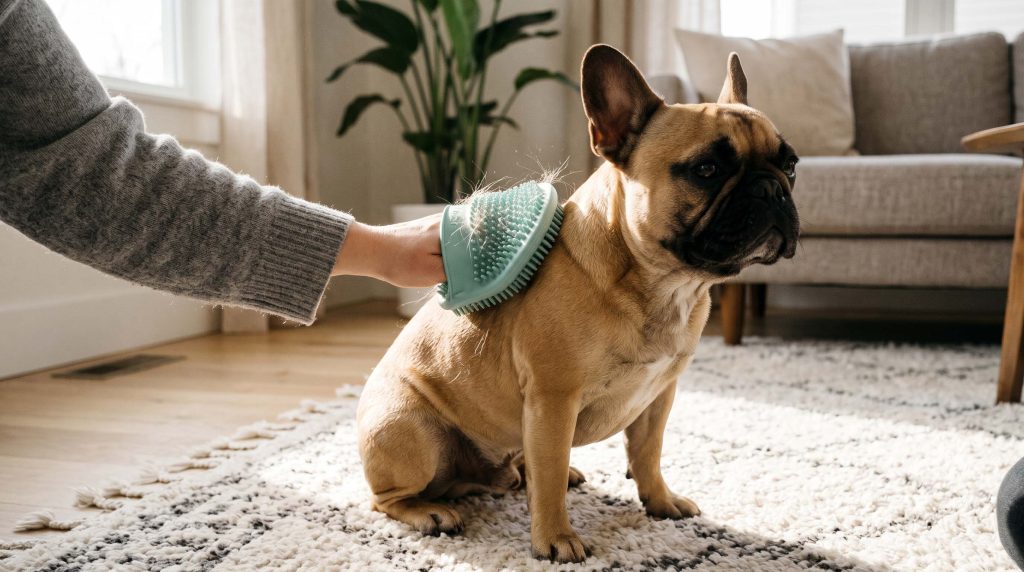
January–February (Pre-Spring Prep): Start the omega-3 and quercetin supplement now. The anti-inflammatory effects take 3 to 4 weeks to build up in the skin, so you need them active before the shed begins. Brush twice a week with a rubber curry comb to remove accumulated telogen hairs before the seasonal push.
March (The Waiting Month): Do not panic if your Frenchie is not shedding yet. Remember the brachycephalic melatonin delay. Most Frenchies will not start their spring shed until mid-to-late April. Continue brushing twice a week. Clean the facial folds and tail pocket every three days with a veterinary wipe.
April–May (Peak Spring Shed): This is when the compressed telogen release hits. Increase brushing to daily sessions of 5 to 10 minutes using a rubber curry comb on the body and a soft-bristle brush on the face. Clean the tail pocket daily. If your Frenchie is scratching more than usual, the histamine amplifier is active — consult your vet about a short course of antihistamines.
June–August (Summer Maintenance): The spring shed should be over. Reduce brushing to three times a week. Focus on the fold zones, which trap sweat and shed hairs in the summer heat. Bathe every 3 to 4 weeks with an oatmeal-based shampoo. Our article on safely diluting professional deshedding shampoo covers ratios that protect sensitive Frenchie skin.
September–October (Fall Shed Window): The fall shed is typically milder than spring but follows the same delayed timeline. Expect it to hit in late October rather than early September. Resume daily brushing and fold cleaning. Restart the omega-3 and quercetin supplement if you stopped during summer.
November–December (Winter Calm): Shedding drops to baseline. Return to twice-weekly brushing. Focus on skin hydration — indoor heating dries out Frenchie skin, which can cause flaky, irritated patches that shed more than healthy skin. Run a humidifier in the room where your dog sleeps.

Common Mistakes When You Try to Manage French Bulldog Shedding During Seasonal Changes
Starting the Grooming Protocol Too Early
If you begin aggressive deshedding in March based on generic “spring shed” advice, you will exhaust your Frenchie’s coat before the actual shed arrives in late April. The premature brushing removes guard hairs that the dog still needs, and when the real telogen release hits, the coat looks patchy and uneven. Wait for the first signs of increased shedding before ramping up your routine.
Ignoring the Tail Pocket During Seasonal Shedding
The tail pocket is the most neglected grooming zone on a French Bulldog, and during a seasonal shed it becomes a ticking time bomb. Trapped shed hairs mixed with moisture and sebum create an ideal environment for bacterial overgrowth. If your Frenchie starts scooting or licking the tail area during a shed, check the pocket immediately. Our article on why dog skin looks pink after a deshedding bath covers how to evaluate skin irritation in fold areas.
Using a Deshedding Blade on Frenchie Skin
French Bulldog skin is thinner than most breeds — roughly 0.5 to 0.8 mm compared to 1.0 to 1.5 mm in a Lab. Deshedding blades with fine metal teeth can easily scratch and irritate this thin skin, causing inflammation that triggers even more shedding. Stick to rubber curry combs and soft-bristle brushes. Our guide on the best bath brush for heavy-shedding short hair dogs covers gentle tools that work well for thin-skinned breeds.
Treating the Shed as Purely a Grooming Problem
If your Frenchie’s seasonal shed is accompanied by excessive itching, red skin, ear infections, or paw licking, the shedding is being amplified by allergies. No amount of brushing will fix an allergic response. Address the histamine trigger with your vet, and the shedding volume will drop significantly.
The Shedding Severity Decoder for French Bulldogs
| Shed Level | What You See | What It Means | Action Required |
|---|---|---|---|
| Baseline | A few hairs on dark clothes | Normal daily telogen release | Brush 2x per week |
| Moderate | Visible fur on furniture, light dusting on floors | Early seasonal transition | Increase to 3x per week, start fold cleaning |
| Heavy | Clumps on brush, fur tumbleweeds on floors | Peak seasonal shed | Daily brushing, daily fold cleaning, antihistamine check |
| Excessive | Bald patches, red skin, odor from folds | Allergy-amplified shed or infection | Vet visit for skin cytology and allergy panel |
Our Team’s Pre-Shed Antihistamine Protocol for Frenchies
Here is a technique we developed after noticing that the Frenchies in our care shed significantly less during seasons when their owners were already managing allergies. We started recommending a proactive antihistamine protocol: four weeks before the expected seasonal shed, add a natural quercetin supplement (a plant-based flavonoid with antihistamine properties) to the Frenchie’s meals at a dosage of roughly 5 to 10 mg per pound of body weight daily.
Quercetin stabilizes mast cells in the skin, reducing the histamine release that accelerates follicle cycling during high-pollen periods. It is not a drug — it is a naturally occurring compound found in apples, berries, and leafy greens — and it has a strong safety profile in dogs. We have seen it reduce peak-season shedding volume by roughly 25 to 35 percent in allergy-prone Frenchies.
Combine the quercetin with an omega-3 fish oil supplement (20 to 30 mg EPA/DHA per pound daily), and you create a dual anti-inflammatory shield that addresses both the histamine amplifier and the skin dryness that worsens seasonal shedding. Honestly, this combination has been the single most impactful change for the Frenchies in our care.
Always check with your vet before starting any supplement, especially if your Frenchie is on other medications.
FAQ — How to Manage French Bulldog Shedding During Seasonal Changes
Do French Bulldogs shed more in spring or fall?
Most French Bulldogs shed more heavily in spring due to the combined effect of the delayed melatonin shift and the seasonal allergy amplifier. The fall shed is typically milder and shorter. However, individual variation is significant — some Frenchies shed equally in both seasons, especially if they live in environments with consistent indoor temperatures year-round.
Can I reduce my Frenchie’s seasonal shedding with diet alone?
Diet plays a supporting role but cannot eliminate seasonal shedding. A high-quality diet with adequate omega-3 fatty acids, zinc, and biotin will produce a healthier coat that sheds less dramatically, but the seasonal telogen release is hormonally driven and will happen regardless of nutrition. Think of diet as damage control, not prevention.
Is it normal for my Frenchie to shed in patches during seasonal changes?
Patchy shedding can be normal if it follows the fold-zone pattern we described — heavier shedding inside skin folds and lighter shedding on exposed areas. However, if the patches are circular, completely bald, or accompanied by redness and scaling, the cause may be ringworm, demodex mites, or a bacterial infection rather than seasonal shedding. Schedule a vet visit for a skin scraping.
Should I bathe my Frenchie more often during the seasonal shed?
No. Over-bathing strips the natural oils that protect Frenchie skin and can worsen shedding. Stick to a bath every 3 to 4 weeks during the shed using a gentle oatmeal shampoo. Focus your effort on brushing and fold cleaning instead. When you do bathe, our article on brushing a dog while the coat is soapy covers techniques that maximize fur removal during the wash.
Does neutering or spaying change the seasonal shedding pattern?
Yes. Altered Frenchies often experience a shift in coat texture and shedding rhythm due to the loss of sex hormones that influence follicle cycling. Some owners report heavier year-round shedding after the procedure, while others notice a more predictable seasonal pattern. The coat typically stabilizes within 6 to 12 months post-surgery.
Final Thoughts on Frenchie Seasonal Shedding
Learning how to manage french bulldog shedding during seasonal changes requires abandoning the generic advice written for longer-nosed, single-cycle breeds and embracing the Frenchie’s unique biology. The delayed melatonin signal, the 70-percent telogen trap, the fold-zone microclimates, and the allergy-shedding overlap all combine to create a shedding pattern that is distinctly French Bulldog.
Start by shifting your grooming calendar two to three weeks later than standard spring and fall advice. Add the fold-zone cleaning routine. Introduce the quercetin and omega-3 protocol four weeks before the expected shed. These three changes address the root causes rather than just the visible symptoms, and most Frenchie owners see a dramatic improvement within the first seasonal cycle.
For more on managing shedding across all coat types, our general guide on how to deal with dog shedding covers breed-specific strategies. And if bath day turns into a soaking disaster, our article on stopping a dog from shaking water everywhere after a bath has practical containment tricks that work well in small spaces.
Disclaimer: This article is for informational purposes only and does not replace professional veterinary advice. If your French Bulldog shows signs of sudden hair loss, bald patches, skin infections, persistent itching, or behavioral changes during a seasonal shed, consult a licensed veterinarian to rule out allergies, hormonal imbalances, demodectic mange, or bacterial skin infections.
