

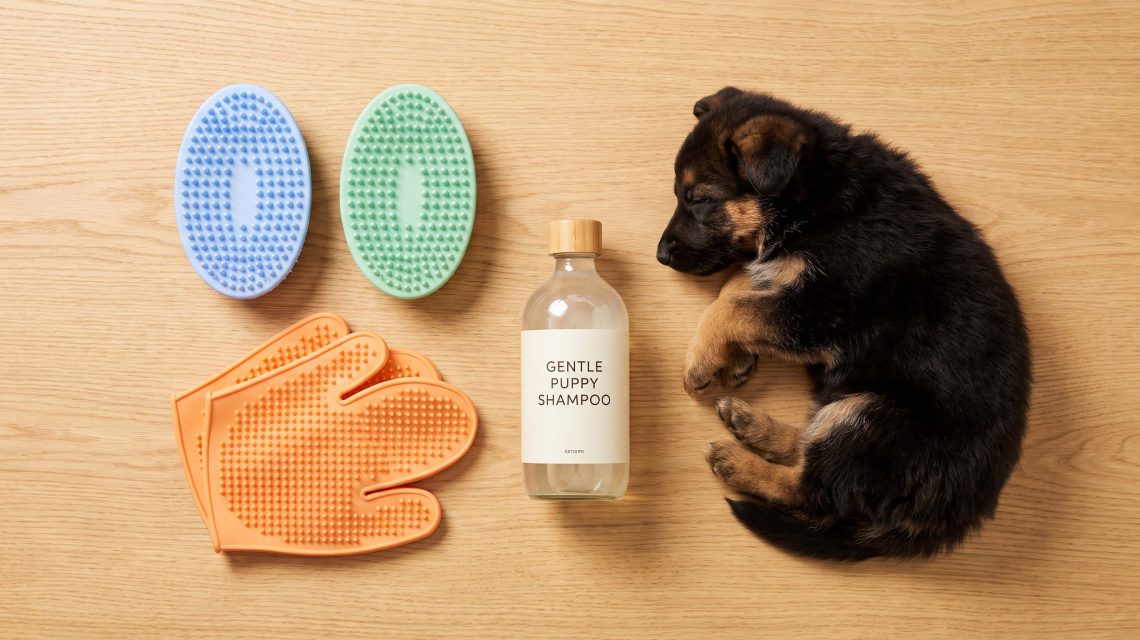
 Animal Zoid Editorial Team
Your German Shepherd puppy is shedding at 4 months because they are entering the first stage of puppy-to-adult coat transition, a completely normal developmental milestone where the soft, single-layer puppy coat begins releasing to make room for the dense double coat underneath. If you are asking why is my german shepherd puppy shedding so early at 4 months, the short answer is that large-breed puppies like German Shepherds mature faster than smaller breeds, and their coat transition often begins between 12 and 16 weeks of age — earlier than most owners expect.
We get this question constantly from new GSD parents who brought home a fluffy, low-shedding puppy and suddenly find tufts of soft fur on their couch at the four-month mark. It feels too early. It feels like something might be wrong. But in the vast majority of cases, this is exactly what should be happening, and understanding the biology behind it will save you a lot of unnecessary worry — and a lot of unnecessary vet bills.
The Puppy Coat Timeline: Why Is My German Shepherd Puppy Shedding So Early at 4 Months?
German Shepherd puppies are born with a single layer of soft, downy fur called the puppy coat. This coat serves one purpose: insulation during the first weeks of life when the puppy cannot regulate its own body temperature effectively. It is not the same coat your adult GSD will carry, and it was never designed to last.
+-----------------------------------------------------------------------------------+
|              GERMAN SHEPHERD COAT DEVELOPMENT TIMELINE                            |
|                                                                                   |
|  Birth – 8 Weeks:    [Puppy Coat Phase]                                           |
|                      Single-layer, soft, downy, minimal shedding                  |
|                      Coat feels like cotton wool                                  |
|                                                                                   |
|  8 – 16 Weeks:       [Pre-Transition Phase]                                       |
|                      Adult guard hairs begin emerging through puppy coat          |
|                      Shedding still minimal but texture starts changing           |
|                                                                                   |
|  16 – 24 Weeks:      [First Coat Blow — THIS IS WHERE YOU ARE]                    |
|                      Puppy coat releases in patches; adult undercoat grows in     |
|                      Visible shedding begins; coat looks uneven and "moth-eaten"  |
|                                                                                   |
|  6 – 12 Months:      [Juvenile Coat Phase]                                        |
|                      Adult double coat fills in; texture becomes coarser          |
|                      Shedding stabilizes at adult baseline                        |
|                                                                                   |
|  12 – 24 Months:     [Full Adult Coat]                                            |
|                      Complete double coat with dense undercoat and harsh guard    |
|                      Seasonal coat blows begin on adult schedule                  |
+-----------------------------------------------------------------------------------+
At 4 months (roughly 16 weeks), your GSD puppy is crossing the threshold from the pre-transition phase into the first real coat blow. The adult guard hairs — those stiff, weather-resistant outer hairs that give German Shepherds their characteristic sleek look — are pushing up through the skin and physically displacing the soft puppy fur above them. The puppy coat has to go somewhere, so it sheds.
This is the primary reason why is my german shepherd puppy shedding so early at 4 months. It is not premature. It is right on schedule.
The Biology Behind Early Shedding in German Shepherd Puppies
Here is where things get interesting, and where most online articles stop short of giving you the full picture.
German Shepherds are a large, fast-maturing breed. Their skeletal growth plates close faster than smaller breeds, their hormonal development accelerates earlier, and their integumentary system (skin and coat) follows the same accelerated timeline. A key driver of this early coat transition is a hormone called IGF-1 (Insulin-like Growth Factor 1), which large-breed puppies produce at significantly higher levels during their first six months compared to small or medium breeds.
IGF-1 stimulates rapid cell turnover in the hair follicles, pushing the puppy coat follicles into the catagen (transition) and telogen (resting) phases much earlier than you would see in, say, a Beagle or a French Bulldog puppy. While a small-breed puppy might not begin shedding its puppy coat until 6 to 8 months, a German Shepherd’s accelerated IGF-1 production compresses that timeline to 3 to 5 months.
[High IGF-1 Production in Large Breed Puppies]
               │
               ▼
[Accelerated Follicle Cell Turnover]
               │
               ▼
[Puppy Coat Follicles Enter Telogen Phase at 14-18 Weeks]
               │
               ▼
[Adult Guard Hairs Emerge Simultaneously]
               │
               ▼
[Visible Shedding at 4 Months — Completely Normal]
There is also a secondary factor that rarely gets discussed: thermoregulatory signaling. German Shepherd puppies develop the ability to regulate their own body temperature much earlier than smaller breeds, typically by 10 to 12 weeks. Once the puppy no longer needs the insulating puppy coat for warmth, the body receives a thermal feedback signal that accelerates the coat transition. If your puppy lives in a warm household or was born during spring or summer, this thermal signal arrives even sooner, which can push shedding to the earlier end of the 3-to-5-month window.
What Early GSD Puppy Shedding Actually Looks Like at 4 Months
Knowing what to expect visually helps you distinguish normal puppy coat transition from actual health problems.
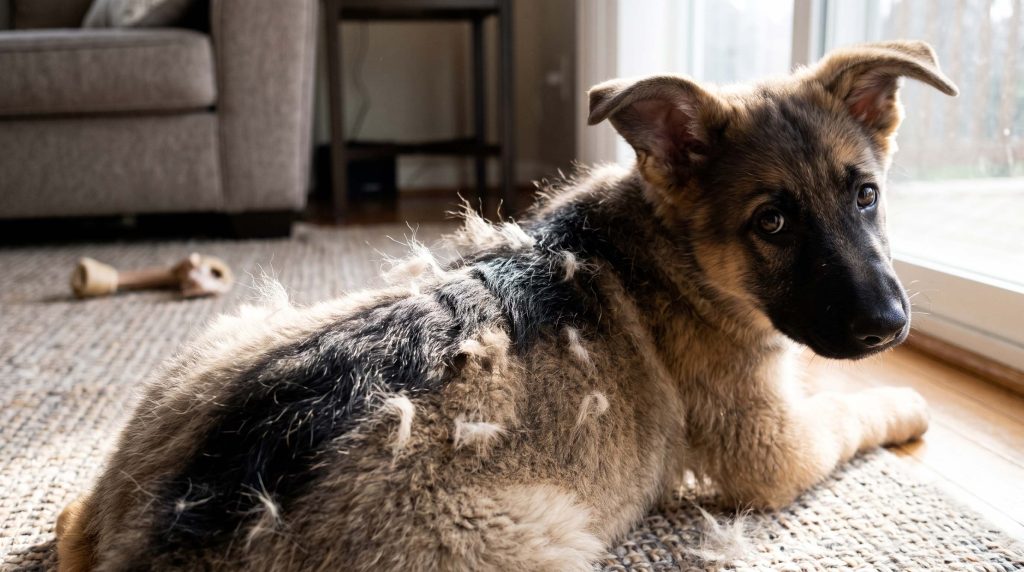
At 4 months, the shedding you see will look different from adult GSD shedding. The puppy coat fibers are finer, softer, and lighter in color than the adult coat growing in beneath them. You will notice:
- Soft, cottony tufts coming loose when you pet your puppy, especially along the back and sides
- A slightly scruffy, uneven appearance to the coat, particularly around the neck, shoulders, and hindquarters, where the adult guard hairs are pushing through at different rates
- Color shifts in the coat, especially around the face, legs, and saddle area, as the darker adult pigmentation replaces the lighter puppy coloring
- No bald patches or raw skin — the coat may look thin in spots, but the skin underneath should look healthy, smooth, and unbroken
This patchy, transitional phase is sometimes called the “puppy uglies” among GSD breeders, and it is a well-known developmental stage that resolves completely by 8 to 12 months as the adult coat fills in uniformly.
Diego’s Story: A 4-Month-Old GSD Who Shed More Than the Adult Dogs
When Rachel and Tom brought home Diego, their long-haired German Shepherd puppy, they were prepared for eventual shedding. They had done their research, bought an undercoat rake, and figured they would start dealing with serious fur around the one-year mark.
At 15 weeks old, Diego started leaving soft, pale tufts of fur on their dark sofa. By 17 weeks, the tufts had turned into noticeable clumps. Rachel found fur in her coffee, on her work clothes, and rolled into little balls in the corners of every room. Diego’s coat, which had been a uniform fluffy gold at 10 weeks, now looked patchy and uneven, with darker adult hairs poking through the lighter puppy fuzz along his back.
Rachel panicked. She called their breeder, convinced Diego had a skin condition or a nutritional deficiency. The breeder laughed and said, “He’s blowing his puppy coat. Welcome to German Shepherd ownership.”
+--------------------------------------------------------------------------+
|                      DIEGO'S PUPPY COAT TRANSITION                       |
|                                                                          |
|  Week 12:  Coat still uniform, fluffy, minimal shedding                  |
|  Week 15:  First soft tufts appearing on furniture                       |
|  Week 17:  Noticeable clumping; coat texture changing along spine        |
|  Week 20:  Peak puppy coat release; "moth-eaten" appearance on flanks    |
|  Week 24:  Adult guard hairs dominant; shedding begins to slow           |
|  Week 32:  Juvenile coat mostly filled in; texture noticeably coarser    |
|                                                                          |
|  Total duration of puppy coat blow: ~10 weeks                            |
|  Skin health throughout: Normal, no redness, no bald patches             |
+--------------------------------------------------------------------------+
The turning point for Rachel was understanding that Diego’s early shedding was a sign of healthy development, not a problem to fix. She switched from worrying to managing. She started brushing Diego gently three times a week with a soft rubber curry brush — the same type we recommend in our guide on the best bath brush for short-haired dogs that shed a lot, adapted for a puppy’s more sensitive skin — and the loose puppy coat came out cleanly without irritating his developing adult coat underneath.
By 8 months, Diego’s adult double coat had fully emerged, and the early shedding phase was a distant memory.
Environmental Factors That Can Accelerate Puppy Shedding at 4 Months
While the primary driver of early GSD puppy shedding is genetic and hormonal, several environmental factors can push the timeline earlier or intensify the volume.
Indoor Climate Control
Puppies raised in consistently warm, climate-controlled homes receive a continuous thermal signal that their insulating puppy coat is unnecessary. This can accelerate the coat transition by two to four weeks compared to puppies spending significant time outdoors in cooler temperatures.
Artificial Lighting Cycles
German Shepherds, like all double-coated breeds, rely on photoperiod (daylight duration) to regulate coat cycling. Puppies exposed to long hours of artificial indoor lighting, especially during winter months when natural daylight is shorter, may experience disrupted melatonin production that triggers earlier-than-expected coat transition. This is the same photoperiod mechanism that drives seasonal coat blows in adult dogs, which we covered in detail in our article on the difference between normal shedding and a full husky coat blow.
Early Spay or Neuter
Puppies spayed or neutered before 6 months of age experience a sudden shift in sex hormone levels that can accelerate coat maturation. Estrogen and testosterone both play roles in regulating the hair growth cycle, and removing these hormones early can push the puppy-to-adult coat transition forward by several weeks.
Nutritional Changes
Switching a puppy from their breeder’s food to a different formula around the 3-to-4-month mark can temporarily increase shedding as the body adjusts to new protein sources, fatty acid ratios, and micronutrient levels. This is usually mild and resolves within two to three weeks.
When to Worry: Distinguishing Normal Puppy Shedding From Health Problems
Most of the time, the answer to why is my german shepherd puppy shedding so early at 4 months is simply developmental biology. But there are specific red flags that warrant a vet visit.
+----------------------------------------------------------------------------+
|               NORMAL PUPPY SHEDDING vs. CONCERNING HAIR LOSS               |
|                                                                            |
|  NORMAL (Developmental Coat Transition):                                   |
|  ✓ Soft, fine puppy fur releasing evenly across the body                   |
|  ✓ Skin underneath looks smooth, pink/gray, and unbroken                   |
|  ✓ No excessive scratching, biting, or rubbing                             |
|  ✓ Puppy is energetic, eating well, and gaining weight                     |
|  ✓ Adult guard hairs visible growing in beneath the shedding puppy coat    |
|                                                                            |
|  CONCERNING (Possible Medical Issue):                                      |
|  ✗ Circular bald patches with red, scaly, or crusty skin                   |
|  ✗ Intense scratching, licking, or chewing at specific spots               |
|  ✗ Hair loss concentrated around the eyes, muzzle, or paws                 |
|  ✗ Dull, brittle, or broken adult hairs instead of smooth new growth       |
|  ✗ Lethargy, appetite loss, or failure to gain weight                      |
+----------------------------------------------------------------------------+
If your puppy’s shedding matches the “normal” column, you are dealing with a standard coat transition. If you see any of the “concerning” signs, schedule a vet appointment to rule out conditions like demodectic mange (common in young GSDs), ringworm, zinc-responsive dermatosis, or food allergies.
How to Manage Your GSD Puppy’s Early Shedding Without Damaging the Adult Coat
This is where many new owners make mistakes that cause long-term coat problems. The puppy coat transition requires a gentler approach than adult GSD grooming.
Use Soft Tools Only
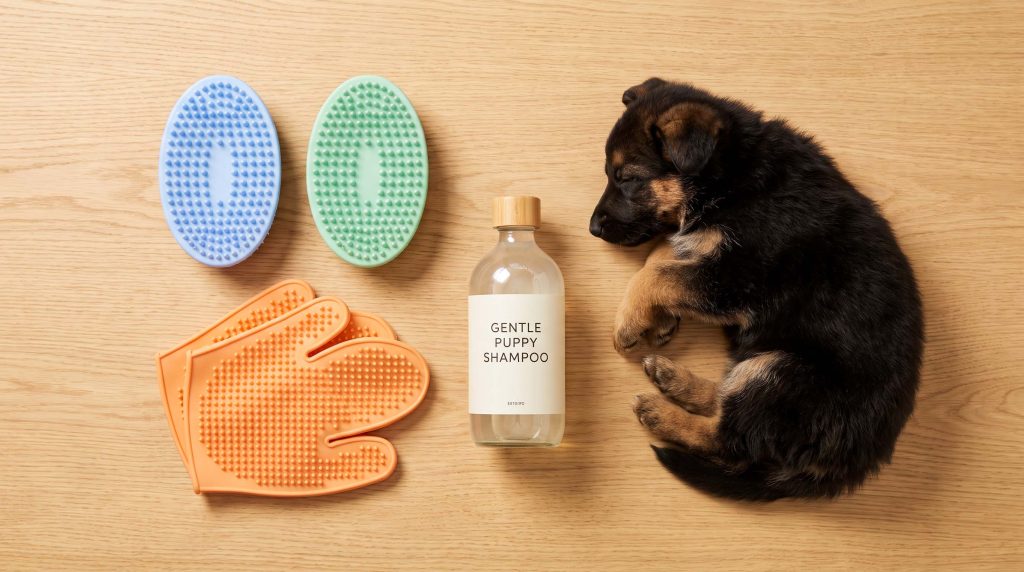
Your puppy’s skin is thinner and more sensitive than an adult dog’s, and the emerging adult guard hairs are still developing their structural integrity. Avoid metal undercoat rakes, deshedding blades, and slicker brushes with stiff wire pins during the puppy coat blow. Instead, use a soft rubber curry brush, a silicone grooming mitt, or a wide-toothed plastic comb.
If you are unsure about brushing technique on a young dog, our guide on can you brush a dog while the coat is soapy covers safe wet-brushing methods that work well for puppies during bath time.
Brush Gently and Frequently
Three to four short sessions per week, lasting five to ten minutes each, work better than one long, aggressive session. Gentle, frequent brushing removes loose puppy coat before it mats against the growing adult coat underneath, without pulling on the delicate new guard hairs.
Bathe Sparingly
Puppy skin produces less protective sebum than adult skin, making it more vulnerable to drying out. Limit baths to once every six to eight weeks during the puppy coat transition, and use a gentle, puppy-specific shampoo rather than an adult deshedding formula. If you do use a deshedding shampoo later, make sure to dilute it properly — our guide on how to safely dilute professional dog deshedding shampoo covers safe ratios for sensitive skin.
Support Coat Health Through Nutrition
Feed a high-quality large-breed puppy food with adequate omega-3 and omega-6 fatty acids, zinc, and biotin. These nutrients directly support healthy follicle development and help the adult coat emerge strong and resilient. Avoid supplementing with excessive fish oil or vitamin A, which can paradoxically increase shedding in developing puppies.
A Detail Most GSD Puppy Guides Miss: The “Double Shed” Phenomenon
Here is something we have observed consistently across dozens of German Shepherd puppies that almost no grooming resource addresses: GSD puppies often experience a double shedding event during their first year.
The first event, the one you are seeing at 4 months, is the puppy coat blow — the release of the soft, single-layer birth coat. This typically resolves by 6 to 7 months.
The second event hits around 9 to 12 months, when the juvenile coat (the transitional coat that grew in after the puppy coat) begins its first seasonal blow to establish the true adult double coat. Many owners think the shedding is finally over after the puppy coat blow, only to be blindsided by a second, even heavier shedding phase a few months later.
Knowing this second blow is coming helps you prepare mentally and logistically, rather than assuming something has gone wrong when your 10-month-old GSD suddenly starts dropping fur again. For a broader understanding of how shedding patterns evolve as dogs mature, our complete shedding management guide covers the full lifecycle.
Quick Reference: GSD Puppy Shedding by Age
| Age | Coat Phase | Shedding Level | What You Will See | Action Needed |
|---|---|---|---|---|
| 0–8 weeks | Puppy coat | None to minimal | Soft, uniform fluff | No grooming needed |
| 8–14 weeks | Pre-transition | Very light | Occasional soft hairs | Gentle petting removes loose fur |
| 14–24 weeks | First puppy coat blow | Moderate to heavy | Soft tufts, patchy appearance, color shifts | Brush 3-4x/week with soft rubber tool |
| 6–9 months | Juvenile coat filling in | Light to moderate | Coat thickening, texture coarsening | Brush 2-3x/week; introduce slicker brush |
| 9–12 months | Second coat blow | Heavy | Dense undercoat release, adult coat emerging | Daily brushing; first deshedding bath |
| 12–24 months | Full adult coat | Baseline + seasonal | Standard adult GSD shedding pattern | Regular adult grooming routine |
Frequently Asked Questions
Why is my German Shepherd puppy shedding so early at 4 months when my friend’s GSD didn’t shed until 7 months?
Individual variation in coat transition timing is completely normal and depends on genetics, birth season, indoor climate, and growth rate. Some GSD puppies start shedding their puppy coat as early as 12 weeks, while others hold onto it until 6 or 7 months. Both timelines fall within the normal range.
Will my GSD puppy’s coat color change during this shedding phase?
Yes, almost certainly. German Shepherd puppies are typically born much darker or much lighter than their eventual adult coloring. The puppy coat blow at 4 months is often when the first significant color shifts become visible, especially around the saddle, face mask, and legs. The final adult color may not fully settle until 18 to 24 months.
Should I bathe my 4-month-old GSD puppy to help remove the loose puppy coat?
Bathing can help loosen dead puppy fur, but limit baths to once every six to eight weeks at this age to avoid drying out the developing skin. Use lukewarm water and a gentle puppy shampoo. If you are concerned about water temperature affecting shedding, our research on does warm water make a dog shed more during a bath provides helpful guidance.
Is it safe to use a deshedding tool on a 4-month-old German Shepherd?
No. Metal deshedding blades and undercoat rakes are too aggressive for a puppy’s developing skin and emerging adult coat. Stick to soft rubber curry brushes and silicone grooming mitts until your GSD is at least 8 to 10 months old and the adult coat has fully established.
How long will this early puppy shedding phase last?
The first puppy coat blow typically lasts 6 to 10 weeks from start to finish. Most GSD puppies complete the transition by 6 to 7 months of age, though the coat will continue thickening and changing texture until 18 to 24 months.
Your Puppy Is Right on Schedule
If you have been losing sleep over why is my german shepherd puppy shedding so early at 4 months, take a deep breath. Your puppy is doing exactly what their biology designed them to do at this age. The soft puppy coat is making way for the impressive double coat your GSD will carry for the rest of their life, and the early timeline is a sign of healthy, accelerated large-breed development — not a medical problem.
Gentle brushing, proper nutrition, and patience are all you need right now. The heavy-duty deshedding tools and intensive grooming routines can wait until your puppy’s adult coat fully emerges. For a complete long-term shedding strategy as your GSD grows, explore our complete shedding management guide and our breed-specific tips on managing heavy shedding around the house to stay ahead of the fur before it takes over your home. 🐾
This article provides general puppy development and grooming guidance for informational purposes. If your German Shepherd puppy shows signs of bald patches, inflamed skin, excessive itching, or failure to thrive, consult a licensed veterinarian to rule out underlying medical conditions such as demodectic mange, fungal infections, or nutritional deficiencies.
