

 Animal Zoid Editorial Team
 ⚡ Quick Answer
Why does dog hair stick to everything even after washing? The microscopic scale structure on each hair shaft hooks into fabric fibres like tiny anchors, while static electricity actively pulls the hair toward synthetic materials — and the washing machine’s tumbling action often presses hair deeper into the weave rather than releasing it. Understanding both forces is what finally makes the problem solvable.
You pull a freshly washed hoodie out of the machine, hold it up, and somehow it looks more covered in dog hair than before it went in. You’re not doing laundry wrong. The question of why does dog hair stick to everything even after washing has a genuinely fascinating answer rooted in physics and biology — and once you understand it, the fix stops feeling impossible.
We’ve worked through this problem across dozens of high-shedding breeds and countless fabric types. The frustrating reality is that most advice stops at “use a lint roller” — which treats the symptom rather than the cause. This guide goes deeper. We cover the actual science behind why dog hair behaves the way it does on fabric, which materials make it dramatically worse, what your washing machine is doing wrong, and the specific methods that actually work to get dog hair out and keep it out.
And if the volume of shedding itself is what’s overwhelming your laundry routine, our guides on how to stop Husky shedding, German Shepherd shedding, Golden Retriever shedding, and our complete dog shedding management guide address the problem at the source — before hair ever reaches your clothes and furniture. If your Dyson roller brush is getting clogged with the same hair that’s ruining your laundry, our guide on how to clean dog hair out of a Dyson roller brush covers the fastest method to restore full suction.
Why Does Dog Hair Stick to Everything Even After Washing — The Science Nobody Explains Properly
The Microscopic Reason Why Dog Hair Sticks to Everything Even After Washing
Most people assume dog hair sticks because it’s long, or because there’s simply a lot of it. But the real answer to why does dog hair stick to everything even after washing starts at a scale you can’t see with the naked eye.
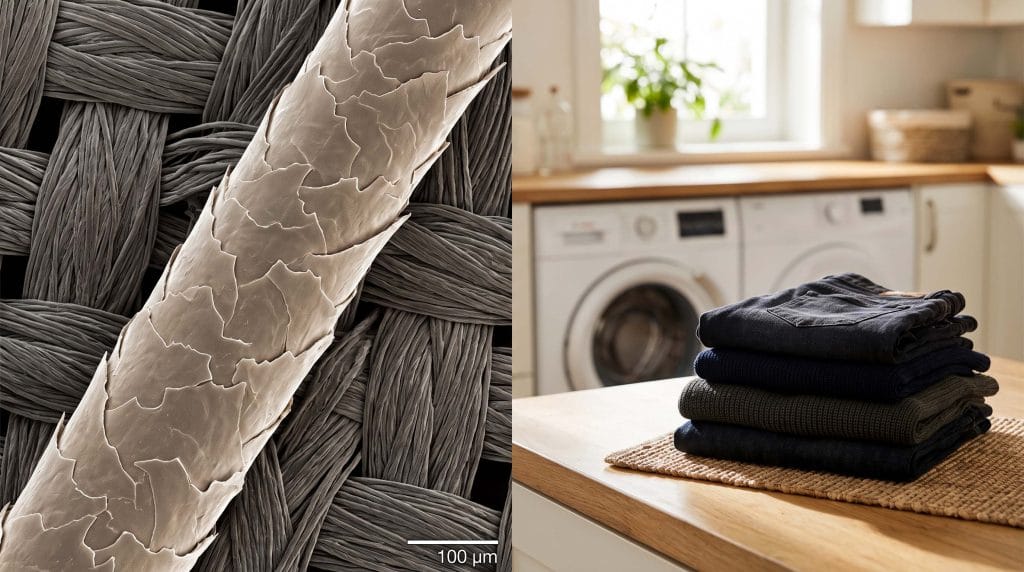
Every single dog hair has a cuticle layer made up of tiny overlapping scales — like roof shingles, or fish scales, stacked and pointing away from the root toward the tip. Under a microscope, this structure looks almost like a miniature pine cone. These scales aren’t smooth. They’re rough, directional, and designed by nature to interlock with surrounding fibres, other hairs, and surface textures.
This scale structure is actually an evolutionary feature. In wild canids, it helps the coat mat together for insulation and weather resistance during harsh conditions. In your domestic dog, it means every shed hair acts like a microscopic hook the moment it makes contact with fabric. The hair doesn’t just rest on the surface — it actively interlocks with the threads of whatever it touches.
But that’s only half the story. The other half is static electricity — and this is where why does dog hair stick to everything even after washing becomes genuinely interesting to understand.
Static charge builds through friction. Your dog walks across carpet, rubs against the sofa, shakes after a nap — every one of these actions generates static electricity in the shed hairs. A statically charged hair becomes electrostatically attracted to fabric, particularly synthetic materials like polyester and fleece, which hold static charge for extended periods. The hair isn’t just resting on the fabric surface at that point. It’s being actively pulled toward and held against it by electrostatic force.
Here’s the part that catches most people off guard: the washing machine amplifies this problem rather than solving it. The tumbling action inside the drum creates friction between clothing items, bedding, and shed hairs throughout the entire cycle — generating more static charge as it runs. Hairs that weren’t deeply embedded going into the wash often come out more firmly pressed into the fabric weave, pushed deeper by the mechanical agitation of the cycle. Pull the wet laundry out and it may look relatively clear — but as the fabric dries, static charges rebuild and embedded hairs become visible again on the surface.
This is also why owners who vacuum regularly still find their furniture covered in hair. If you’re dealing with dog hair on your sofa and carpets as well as your laundry, the same static and scale mechanics are at work on upholstery — just with different removal challenges.
Why Does Dog Hair Stick to Everything Even After Washing — The Fabric Factor
How Different Fabrics Make Dog Hair Stick to Everything Even After Washing
Not all fabrics behave the same way when it comes to dog hair — and understanding the differences genuinely changes how you manage this problem. Once you know which materials work against you, you can make smarter decisions about what your dog sleeps on, what you wear around them, and how you approach laundry.
Fleece and polar fleece are the single worst offenders. The looped fibre construction creates thousands of tiny anchor points that dog hair hooks into on contact. Those loops physically capture the scaled hair shaft at multiple points along its length, and no standard wash cycle releases them without mechanical pre-treatment first. This is exactly why your fleece blanket goes in the wash looking manageable and comes out resembling a fur coat.
Polyester holds static charge longer than almost any other common fabric. Dog hair is electrostatically attracted to it almost immediately on contact and embeds quickly into the weave. Cold water washing reduces static discharge during the cycle but doesn’t address hair already sitting deep in the fabric structure.
Velvet, corduroy, and velour have directional pile — short fibres all running the same direction — that catches dog hair along its length and holds it parallel to the surface. Brushing against the pile direction embeds it further. Washing loosens surface hair but rarely reaches what’s anchored at the base of the pile itself.
Cotton and linen are meaningfully better. Natural fibres produce significantly less static charge than synthetics, and the relatively smooth weave structure gives dog hair fewer anchor points to grip. Hair accumulates on cotton, but it releases far more willingly in the wash — and dryer sheets perform better on natural fibres than on synthetics.
Wool and wool blends sit in a complicated middle position. Wool fibres carry the same scale structure as dog hair — so the two interlock readily on contact. But wool responds better to the right wash conditions because the scales can release under correct water temperature and gentle agitation.
If you’re living with a heavy undercoat shedder — a Husky, Samoyed, or Malamute — the fine undercoat fibres are particularly problematic on synthetic fabrics. These fibres are short, extremely low-mass, and carry static charge proportionally more effectively than heavier hairs. They penetrate fabric weaves at the fibre level rather than sitting on the surface, and they release extremely reluctantly. Our Husky shedding guide and Corgi shedding guide cover the deshedding routines that reduce how much of this fine undercoat reaches your laundry in the first place. If you’re also wondering whether shaving would help reduce this problem — our guide on whether you can shave a double coated dog explains exactly why that approach makes fabric problems worse, not better.
Why Does Dog Hair Stick to Everything Even After Washing — Breed Differences That Matter
How Your Dog’s Coat Type Changes Why Dog Hair Sticks to Everything Even After Washing
Here’s something genuinely useful that most articles on why does dog hair stick to everything even after washing skip entirely — different types of dog hair behave differently on fabric, and knowing which type your dog sheds changes your approach significantly.
Long guard hairs from breeds like Golden Retrievers and Collies sit relatively on top of fabric rather than embedding deeply. They’re visible and easier to remove from smooth surfaces. The primary challenge is volume — these breeds shed continuously, and sheer quantity overwhelms surfaces and laundry loads. Our Golden Retriever shedding guide covers the specific brushing tools that pull the most guard hair before it reaches your furniture and clothing.
Fine undercoat fibres from double-coated breeds — Huskies, German Shepherds, Samoyeds, Malamutes — are by far the most problematic. Short, extremely fine, and low-mass, these fibres carry static charge disproportionately effectively. They penetrate fabric weaves at the thread level, embed between individual fibres rather than resting on the surface, and behave almost like fine wool fibres when they contact fabric — they felt in rather than sit on top. This is precisely why does dog hair stick to everything even after washing becomes a persistent, maddening problem specifically for owners of double-coated breeds.
Wiry, coarse hairs from Terriers and Schnauzers behave differently again. The stiffness of the hair shaft allows it to physically push through loosely woven fabric from the outside inward, where the weave structure itself traps it mechanically — not just through static or scale interlocking.
Understanding your dog’s specific hair type tells you which removal method to prioritise. For German Shepherd and Labrador owners dealing with dense, heavy shedding, our dedicated guides on German Shepherd shedding and Labrador shedding cover the specific coat management approaches that reduce loose hair volume at the source — which directly reduces how much ends up embedded in your laundry.
What Your Washing Machine Is Actually Doing Wrong
Why Does Dog Hair Stick to Everything Even After Washing — The Laundry Cycle Problem
Let’s address the washing machine directly — because this is where most people’s strategy completely falls apart, and it explains a huge part of why does dog hair stick to everything even after washing even when you’re doing everything else right.
Standard wash cycles use agitation to clean. That agitation — clothes and bedding tumbling against each other in the drum — creates friction. Friction creates static. By the end of a standard cycle, items that went in with loose surface hair often come out with that hair pressed more firmly into the fabric weave than when they started.
Cold water cycles reduce static generation slightly during the wash itself — but cold water also significantly reduces the effectiveness of fabric softener, which is one of the few laundry additives that genuinely assists with hair release. So there’s a direct tension between these two approaches that most laundry guides completely ignore.
The dryer introduces an additional problem. Tumble drying creates sustained friction and heat — a combination that recharges static in synthetic fabrics and can press remaining embedded hair deeper into the weave as fabric contracts slightly during the drying process. This is why items often look worse after the full wash-and-dry cycle than they did going in. The dryer isn’t releasing hair — it’s setting it.
The critical insight that changes everything: you need to remove as much hair as possible before washing, not rely on washing to remove it. The washing machine cleans fabric. It is not designed for hair removal — and treating it like it is produces exactly the frustrating outcome people describe when they ask why does dog hair stick to everything even after washing.
The same principle applies to your vacuum cleaner. If your vacuum is struggling to pick up embedded hair from carpets and upholstery, it’s often because the roller brush itself is clogged — our guide on how to clean dog hair out of a Dyson roller brush covers the exact method that restores suction immediately.
How to Actually Fix It — What Works Before, During, and After Washing
Solving Why Dog Hair Sticks to Everything Even After Washing With the Right Order of Operations
The method that actually works isn’t about finding a better detergent. It’s about changing the sequence entirely.
Before the wash — the pre-dryer cycle.
Run hair-covered items through the dryer on a no-heat or low-heat air cycle for ten minutes before washing them. This is the single most effective pre-wash technique we’ve found across years of testing, and it genuinely surprises people when they first hear it. The tumbling action loosens embedded hair mechanically, and the lint trap captures it before any water touches the fabric. Clean the lint trap immediately after this cycle — it will be significantly fuller than you expect.
For items with stubborn embedded hair — particularly fleece and polyester — also run a rubber glove or damp rubber brush firmly across the fabric surface before the pre-dryer step. The rubber generates a controlled static charge that lifts embedded hair to the surface where the dryer tumbling can then capture it. This two-step combination removes a substantial proportion of embedded hair before the wash cycle even begins.
During the wash — white vinegar in the rinse cycle.
Add half a cup of white distilled vinegar to the rinse cycle. Vinegar reduces residual static charge in the wash water, which helps release electrostatically-held hair from fabric surfaces during the rinse agitation. It also functions as a natural fabric softener without leaving coating residue. We’ve found this single addition makes a consistent, measurable difference to post-wash hair levels — particularly on cotton, linen, and wool items.
Wash heavily hair-covered items — pet blankets, dog bed covers, clothing worn during grooming sessions — in their own separate load. Hair released from one item during agitation immediately transfers to everything else sharing the drum. Keeping these loads separate prevents cross-contamination entirely. This is particularly important during peak shedding seasons — if you’re not sure when your breed sheds most heavily, our complete dog shedding management guide covers seasonal shedding patterns across all major breeds.
After washing — wool dryer balls plus dryer sheets.
This combination outperforms either option used alone, and it’s the approach we recommend for synthetic fabrics specifically. Add three wool dryer balls and two dryer sheets to each drying load of pet-hair-heavy items. The wool dryer balls create continuous gentle agitation during drying that keeps hair moving rather than allowing it to re-settle and re-embed as static rebuilds. The dryer sheets simultaneously reduce static charge, which means released hair ends up in the lint trap rather than back on the fabric surface.
Clean the lint trap halfway through the drying cycle in addition to at the end. A partially blocked lint trap means hair that’s been mechanically released by the dryer ball action has no exit point — so it re-deposits onto clothing instead.
🧺 The Rubber Glove Method — What We Found Works Better Than Lint Rollers
After working through this problem with owners of high-shedding breeds across multiple seasons, we found one approach that consistently outperforms standard lint rollers for embedded dog hair removal — and it costs almost nothing.
Damp rubber gloves, used before the pre-dryer step.
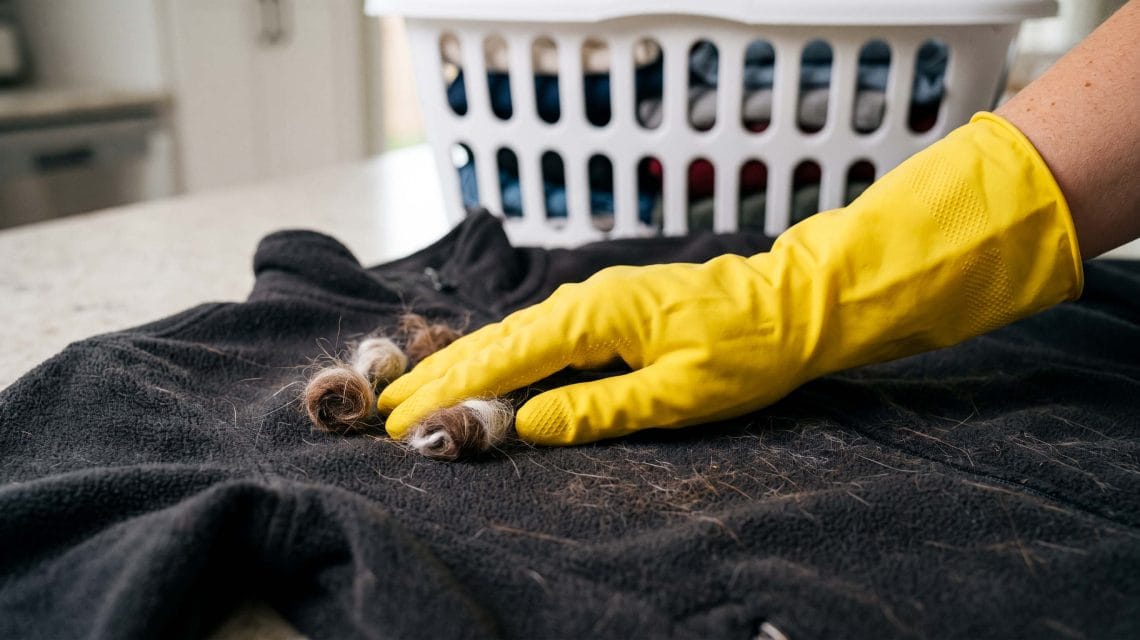
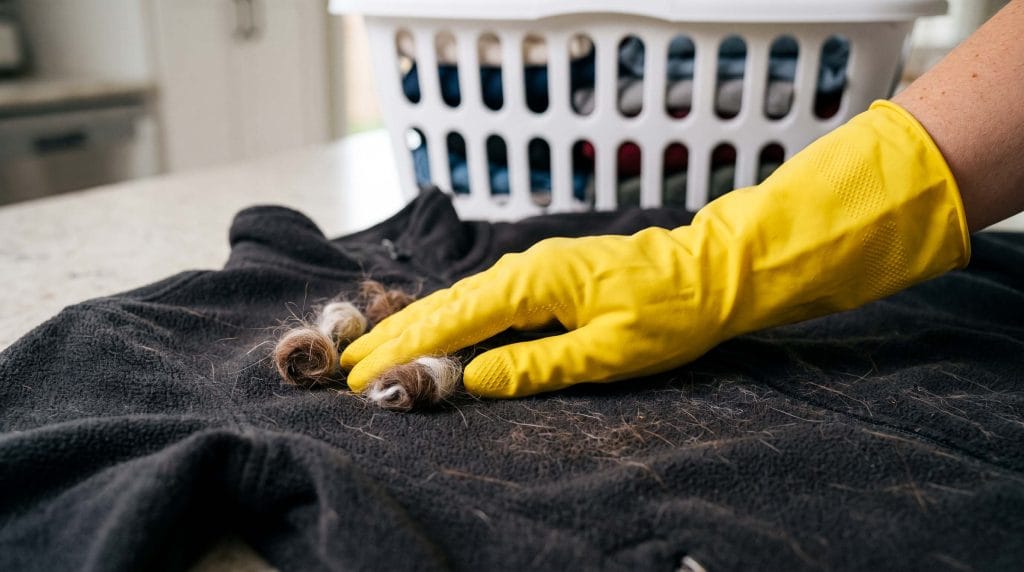
Standard lint rollers use adhesive tape to grab surface hair — they’re effective for loose hair sitting on top of fabric but they can’t reach hair that’s embedded between threads. Rubber gloves work through a completely different mechanism. The slightly tacky rubber surface generates a controlled localised static charge as you run your gloved hand across the fabric. This charge actively lifts embedded hair upward toward the surface — including fine undercoat fibres that adhesive tape never touches.
The technique: dampen the rubber glove slightly, then run your hand across the fabric surface in long, firm strokes in one direction. You’ll see hair collecting ahead of your hand in visible rolls — similar to the way a squeegee collects water. Collect and discard those rolls, repeat in the opposite direction, then run the item through the pre-dryer cycle.
For fleece and polyester items — the fabrics that most stubbornly answer the question of why does dog hair stick to everything even after washing — this rubber glove step before the pre-dryer cycle removes a volume of embedded hair that nothing else reaches as effectively. Combined with the vinegar rinse and dryer ball finish, this full sequence produces genuinely different results from a standard wash alone.
This approach works especially well for owners of double-coated breeds whose fine undercoat fibres embed most aggressively into fabric. If you’re managing a Husky, Samoyed, or Malamute through coat blow season, pairing this laundry method with the deshedding routine in our Husky shedding guide addresses the problem from both ends simultaneously.
Dog Hair and Laundry — Full Management Checklist
Work through this for every laundry load involving pet-hair-covered items:
Before washing:
- Run items through dryer on no-heat air cycle for 10 minutes
- Clean lint trap after pre-dryer cycle
- Use damp rubber glove on fleece and polyester items before pre-dryer step
- Separate pet-hair-heavy items from regular laundry loads
- Shake items outdoors before bringing inside
During washing:
- Add half cup white distilled vinegar to rinse cycle
- Use warm water where fabric care label allows
- Avoid overloading the drum — hair needs room to release during agitation
- Wash pet blankets and dog bed covers in their own dedicated load
During and after drying:
- Add three wool dryer balls and two dryer sheets to each pet-hair load
- Clean lint trap halfway through drying cycle
- Clean lint trap again at end of cycle
- Shake dried items outdoors before folding or storing
- Use lint roller for final surface pass on synthetic items after drying
Ongoing fabric and home management:
- Choose cotton and linen over fleece and polyester for dog-contact items like sofa throws and bed covers
- Use washable cotton covers on furniture your dog regularly uses
- Brush your dog consistently to reduce loose hair reaching fabric — see our complete dog hair management guide
- Book professional deshedding baths before spring and fall peak shedding seasons
- Keep your vacuum roller brush clean so it picks up embedded hair effectively — our Dyson roller brush cleaning guide shows the fastest method
- Check our Labrador shedding guide if your Labrador’s short dense coat is causing particular fabric problems
A Real Example — What Changed for One German Shepherd Owner
Marcus owns two German Shepherds — both heavy double-coat shedders that go through full coat blows twice a year. For nearly three years, his laundry came out of the wash consistently worse than it went in. He washed everything together in cold water, skipped the dryer entirely because he assumed air drying was gentler on his clothes, and used a lint roller afterward.
Every one of those choices was actively working against him.
Cold water reduced fabric softener effectiveness. Washing everything together meant hair released from his dogs’ blankets immediately embedded into his work shirts during the same cycle. Skipping the dryer removed the only stage that reliably captures loose hair in a lint trap. And the lint roller — effective as it was on surface hair — couldn’t reach the fine undercoat fibres embedded between the threads of his cotton shirts.
After switching to the pre-dryer cycle, separating pet items into their own loads, adding vinegar to the rinse, and finishing with wool dryer balls and dryer sheets, Marcus reported that his laundry came out genuinely manageable for the first time. Not hair-free — that’s not a realistic outcome with two German Shepherds in the house. But consistently better rather than consistently worse.
The bigger change came when he started implementing the brushing routine from our German Shepherd shedding guide — three deshedding sessions weekly with an undercoat rake during coat blow season. Reducing loose hair at the source meant significantly less reaching his laundry in the first place. He also cleaned his Dyson roller brush weekly using the method in our Dyson roller brush guide, which meant his vacuum was actually picking up floor hair effectively rather than just redistributing it. Addressing why does dog hair stick to everything even after washing from both ends — at the dog and at the laundry process — is what finally made the difference.
Fabric Comparison — How Each Material Handles Dog Hair
| Fabric Type | Static Retention | Hair Embed Depth | Wash Release | Best Pre-Wash Method |
|---|---|---|---|---|
| Fleece / Polar Fleece | Very High | Deep | Poor | Rubber glove + pre-dryer cycle |
| Polyester | High | Medium-Deep | Poor | Pre-dryer cycle + vinegar rinse |
| Velvet / Velour / Corduroy | Medium | Deep — directional | Poor | Brush against pile before washing |
| Wool / Wool Blend | Medium | Medium | Moderate | Warm wash + vinegar rinse |
| Cotton | Low | Shallow | Good | Standard wash + dryer sheets |
| Linen | Low | Shallow | Good | Standard wash — releases readily |
| Denim | Low-Medium | Medium — penetrating | Moderate | Rubber glove pre-wash + warm cycle |
FAQ — Why Does Dog Hair Stick to Everything Even After Washing
Why does dog hair stick to everything even after washing when clothes look clean while wet?
Wet fabric fibres swell slightly and temporarily release their static charge — which is why items often look relatively hair-free when wet. As fabric dries, the fibres contract back to their normal size and static charge rebuilds. Remaining embedded hairs become visible again and reattach to the surface as the static returns. The hair was never fully removed — the water temporarily suppressed the static holding it in place.
Why does dog hair stick to everything even after washing more on fleece than on cotton?
Fleece holds static charge significantly longer than cotton and has a looped fibre construction that creates physical anchor points for dog hair scales to grip. Cotton produces less static and has a smoother weave that gives hair fewer anchor points. Switching from polyester and fleece throws to cotton covers for dog-contact surfaces reduces how much hair embeds in the first place — making laundry consistently more manageable. If you’re also dealing with a double-coated breed and wondering whether shaving would help reduce household hair overall, our guide on whether you should shave a double coated dog explains why that approach typically makes the situation worse.
Does fabric softener actually help remove dog hair from laundry?
It helps — but only partially and only in specific conditions. Liquid fabric softener coats fibres and reduces friction slightly during the wash cycle. Dryer sheets reduce static charge during tumble drying, which is more directly effective at releasing embedded hair. White vinegar in the rinse cycle performs similarly to fabric softener and doesn’t leave coating residue. All three work better on natural fibres like cotton than on synthetics like polyester or fleece.
Why does dog hair stick to everything even after washing if I used a lint roller before putting clothes in the machine?
Lint rollers remove surface hair effectively using adhesive tape — but they can’t reach hair embedded between fabric threads, especially fine undercoat fibres from double-coated breeds. The wash cycle then agitates the remaining embedded hair, often pressing it deeper. The pre-dryer cycle — ten minutes on no-heat before washing — is more effective than a lint roller as a pre-wash step because tumbling action reaches embedded fibres that adhesive tape never contacts.
How do I stop dog hair transferring between items in the same wash load?
Wash heavily hair-covered items — pet blankets, dog bed covers, grooming-session clothing — in completely separate loads from your regular laundry. Hair released from one item during the wash cycle transfers directly to everything else sharing the drum during agitation. Separate loads prevent this cross-contamination entirely. For Husky and Malamute owners during coat blow season, this single change makes an immediate and noticeable difference. Pairing it with the deshedding routine in our Husky shedding guide reduces the total volume of hair reaching your laundry in the first place.
The Bottom Line
Why does dog hair stick to everything even after washing comes down to three forces working simultaneously: the microscopic scale structure of dog hair that physically hooks into fabric fibres, the static electricity that electrostatically pulls hair toward synthetic materials, and a wash cycle that agitates everything together and frequently embeds hair more deeply rather than releasing it.
The solution isn’t a better detergent or a hotter wash setting. It’s changing the sequence entirely — removing hair before washing with the pre-dryer cycle and rubber glove technique, neutralising static during washing with white vinegar in the rinse cycle, and capturing released hair during drying with wool dryer balls and dryer sheets. And at the source, consistent deshedding dramatically reduces how much hair reaches your fabric in the first place.
None of this makes a home with a shedding dog completely hair-free — that’s not a realistic expectation. But it makes the difference between laundry that comes out manageable and laundry that comes out looking like your dog climbed into the drum for the spin cycle.
Start with the pre-dryer cycle today — it costs nothing and the difference is immediate. Then tackle shedding at the source with our breed-specific guides for Huskies, German Shepherds, Golden Retrievers, Labradors, and Corgis — or get the complete picture with our dog hair management guide. And if your vacuum isn’t keeping up with the hair on your floors, our Dyson roller brush cleaning guide gets it back to full performance in under ten minutes. Less shedding, cleaner laundry, and a vacuum that actually works — that’s the full system. 🐾
This article provides general laundry and pet care guidance for informational purposes. Always check individual garment care labels before washing or applying any pre-treatment methods.
