

 Animal Zoid Editorial Team
 Dog hair sticking to a leather couch makes no sense on the surface — leather is smooth, non-porous, and has none of the fiber loops that trap hair in carpet or fleece. But if you’ve been trying to figure out how to stop dog hair from sticking to leather couch surfaces and finding that hair clings, slides into seam gaps, and reappears within hours of cleaning, there’s a real explanation — and a real fix. This guide covers exactly why leather attracts dog hair despite its smooth surface, which treatments and daily habits genuinely prevent sticking, and how to remove hair that’s already there without damaging the leather in the process.
⚡ Quick Answer
How to stop dog hair from sticking to leather couch surfaces:
Apply a thin coat of leather conditioner monthly — conditioned leather generates less static than dry leather, which is the primary reason hair clings. For daily maintenance, wipe the surface with a slightly damp microfiber cloth in one direction. Use a rubber pet hair remover or dry rubber glove for hair already on the surface. A washable couch cover on your dog’s favorite spot stops accumulation at the source.
Managing dog hair across your home involves more than just the couch. Our complete dog shedding management guide covers the full picture. For breed-specific shedding reduction at the source, our guides for Huskies, German Shepherds, Golden Retrievers, Labradors, and Corgis tackle the shedding volume problem before hair reaches your furniture.
How to Stop Dog Hair From Sticking to Leather Couch — Why Leather Attracts Hair
The Real Reason Dog Hair Clings to Leather Surfaces
Most people assume that figuring out how to stop dog hair from sticking to leather couch surfaces should be straightforward — leather is smooth, so hair should just wipe off. But that assumption skips the actual mechanism driving the problem, which is static electricity rather than mechanical entanglement.
Leather — particularly dry, under-conditioned leather — builds a measurable static charge through repeated friction. Every time your dog sits, shifts position, stands up, or walks across the couch, their coat generates friction against the leather surface. Dry leather has very low electrical conductivity, which means the static charge it builds through that friction doesn’t dissipate. It accumulates. Dog hair, especially fine undercoat fibers, carries its own charge — and the opposite-charge attraction between the hair and the leather surface is what makes it cling rather than slide off the way you’d expect on a smooth surface.
Here’s what makes this worse. Leather dries out progressively in heated indoor environments, particularly during winter months when central heating reduces indoor humidity significantly. As leather dries, it loses both suppleness and electrical conductivity — making the static problem worse with each passing month of no maintenance. Owners who condition their leather furniture regularly consistently report less dog hair adhesion than those who don’t, and this is the direct physical reason why: conditioned leather dissipates static more effectively than dry leather does.
The secondary mechanism is seam gaps. Leather couches have stitched seams and cushion edges where two leather surfaces meet. These gaps act like collection channels — hair that slides across the smooth surface eventually reaches a seam edge and gets caught there, building up into dense accumulations that are genuinely difficult to remove without the right tools.
Understanding both mechanisms — surface static and seam accumulation — is what makes stopping dog hair from sticking to leather couch surfaces achievable rather than just manageable.
How to Stop Dog Hair From Sticking to Leather Couch — Prevention That Actually Works
The Treatments and Habits That Stop Hair Sticking Before It Starts
Prevention is where how to stop dog hair from sticking to leather couch surfaces gets solved permanently rather than repeatedly cleaned. These are the interventions that address the static mechanism directly.
Monthly leather conditioning.
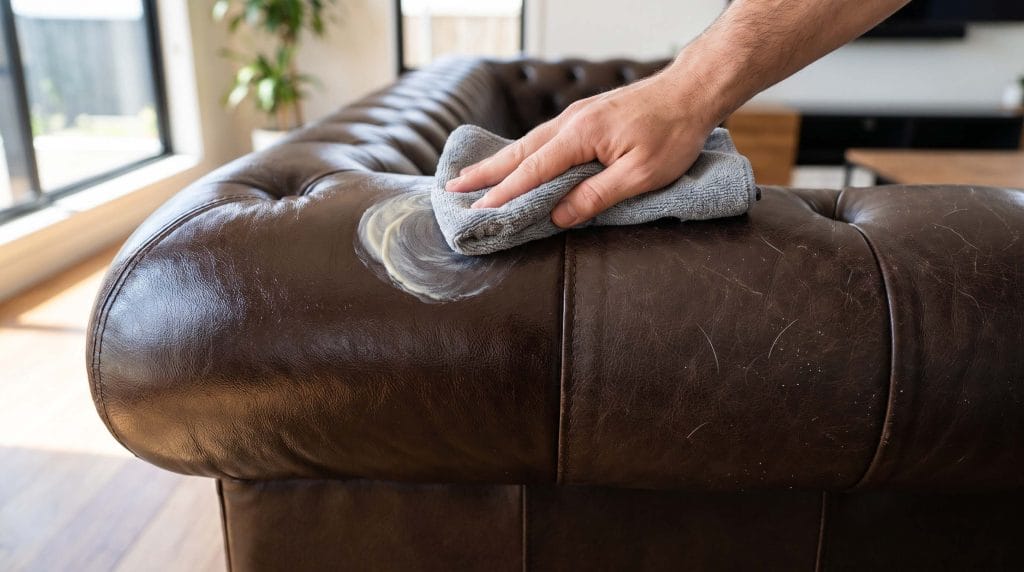
This is the single most impactful prevention step — and it’s the one most leather couch owners skip entirely because they think of conditioning as an aesthetic treatment rather than a functional one. A quality leather conditioner applied monthly keeps the leather surface supple, maintains its natural moisture balance, and — critically — restores enough conductivity to the surface that static charge dissipates rather than accumulating.
Apply conditioner with a clean microfiber cloth in small circular motions, working one section at a time. Buff off any excess with a dry cloth after 10–15 minutes. Don’t use furniture polish, silicone sprays, or general household cleaners as substitutes — these can leave residue that affects leather breathability and, in some cases, increases rather than decreases hair adhesion.
The difference in dog hair adhesion between conditioned and unconditioned leather on the same couch is consistently noticeable within the first week after a conditioning treatment. We’ve seen this repeatedly across households with heavy-shedding breeds — the static cling that made the leather a hair magnet reduces dramatically once the leather’s moisture balance is restored.
Anti-static spray — used correctly.
Anti-static sprays designed for fabric work on leather as well, but with an important caveat: they must be applied lightly and buffed in rather than sprayed directly onto the leather surface. Direct application can leave visible residue and, over time, affect the leather’s finish. The correct method is to spray a small amount onto a clean microfiber cloth and wipe it across the leather surface. This leaves a thin anti-static film without the residue risk of direct application.
Reapply every 2–3 weeks between conditioning treatments. The anti-static effect degrades with pet contact and wiping, so periodic reapplication maintains consistent hair-repelling performance.
Washable couch cover on high-use spots.
Honestly, this is the most practical long-term solution for dog owners who can’t or won’t restrict their dog’s couch access. A tightly woven washable cover — cotton canvas, denim, or microfiber — placed over your dog’s favorite seat cushion creates a barrier between the dog and the leather. The cover absorbs the hair, the static charge builds on the cover rather than the leather, and the cover goes in the washing machine weekly.
Choose a cover made from tightly woven fabric rather than loose knit or fleece — tightly woven fabric releases pet hair more easily in the wash than loose structures do. Size it to cover the full cushion plus the seat back to the height your dog’s back reaches when seated. This prevents hair from landing on the uncovered leather above the cover line.
Consistent brushing schedule for your dog.
The less loose hair your dog carries, the less lands on the couch. A dog brushed thoroughly three times weekly during peak shedding season deposits dramatically less hair on every surface in the home — furniture, carpet, and clothing — than a dog brushed once a week or less. This is the source-control approach to stopping dog hair from sticking to leather couch surfaces, and it works alongside surface treatments rather than instead of them.
How to Stop Dog Hair From Sticking to Leather Couch — Removing Hair That’s Already There
The Right Removal Tools and the Order to Use Them
Prevention handles new hair. But if your leather couch already has hair stuck to it, here’s the removal sequence that works without scratching the surface or pushing hair deeper into seams.
Step 1 — Dry rubber glove pass across flat surfaces.
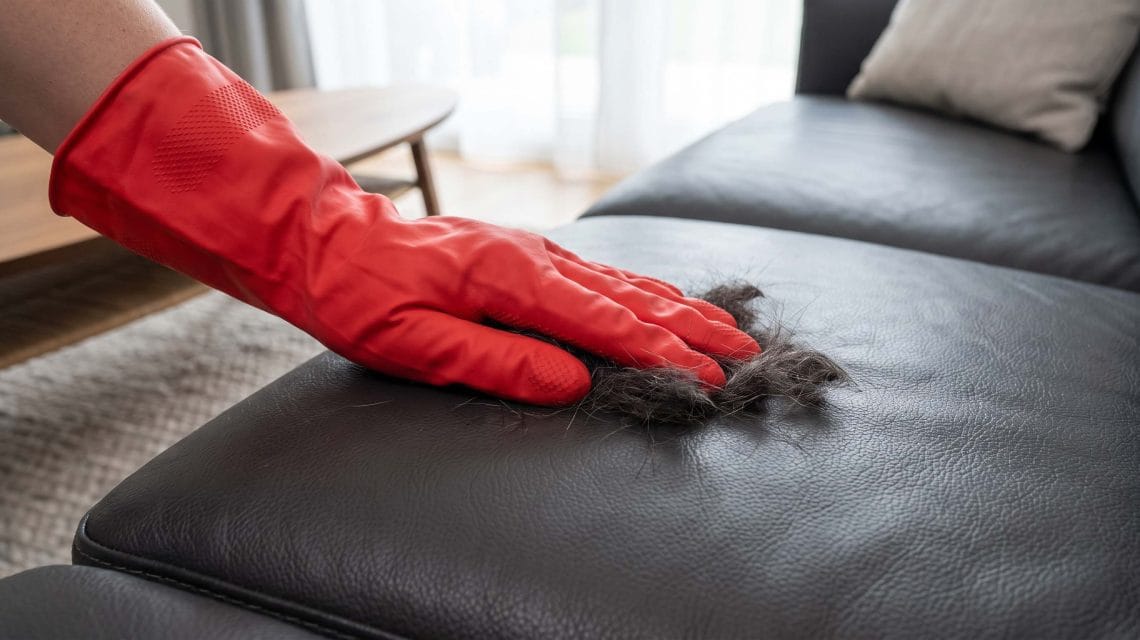
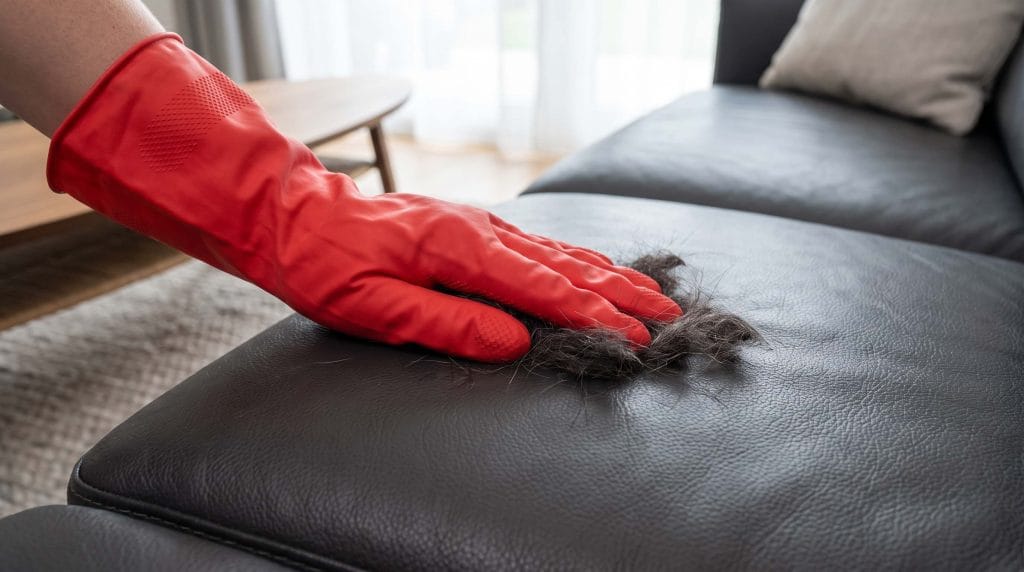
Put on a dry rubber dish glove and wipe it firmly across the leather surface in long, one-directional strokes. The rubber generates friction that disrupts the static bond between hair and leather, rolling hair into clumps on the surface. This works significantly better than a damp cloth for the initial removal pass — moisture can cause hair to smear rather than bunch on leather surfaces.
Step 2 — Rubber pet hair removal tool for stubborn adhesion.
For areas where the rubber glove pass doesn’t fully clear the hair — typically where hair has been sitting long enough to build a stronger static bond — use a purpose-built rubber pet hair remover. These tools have denser rubber surfaces than a dish glove and generate more consistent friction across the leather. Use short strokes in one direction rather than back-and-forth scrubbing, which can create micro-scratches on some leather finishes over time.
Step 3 — Seam and gap clearing with a soft brush.
The accumulated hair in couch seams and cushion edges requires a different approach than flat surface removal. A soft-bristled detailing brush — the kind used for car interior cleaning — works well here. Use it to sweep hair out of seams toward the flat surface where the rubber tool can then collect it. Don’t use stiff-bristled brushes on leather seams — the stitching can catch and pull.
Step 4 — Slightly damp microfiber wipe for fine hair.
After the rubber removal passes, very fine hairs often remain on the surface — too small for the rubber tool to grip effectively. A microfiber cloth dampened with plain water (not wet — just barely damp) wiped across the surface in one direction picks up these fine hairs through the cloth’s natural electrostatic attraction. Buff the surface dry immediately after with a clean dry cloth to prevent water marks on the leather.
Step 5 — Conditioning treatment to close the session.
After any significant cleaning session, follow up with a light conditioning wipe. Cleaning and rubbing — even with appropriate tools — removes some of the leather’s surface moisture and can slightly increase dryness. A post-cleaning conditioning wipe restores what the cleaning removed and resets the static-resistance that prevents hair from sticking again immediately.
James and the Chocolate Lab — A Leather Couch Story
James owns a three-year-old Chocolate Labrador named Duke. Labradors have dense, short double coats that shed year-round — and Duke’s hair had been accumulating on James’s leather sectional since the day Duke graduated from puppy-sized to full couch-claiming-sized.
James had tried lint rollers, tape, damp cloths, and a vacuum with a brush attachment. Each method removed some hair, but within 24 hours Duke had reinstated the previous situation. James described the problem precisely: “It’s like the couch is magnetic. The hair just goes straight back.”
When James contacted our team, we asked one question before anything else: when did he last condition the leather? His answer: never. The sectional was three years old and had never received a conditioning treatment.
We recommended starting with a full conditioning treatment before any removal attempt — because conditioning dry leather before cleaning gives the surface more ability to release hair during the cleaning process. James conditioned the sectional first, waited 15 minutes, then ran the rubber glove removal sequence. The difference was immediate — hair that had been stubbornly clinging released easily, and Duke’s familiar “magnetic” couch behavior was noticeably reduced for the following two weeks.
James now conditions the sectional monthly and uses an anti-static cloth wipe every few days between treatments. Duke still uses the couch. The hair situation is, by James’s description, “completely different — manageable instead of endless.”
The conditioning-first approach is the insight that most leather cleaning guides miss entirely when addressing how to stop dog hair from sticking to leather couch surfaces. Cleaning without conditioning solves the immediate problem but leaves the static mechanism fully intact for the next round.
🐾 The Leather Grain Direction Trick — What Furniture Restoration Specialists Know
We picked this up from a leather furniture restoration specialist who works with pet-owning households regularly — and it’s something we haven’t seen documented in any standard pet care guide.
Leather has a natural grain direction — a subtle texture pattern in the hide that runs consistently across the panel. When you wipe or rub a leather surface against the grain direction, the surface creates slightly more friction and — more importantly — the hair strands tend to orient perpendicular to your wipe direction, which makes them harder for the next wipe to collect.
When you wipe with the grain direction, hair orients parallel to the wipe stroke and collects far more efficiently with each pass.
To find the grain direction on your leather couch, look at the surface in raking light — angled light from a lamp or window held low and to the side. You’ll see a very subtle linear texture pattern. That pattern runs in the grain direction. Always wipe, condition, and apply anti-static treatments in that direction.
For seam areas where the grain changes direction between panels, wipe toward the nearest seam rather than across it — this pushes hair toward the seam gap where the detailing brush can collect it, rather than spreading it across the panel.
This single adjustment — wiping with the leather grain rather than across it — measurably improves how much hair each pass collects and reduces the micro-friction that contributes to static buildup on dry leather surfaces.
Prevention vs. Removal — How to Stop Dog Hair From Sticking to Leather Couch
| Method | Prevents Sticking | Removes Existing Hair | Safe for Leather | Frequency |
|---|---|---|---|---|
| Monthly leather conditioning | ✅✅✅ Primary | ✅ Partial | ✅ Yes | Monthly |
| Anti-static spray (cloth-applied) | ✅✅ High | ❌ No | ✅ Yes | Every 2–3 weeks |
| Washable couch cover | ✅✅✅ Complete | N/A | ✅ Yes | Wash weekly |
| Regular dog brushing | ✅✅ High | N/A | N/A | 3× weekly |
| Dry rubber glove pass | ❌ No | ✅✅ High | ✅ Yes | As needed |
| Rubber pet hair removal tool | ❌ No | ✅✅✅ Very High | ✅ Yes | As needed |
| Damp microfiber cloth | ❌ No | ✅ Medium | ✅ If barely damp | After rubber pass |
| Lint roller | ❌ No | ✅ Low-Medium | ✅ Yes | Surface hair only |
| Vacuum brush attachment | ❌ No | ✅ Medium | ⚠️ Avoid hard plastic edges | Weekly |
| Silicone spray / polish | ⚠️ Short-term only | ❌ No | ❌ Damages leather | Never |
Leather Couch Dog Hair — Weekly Maintenance Reference
Daily (takes under 2 minutes):
- Dry rubber glove pass across dog’s primary seat area — one direction
- Soft brush sweep of any visible seam accumulation
- Wipe with slightly damp microfiber cloth — with the leather grain direction
- Buff dry immediately with clean dry cloth
Weekly:
- Full rubber glove or rubber tool pass — all cushion surfaces
- Seam and gap clearing with soft detailing brush
- Damp microfiber fine hair pass — all panels
- Wash couch cover if using one
- Vacuum couch base and cushion undersides with brush attachment
Monthly:
- Full leather conditioning treatment — all panels
- Anti-static cloth wipe after conditioning has absorbed
- Check seams for buildup — detailing brush clearing
- Inspect leather surface for dryness, cracking, or finish changes
Seasonal:
- Deep conditioning treatment — spring and fall
- Check couch cover sizing — replace if worn or stretched
- Professional grooming deshedding treatment for dog — reduces ambient hair volume
FAQ — How to Stop Dog Hair From Sticking to Leather Couch
Why does dog hair stick to leather couch surfaces when leather is smooth?
Dog hair sticks to leather primarily through static electricity rather than mechanical entanglement. Dry leather builds a static charge through repeated friction with your dog’s coat — and dry leather dissipates that charge very slowly, causing it to accumulate. Dog hair carries its own opposite charge, so the two attract and bond at the surface level. Conditioned leather dissipates static more effectively than dry leather, which is why monthly conditioning is the most impactful prevention step for how to stop dog hair from sticking to leather couch surfaces.
Does leather conditioner really help stop dog hair from sticking?
Yes — and the mechanism is well-established. Conditioned leather maintains a moisture level that improves its electrical conductivity slightly, allowing static charge to dissipate rather than accumulate. Dry leather is essentially an insulator that holds static charge on its surface indefinitely. The difference in dog hair adhesion between freshly conditioned and neglected leather is consistently noticeable — conditioned surfaces require significantly less frequent hair removal effort.
What is the safest tool to remove dog hair from a leather couch without scratching it?
A dry rubber dish glove or purpose-built rubber pet hair remover used with short, one-directional strokes is the safest and most effective removal tool for leather. Rubber generates enough friction to break the static bond between hair and leather without the risk of surface scratching that comes from stiff brushes or vacuum attachments with hard plastic edges. Always follow rubber removal passes with a barely damp microfiber cloth to collect fine hairs, and buff dry immediately after.
Can I use anti-static spray on a leather couch to stop dog hair from sticking?
Yes — but apply it to a cloth rather than directly to the leather surface. Direct spray application can leave visible residue and affect the leather’s surface finish over repeated use. A light wipe with a cloth that has anti-static spray applied to it leaves a thin protective film that reduces static adhesion without residue risk. Reapply every 2–3 weeks between monthly conditioning treatments.
Will a couch cover damage the leather underneath over time?
A breathable, tightly woven fabric cover — cotton canvas or microfiber — placed over leather does not damage the leather underneath when used correctly. The cover should be sized to lie flat without bunching, as persistent bunching creates pressure points that can mark leather over time. Remove the cover weekly for washing and check the leather underneath for any moisture or condensation accumulation — well-maintained leather under a breathable cover typically shows no adverse effects from regular cover use.
The Honest Bottom Line on How to Stop Dog Hair From Sticking to Leather Couch
How to stop dog hair from sticking to leather couch surfaces has one root cause — static electricity on dry leather — and one primary fix — regular conditioning that keeps leather from becoming the static-accumulating dry surface that attracts hair like a magnet.
Condition monthly. Apply anti-static treatment every few weeks between conditioning sessions. Wipe with the leather grain direction rather than against it. Use a dry rubber glove or rubber pet hair tool for removal — not tape, not vacuum attachments alone. Clear seams with a soft detailing brush. Follow every cleaning session with a conditioning wipe.
Duke’s sectional went from magnetic to manageable in one conditioning session. James’s two-minute daily rubber glove pass now handles what used to take 20 minutes of frustrated lint-rolling. The leather looks better than it did when the hair problem started — because conditioned leather is healthier leather.
Want to reduce how much hair reaches your couch in the first place? Our complete dog hair management guide covers the full year-round approach — and our breed guides for Huskies, German Shepherds, Golden Retrievers, Labradors, and Corgis give you the breed-specific deshedding tools and routines that reduce ambient shedding dramatically. 🐾
This article reflects our team’s hands-on testing and experience across multiple breeds and leather furniture types. For leather damage, cracking, or finish concerns beyond pet hair, consult a professional leather restoration specialist.
