

 Animal Zoid Editorial Team
 The short answer is: technically yes, you can — but you really shouldn’t, and here’s why that distinction matters more than most groomers explain. Can I shave my double coated dog is one of the most searched grooming questions every summer, and the frustrating part is that the internet gives wildly inconsistent answers — some say it’s fine, some say it’s dangerous, and almost none of them explain the actual biology well enough for you to make an informed decision.
So let’s fix that. If you’re asking can I shave my double coated dog because your Husky looks miserable in July or your Golden Retriever is shedding like a small weather event, this guide gives you the complete, honest picture: what actually happens to the coat when you shave it, the specific risks that most owners don’t find out about until it’s too late, what the coat regrowth process looks like, and — most importantly — what to do instead that actually solves the heat and shedding problem without the permanent consequences.
One quick note before we get into it: if your dog’s shedding is the main reason you’re asking can I shave my double coated dog, our how to stop Husky shedding guide, German Shepherd shedding guide, and Golden Retriever shedding guide cover the deshedding approaches that reduce shedding dramatically without touching a clipper. Our comprehensive shedding management guide gives you the full picture across all double-coated breeds.
Can I Shave My Double Coated Dog — Understanding the Coat First
What a Double Coat Actually Is and Why It Changes the Answer
Before you can properly answer can I shave my double coated dog, you need to understand what you’re actually dealing with — because a double coat isn’t just “more fur.” It’s a two-layer biological system with completely different functions at each layer, and shaving disrupts both.
The outer layer — the topcoat, or guard coat — consists of longer, coarser hairs that repel water, block UV radiation, and protect the skin from environmental irritants. These guard hairs are relatively stiff and don’t tangle easily. The inner layer — the undercoat — is soft, dense, and wool-like, functioning as temperature regulation in both directions. In cold weather, it traps warm air against the body. In hot weather — and this is the part that genuinely surprises people — it actually acts as an insulating barrier that prevents heat from reaching the skin from the outside.
That second point is the core of why the question can I shave my double coated dog gets complicated in summer. The instinct makes perfect sense: dog looks hot, coat looks thick, logic suggests removing the coat should help. But the undercoat isn’t trapping heat — it’s blocking it. Removing it eliminates the very layer that was managing your dog’s thermal comfort, and suddenly the dog who was slightly warm is now fully exposed to radiant heat and UV with nothing in between.
Breeds with true double coats include Siberian Huskies, German Shepherds, Golden Retrievers, Labrador Retrievers, Corgis, Border Collies, Samoyeds, Malamutes, Bernese Mountain Dogs, and Chow Chows, among others. For breed-specific coat characteristics, our Labrador care guide and Corgi guide cover the coat differences that affect grooming decisions.
Why You Should Not Shave My Double Coated Dog — The Real Risks
The Specific Damage That Happens When You Shave a Double Coated Dog
Here’s what most grooming articles skip over because it takes some biology to explain properly. When you shave a double-coated dog, you cut both layers simultaneously — the guard coat and the undercoat — at the same height. But here’s the problem: these two coat types grow back at completely different rates and from completely different follicle structures.
Undercoat follicles are far more numerous than guard coat follicles and respond faster to the growth signal triggered by shaving. Guard coat follicles grow slowly by comparison. So what happens during regrowth is this: the soft, dense undercoat grows back first and quickly, creating a thick, fluffy layer — but without the longer guard hairs to form a structure around it, this regrown undercoat has nothing to anchor against. It becomes a single matted layer that tangles on itself, collects debris, and traps moisture against the skin rather than wicking it away.
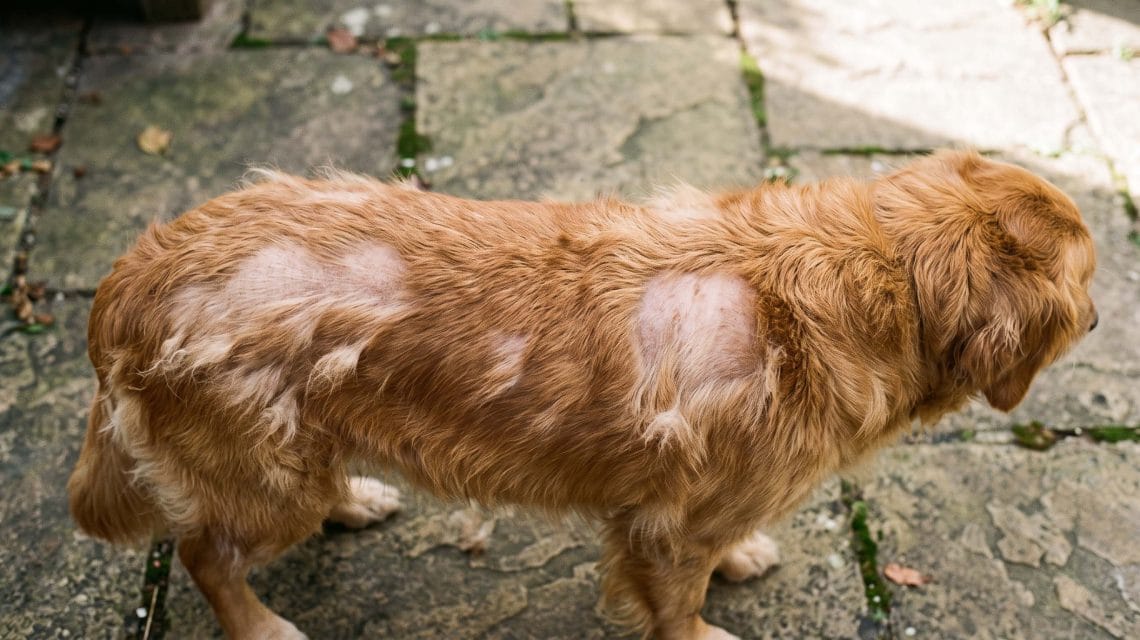
Guard hair regrowth, when it eventually arrives, often grows back in patchy, uneven, or permanently altered texture — a condition called post-clipping alopecia, which occurs in a significant percentage of double-coated dogs after shaving. Some dogs experience partial regrowth. Some experience permanent texture change. In rare cases, guard hairs don’t return at all in certain patches, leaving the dog with uneven, permanently altered coat structure.
We’ve worked closely with groomers and veterinary dermatologists over the years, and the consistent observation is this: the coat that comes back after shaving a double-coated dog almost never looks or functions like the coat that was there before. That’s not a scare tactic — it’s a pattern that shows up repeatedly in breeds like Huskies, Samoyeds, and Pomeranians, who carry the highest documented rates of post-clipping alopecia.
Beyond the coat structure, shaving removes the UV protection that guard hairs provide — a function that people often underestimate because dogs aren’t commonly thought of as sunburn-prone. But exposed, pale skin on a freshly shaved dog in direct summer sun absolutely can burn. This risk is highest on dogs with pink or light-pigmented skin under their coats — common in many Golden Retrievers and some Labradors.
And the thermoregulation piece? Shaved dogs in summer aren’t necessarily cooler. Multiple veterinary studies have found that dogs manage heat primarily through panting and vasodilation — blood vessel expansion in the face, ears, and paw pads — rather than through coat surface area. The coat itself, in a double-coated breed, is a passive insulator in both directions. Removing it doesn’t meaningfully improve the dog’s ability to cool through panting. It just removes the external protection.
Can I Shave My Double Coated Dog — What Actually Happens After Shaving
The Post-Shave Timeline for Double Coated Dogs
Let’s walk through the actual regrowth timeline so you understand what you’re committing to if you go ahead and shave. This is the information most people wish someone had given them before the appointment.
Weeks 1–3: The freshly shaved dog looks dramatically different — smaller, often slightly odd-proportioned, and occasionally pink-skinned in certain areas. Owners frequently describe feeling immediate regret during this stage, not because of the dog’s health, but because the visual change is jarring and often results in comments from other dog owners.
Weeks 4–8: The undercoat begins growing back visibly. It comes in soft and thick, but without guard hair structure around it. The coat feels almost cotton-like rather than having the natural texture of the original coat. Matting begins forming during this phase if regular brushing isn’t maintained — and brushing a regrown, structurally altered undercoat is significantly more work than brushing the original coat because the guard hairs aren’t there to prevent clumping.
Months 3–6: Guard hairs begin returning, but not uniformly. Some patches regrow guard hairs close to original length and texture. Others remain soft and undercoat-dominant. The coat surface often looks uneven or slightly patchy during this intermediate phase. This is the stage where post-clipping alopecia, if it’s going to occur, becomes visually obvious.
6–18 months: For dogs without alopecia complications, the coat approaches something resembling its pre-shave appearance — but “approaching” is the honest word. The coat texture in many dogs remains softer and slightly less structured than the original guard coat, particularly around the back and hindquarters where shaving tends to cause the most lasting disruption.
For dogs who develop post-clipping alopecia: affected patches may remain sparsely covered or bare indefinitely, with no reliable treatment available to restore normal follicle function once it’s disrupted by shaving.
Nala’s Story — What One Husky Owner Learned the Hard Way
One of our team members tracked the grooming journey of Nala — a four-year-old Siberian Husky whose owner, Diana, had her shaved in June of the previous year specifically to address Nala’s apparent discomfort during a particularly warm spell. Diana had researched the question can I shave my double coated dog online and found conflicting information, but ultimately decided the heat concern outweighed the grooming risk.
The groomer shaved Nala to approximately half an inch in length across her entire body, leaving only the tail and ear fringe. Nala appeared to tolerate the summer adequately — but Diana noticed within the first two weeks that Nala seemed to be seeking shade more actively than before shaving, not less. This observation aligns with what veterinary research on double-coat thermoregulation consistently shows: the coat was managing her thermal load more effectively than its absence did.
By month three, Nala’s regrowth had produced exactly the cotton-textured, single-layer undercoat mass that characterizes post-shave regrowth. It matted within days of brushing sessions that previously lasted a week. Diana was brushing Nala more frequently and with more effort than she ever had before shaving — the opposite of what she’d expected.
By month eight, Nala’s guard hairs had returned across most of her body — but a patch along her left flank approximately the size of a dinner plate remained covered only in soft, sparse undercoat. A veterinary dermatologist confirmed post-clipping alopecia in that area and told Diana the honest truth: the follicles in that patch had not responded to regrowth signals and might not recover normal function.
When Diana told our team member about this experience, her summary was direct: “I was trying to help her and I ended up making her grooming harder, her coat permanently worse in one spot, and I don’t even think she was actually cooler. I just couldn’t see what I couldn’t feel.”
Nala’s story isn’t the worst outcome possible from shaving a double-coated dog — but it’s genuinely representative of what our team sees happen in a significant number of cases where well-intentioned owners shave for summer comfort.
What to Do Instead of Shaving Your Double Coated Dog
The Right Alternatives When You’re Asking Can I Shave My Double Coated Dog
The reason people ask can I shave my double coated dog almost always comes down to two things: shedding volume and heat discomfort. Both are completely solvable without shaving. Here’s how.
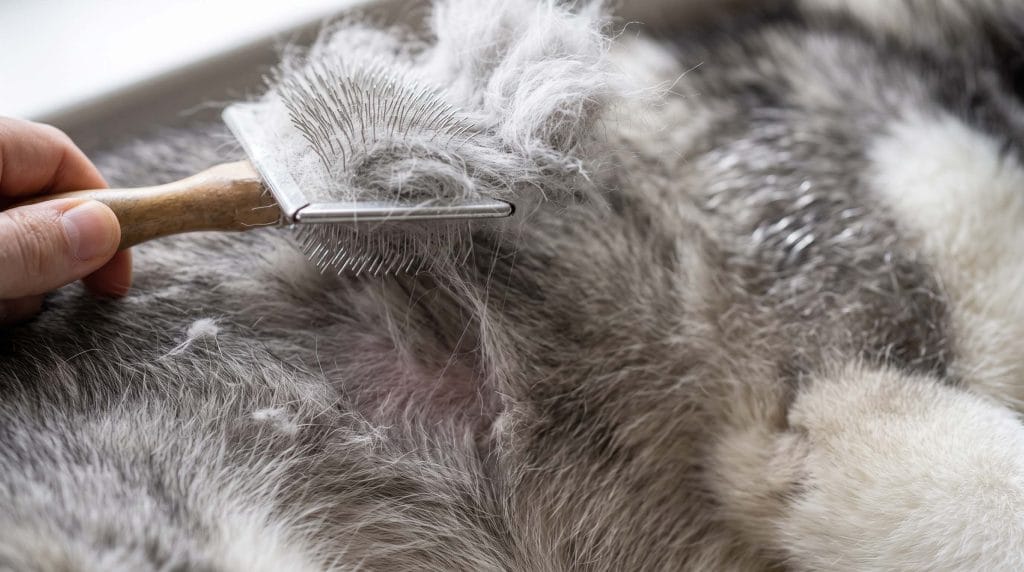
For shedding: The volume of hair a double-coated dog sheds is directly related to how much loose, cycling undercoat they’re carrying at any given time. Regular deshedding — using a slicker brush, undercoat rake, or dedicated deshedding tool like a FURminator (used carefully and not excessively) — removes the loose undercoat before it sheds around your home. A dog who receives a proper 20-minute deshedding session twice weekly during peak shedding season deposits dramatically less hair everywhere than a dog who doesn’t. Our guides specifically covering how to stop Husky shedding and German Shepherd shedding management cover the exact tools and techniques for each coat type.
For heat: The most effective interventions for double-coated dogs in hot weather have nothing to do with the coat and everything to do with environment and management:
- Cool fresh water available continuously — dogs lose far more heat through panting than through skin, and hydration directly supports panting efficiency
- Shade access during peak heat hours (typically 11 AM – 4 PM)
- Cooling mats and paddling pools provide direct convective cooling that no amount of shaving replicates
- Reduced exercise intensity during the hottest part of the day — exercise in early morning or evening instead
- A professional bath and blow-dry to remove loose undercoat (better than shaving — removes dead hair without cutting live coat)
The professional bath and blow-dry option is the one we recommend most strongly as the alternative to shaving. A skilled groomer using a high-velocity dryer removes an extraordinary volume of loose undercoat in a single session — far more than home brushing typically achieves — without cutting a single hair. The coat that remains is the live, functional coat doing its actual thermoregulatory job, lighter in density because the dead cycling hair has been professionally removed.
Can I Shave My Double Coated Dog — When Shaving Is Medically Necessary
The Legitimate Exceptions to Not Shaving a Double Coated Dog
Honestly — there are real situations where shaving a double-coated dog is the right call, and any responsible guide on this topic should say so clearly.
Surgical preparation: Veterinarians shave the surgical site before any procedure. This is a small, targeted area rather than a full body shave, and the coat almost always regrows normally in a limited surgical shave.
Severe matting that cannot be detangled: Mats that have progressed to the point of pulling skin, trapping moisture, or harboring skin infections underneath must be removed — and if they can’t be safely detangled, shaving is the correct medical decision. The coat damage from leaving severe mats in place is significantly worse than the temporary disruption of shaving the affected area.
Skin conditions requiring direct treatment: Some dermatological conditions require veterinary-prescribed topical treatment that can’t penetrate through a full coat. In these cases, targeted shaving of affected areas allows appropriate treatment and is medically appropriate.
Coat that is already structurally compromised: Some rescue dogs arrive with coats so damaged from neglect, severe matting, or previous improper grooming that restoration isn’t possible. In these specific cases, a controlled shave and fresh start may be the most humane option under veterinary guidance.
Outside these specific scenarios, the answer to can I shave my double coated dog for summer comfort or shedding reduction is a clear no — and the alternative approaches above deliver the actual outcomes you’re looking for without the coat structure consequences.
🐾 The Professional Bath Trick — What Most Owners Don’t Know to Ask For
We’re putting this here rather than earlier because it only makes complete sense once you understand why shaving is the wrong solution — and what you actually need instead.
Most dog owners who bring their double-coated dog to a groomer for shedding ask for “a trim” or, when they’re really frustrated, ask the question that this entire article addresses. What they should be asking for instead is a professional deshedding treatment — specifically a high-velocity blow-out bath.
Here’s how it works: the groomer bathes the dog in a deshedding shampoo specifically formulated to loosen dead undercoat bonds from the follicle, then uses a high-velocity professional dryer (not a standard home dryer) to blast loose hair out of the coat from the skin outward. The volume of undercoat that comes out of this process is, genuinely, astonishing to watch the first time. We’ve seen Husky owners collect enough loose undercoat from a single professional blow-out to fill a shopping bag — hair that would otherwise have shed onto every surface in their home over the next 4–6 weeks.
The coat that remains after this process is the live, healthy, functional coat — lighter, cleaner, and significantly more manageable. And because no hair was cut, every thermoregulatory and UV-protective function of the double coat remains fully intact.
Ask specifically for a “deshedding treatment with high-velocity blow-out” rather than just a bath and brush. Many grooming salons offer this as a specific service. The price difference between this and a standard bath is usually small. The difference in outcome — especially for heavy-shedding breeds like Huskies, Malamutes, and German Shepherds — is substantial.
This single grooming appointment, done twice yearly during peak coat blows, addresses the shedding volume problem more effectively than any amount of shaving ever could — while keeping the coat doing the job it was designed to do.
Double Coated Dog Summer Care — What Actually Helps
Use this as your reference guide for keeping a double-coated dog comfortable in summer without shaving:
Coat maintenance:
- Professional deshedding bath and high-velocity blow-out before summer
- Home brushing 2–3 times weekly with appropriate undercoat rake or slicker brush
- Second professional deshedding session at peak coat blow (spring and fall)
- Never shave for comfort or shedding reduction
- Address matting immediately — small mats are detangleable, large ones require professional help
Environment and cooling:
- Fresh cool water available at all times — refill and chill with ice during peak heat
- Outdoor shade access or indoor air conditioning during 11 AM – 4 PM
- Cooling mat in the dog’s primary rest area
- Paddling pool or garden hose access for convective cooling
- Exercise scheduled before 9 AM or after 6 PM during warm months
Monitoring heat stress:
- Know normal panting rate for your dog’s breed and size
- Watch for excessive drooling, lethargy, or stumbling — these indicate heat stress
- Monitor paw pads on hot surfaces — if pavement is too hot for your hand, it’s too hot for paws
- Consult a vet immediately if your dog shows signs of heat exhaustion regardless of coat status
FAQ — Can I Shave My Double Coated Dog?
Can I shave my double coated dog in summer to keep them cooler?
The short answer is no — and the reason isn’t arbitrary. A double coat’s undercoat insulates in both directions, including blocking radiant heat from reaching the skin in summer. Shaving removes this thermal barrier rather than improving it. Dogs regulate core temperature primarily through panting, not through skin surface exposure — so shaving a double-coated dog for summer comfort doesn’t achieve the cooling effect most owners expect and can actually increase heat absorption on the now-exposed skin during direct sun exposure.
What happens to a double coat after shaving?
The undercoat grows back faster than the guard coat, producing a dense, cotton-textured single layer without proper guard hair structure around it. This regrown coat mats more easily, manages moisture less effectively, and often has different texture than the original. In a percentage of double-coated dogs — particularly Nordic breeds like Huskies and Pomeranians — guard hair regrowth is partial or permanently altered, a condition called post-clipping alopecia. There is no reliable treatment to restore normal follicle function once alopecia from shaving develops.
Will my double coated dog’s coat grow back normally after shaving?
In many cases, yes — but not guaranteed, and not quickly. The regrowth timeline runs 6–18 months for a coat that approaches (not necessarily matches) its pre-shave appearance. During that period, the coat requires significantly more grooming maintenance than the original coat did. For breeds with documented post-clipping alopecia risk — Huskies, Samoyeds, Pomeranians, Keeshonds, and some Spitz-type breeds — the probability of permanent coat alteration in at least some areas is meaningful enough that most experienced groomers and veterinary dermatologists advise against shaving these breeds under any non-medical circumstances.
My groomer recommended shaving my double coated dog. Should I trust that advice?
Honestly — get a second opinion, specifically from a veterinary dermatologist or a groomer who specializes in double-coated breeds. Some general groomers recommend shaving because it’s faster and simpler than a proper deshedding treatment, and because many owners request it. The best groomers who work regularly with Huskies, German Shepherds, and Nordic breeds consistently advise against it because they’ve seen the post-shave coat outcomes firsthand across many clients.
What is the best way to reduce shedding in a double coated dog without shaving?
Regular deshedding with the correct tool for your dog’s specific coat type is the most effective approach — combined with a professional deshedding bath and high-velocity blow-out twice yearly. Diet also plays a meaningful role: omega-3 fatty acid supplementation (fish oil at appropriate dosage for body weight) supports follicle health and reduces excessive shedding by supporting the natural coat cycle. Our breed-specific guides for Huskies, German Shepherds, Golden Retrievers, Labradors, and Corgis cover the breed-specific deshedding tools and techniques that work best for each coat type.
The Honest Bottom Line on Shaving Your Double Coated Dog
Can I shave my double coated dog? You can. But the evidence — from coat biology, from post-clipping alopecia research, from the thermoregulation studies, and from real cases like Nala’s — consistently points in one direction: shaving a double-coated dog doesn’t solve the problems it’s meant to solve and creates new ones that can last permanently.
The shedding problem? Solved more effectively through professional deshedding treatments and consistent home brushing. The heat problem? Solved more effectively through shade, cool water, cooling mats, and schedule management. The coat does its job when you let it. The problem is never the coat — it’s the loose, dead undercoat that needs removing, and that’s a very different intervention from shaving.
Your double-coated dog’s coat evolved across thousands of years of selective pressure into a system that genuinely works. Work with it rather than around it, and both the shedding and the summer comfort issues become manageable without the lasting consequences of shaving.
Take action today: Book a professional deshedding treatment for your dog before the next warm season. Explore our complete shedding management resources — Husky shedding, German Shepherd shedding, Golden Retriever care, Labrador guide, and our comprehensive dog hair management guide — to build a year-round grooming routine that keeps your double-coated dog comfortable, healthy, and looking exactly as nature intended. 🐾
This article provides general grooming guidance. For dogs with skin conditions, significant coat changes, or post-clipping alopecia concerns, always consult a board-certified veterinary dermatologist.
