

 animalzoid
 You’re cutting a bowl of golden pineapple, and before you can spear the first chunk, your dog appears—eyes huge, nose twitching, tail going. In that moment, is pineapple bad for dogs stops being an abstract question and becomes a real decision: share or not?
I’ve watched this exact scene with clients many times. One family told me proudly that their Lab loves frozen pineapple in summer. Another called after their terrier dragged a whole pineapple off the counter and gnawed on the spiky skin and core. Same fruit, very different stories—and the difference came down to how, and how much, the dog got.
In this long, in‑depth guide, we’ll unpack:
- What people really mean when they ask “is pineapple bad for dogs”
- When pineapple can cause harm, and when it’s just another occasional treat
- The specific parts of pineapple that are bad for dogs
- How to prepare safe portions step by step
- Common myths (like the poop‑eating cure) and real‑world case studies
By the end, you’ll know exactly when the answer to is pineapple bad for dogs is yes, when it’s no, and how to keep your own dog firmly on the safe side.
What Does “Is Pineapple Bad for Dogs” Really Mean?
When someone types is pineapple bad for dogs into a search bar, they usually aren’t just asking “toxic or not.” Underneath, they’re also asking:
- Will pineapple upset my dog’s stomach?
- Is it bad if my dog eats the core, skin, or leaves?
- Does pineapple hurt long‑term health or just cause short‑term problems?
- How does pineapple compare to other fruits and treats?
So we need a more precise definition.
From a veterinary point of view, “is pineapple bad for dogs” means:
Does feeding pineapple—fresh or processed, in real‑world amounts—cause a meaningful risk of toxicity, digestive trouble, weight gain, or disease in dogs?
Right away, that suggests we need to separate pineapple into its different parts and forms.
Parts That Decide When Is Pineapple Bad for Dogs
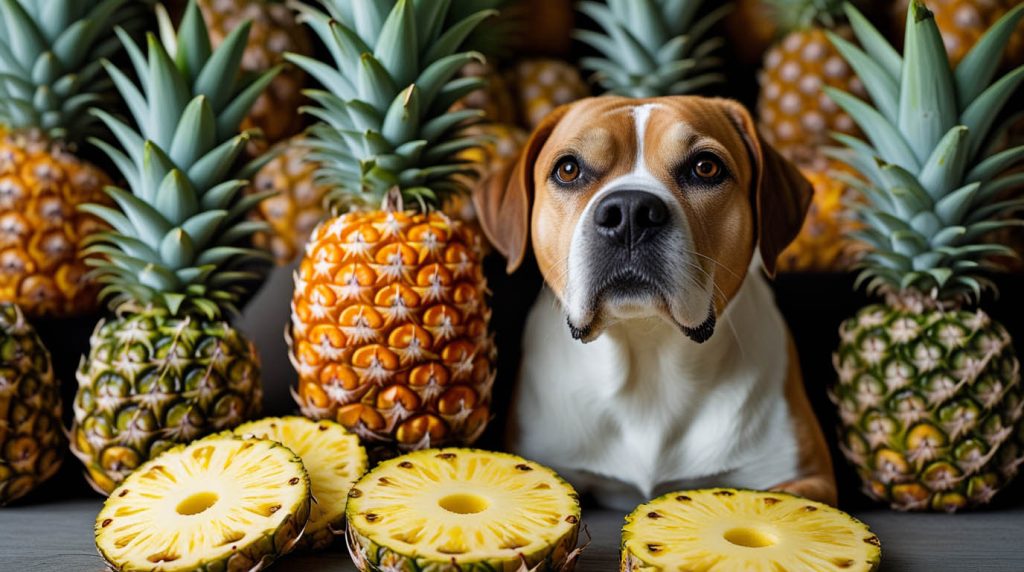
A pineapple isn’t a simple fruit like a grape or blueberry. It has:
- Flesh – the soft, juicy yellow part
- Core – the tough, fibrous center
- Skin (rind) – spiky, hard exterior
- Crown/leaves – stiff, serrated top
- Juice – usually without fiber, often with added sugar
Here’s how each part lines up with the is pineapple bad for dogs question:
- Flesh:
- Not toxic.
- High in sugar and mildly acidic, but usually safe in small amounts for healthy dogs.
- Core:
- Very tough; can be a choking or blockage risk.
- This is where “is pineapple bad for dogs” can become “yes, absolutely,” if eaten.
- Skin and crown:
- Sharp, fibrous, indigestible.
- Can injure the mouth or GI tract and cause blockages. Definitely bad.
- Juice (especially canned or sweetened):
- Sugar bomb with no fiber; can spike blood sugar and upset the stomach.
So when you really break it down, the phrase is pineapple bad for dogs applies mostly to:
- The wrong parts (core, skin, leaves, sweetened juice)
- The wrong dogs (with health issues)
- The wrong amounts (too much, too often)
Nutrition Basics Behind “Is Pineapple Bad for Dogs”
To answer is pineapple bad for dogs with any nuance, we should look at what’s actually inside pineapple.
What’s in Pineapple That Can Be Bad for Dogs?
According to USDA FoodData Central, 100 g of raw pineapple chunks (about 2/3 cup) contains roughly :
- Calories: ~50
- Carbohydrates: ~13 g
- Sugars: ~10 g
- Fiber: ~1.4 g
- Protein: ~0.5 g
- Fat: ~0.1 g
- Vitamin C: ~47.8 mg
- Small amounts of manganese, vitamin B6, and other micronutrients
For dogs, the main “bad” candidates are:
- Sugar:
- Ten grams of sugar per 100 g is significant for a creature that doesn’t need fruit sugars at all.
- Too much sugar—yes, even natural sugar—can contribute to weight gain and insulin stress.
- Acidity:
- Pineapple is more acidic than many fruits.
- Acid can irritate the stomach and esophagus in some dogs.
- Fiber:
- In moderation, fiber helps digestion.
- In excess, or in sensitive dogs, it can cause gas and diarrhea.
So, nutritionally speaking, the honest answer to is pineapple bad for dogs is:
- For healthy dogs, a little bit of pineapple flesh isn’t bad.
- In larger or frequent amounts, or in some health conditions, pineapple can definitely become “bad.”
Bromelain and the Is Pineapple Bad for Dogs Debate
Pineapple contains bromelain, an enzyme that breaks down proteins. You’ll see claims that:
- Bromelain reduces inflammation
- Bromelain improves digestion
- Pineapple (because of bromelain) can stop dogs from eating poop
Here’s the grounded version:
- Bromelain is most concentrated in the core, which dogs shouldn’t eat because of blockage risk.
- The amount in the flesh is modest and not a magic cure‑all.
- There’s no strong veterinary evidence that bromelain in typical treat amounts reverses disease or fixes behavior.
So bromelain makes pineapple interesting, but it doesn’t flip the overall answer to is pineapple bad for dogs or “good for dogs” on its own.
When Is Pineapple Bad for Dogs and Why?
Now let’s tackle the heart of it: in which situations is pineapple bad for dogs in a meaningful way?
Is Pineapple Bad for Dogs With Certain Health Conditions?
Pineapple often is a bad idea for dogs with specific issues:
- Diabetes
- Pineapple’s sugar can spike blood glucose.
- For diabetic dogs, vets usually recommend avoiding sugary fruits entirely.
- In these dogs, the real answer to is pineapple bad for dogs is “yes, it’s too risky.”
- Obesity or Weight‑Loss Plans
- The Association for Pet Obesity Prevention estimates that over 50% of US dogs are overweight or obese.
- For these dogs, every extra treat counts—especially sugary ones.
- In this context, pineapple isn’t as bad as cookies, but it’s not “good” either.
- Chronic GI Problems (IBD, frequent diarrhea, pancreatitis history)
- Extra fiber, sugar, and acidity can trigger flare‑ups.
- Dogs with these issues may react badly even to small amounts.
- Dogs on Prescription Diets
- VCA Animal Hospitals emphasize that treats—even healthy seeming ones—can undermine a therapeutic diet .
- In these cases, pineapple can be bad simply because it interferes with a carefully controlled plan.
If your dog fits into any of these categories, don’t experiment on your own. Ask your vet whether pineapple is bad for your dog in their specific situation. Often the answer will be “better skip it.”
Is Pineapple Bad for Dogs When They Eat Skin or Core?
Short answer: yes.
Here’s why the less edible parts make is pineapple bad for dogs a very real concern:
- Core:
- Dense, woody, and stringy.
- Hard for dogs to chew properly.
- Can lodge in the esophagus or intestines, causing obstruction.
- Skin and crown:
- Tough and sharp.
- Can scrape or puncture the mouth, throat, or gut.
- Also hard to move through the digestive tract.
I’ve heard real‑world cases where a dog raided the trash, swallowed large pieces of core or rind, and ended up with repeated vomiting and a blockage that required surgery. In those stories, nobody had to ask is pineapple bad for dogs afterward—the vet bill answered it.
So, even if pineapple flesh in moderation isn’t bad, letting your dog anywhere near skin, core, or leaves is.
Is Pineapple Bad for Dogs in Canned or Juice Form?
Now we get into processed versions.
- Canned pineapple in syrup:
- Loaded with added sugar (and sometimes preservatives).
- For dogs, that much sugar is absolutely not needed and is bad.
- Canned in juice (no added sugar):
- Still very sweet; basically fruit candy.
- All the sugar, little control over portions.
- Pineapple juice (fresh or bottled):
- Sugar without the fiber to slow absorption.
- Can cause rapid spikes in blood sugar and upset stomach.
So if your question is is pineapple bad for dogs in canned or juice form, the realistic answer is yes—it’s not an appropriate dog treat.
Is Pineapple Bad for Dogs Compared to Other Foods?
One reason people ask is pineapple bad for dogs is that they know some human foods are truly dangerous.
Toxic vs. Just Not Great: Where Does Pineapple Fit?
It helps to separate:
- Foods that are toxic even in small amounts
- Foods that are safe in moderation
- Foods that are harmful mainly in large amounts
Pineapple falls into that third category.
Examples:
- Truly toxic for dogs:
- Grapes and raisins
- Onions and garlic (in sufficient quantity)
- Xylitol (in sugar‑free gum, candy, some peanut butters)
These can cause organ damage or death even in small doses.
- Pineapple:
- Not in the toxic category like grapes.
- Instead, it’s a “handle carefully” food: safe for many dogs in small amounts, but harmful if you get the parts, portions, or health context wrong.
The ASPCA Animal Poison Control Center doesn’t list pineapple flesh as a common toxin; instead, their focus is on genuinely toxic plants and foods. That’s a good hint that pineapple isn’t inherently poisonous—just nutritionally tricky.
So the nuanced answer to is pineapple bad for dogs is:
- Not in the same way grapes are.
- But still bad for some dogs, and bad in certain forms or amounts.
How to Use “Is Pineapple Bad for Dogs” in Daily Decisions
Let’s get practical. Suppose your dog is generally healthy and your vet hasn’t forbidden fruit. How do you bring the “is pineapple bad for dogs” answer into everyday life?
Step-by-Step Guide: Implementing “Is Pineapple Bad for Dogs” Safely
Here’s a simple, repeatable process to keep pineapple from becoming bad for your dog:
- Ask your vet first
- Bring it up at your next visit: “Is pineapple bad for my dog given their health and weight?”
- If your dog has any chronic conditions, this step is non‑negotiable.
- Use only fresh or plain frozen pineapple flesh
- No canned in syrup.
- No juice.
- No dried, sugar‑coated pineapple.
- Remove all dangerous parts
- Cut off and discard crown and skin.
- Slice out the entire core.
- Make sure discarded bits go where your dog can’t access them.
- Cut small, appropriate pieces
- Small dogs: tiny cubes, pea‑sized.
- Medium dogs: small chunks.
- Large dogs: modest cubes—never whole rings.
- Start tiny and observe
- First time, offer 1–2 small cubes only.
- Watch for 24–48 hours for vomiting, diarrhea, excess gas, or itching.
- Limit frequency and amount
- Even if things go well, keep pineapple as a once‑in‑a‑while treat.
- Fold it into the 10% treat rule, not on top of everything else.
By following those steps, you change the question from is pineapple bad for dogs to “is pineapple handled in a way that’s safe for my dog?” That’s a much easier problem to solve.
Portion Guide for Owners Asking “Is Pineapple Bad for Dogs?”
Even fresh pineapple flesh becomes a “yes” to is pineapple bad for dogs if you offer half a fruit at once. Portion control matters.
For healthy adult dogs:
- Under 10 lb (toy breeds):
- 1–2 tiny cubes (1–2 teaspoons) once or twice a week.
- 10–25 lb (small dogs):
- 2–4 small cubes (up to 1 tablespoon) once or twice a week.
- 25–50 lb (medium dogs):
- 1–2 tablespoons of cubes once or twice a week.
- 50+ lb (large dogs):
- Up to ¼ cup of cubes once or twice a week.
Always keep total treats, including pineapple, under about 10% of daily calories. For dogs on weight‑loss plans, aim even lower.
If you stay close to these limits and your dog feels and looks good, the answer to is pineapple bad for dogs in your home can stay “no, not the way we use it.”
Common Mistakes That Make “Is Pineapple Bad for Dogs” True
In my experience, a few patterns turn safe pineapple into a real problem.
Overfeeding Turns “Is Pineapple Bad for Dogs” Into Reality
Owners often think:
“It’s fruit, so it’s healthy—I don’t need to count it.”
That mindset quietly changes the answer to is pineapple bad for dogs from “occasionally fine” to “actually, yes” because:
- Calories and sugar add up fast.
- Pineapple gets added on top of biscuits, chews, and table scraps.
- Nobody adjusts the main meal portion.
Over weeks and months, that can mean:
- Noticeable weight gain
- Sluggishness
- Greater risk for diabetes and joint strain
The fix is simple: if pineapple is coming in, something else has to go out. Don’t just add; replace.
Misusing “Is Pineapple Bad for Dogs” as a Poop-Eating Cure
You’ve probably heard it: add pineapple to your dog’s food and they’ll stop eating poop.
This idea rests on the claim that pineapple makes stool taste bad. Some owners swear it works; others see no difference. Veterinary behaviorists generally consider this an unreliable home remedy.
The danger is obvious:
- Owners feed increasing amounts of pineapple trying to “fix” coprophagia.
- The dog gets too much sugar and fiber, leading to GI upset.
- Meanwhile, the real causes (boredom, anxiety, nutrition gaps, learned behavior) go unaddressed.
If you want to ask is pineapple bad for dogs that eat poop, the honest answer is:
- Pineapple isn’t a dependable cure.
- Overusing it in that role can be bad for your dog’s health.
- A proper plan with your vet and possibly a trainer is far better.
Best Practices So “Is Pineapple Bad for Dogs” Stays No
Let’s turn all this into some concrete, positive habits.
Training Uses Where “Is Pineapple Bad for Dogs” Matters
Pineapple isn’t the highest‑value treat for most dogs, but some genuinely love it.
Smart ways to use it:
- Occasional high‑value bonus:
- Mix a couple of tiny pineapple pieces into your treat pouch with meat‑based rewards.
- The unpredictability can keep training exciting.
- Cooling summer reward:
- Offer one frozen cube after a walk on a hot day.
- Don’t turn it into a daily ritual; think of it as a seasonal perk.
- “Event” treat:
- Save pineapple for special days—like groomer visits or vet rechecks if your dog handles it well.
This approach lets you say “yes” sparingly without letting pineapple dominate your treat strategy. It keeps the honest answer to is pineapple bad for dogs at “no, not the way we do it.”
Balancing Treats When You Wonder “Is Pineapple Bad for Dogs?”
Think of your dog’s weekly treat plan like a budget:
- Low‑calorie staples:
- Green beans, cucumber slices, small carrot pieces.
- Medium treats:
- Pineapple, apple (no seeds), blueberries.
- High‑value, higher‑cal treats:
- Cheese, sausage bits, many commercial treats.
If you build a plan where:
- 70–80% of treats come from the low‑calorie group
- 10–20% from the medium group (including pineapple)
- 10% or less from the high‑cal group
…then the overall answer to is pineapple bad for dogs becomes: “No, it’s just one of several tools we use carefully.”
Tools and Resources to Decide “Is Pineapple Bad for Dogs?”
You don’t have to rely on guesswork; a few tools make the is pineapple bad for dogs question much easier to answer for your own pet.
Online Resources That Address “Is Pineapple Bad for Dogs?”
Beyond your own veterinarian, several reputable sites talk directly or indirectly about pineapple and other fruits:
- AKC (American Kennel Club) – A clear article on dogs and pineapple.
- PetMD – Overviews of which fruits dogs can safely eat and why.
- ASPCA Animal Poison Control – Lists truly toxic foods and plants so you can see where pineapple doesn’t rank.
- VCA Animal Hospitals – Great explanations of how to integrate treats into a balanced diet.
When multiple veterinary‑backed sources agree that pineapple flesh is okay in moderation but warn about sugar, GI upset, and unsafe parts, that’s a good basis for your own decision.
Simple Tracking When You Test “Is Pineapple Bad for Dogs?”
To move from theory to data for your dog:
- Use a notes app or journal
- Log when you give pineapple, how much, and how your dog seems afterward.
- Track weight and body condition
- Weigh your dog monthly.
- Ask your vet to show you a Body Condition Score chart—then watch for changes.
- Take monthly photos
- Same angle, same lighting.
- Subtle weight gain often shows up visually before you feel it by hand.
With that information, you can answer is pineapple bad for dogs not just in general, but very specifically: is pineapple bad for my dog, under my feeding habits?
Case Studies That Answer “Is Pineapple Bad for Dogs?”
A couple of real‑world stories often stick better than pure theory.
Overweight Dog Learning When Is Pineapple Bad for Dogs
Dog: Bailey, 7‑year‑old Beagle, 18% overweight
Owner’s question: “Is pineapple bad for dogs if I use it instead of biscuits?”
Vet’s analysis:
- Bailey’s diet already had too many treat calories.
- Pineapple itself wasn’t toxic, but the extra calories were the bigger issue.
Plan:
- Replace half of Bailey’s daily biscuits with green beans and measured pineapple cubes.
- Limit pineapple to 1 tablespoon twice a week.
- Log all treats and adjust main meal slightly to compensate.
Outcome over 4 months:
- Bailey lost a noticeable amount of weight and had more energy.
- Owner reported, “We still share pineapple sometimes, but within limits. Before, I never thought about how much sugar was in there.”
Here, the refined answer to is pineapple bad for dogs was: “It can be, if you don’t count it. When we treat it carefully, it’s not bad—and it helped us cut worse treats.”
Sensitive-Stomach Dog Proving Is Pineapple Bad for Dogs
Dog: Nova, 3‑year‑old Husky, history of intermittent soft stools
Scenario: Owner wanted a fun summer treat and asked online if pineapple was okay. After hearing mixed answers, she tried a few small pieces.
What happened:
- Within hours, Nova had gas and loose stool.
- The same thing happened after a second attempt the following week.
- They stopped offering pineapple, and the episodes disappeared.
For Nova, despite pineapple being safe for many dogs, her body clearly decided pineapple is bad for this dog. Sticking to lower‑sugar, lower‑acid treats made much more sense.
Future Trends Around “Is Pineapple Bad for Dogs?”
As more people treat dogs like full family members, questions like is pineapple bad for dogs only become more common.
Industry Shifts and Where “Is Pineapple Bad for Dogs?” Fits
The pet industry now:
- Uses pineapple and other fruits in treats to signal “real food” ingredients.
- Creates “tropical” flavor profiles like chicken & pineapple chews.
- Markets freeze‑dried fruit bits as training treats.
According to Pet Food Industry reports, demand for simple‑ingredient treats keeps climbing. That means more products where pineapple appears on the label.
However, clever marketing doesn’t change physiology. Whether pineapple appears in a bag of treats or your fruit bowl, the core questions remain:
- What’s the sugar load?
- How much is my dog actually eating?
- Do they have any conditions that would make this risky?
No matter how fancy the packaging, the answer to is pineapple bad for dogs will still hinge on ingredients, portion, and your dog’s health—not the branding.
Research Directions That May Refine “Is Pineapple Bad for Dogs?”
Future veterinary nutrition research may look more closely at:
- How fruit components like fiber and antioxidants affect dogs long‑term
- Whether small amounts of tropical fruits have measurable health impacts
- How best to design treats that satisfy human desires (sharing fruit) and canine needs (low sugar, complete nutrition)
For now, though, no major veterinary body recommends pineapple as a necessary food. At best, we’re in the “can be okay sometimes” category—not in the “every dog should eat pineapple” camp.
FAQ: Quick Answers About “Is Pineapple Bad for Dogs?”
Q: Is pineapple bad for dogs if they just eat a small piece?
For most healthy adult dogs, a few small cubes of fresh pineapple flesh aren’t bad and are usually tolerated well. However, any vomiting or diarrhea afterward means you should stop and talk to your vet.
Q: Is pineapple bad for dogs if they eat the core?
Yes, the core is a real concern. It’s tough and fibrous, which makes it a choking and blockage risk. If your dog swallows a chunk of pineapple core, call your vet or an emergency clinic for guidance.
Q: Is pineapple bad for dogs with diabetes?
Generally, yes. The natural sugars in pineapple can spike blood glucose. Diabetic dogs usually need very controlled, predictable carbohydrate sources, so most vets avoid fruit treats like pineapple in these cases.
Q: Is pineapple bad for dogs as a daily treat?
Daily pineapple is more likely to cause problems, especially weight gain and digestive upset. It’s safer to think of pineapple as an occasional treat—weekly, not daily—and use other, less sugary snacks the rest of the time.
Q: Is pineapple bad for dogs when it’s canned or in juice?
Yes, canned pineapple in syrup and pineapple juice are not recommended. They contain lots of sugar and no fiber, which dogs don’t need. Stick to fresh or plain frozen pineapple flesh, in very small amounts, if your vet approves.
Conclusion: Final Verdict on “Is Pineapple Bad for Dogs?”
So, is pineapple bad for dogs? For many healthy adult dogs, the realistic answer is “not if you use it sparingly and correctly.” Fresh pineapple flesh—peeled, cored, and cut into small cubes—can be a low‑fat, occasional alternative to more processed treats. However, pineapple becomes bad for dogs when you:
- Offer too much, too often
- Let them chew core, skin, or leaves
- Use sugary canned versions or juice
- Ignore existing health issues like diabetes, obesity, or GI disease
Ultimately, pineapple is a “handle with care” food. It’s not toxic like grapes, but it’s not nutritionally essential either. Whether it’s bad for your dog depends entirely on their health, the form you use, and how disciplined you are with portions.
Your next step is straightforward: ask your veterinarian where pineapple fits into your dog’s overall diet and health situation. If you get the go‑ahead, start with a single small cube, track how your dog responds, and fold pineapple into a thoughtful, calorie‑aware treat routine. And if you know another dog owner hovering over a cutting board with a hopeful pup at their feet, share this guide before “just one bite” turns into something you both regret.

 Is Pineapple Bad for Dogs? Safety Facts Guide